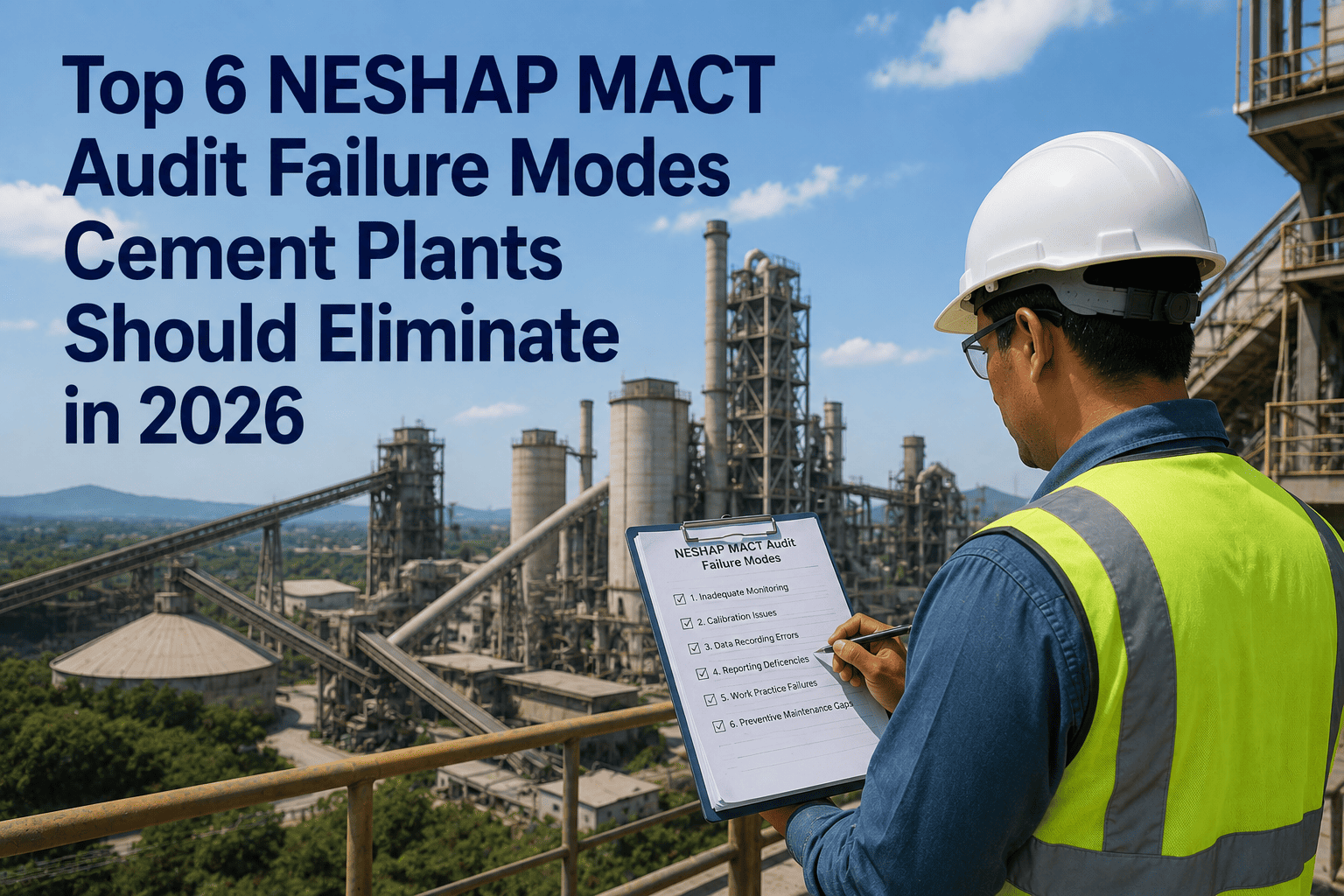
MSHA enforcement at cement quarries is following a measurable pattern in 2026: inspectors are spending more time on documentation gaps and less time on equipment condition, because the equipment condition issues tend to be visible and corrected on the spot, while documentation failures generate citations that survive the inspection and become the basis for S&S designations and section 104 orders. The six citation risks below are ranked by frequency and enforcement severity based on MSHA Mine Data Retrieval System records and the patterns cement quarry safety managers encounter when they review their inspection history with OxMaint. If your quarry is approaching an inspection window, book a 30-minute call to walk through your current workplace exam records before the inspector does.
6
Citation risks ranked by 2026 MSHA enforcement frequency
Part 56
Surface metal and nonmetal mines — applies to cement quarries
S&S
Significant and Substantial designation — highest penalty tier
104(d)
Unwarrantable failure orders — repeat documentation gaps
Risk 1 — Highest citation frequency
Workplace Examination Gaps and Incomplete Records
Workplace exam failures under 30 CFR 56.18002 are the most cited violation category at cement quarries nationally. The regulation requires pre-shift examination of all working places, but the citation is almost always for a documentation failure rather than the absence of the exam itself. Quarry supervisors typically perform the exam; the problem is that the record of the exam is either missing, incomplete, or cannot be located at the time of inspection. MSHA has increasingly treated missing exam records as an S&S citation rather than a non-S&S paperwork issue.
30 CFR 56.18002
S&S Designation Risk
Citation Frequency: Very High
What MSHA inspectors cite
Missing pre-shift exam record for an active working area. Exam record present but not signed by the examiner. Record does not include conditions found and corrective actions taken. Records not retained for the required period.
OxMaint fix
Digital workplace exam work orders in OxMaint capture examiner signature, conditions found, corrective actions, and timestamp. Records auto-archive with full audit trail. Overdue exam triggers a supervisor alert before the shift begins, not after the inspector arrives.
Risk 2 — Ground control documentation
Ground Control Plan Not Current or Not Followed
Cement quarries with bench mining operations are required to maintain a written ground control plan under 30 CFR 56.3200. MSHA citations in this category arise from two separate failure modes: plans that have not been updated to reflect current bench height or equipment changes, and plans that exist on paper but cannot be shown to have been followed through inspection records. In 2026, MSHA district offices have accelerated the pace of ground control reviews following several fatalities in surface nonmetal mines.
30 CFR 56.3200
S&S Designation Risk
Citation Frequency: High
What MSHA inspectors cite
Ground control plan not reviewed or updated within the required period. Plan does not reflect current bench geometry. No documented slope stability inspections linked to the plan. Scaling and barring records missing or incomplete.
OxMaint fix
Ground control inspection work orders scheduled against the plan review cycle. Slope stability checks linked to the active plan version in OxMaint. When the plan is updated, inspection templates update automatically. All records are searchable and exportable at inspection time.
Risk 3 — Mobile equipment
Mobile Equipment Pre-Operational Inspection Gaps
Pre-operational checks for mobile equipment under 30 CFR 56.14100 are a consistent top-five citation category at surface nonmetal mines. The most common finding is not that the check was skipped but that there is no written record of it. Haul trucks, wheel loaders, and drilling equipment in cement quarries operate across multiple shifts, and pre-shift check records are often completed verbally or on paper cards that are discarded or never collected. When MSHA requests 90 days of pre-operational check records, most quarries can produce a fraction of what the regulation requires.
30 CFR 56.14100
Elevated Risk
Citation Frequency: High
What MSHA inspectors cite
No written record of pre-operational check for a specific equipment unit. Defects noted but no work order for corrective action. Equipment placed out of service but no documentation of the decision or the repair completion before return to service.
OxMaint fix
Mobile equipment pre-op check templates in OxMaint are assigned per unit per shift. Any defect noted auto-generates a corrective action work order. Out-of-service records and return-to-service sign-offs are captured in the same chain.
Start a free trial to configure your equipment fleet.
MSHA inspection readiness
MSHA inspectors are spending more time on your records than your equipment in 2026
The OxMaint team will review your workplace exam records, ground control plan documentation, and mobile equipment check history to identify which of these six citation risks your quarry is most exposed to before your next inspection.
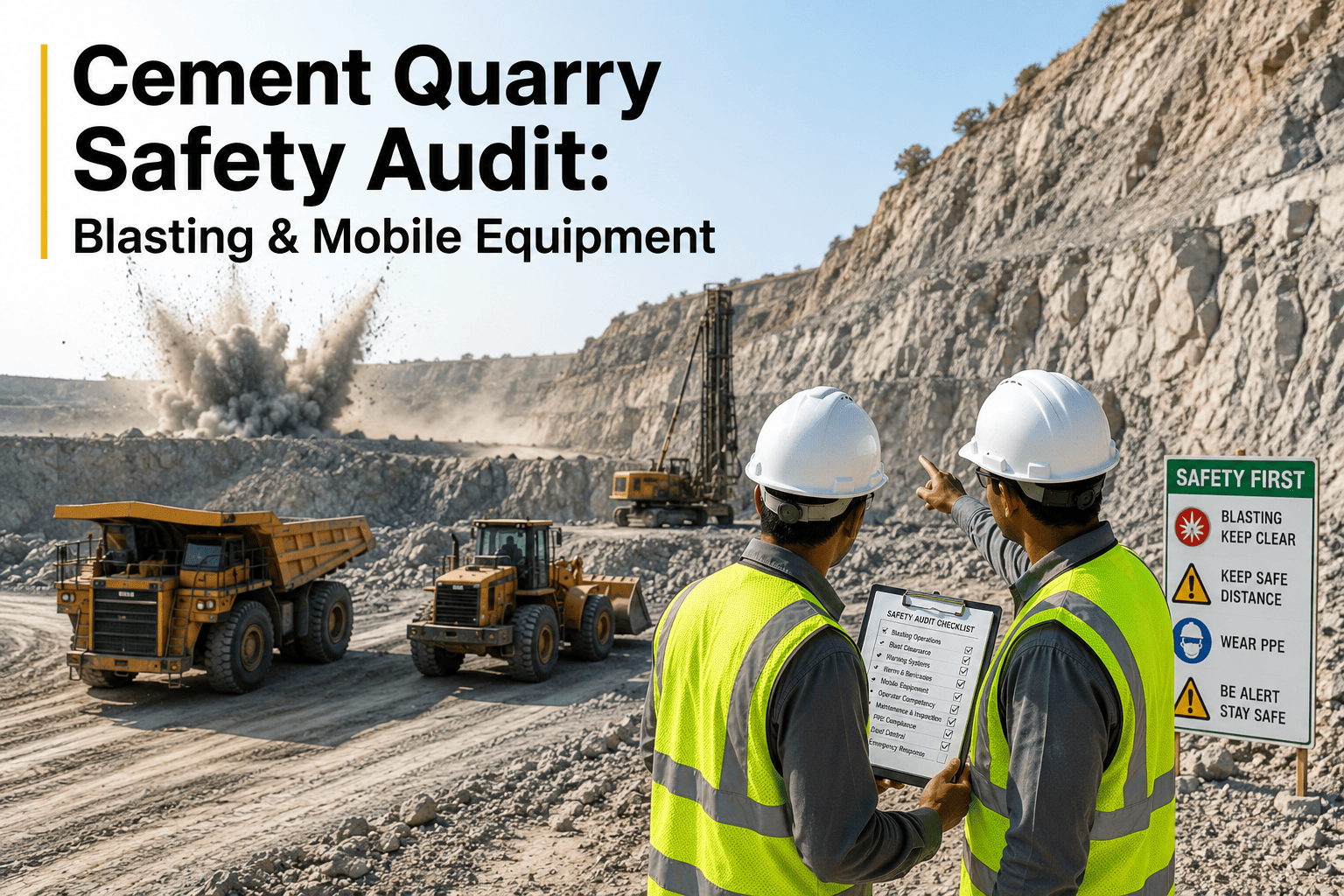
Risk 4 — Blasting records
Blasting Record Gaps and Misfire Documentation Failures
Blasting at cement quarries is governed by 30 CFR 56.6000 through 56.6903, and the record requirements are among the most specific in the Part 56 standard. MSHA inspectors review blasting records in detail because the fatality history in surface mine blasting operations makes this a compliance priority. The most common citation is a blaster's record that omits required fields, particularly the quantity and type of explosive, the delay pattern, and the misfire disposition record if a misfire occurred. Missing misfire records are treated as S&S violations because they indicate a potential undetonated explosive left in the shot area.
30 CFR 56.6303
S&S Designation Risk
Citation Frequency: Medium-High
What MSHA inspectors cite
Blaster's record with missing required fields. Misfire event with no disposition record. Explosive storage records not reconciling to blasting records. Blaster certification not current or not on file at the mine.
OxMaint fix
Blasting work orders in OxMaint include all required field entries as mandatory completions before the work order can be closed. Misfire events trigger a separate disposition work order. Blaster certification expiry dates are tracked with advance renewal alerts.
Risk 5 — Training records
New Miner and Annual Refresher Training Documentation Incomplete
MSHA Part 46 training requirements apply to surface nonmetal mines including cement quarries. New miner training, experienced miner training, newly hired experienced miner training, and annual refresher training each carry distinct documentation requirements. Citation frequency in this category has increased because quarries operating with higher-than-normal contractor and seasonal workforce turnover in 2024 and 2025 have accumulating training record gaps that are becoming visible in 2026 inspections.
30 CFR Part 46
Elevated Risk
Citation Frequency: Medium-High
What MSHA inspectors cite
New miner 24-hour training not completed before task assignment. Annual refresher training overdue for one or more miners. Training plan not current. Records for contractor employees not available at the mine site.
OxMaint fix
Training compliance tracked per employee in OxMaint with automatic alerts before expiry dates. Contractor employee training records uploaded to the relevant work site asset. Annual refresher schedule visible in the PM calendar alongside equipment maintenance.
Book a demo to see the training tracking module.
Risk 6 — S&S repeat violations
Repeat Violations Leading to Unwarrantable Failure Designation
A single S&S violation is a citation. The same violation cited in a subsequent inspection is the basis for a 104(d) unwarrantable failure order, which triggers elevated penalties and can restrict mine production. Cement quarries with recurring workplace exam or equipment inspection citation histories are at the highest risk for 104(d) orders in 2026, because MSHA pattern enforcement has reduced the number of S&S instances required before an unwarrantable failure designation is applied. The safest position is to treat every S&S citation as a systemic record-keeping failure, not a one-off oversight.
Section 104(d)
Highest Penalty Tier
Escalation Risk: High
What MSHA inspectors cite
Same violation cited in two or more consecutive inspections. Citation history shows a pattern in the same regulatory area. Mine management cannot demonstrate corrective action was systemic rather than point-in-time.
OxMaint fix
Citation history tracking in OxMaint creates a closed-loop corrective action record for every MSHA citation. When a citation closes, the root cause and systemic fix are documented in the same work order. This record is the evidence that management took systemic action, not a spot repair.
All six at a glance
Ranked by 2026 MSHA enforcement severity and frequency
| Rank |
Citation risk |
Regulation |
S&S Risk |
2026 Frequency |
| 1 |
Workplace exam gaps |
56.18002 |
Yes |
Very High |
| 2 |
Ground control plan |
56.3200 |
Yes |
High |
| 3 |
Mobile equipment pre-op |
56.14100 |
Conditional |
High |
| 4 |
Blasting records |
56.6303 |
Yes |
Medium-High |
| 5 |
Training records |
Part 46 |
Conditional |
Medium-High |
| 6 |
Repeat 104(d) escalation |
Section 104(d) |
Yes |
Medium |
Common questions
Frequently asked questions from cement quarry safety teams
How often does MSHA inspect a typical cement quarry in 2026?
Surface nonmetal mines are required to receive at least two complete inspections per year under the Mine Act. Larger quarries with more complex operations or prior citation histories typically receive more. Special emphasis programs can trigger additional targeted inspections beyond the minimum. Maintaining audit-ready records continuously is the only reliable approach.
Start a free trial to see what continuous readiness looks like in OxMaint.
Can OxMaint store contractor training and pre-op records alongside our own employees?
Yes. Contractor employees are configured as a separate workforce category in OxMaint with their own training record requirements and pre-op check assignments. Records are searchable by contractor company, individual employee, and work site. MSHA requires contractor records to be available at the mine; OxMaint makes them accessible on any device during an inspection.
Book a demo to see the contractor module.
What happens if an MSHA inspector finds a documentation gap during an inspection — can OxMaint help in real time?
OxMaint records are searchable in real time during an inspection. If an inspector asks for workplace exam records for a specific bench area over the past 60 days, a safety manager can pull the complete list of signed work orders on a tablet in under two minutes. Having records available on demand, rather than in a filing cabinet, consistently reduces the time and friction of the on-site review.
Does OxMaint help with the corrective action documentation required after an MSHA citation is issued?
Post-citation corrective action records are one of OxMaint's most directly useful compliance functions. Each citation is entered as a work order with the violation details, the required abatement action, the person responsible, and the completion deadline. The closed work order is the evidence of abatement. For repeat citation avoidance, the root cause field in the work order documents what systemic change was made, not just the point-in-time repair.
Is a 104(d) order avoidable if our quarry already has one S&S citation on record?
A 104(d) order requires MSHA to find that the violation was an unwarrantable failure, meaning management knew about the condition and failed to act appropriately. Demonstrating through documented corrective action records that the prior S&S citation triggered a systemic fix is the strongest defense against a 104(d) designation. OxMaint's closed-loop work order records are the documentation that makes that defense credible.
Eliminate your highest citation risks before the next inspection
The quarries that avoid S&S designations run the same maintenance work, with better records
A 30-minute review with the OxMaint team will identify which of these six citation risks your quarry is most exposed to and show you what a complete, inspection-ready documentation system looks like for your specific operation. No generic compliance checklist, just your quarry's record gaps mapped to a structured fix.