At 4:15 PM on a Friday in October, an MSHA inspector walked into a cement plant in the southeastern United States with a formal inspection notice and a records request covering 18 months of workplace examination logs, equipment maintenance records, and corrective action documentation. The plant had three days to produce everything. What followed was a 60-hour manual search across five separate systems, missing records for 14 inspection events, and a citation that cost $94,000 in penalties. The plant's CMMS was fully operational — it just wasn't built for compliance. In 2026, that gap between having a CMMS and having an audit-ready CMMS is costing cement plants in citations, penalties, and OEM relationship risk they can't afford. This guide covers exactly what NESHAP and MSHA audit-readiness requires from a cement plant CMMS — and how to evaluate whether your current platform delivers it. Start a free trial with Oxmaint and see how audit-ready exports work in a live cement plant compliance environment.
Compliance Guide · NESHAP · MSHA · Cement Plants · 2026
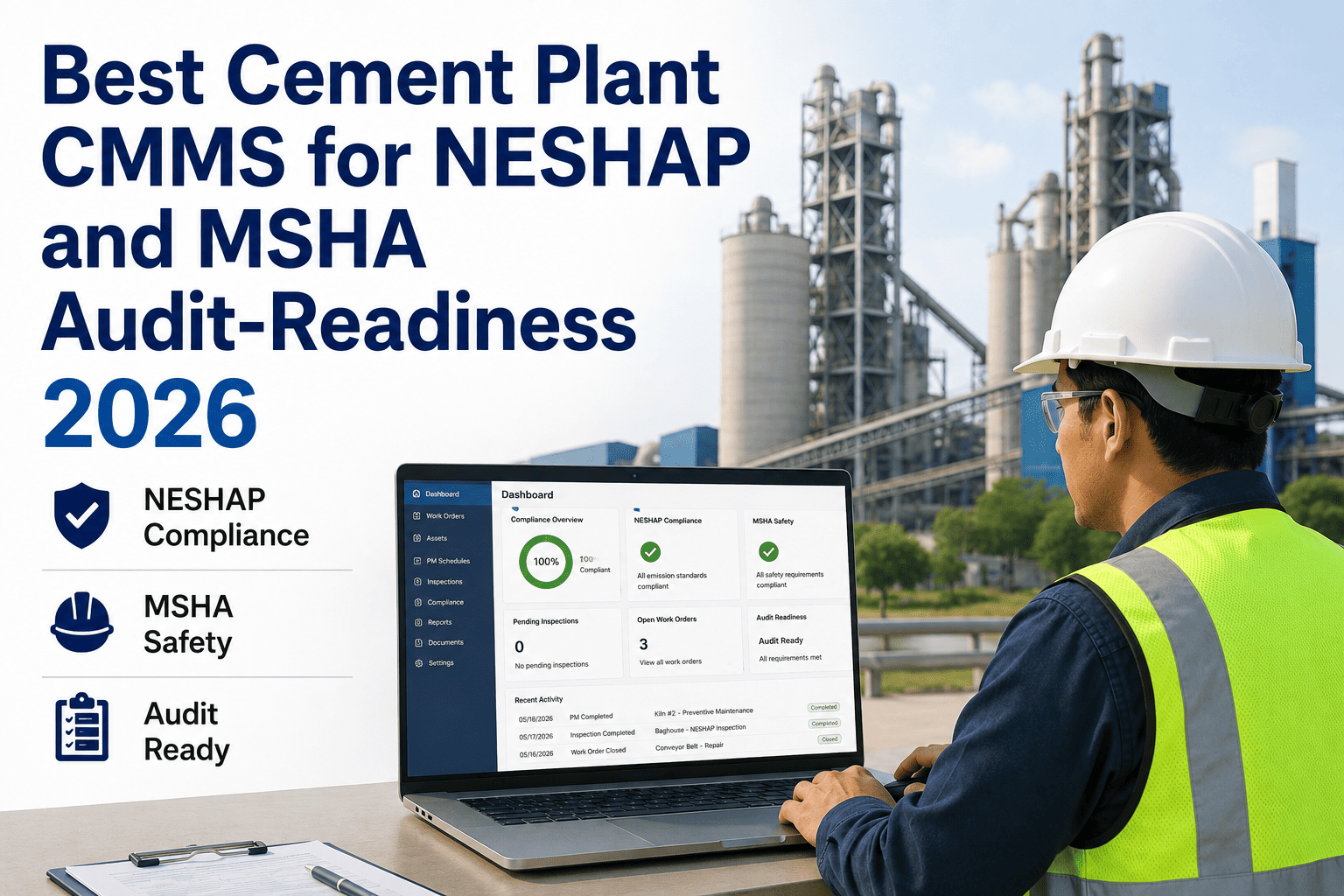
Best Cement Plant CMMS for NESHAP and MSHA Audit-Readiness 2026
Inspectors don't call ahead. Citation defense isn't possible without complete, retrievable records. Here's what your CMMS must deliver before the next audit — and the questions to ask every vendor.
!
The Citation Risk
Average MSHA citation cost for recordkeeping violations: $9,700 per citation. A single 18-month records inspection can produce multiple citations across incomplete records, missing examinations, and documentation gaps.
72%
Faster Audit Response
Cement plants with structured compliance modules in their CMMS report 72% faster audit response times versus plants assembling records manually from disconnected systems.
0
The Target
Zero citations from documentation gaps. Every required record retrievable in minutes. Every corrective action documented with timestamp, assignee, and closure evidence.
The Compliance Landscape
What NESHAP and MSHA Actually Require From Cement Plant Records
Understanding what auditors look for — and what generates citations — is the starting point for evaluating whether your CMMS delivers the right structure.
NESHAP: What Auditors Look For
CEMS Operation and Calibration Records
Continuous emissions monitoring system calibration logs, quality assurance records, and exceedance reports must be maintained for a minimum of 5 years and retrievable on demand. Gaps in CEMS records are among the most common NESHAP citations at cement facilities.
Kiln and In-line Kiln/Raw Mill Operation Records
Operating hours, production records, and documentation of any periods of startup, shutdown, or malfunction must be maintained with clear timestamps and corrective actions documented against each event.
Parametric Monitoring Data
Temperature, pressure drop, and flow rate data for control equipment must be recorded against operating limits specified in the permit. Exceedances require documented corrective actions with closure evidence.
Performance Test Reports
Stack test reports and supporting data must be retained and linked to the specific equipment tested. Auditors cross-reference test dates against equipment maintenance records to confirm no modifications occurred between tests that would invalidate results.
MSHA: What Inspectors Examine
Workplace Examination Logs
30 CFR 56.18002 requires workplace examinations before each shift. Records must show examiner name, date, time, area examined, and any hazardous conditions found — plus documentation that conditions were corrected before work continued.
Equipment Maintenance and Inspection Records
Maintenance records for safety-critical equipment — conveyor guards, dust suppression systems, mobile equipment — must be complete, dated, and signed. MSHA inspectors routinely request these records across 12 to 24 month periods.
Hazardous Condition Correction Evidence
Every hazardous condition identified in a workplace examination must have a documented corrective action with a completion timestamp. Open hazardous conditions without documented closure are cited as standalone violations regardless of intent.
Training and Competency Records
Miner training records under 30 CFR Part 46 must be current, individual, and retrievable by employee. MSHA inspectors cross-check training records against task assignments to confirm workers are only performing tasks for which they are trained.
The Gap
Why Standard CMMS Platforms Fail Compliance Audits
Records scattered across systems
CEMS data lives in a historian. Workplace exams are in paper logbooks. Equipment records are in the CMMS. Performance tests are in email attachments. An auditor requesting all records for a single piece of equipment across 18 months can force a multi-day manual assembly exercise — and gaps are inevitable.
No corrective action closure tracking
Most CMMS platforms record that a corrective action was created. They don't enforce closure documentation — photo evidence, technician sign-off, supervisory approval. An MSHA inspector who asks "show me that this hazardous condition was corrected" needs a timestamped record, not a work order marked closed with no evidence attached.
No audit export format
Even when all the data is in the CMMS, generating it in an audit-ready format — sorted by asset, by date range, by regulation reference — requires manual report configuration that generic CMMS platforms weren't built to support. The result is formatted spreadsheets built under deadline pressure, with the risk of missed records.
No calendar-based compliance scheduling
Regulatory compliance in cement plants has mandatory frequency requirements — shift-by-shift workplace exams, annual performance tests, periodic parametric monitoring calibrations. Generic CMMS PM scheduling doesn't enforce these against regulatory calendars or flag overdue compliance tasks as compliance risks versus maintenance priorities.
What Audit-Ready Looks Like
5 CMMS Capabilities That Make NESHAP and MSHA Audits Manageable
On-Demand Compliance Record Export
The CMMS must generate a complete, filtered export of all records relevant to a regulatory request — by equipment, by date range, by regulation type — in minutes. Not hours, not days. The export should require no custom report configuration and produce a formatted document ready to hand to an inspector. Oxmaint generates NESHAP and MSHA record exports with one selection — equipment, date range, record type — producing a formatted PDF or spreadsheet export immediately.
Proof-of-capability test: "Generate all workplace examination records for the kiln building, January to June 2025, in an MSHA-formatted export. How long does that take?"
Forced Corrective Action Closure with Evidence
Every hazardous condition identified in a workplace examination or equipment inspection must require documented closure before the record is considered complete. The CMMS should enforce photo capture, technician sign-off, and supervisory approval before a corrective action can be closed — not allow a work order to be marked done with no supporting evidence. Oxmaint's corrective action workflow enforces configurable closure requirements per action type, creating a defensible evidence trail for every remediation event.
Proof-of-capability test: "What prevents a technician from closing a hazardous condition work order without attaching the corrective action evidence?"
Regulatory Calendar with Overdue Compliance Alerts
Compliance-critical tasks — shift workplace examinations, annual stack test schedules, CEMS calibration intervals — must be tracked against regulatory frequency requirements, not maintenance priority queues. Overdue compliance tasks should generate immediate alerts distinguishing them from routine deferred maintenance. A shift workplace examination 2 hours overdue carries regulatory risk that a deferred lubrication task does not — the CMMS must treat them differently and surface the distinction immediately.
Proof-of-capability test: "Show me how the system distinguishes between a regulatory compliance task that's overdue and a routine PM that's been deferred — and how it alerts the right person immediately."
CEMS and Parametric Data Integration
CEMS records, parametric monitoring data, and exceedance reports should flow directly into the CMMS from the historian or control system — not sit in a separate system that requires manual cross-referencing during an audit. When an exceedance occurs, the CMMS should automatically create a linked corrective action record that must be closed before the exceedance event is marked resolved. This creates a complete, auditable chain from the emission event to the corrective response — exactly what NESHAP auditors are looking for.
Proof-of-capability test: "When a CEMS exceedance is recorded, how does the system create and track the required corrective action response?"
Immutable Audit Trail with Timestamp and User Logging
Every record modification, closure, or deletion must be logged with the user identity, timestamp, and original value — and that log must be tamper-evident. Auditors who suspect record manipulation will ask for system-level audit logs. A platform that allows record edits without audit trail exposure creates legal risk that goes far beyond a citations penalty. Oxmaint's audit log is immutable, user-attributed, and exportable as part of any compliance record package.
Proof-of-capability test: "If a workplace examination record is edited after the fact, what does the audit log show, and can that log be exported as part of the compliance record?"
Build Your Audit-Ready CMMS
NESHAP Records. MSHA Workplace Exams. Corrective Action Evidence. All in One Platform.
Oxmaint generates audit-ready compliance exports in minutes — not days. Workplace examination logs, CEMS records, corrective action closure evidence, and equipment inspection history available on demand for any date range or asset group.
Compliance Readiness Audit
Is Your Current CMMS Audit-Ready? A Self-Assessment
Answer these questions about your current system. If you answer "No" or "I don't know" more than twice, your CMMS is creating regulatory exposure that Oxmaint can close.
| Question |
What a Passing Answer Looks Like |
What a Failing Answer Creates |
| Can you export all MSHA workplace exam records for any 18-month period in under 5 minutes? |
Formatted export, complete records, no manual assembly |
Manual search, potential missing records, citation risk |
| Does the system prevent closing a hazardous condition without corrective action evidence attached? |
Mandatory photo or document attachment enforced before closure |
Open-ended work order closures with no evidence trail |
| Are compliance-critical tasks distinguished from routine PM in scheduling and alerting? |
Regulatory tasks have separate overdue alerts and escalation paths |
All tasks in one queue — compliance tasks deferred like routine PM |
| Does CEMS exceedance data auto-create a linked corrective action in the CMMS? |
Automatic CEMS-to-CMMS link with mandatory corrective action workflow |
Manual cross-referencing between historian and CMMS records |
| Is every record edit timestamped, user-attributed, and preserved in an immutable audit log? |
Tamper-evident audit log exportable with any compliance package |
Edit history unavailable or incomplete — creates legal exposure |
Frequently Asked Questions
NESHAP and MSHA Compliance in Cement Plants — Common Questions
How long does Oxmaint take to configure NESHAP and MSHA compliance templates for a cement plant?
NESHAP and MSHA compliance record templates are pre-configured for cement plant operations in Oxmaint — typically activated and customized to your permit and location within the first 30 days of deployment.
Book a demo to see the compliance configuration specific to your plant's permit requirements.
Can Oxmaint integrate with existing CEMS historians to pull exceedance records automatically?
Yes. Oxmaint connects to PI historian, OSIsoft, and OPC-UA CEMS data sources to pull exceedance events directly into the compliance record system, triggering linked corrective action workflows automatically.
Start a free trial to review integration options for your installed historian system.
Does Oxmaint support multi-shift workplace examination workflows with supervisor review and sign-off?
Yes. Oxmaint supports configurable workplace examination workflows with per-shift assignment, hazard identification fields, corrective action creation, supervisor review, and digital sign-off — fully compliant with 30 CFR 56.18002 requirements.
Book a demo to walk through a shift workplace examination workflow configured for cement plant operations.
What happens to compliance records if we switch CMMS platforms in the future?
All Oxmaint compliance records are exportable in standard formats (PDF, CSV, Excel) at any time, ensuring your historical records remain accessible regardless of future platform decisions. Regulatory retention requirements are always met.
Start a free trial to review the record export and retention architecture for your compliance programme.
Can Oxmaint support both NESHAP and MSHA compliance tracking from a single platform?
Yes. Oxmaint manages both NESHAP environmental records and MSHA safety inspection records from a single plant-level account, with separate record types, audit exports, and compliance calendars for each regulatory framework.
Book a demo to see both compliance modules demonstrated in a cement plant context.
Stop Dreading Audit Day
NESHAP Records. MSHA Workplace Exams. Corrective Action Trails. All Audit-Ready in Oxmaint.
When an inspector walks in, your records should be retrievable in minutes — not assembled over three days. Oxmaint builds the audit trail automatically, every shift, every inspection, every corrective action.