NESHAP MACT under 40 CFR Part 63 Subpart LLL is the compliance framework every Portland cement plant in the United States operates under — covering mercury, particulate matter, hydrochloric acid, total hydrocarbons, and dioxins/furans from kilns, clinker coolers, raw material dryers, and open clinker storage piles. The rule requires rolling 30-day averages for mercury and THC, minute-by-minute temperature records during startup, semiannual summary reports submitted within 60 days of period close, and continuous emissions monitoring or parametric monitoring systems that generate data regulators will request in any audit. The gap between plants that sail through EPA audits and those that receive notices of violation is almost never a gap in equipment performance — it is a gap in documentation. A CMMS like Oxmaint closes that gap by making every required record a structured, timestamped asset entry rather than a spreadsheet that someone has to rebuild before the inspector arrives. If your plant has a compliance milestone or a scheduled performance test in the next 12 months, book a consultation to map your current records against Subpart LLL requirements.
40 CFR Part 63 Subpart LLL
NESHAP MACT for Cement Manufacturing
How CMMS eliminates audit risk by turning every compliance record into a structured, timestamped, regulator-ready asset entry.
Mercury
30-day rolling avg
HCl
30-day rolling avg (CEMS)
Regulated pollutants under Subpart LLL — each with distinct monitoring, averaging, and recordkeeping requirements
Scope of Coverage
What Subpart LLL Covers — and What It Requires from Every Source
Subpart LLL applies to kilns, alkali bypasses, clinker coolers, raw material dryers, and open clinker storage piles at Portland cement plants that are major sources of hazardous air pollutants. The scope is broad. The recordkeeping burden is continuous. And the amendment history — most recently clarified effective July 25, 2018 — has tightened several reporting provisions that previously created compliance gaps.
Affected Sources
Kilns + alkali bypasses
Clinker coolers
Raw material dryers
Open clinker storage piles
In-line kiln/raw mills
REQUIRES
Continuous Obligations
CEMS or CPMS operation
30-day rolling average calculation
1-minute startup temp records
Semiannual reports (60-day deadline)
Performance test records (CEDRI)
TRIGGERS
Audit Risk When Missing
Notice of violation
Penalty assessment
Mandatory re-testing
Permit revision requirement
Consent agreement / schedule
Pollutant by Pollutant
The Five Regulated Pollutants: What Each One Demands
Each pollutant under Subpart LLL has its own monitoring methodology, averaging period, and recordkeeping standard. Plants that treat them as a single compliance obligation routinely create documentation gaps in one or two categories that surface only during an audit.
Averaging
30-day rolling average, corrected to total clinker production (million tons)
Monitoring
Sorbent trap or CEMS; semiannual performance tests
CMMS record
Daily clinker production, test method results, rolling average log
Raw material variability — IQV factor applies to mercury content across geological time
Averaging
Per performance test; opacity monitored continuously (COMS)
Monitoring
Method 5 or Method 17; parametric CPMS for operating limits
CMMS record
Baghouse/ESP condition data, differential pressure logs, bag replacement history
Applies to kilns, clinker coolers, raw material dryers, and alkali bypasses — all as separate source points
Averaging
30-day rolling average when CEMS is used; or per performance test
Monitoring
Method 321; wet scrubber pressure drop, liquid flow rate, pH at ≤15-minute intervals
CMMS record
Scrubber parametric logs, CPMS calibration records, SO2 CPMS data if used for HCl surrogate
2018 amendments resolved conflicting provisions between §63.1349(b)(8)(x) and §63.1350(l)(3) — verify your monitoring configuration is updated
Averaging
30-day rolling average; measured as propane; corrected to 7% O₂ for kilns
Monitoring
CEMS; separate raw mill on/off conditions for inline raw mills
CMMS record
CEMS calibration records, raw mill operating status log, 30-day average calculations
New (greenfield) sources post-March 1998 face THC limits that existing sources do not — source classification matters for compliance planning
Averaging
Per performance test; temperature surrogate monitored on 30-day basis
Monitoring
Temperature-based CPMS; 1989 TEF values required for TEQ calculation (not 2005 scale)
CMMS record
Temperature exceedance logs, corrective action records, performance test data
2018 amendments corrected a reporting error in the 30-day rolling average for D/F temperature monitoring — verify your CPMS configuration against updated rule language
Every pollutant has its own record. Every record has its own audit risk.
Oxmaint structures NESHAP records at the asset level — so every CEMS reading, every CPMS log, every performance test result is tied to the specific kiln, cooler, or dryer it belongs to. No reconciliation, no spreadsheet risk, no audit scramble.
Where Audit Risk Lives
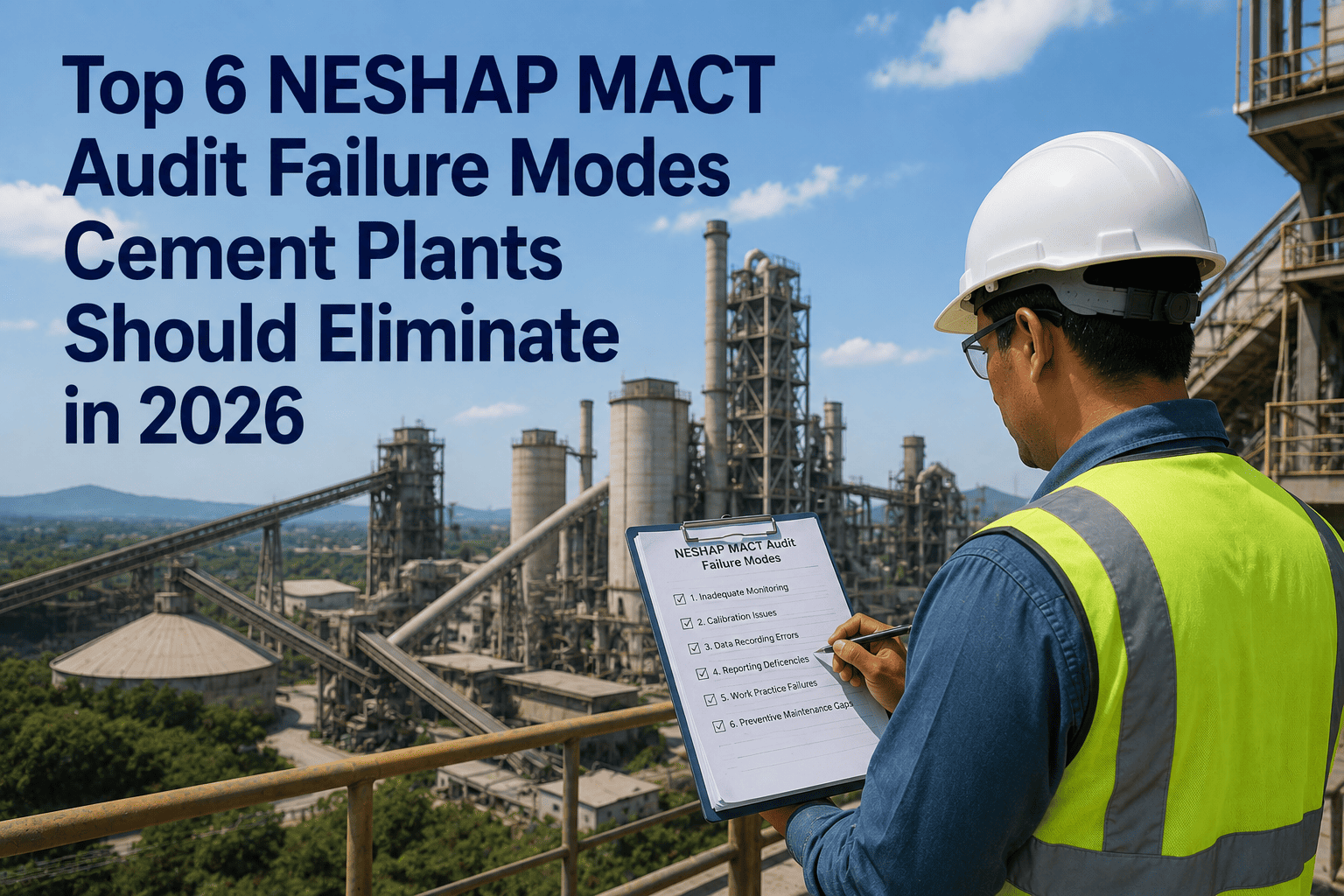
The Six Documentation Gaps That Generate Notices of Violation
Most NESHAP violations are not caused by emission exceedances — they are caused by documentation failures. These are the six gaps that appear most frequently in EPA enforcement actions against Portland cement plants.
01
Missing 1-Minute Startup Temperature Records
Subpart LLL requires temperature measurement at the inlet of the baghouse or ESP calculated at least every 60 seconds during startup, from readings taken at least once per 15-second period. Manual logging cannot reliably produce this record. CMMS with OPC-UA or MQTT sensor integration can.
02
Semiannual Reports Submitted Late
The 2018 amendments clarified that semiannual summary reports must be submitted within 60 days of the end of the reporting period. Plants that treat this as an approximate deadline routinely miss the statutory requirement. CMMS-driven due date alerts remove the ambiguity.
03
30-Day Rolling Average Calculation Errors
Mercury and THC limits are based on a 30-day rolling average covering all operating hours within 30 consecutive kiln operating days, excluding startup and shutdown. Plants that include startup hours or miscalculate the clinker production denominator produce incorrect averages — and incorrect reports.
04
Corrective Action Records Not Linked to Exceedances
Regulators require corrective action documentation linked to the specific exceedance event and the specific emission point. Unlinked records — stored in separate spreadsheets or maintenance logs — create the appearance of non-compliance even when the corrective action was completed.
05
Coal Mill Exhaust Not Properly Accounted For
When coal mill exhaust is commingled with kiln exhaust in a single stack, all emissions from both sources must be added together and demonstrated not to exceed the per-pollutant limit. Plants that test only the combined stack without accounting for the individual streams create reportable gaps.
06
CPMS Parameter Limits Not Updated After Process Changes
Subpart LLL requires performance testing when any change in operations may adversely affect compliance. Plants that modify raw material blends, fuel types, or production rates without updating their CPMS site-specific parameter limits are operating outside their permit conditions — even if emissions remain within limits.
CMMS Architecture
How Oxmaint Structures NESHAP Records to Remove Audit Risk
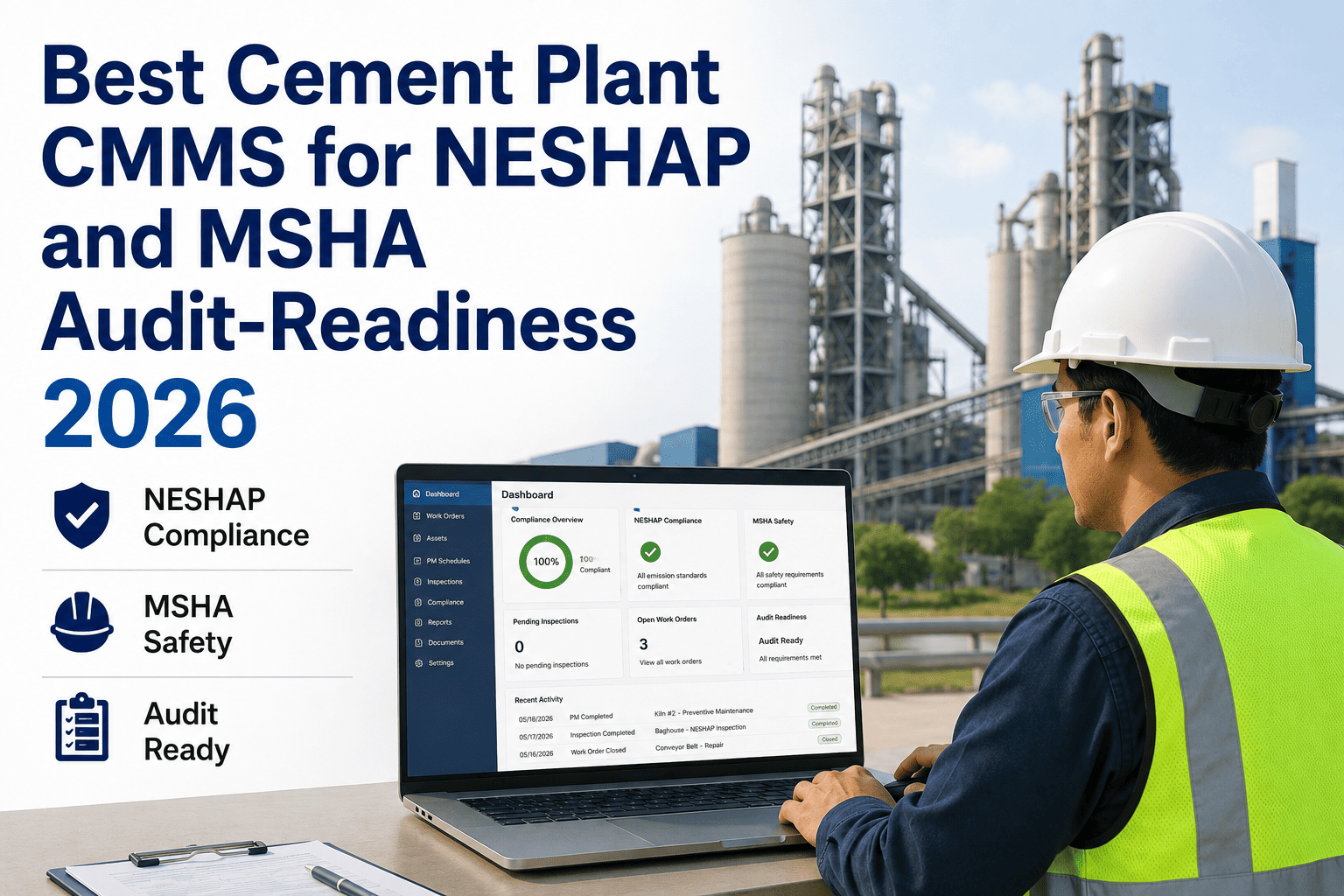
Audit risk is a records architecture problem. Oxmaint solves it by structuring every NESHAP obligation as a linked chain: emission point → monitoring data → work order → corrective action → report. No manual assembly before audit; every record is already in the right place.
Emission Point
Kiln, cooler, dryer, or storage pile registered as an Oxmaint asset with source classification (new vs existing), applicable limits, and compliance dates
Monitoring Data
CEMS and CPMS readings ingested via OPC-UA or MQTT; 1-minute startup records auto-generated; 30-day rolling averages calculated and flagged against limits
Work Order
Threshold breach auto-generates a corrective action work order linked to the specific exceedance record, with timestamp, asset ID, and pollutant tag
Compliance Report
Semiannual summary report assembled from structured records — not manually compiled. Submitted within the 60-day window with full CEDRI-compatible export
What "Audit-Ready" Actually Means in Practice
Ready
Every startup temperature record retrievable by date, kiln ID, and operating event — not buried in a historian export
Ready
30-day rolling averages for mercury and THC recalculable from raw data on demand — not dependent on a single analyst's spreadsheet
Ready
Every corrective action linked to the exceedance event that triggered it — with completion timestamp and technician sign-off
Ready
CPMS parameter limits updated in the system every time a process change work order is completed — not managed separately
FAQ
Questions Compliance Managers and Plant Engineers Ask About Subpart LLL
What sources at our cement plant are subject to Subpart LLL?
Kilns and their associated alkali bypasses, clinker coolers, raw material dryers, and open clinker storage piles (defined as ground piles present for more than three days, not fully enclosed) are all affected sources. In-line kiln/raw mills are also covered and require separate testing for raw mill on and raw mill off conditions for HCl compliance.
Oxmaint registers each affected source as a separate asset with its own compliance record.
How is the 30-day rolling average for mercury calculated correctly?
The 30-day period covers all operating hours within 30 consecutive kiln operating days, excluding startup and shutdown hours. Mercury emissions are normalized to total clinker production in million tons (P) over the same period. Startup and shutdown periods are excluded from the operating day count. Miscalculating the denominator or including startup hours are the two most common errors that produce incorrect averages and inaccurate semiannual reports.
Book a consultation to review your calculation methodology.
What did the 2018 Subpart LLL amendments change that affects our compliance today?
The 2018 amendments (effective July 25, 2018) corrected the D/F temperature monitoring rolling average reporting requirement, clarified that semiannual reports are due within 60 days of period close, resolved conflicting provisions between SO2 CPMS and HCl compliance monitoring, and corrected the daily clinker production and kiln feed rate recordkeeping provision. Plants that have not updated their CPMS configurations and reporting workflows to reflect these corrections remain out of compliance even if their emissions are within limits.
When does a process change trigger a new performance test requirement?
Subpart LLL requires a new performance test whenever a planned operational change may adversely affect compliance with any applicable standard, operating limit, or parametric monitoring value. Changes to fuel type, raw material blend, production rate, or emission control configuration typically trigger this requirement. The CMMS work order for the process change should automatically flag the performance test obligation.
Can a CMMS replace our CEMS or CPMS for NESHAP compliance?
No. CEMS and CPMS are required by the regulation and cannot be replaced. A CMMS like
Oxmaint receives data from CEMS and CPMS via OPC-UA or MQTT integration, structures and stores it against the correct asset record, calculates rolling averages, flags exceedances, and generates the audit trail that makes CEMS data defensible. The two systems work together — the CMMS is the recordkeeping and compliance management layer, not the measurement layer.
NESHAP audits do not punish bad emissions. They punish bad records.
Oxmaint gives every cement plant a structured, asset-level compliance record that survives an EPA audit without a week of manual preparation — covering all five Subpart LLL pollutants, all six affected source categories, and all continuous monitoring obligations.