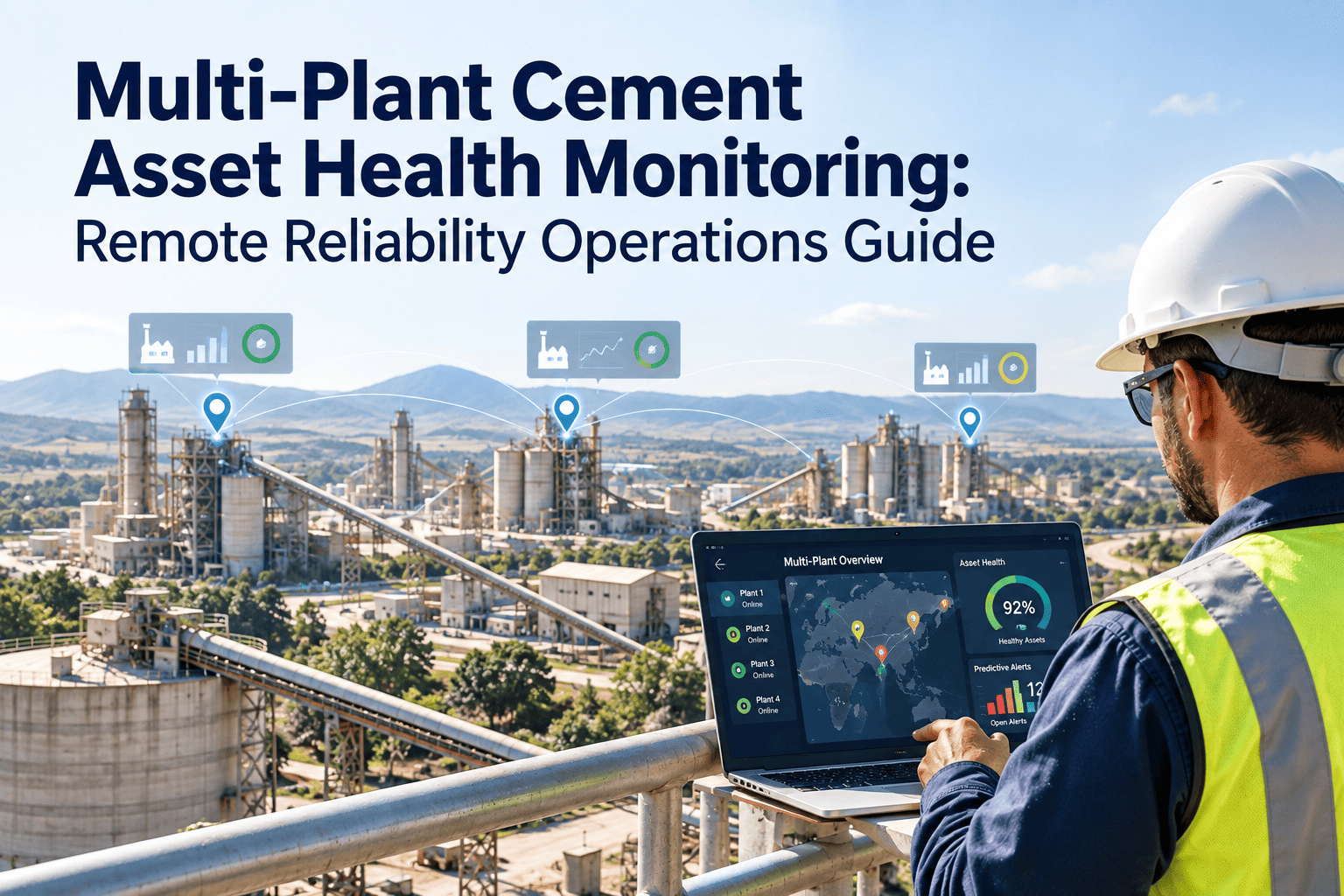
Every cement plant runs on a handful of assets that cannot afford to fail. Your rotary kiln operates at 1,450°C around the clock. Your ball mills grind raw meal through 44+ bearing points under constant abrasive stress. Your vertical roller mills, crushers, and clinker coolers each carry the full weight of production on their shoulders. When any one of them goes down without warning, the cost is staggering: up to $300,000 per day in lost output for a 1 MTPA facility. The real question is not whether your equipment will degrade. It will. The question is whether you will see it happening in time to act. That is exactly what real-time equipment health scoring delivers. If your plant is still relying on manual rounds and gut instinct to judge asset condition, schedule a walkthrough with OxMaint to see AI-calculated health scores on every critical asset in your operation.
What Is an Equipment Health Score?
An equipment health score is a single, AI-calculated number between 0 and 100 that represents the real-time operating condition of any asset in your cement plant. Instead of forcing your maintenance team to interpret dozens of separate sensor readings, vibration charts, and temperature logs manually, the health score synthesizes all of that data into one actionable metric. A score of 92 means your kiln drive is running within normal parameters. A score of 64 means degradation has been detected and a work order should be planned. A score of 38 means failure is imminent and immediate intervention is required.
Health Score Scale
0 - 40
41 - 70
71 - 90
91 - 100
Critical
Needs Attention
Good
Optimal
$300K
per day lost to unplanned downtime at a 1 MTPA cement plant
15-25%
of total manufacturing cost goes to maintenance in cement plants
91%
of plants reduce unplanned downtime after implementing predictive maintenance
Why Cement Plants Need Real-Time Health Scoring
Cement manufacturing is one of the harshest operating environments in heavy industry. Machinery handles particles between 6 and 40 microns that aggressively wear down bearings, shafts, and seals. Kiln temperatures exceed 1,000°C. Equipment runs continuously for months between planned shutdowns. Traditional maintenance approaches, whether reactive or calendar-based preventive, simply cannot keep pace with the rate at which conditions change inside these machines. Health scoring closes that gap by converting raw sensor data into a continuously updated condition assessment for every monitored asset.
Manual Condition Assessment
Technicians walk routes weekly, checking equipment by hand and ear
Sensor data sits in SCADA historians, rarely analyzed proactively
Failures detected only after vibration or temperature spikes visibly
No unified view of which assets are degrading fastest
Knowledge depends on experienced operators who may retire or transfer
AI-Powered Health Scoring with OxMaint
Every critical asset scored 0-100 in real time, updated continuously
Multiple sensor parameters fused into one actionable health index
Degradation detected weeks before failure through pattern recognition
Plant-wide dashboard ranks assets by urgency automatically
AI captures failure patterns as permanent institutional knowledge
How OxMaint Calculates Health Scores for Cement Assets
The health score is not a simple threshold alarm. OxMaint uses a multi-parameter AI engine that weighs different sensor inputs based on the specific asset type, its operating context, and historical failure patterns from your plant. Here is what feeds into the calculation for each major equipment category in a cement facility.
1,450°C Operating Temp
Shell temperature profile and hot spot detection
Kiln drive motor current and torque fluctuation
Tyre migration and shell ovality measurement
Refractory lining condition via infrared imaging
Bearing temperature and vibration on support rollers
Gear mesh frequency analysis on girth gear
44+ Bearing Monitoring Points
Main bearing vibration amplitude and frequency spectrum
Gearbox oil temperature and particle contamination
Motor current draw relative to feed rate
Separator efficiency and product fineness
Coupling alignment status
Grinding media wear rate based on throughput decline
Hydraulic + Vibration Monitoring
Roller and table vibration patterns
Hydraulic system pressure stability
Gearbox bearing temperature and vibration
Dam ring wear and material bed depth
Separator drive motor load
Differential pressure across mill body
Continuous Feed Monitoring
Jaw or hammer wear rate via throughput analysis
Bearing vibration on crusher shaft
Rotary feeder condition and classifier performance
Seal air fan pressure differential
Motor temperature and current harmonics
Material level and feed consistency
See Health Scores on Your Actual Assets
Walk through a live demo configured for cement manufacturing. Our team will map the health scoring engine to your kiln, mills, crushers, and critical auxiliaries.
From Raw Data to Actionable Decisions: The Health Scoring Pipeline
01
Sensor Data Ingestion
OxMaint connects to your existing SCADA, DCS, and historian systems through standard industrial protocols. Vibration, temperature, pressure, current, and flow data streams into the platform in real time. No rip-and-replace of your existing infrastructure is required.
02
Multi-Parameter Fusion
Instead of evaluating each sensor in isolation, the AI engine correlates multiple parameters simultaneously. A slight vibration increase on a ball mill bearing combined with rising oil temperature and increasing current draw tells a fundamentally different story than any one of those signals alone.
03
Baseline Learning and Anomaly Detection
The system establishes normal operating signatures for each asset based on historical data and continuously compares live readings against those baselines. Deviations are classified by severity and mapped to known failure modes from your plant's own history.
04
Health Score Calculation
All inputs are weighted by asset type and criticality, then combined into a single 0-100 score. The score updates continuously, and trend analysis shows whether condition is stable, gradually declining, or deteriorating rapidly. Each score includes a breakdown showing which parameters are driving the rating.
05
Automated Response
When a health score crosses your configured thresholds, OxMaint automatically generates a prioritized work order with the relevant asset history, recommended procedures, and required parts. Your maintenance team gets the right information at the right time without anyone having to manually interpret sensor data.
Measurable Impact on Cement Plant Operations
Real-time health scoring transforms maintenance from a cost center into a competitive advantage. These results are consistent with industry benchmarks from cement manufacturing facilities that have moved from reactive or calendar-based maintenance to AI-driven predictive approaches.
Reduction in Unplanned Downtime
Catching degradation weeks before failure means repairs happen during planned windows, not during peak production runs
Maintenance Cost Savings
Predictive techniques reduce emergency repairs, overtime labor, and excess spare parts consumption across the plant
Faster Fault Diagnosis
Health score breakdowns pinpoint exactly which parameter is degrading, eliminating hours of manual troubleshooting
Failure Prediction Accuracy
Multi-parameter AI models that learn from your plant's own failure history achieve high-confidence predictions over time
Critical Cement Plant Assets That Benefit Most
Raw Material
Limestone Crushers
Conveyor Systems
Blending Bed Stackers
Grinding
Raw Mills (VRM / Ball)
Coal Mills
Separator Fans
Pyro Processing
Preheater Tower
Rotary Kiln
Clinker Cooler
Finish Grinding
Cement Mills
Roller Press
Bag House Fans
Storage and Dispatch
Cement Silos
Packing Machines
Bucket Elevators
Cement plants are facing a dual challenge: aging equipment and a shrinking pool of experienced technicians. With first-generation plants still running machinery that is three to four decades old, failure frequency and repair complexity are increasing. Meanwhile, the operators who know these machines best are retiring faster than they can be replaced. Real-time health scoring is not just a monitoring upgrade. It is how modern cement plants capture decades of operational knowledge into an AI system that continuously learns, never forgets, and makes that knowledge instantly available to every technician on the floor. Plants that implement health scoring consistently report moving from under 80% uptime on critical mills to above 92%, with maintenance costs dropping by 5 to 10% within the first year.
102+ Monitoring Points on Kilns Alone
From PH fans and kiln feeder elevators to drive alignment and gear mesh, OxMaint monitors every parameter that matters for kiln reliability
56-Hour Downtime Risk Per Mill Gearbox Failure
Bearing and gearbox defects in cement mills can halt production for over two days. Health scoring catches these faults weeks in advance
Works With Your Existing Infrastructure
Cloud-based deployment connects to existing SCADA and historian systems. Most cement plants go live within 4 to 8 weeks including full asset data migration
What You Get with OxMaint Health Scoring for Cement
Real-time 0-100 health scores for every critical asset
SCADA and historian integration via standard industrial protocols
Multi-parameter AI fusion for vibration, temperature, pressure, current
Automatic work order generation when scores cross thresholds
Asset-specific failure mode mapping from plant history
Plant-wide dashboard ranking all assets by health urgency
Trend analysis showing stable, declining, or rapid deterioration
Mobile access for maintenance teams on the plant floor
Bi-directional SAP, Oracle, and ERP synchronization
Self-learning AI that improves prediction accuracy over time
Stop Guessing. Start Scoring Every Asset in Real Time.
Join cement manufacturers using OxMaint to monitor equipment health continuously, eliminate unplanned downtime, and turn maintenance data into a strategic advantage. See the platform configured for your plant.
Frequently Asked Questions
How does the health score differ from standard SCADA alarms?
SCADA alarms trigger on single-parameter thresholds, which means you only get an alert when one specific value crosses a limit. Health scoring fuses multiple parameters simultaneously using AI, detecting subtle patterns of degradation that no single alarm would catch. For example, a kiln drive might show a minor vibration increase, a slight temperature rise, and a small current fluctuation that are all individually within normal range, but together indicate bearing wear that will cause failure in three weeks. The health score catches this. A SCADA alarm does not.
Does OxMaint work with our existing sensors and SCADA system?
Yes. OxMaint connects to your existing SCADA, DCS, and historian systems through standard industrial protocols including OPC-UA, Modbus, and PI. There is no need to replace your current sensor infrastructure. The platform ingests whatever data you are already collecting and adds AI-powered health analysis on top of it. If additional sensor coverage is needed for specific assets, our team will identify gaps during the deployment assessment.
How long does it take to deploy health scoring across a cement plant?
Most cement plants complete deployment within 4 to 8 weeks, including SCADA integration, asset hierarchy configuration, baseline learning, and team training. The system starts generating useful health scores within the first two weeks as it establishes operating baselines. Prediction accuracy improves progressively as the AI engine accumulates more operational data and failure history from your specific plant.
Can health scoring be applied to all equipment or only specific assets?
Health scoring can be applied to any asset that has sensor data available. Most cement plants start with the highest-criticality equipment: rotary kilns, ball mills, vertical roller mills, and clinker coolers. From there, coverage expands to crushers, coal mills, fans, conveyors, bucket elevators, and packaging units. The system supports nested asset hierarchies, so you can view health scores at the component level, equipment level, or entire production line level.
What kind of ROI can a cement plant expect from real-time health scoring?
Industry data shows that predictive maintenance techniques reduce maintenance costs by 5 to 10% of total production costs in cement manufacturing. For a facility where maintenance represents 15 to 25% of manufacturing expenditure, this translates to significant savings. Combined with the elimination of unplanned downtime events that cost up to $300,000 per day, most plants see full ROI within the first six months of deployment. The savings compound over time as the AI model becomes more accurate with more data.