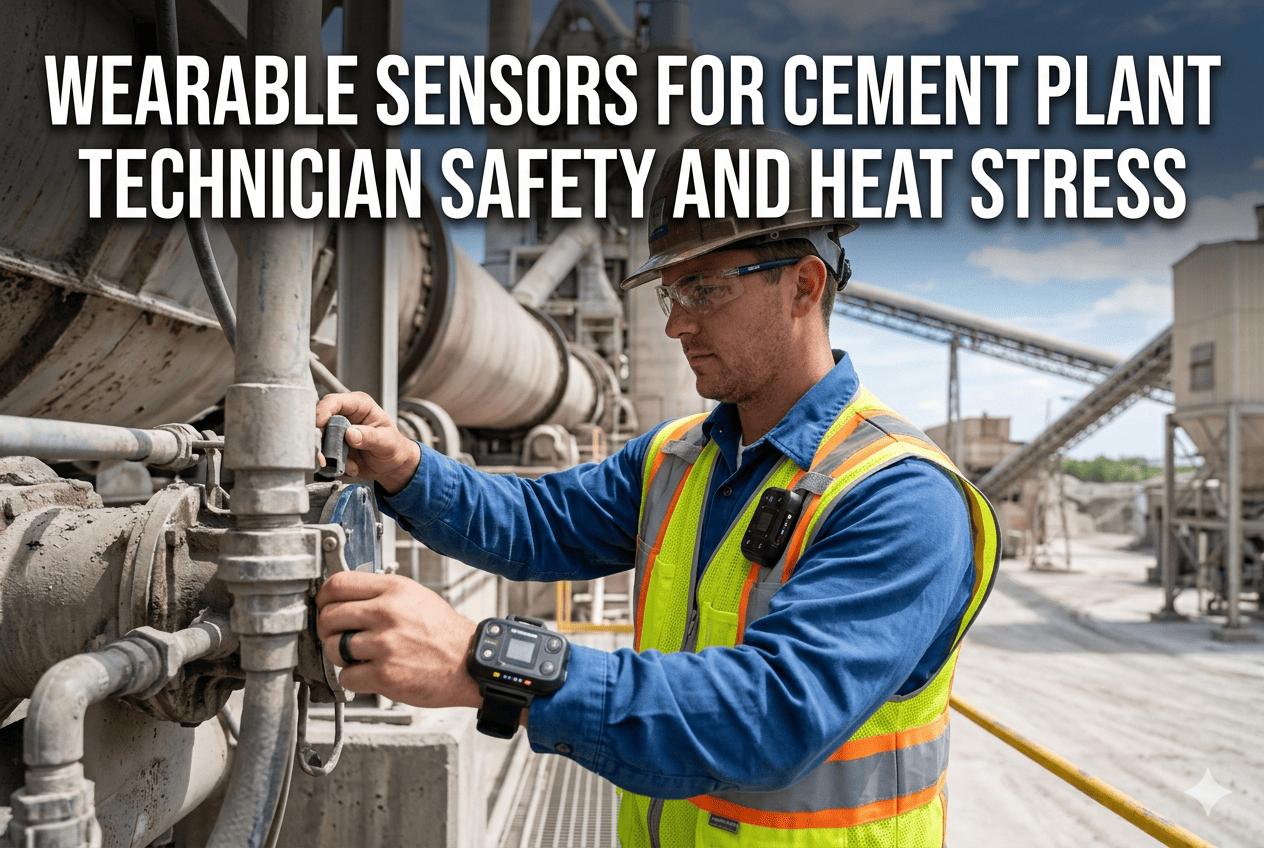
Wearable Sensors for Cement Plant Technician Safety and Heat Stress

By Johnson on April 22, 2026

cement-plant-wearable-sensors-technician-safety-heat-stress-cmms

Cement plant technicians working near rotary kilns, preheater towers, and clinker coolers are routinely exposed to ambient temperatures exceeding 60°C — environments where heat stress progresses from fatigue to medical emergency within minutes. Wearable physiological sensors now give maintenance teams the data they need before that threshold is crossed. Connect your wearable safety data directly to maintenance workflows at OxMaint, or book a 30-minute demo to see how CMMS safety dashboards and mandatory rest rotation triggers work in a live cement plant context.

Worker Safety · Cement Plant · IoT Wearables

Wearable Sensors for Cement Plant Technician Safety & Heat Stress Monitoring

How physiological wearables monitoring core temperature, heart rate variability, and fatigue scores are preventing heat casualties in kiln zones — and how that data flows into CMMS safety dashboards to trigger mandatory rest rotations before emergencies occur.

60°C+ Ambient temp near kiln shell
38.5°C Core temp alert threshold
20 min Avg onset: fatigue to danger

Why Cement Plants Are Different from Other Hot Workplaces

Steel mills are hot. Glass furnaces are hot. But cement kilns create a specific combination of radiant heat, dust, and confined access routes that makes technician heat exposure uniquely difficult to manage. A kiln shell can radiate surface temperatures above 300°C. The preheater tower — where technicians perform regular inspections and blockage clearing — traps heat vertically with no natural airflow. Maintenance tasks are not optional and cannot always wait for cooler conditions. The result: technicians are frequently working at physiological limits that a supervisor on the ground cannot observe.

Kiln Shell Zone
300°C surface
Radiant heat load even at 3–4m distance. Brick replacement and shell scanning tasks require close proximity work with limited dwell time.
Preheater Tower
60–80°C ambient
Vertical heat stack with no cross-ventilation. Blockage clearing and cyclone inspection are routine tasks in worst-case thermal conditions.
Clinker Cooler
45–55°C ambient
Fine clinker dust compounds respiratory load. Grate inspection and cooler maintenance tasks combine heat stress with dust exposure.
Coal Mill Area
40–50°C ambient
Elevated temperature combined with explosion risk means PPE adds to heat burden. Technicians are physically constrained in fire-rated gear.

What Wearable Sensors Actually Measure

Not all wearables are the same. The physiological signals that matter for heat stress prediction are specific — and the sensors that capture them range from wrist-worn devices to smart hard hat inserts to skin-contact patches worn under PPE. Here is what each signal means for a technician's safety status.

Physiological Signal Sensor Type What It Indicates Alert Threshold (Cement Zone)
Core Body Temperature Ingestible capsule or skin-patch estimator Direct heat strain — the primary indicator before heat stroke 38.5°C warning / 39°C mandatory exit
Heart Rate & HRV Chest strap or wrist PPG sensor Cardiovascular strain; HRV drop signals impending fatigue before technician feels it HR >85% max sustained; HRV drop >25% baseline
Skin Temperature Patch sensor (forearm or torso) Peripheral vasoconstriction — early sign body is prioritising core cooling Skin temp delta >4°C from baseline
Sweat Rate / Hydration Electrochemical sweat sensor patch Dehydration progression — sweat electrolyte shifts precede performance collapse Sweat sodium >60 mmol/L flags dehydration
Fatigue Score Multi-parameter algorithm (HR, HRV, motion) Composite score combining physiological signals with activity data Score above 7/10 triggers rest rotation

Connect Wearable Alerts to Maintenance Workflows

OxMaint's safety dashboard receives physiological alerts from wearable sensors and triggers mandatory rest rotations — automatically logged against the technician's work order record.

How CMMS Integration Turns Sensor Alerts into Mandatory Action

A wearable sensor that sends an alert to a phone app is a consumer device. A wearable sensor whose alert triggers a CMMS safety event, pauses the active work order, logs the physiological reading against the technician record, and notifies a supervisor — that is an industrial safety system. The difference is integration architecture.

01
Sensor Threshold Crossed
Core temperature, HR, or fatigue score exceeds configured limit. Wearable device generates a timestamped physiological event with technician ID, location, and sensor readings.
02
Alert Transmitted to OxMaint
Structured alert payload sent via API to OxMaint safety dashboard. Supervisor sees real-time technician status map with colour-coded physiological status across all active personnel.
03
Work Order Paused Automatically
For critical threshold breaches, the technician's active work order is placed in mandatory hold status. No manual step required. The work order cannot be resumed until rest period is logged as complete.
04
Rest Rotation Assigned
OxMaint assigns a replacement technician from the available pool if the work is time-critical. Rest rotation minimum is logged (typically 20–30 minutes in a cool zone for kiln area work).
05
Physiological Record Updated
Event logged against technician safety record. Cumulative heat exposure tracked per shift and per week. Trend data supports fitness-for-duty assessments and heat acclimatisation programme management.

Smart PPE and Wearable Formats Used in Cement Plants

Cement plant environments impose constraints that rule out most consumer wearables. Dust ingress, radiant heat, chemical splash, and the requirement to function under hard hats and full-face respirators narrow the viable form factors significantly. These are the formats that have been proven in cement plant deployments.

Hard Hat Insert
Smart Hard Hat Module
Sensor module clipping to the inner suspension of a standard hard hat. Captures skin temperature at the forehead, ambient temperature, and GPS/location. IP68-rated. Compatible with all major hard hat brands. No changes to PPE compliance required.
Chest Strap
Cardiac Monitor Band
Medical-grade ECG chest strap worn under workwear. Captures heart rate and HRV with clinical accuracy. Battery life typically 72 hours. Bluetooth transmission to belt-worn gateway or smartphone. Most accurate HR signal available for industrial use.
Skin Patch
Disposable Biosensor Patch
Single-use biosensor worn on upper arm or torso. Captures skin temperature, sweat electrolyte concentration, and activity. Designed for shift-length wear in hot environments. No recharging required. Cost-effective for large maintenance teams.
Wristband
Industrial Smart Wristband
IP67/68-rated industrial wristband with optical HR sensor, skin temp, accelerometer, and GPS. Ruggedised for dusty, high-temp environments. Haptic and visual alert to technician when threshold crossed. Long battery life for multi-shift operation.

Heat Stress Levels: What Supervisors Need to Act On

The physiological progression from normal working state to heat stroke has four recognisable stages. CMMS safety dashboards that display only binary alerts miss the actionable window. Supervisors need to see where each technician sits on this continuum — and what the required intervention is at each stage.

Stage 1 Heat Fatigue Monitor
Core temp 37.5–38°C. HR elevated but within tolerance. Technician functional. Hydration reminder triggered. Supervisor alerted to watch trend. Work order continues.
Stage 2 Heat Strain Scheduled Rest
Core temp 38–38.5°C. HRV dropping. Fatigue score rising. Mandatory hydration break logged. Work order paused with 15-minute cool-down timer. Supervisor notified.
Stage 3 Heat Exhaustion Risk Immediate Rotation
Core temp 38.5°C+. HR >85% max sustained. Replacement technician assigned. Work order held minimum 30 minutes. Safety incident record opened in OxMaint. Site safety officer notified.
Stage 4 Medical Emergency Emergency Protocol
Core temp 39°C+. Rapid HR escalation or sudden drop. Emergency alert to all supervisors. Medical response protocol triggered. Work in zone suspended. This is the stage wearables are designed to prevent reaching.

Frequently Asked Questions

Industrial-grade wearables in hard hat insert, chest strap, and skin patch formats are specifically designed for full-PPE environments. They do not require line-of-sight or skin exposure. Chest straps and biosensor patches operate under coveralls without signal degradation. Confirm IP rating and operating temperature range match your specific zone conditions before deployment. OxMaint's safety module supports integration with all major industrial wearable platforms.
Most industrial wearables use Bluetooth Low Energy to a belt-worn gateway device, which then transmits via LoRaWAN, 4G LTE, or Wi-Fi depending on plant coverage. LoRaWAN is increasingly preferred for cement plants because of its long range and penetration through concrete structures. Book a demo to review connectivity options for your plant layout.
Wearable safety data improves shift planning rather than disrupting it. Cumulative heat exposure records enable evidence-based rotation scheduling — kiln zone tasks are assigned to acclimatised technicians, dwell times are calibrated to physiological capacity, and rest periods are built into the shift schedule as standard rather than reactive. OxMaint's scheduling module uses wearable data to auto-flag over-allocation of high-heat tasks to individual technicians.
Physiological data is health data and is subject to data protection regulations in most jurisdictions. Best practice is to aggregate data at the safety-event level for supervisors — displaying threshold breach status rather than raw biometric readings. Technicians see their own full data. Consult your HR and legal teams on disclosure requirements before deploying. OxMaint supports configurable data visibility controls.
A single avoided heat-related hospitalisation typically covers the hardware cost of a 20-person wearable programme. Beyond incident avoidance, reduced insurance premiums, improved safety audit scores, and reduced time lost to heat-related sickness absence contribute to payback. Most cement plants deploying wearable programmes report full cost recovery within 12–18 months. Book a demo to model the ROI case for your plant size and zone configuration.

Your Kiln Zone Technicians Are Working at Their Physiological Limit. Start Measuring It.

OxMaint connects wearable sensor alerts to CMMS work orders, mandatory rest rotations, and safety incident records — giving your supervisors real-time visibility and your safety programme an auditable record of every threshold event.


Share This Story, Choose Your Platform!