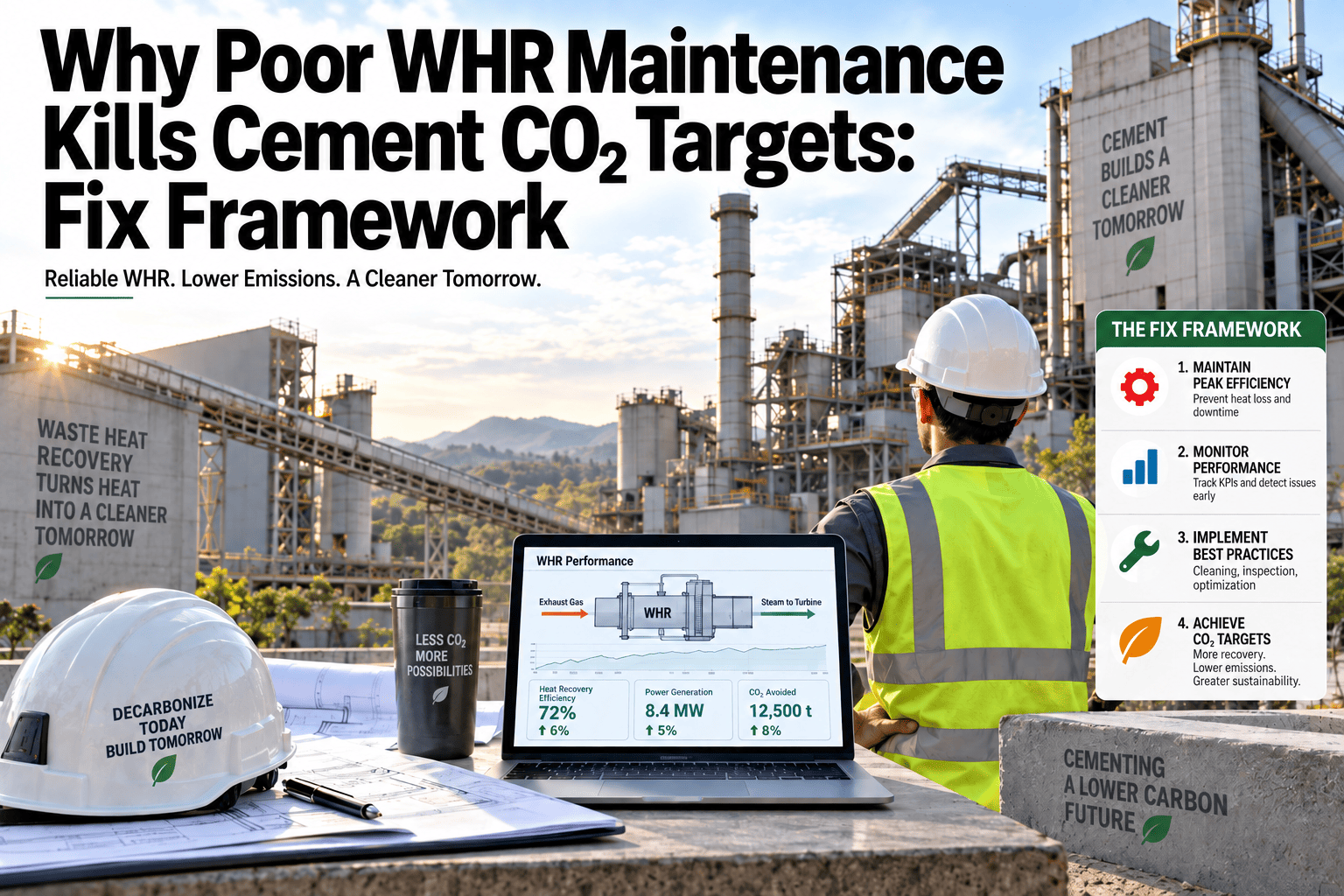
Waste heat recovery has become one of the few decarbonization levers a cement plant can install without changing its clinker chemistry, and it works by capturing exhaust gas from the preheater tower and clinker cooler that would otherwise vent straight into the atmosphere. That heat drives a steam or organic Rankine cycle turbine, and the electricity it produces can supply 25 to 30 percent of a plant's total power demand while cutting purchasing from the grid. But WHR only delivers that CO2 benefit for as long as the boiler tubes, turbine seals and bypass dampers stay in the condition they were designed for — and on most sites, that assumption gets tested a lot sooner than anyone plans for maintenance workflows built specifically for waste heat systems, see how Oxmaint AI tracks WHR condition data.
The Emissions Math Behind a WHR System
Cement manufacturing carries a heavy energy footprint before a single tonne of clinker even reaches the mill, and thermal energy alone runs 3.0 to 3.6 gigajoules per tonne of clinker across a typical kiln line. Waste heat recovery does not touch that thermal number directly — it targets the electrical side of the ledger, where recovered heat can supply 25 to 30 percent of total plant demand and cut indirect CO2 emissions tied to purchased grid power by a wide margin in coal- or gas-heavy grids.
Where WHR Output Actually Erodes
A WHR system does not fail all at once. It loses output in small increments across a handful of predictable failure points, and each one has a direct maintenance cause behind it. None of these show up on the monthly production report as a dramatic event — they show up months later as a lower-than-designed generation number that everyone assumes is just "how the system runs."
WHR Asset Classes and What Each One Needs
A WHR system is not one asset — it is a chain of interdependent equipment groups, and a maintenance program that only covers the turbine while ignoring the boiler and ductwork will still lose generation capacity. The table below breaks the chain into its core asset classes with the monitoring parameter and maintenance action tied to each.
| WHR Asset Class | Primary Failure Mode | Monitoring Parameter | Maintenance Action |
|---|---|---|---|
| SP/AQC boiler tube banks | Fouling, scaling, tube leaks | Outlet gas temperature, differential pressure | Soot-blower cycle checks, scheduled cleaning, tube inspection by operating hours |
| Steam / ORC turbine | Bearing wear, seal leakage | Vibration RMS trend, seal leak-off flow | Vibration-triggered inspection, bearing PM by start-stop count |
| Feedwater / working fluid system | Chemistry drift, fluid degradation | Conductivity, pH, dissolved oxygen | Scheduled sampling, treatment dosing verification |
| Bypass dampers | Seal wear, actuator drift | Position feedback vs. commanded position | Actuator calibration, seal replacement on condition |
| Hot gas ductwork & refractory | Refractory wear, shell hot spots | Shell thermography, visual inspection | Scheduled thermographic survey, refractory patch repair |
| Generator & electrical interconnect | Winding insulation degradation | Insulation resistance, thermal imaging | Annual electrical testing, connection torque checks |
Turning WHR Condition Data Into a Maintenance Record
Most of the instrumentation described above already exists on a modern WHR installation — the gap is rarely the sensor, it is the workflow that connects a reading to a scheduled action and closes the loop with a record anyone can review later. This is the part of WHR reliability that a CMMS is built to own.
Building the Business Case for WHR Reliability
Plant management teams often treat WHR as a capital project that finished the day it was commissioned, rather than a rotating-equipment asset that needs the same reliability discipline as a kiln drive or a cement mill. That framing matters because the financial case for WHR is strongest at the point of investment decision and weakest years later, when nobody is actively tracking whether the system is still hitting its design generation numbers.
The payback math on a WHR retrofit is usually built around a projected generation figure — a specific number of megawatts the system is expected to deliver continuously while the kiln runs. Every percentage point of efficiency lost to fouling, worn seals, or drifting feedwater chemistry pushes that payback further out, even though the capital has already been spent. A maintenance program is not an added cost on top of the WHR investment — it is the mechanism that protects the return the investment was justified on in the first place.
Common Objections to a Structured WHR Maintenance Program
How WHR Reliability Fits Into a Broader Decarbonization Plan
Cement is one of the harder industries to decarbonize, since the largest share of emissions comes from the chemical calcination reaction itself rather than fuel combustion, and that portion cannot be engineered away with equipment upgrades alone. Waste heat recovery sits in the smaller, more controllable slice of the emissions picture — the electrical and thermal efficiency side — where equipment condition has a direct, measurable effect on the outcome.
That makes WHR reliability one of the few decarbonization levers a plant maintenance and reliability team can actually own end to end. Alternative fuel substitution, clinker factor reduction and carbon capture all involve process, supply chain or capital decisions well outside a maintenance department's control. Keeping a WHR boiler clean, a turbine within its vibration limits and a bypass damper sealing correctly is squarely a maintenance responsibility — and it is one of the few places where a maintenance team's daily work shows up directly in the plant's sustainability numbers.
A Simple Discipline Most Plants Are Missing
None of the individual practices described on this page are complicated. Trending a boiler differential pressure, logging a turbine bearing vibration reading, checking a damper's actual position against its commanded position — each one takes a technician a few minutes. What separates a plant that sustains its WHR design output from one that watches it erode is whether those few minutes happen on a schedule, get recorded somewhere searchable, and generate a work order when a reading crosses a line, rather than depending on whoever happens to notice.