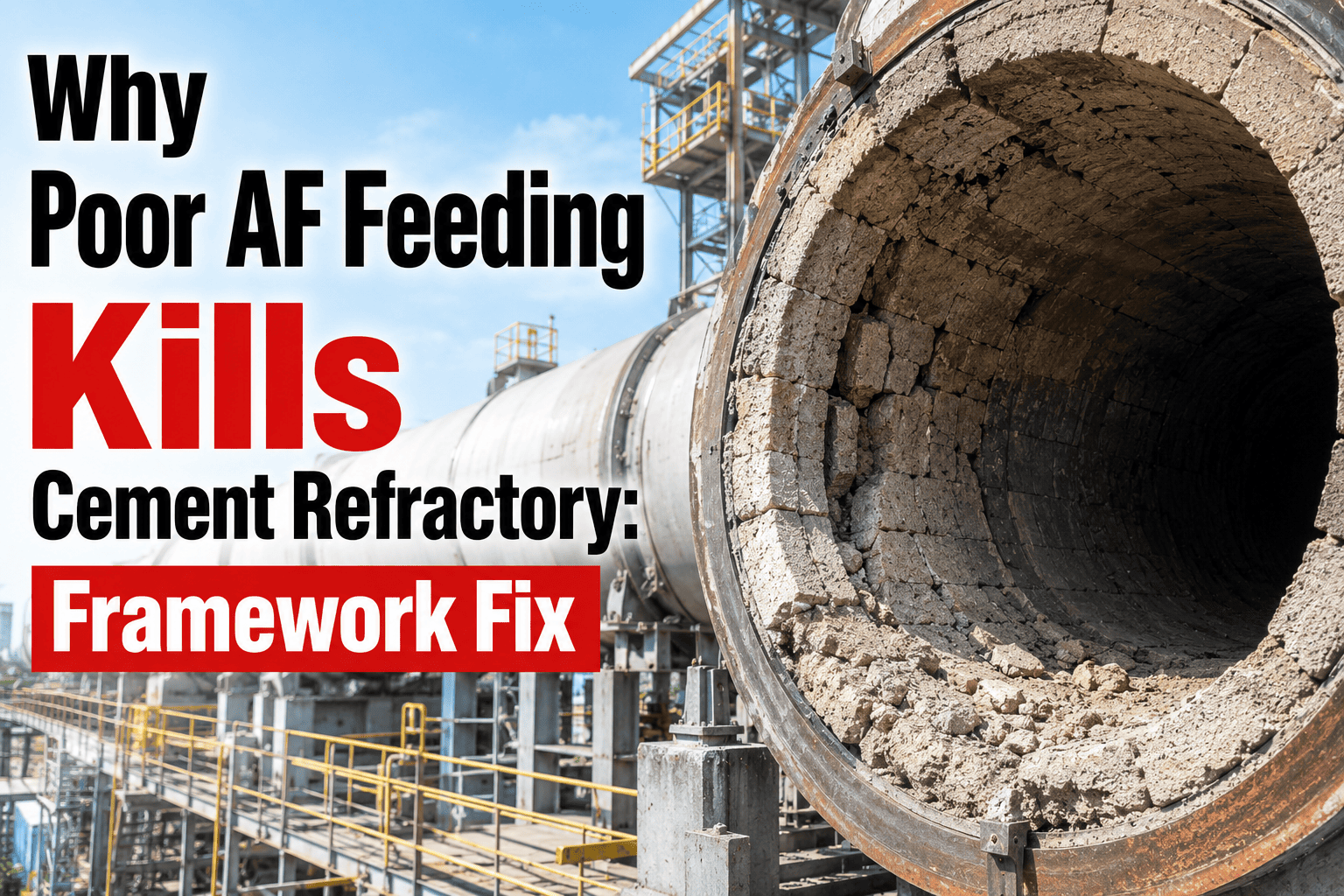
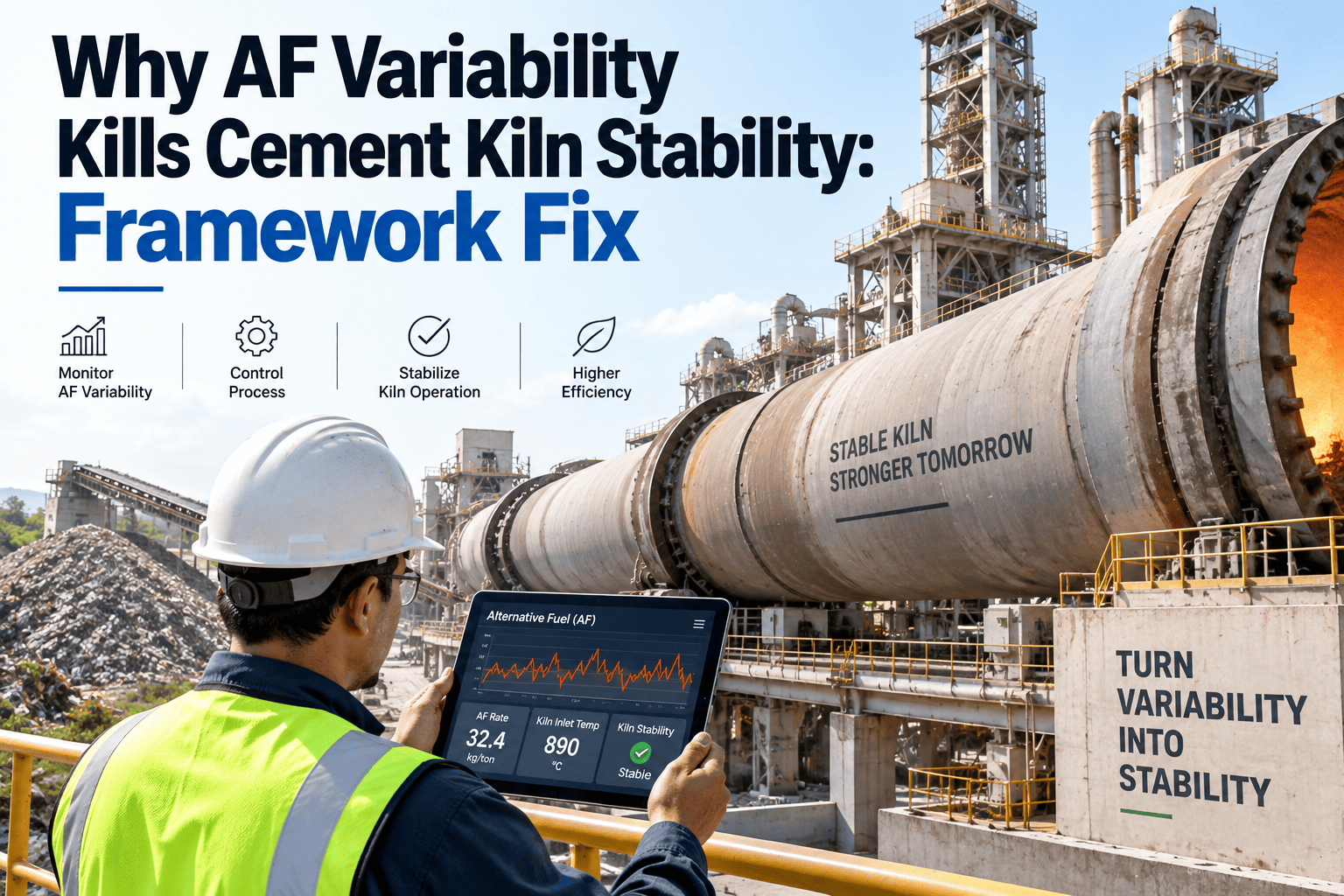
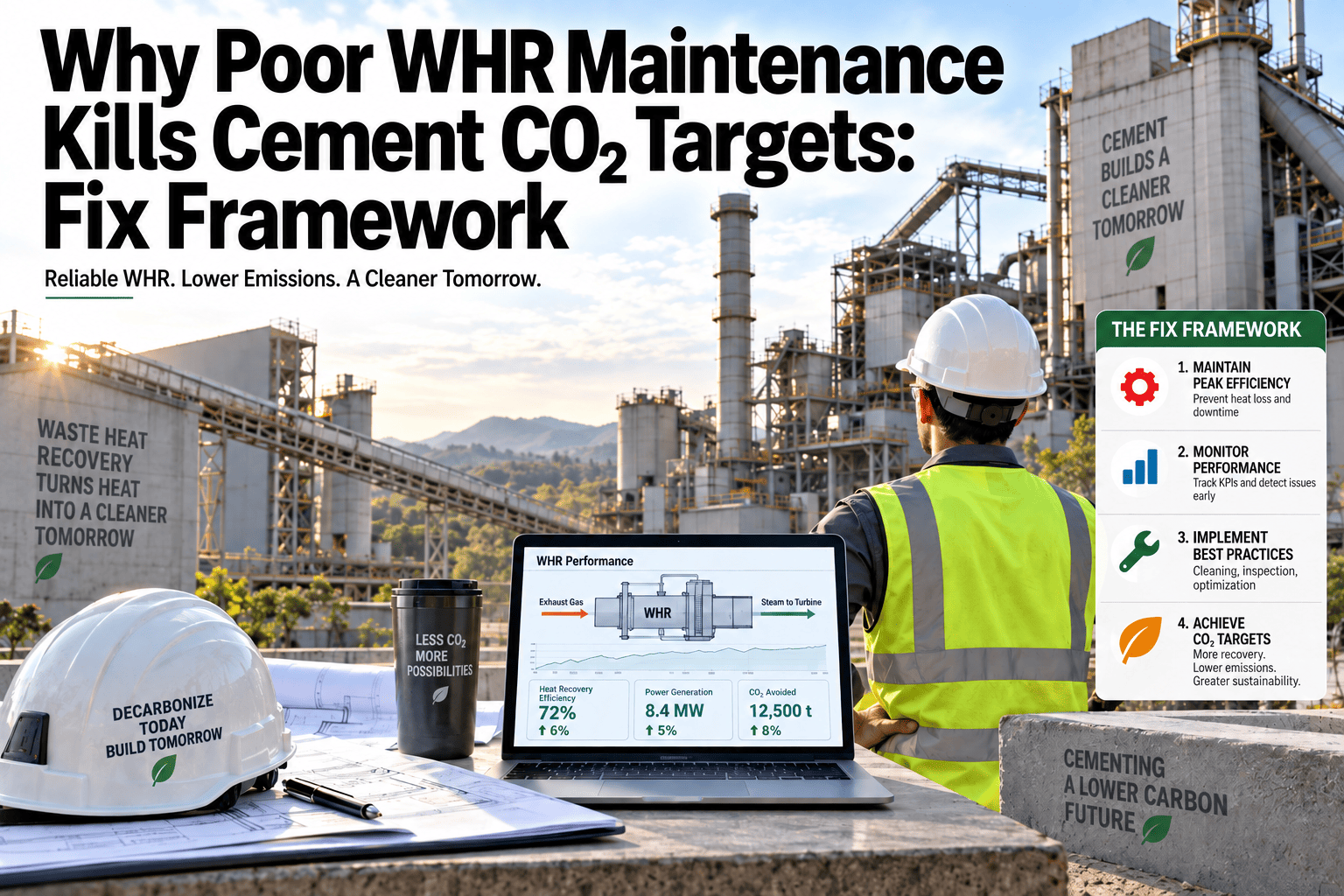
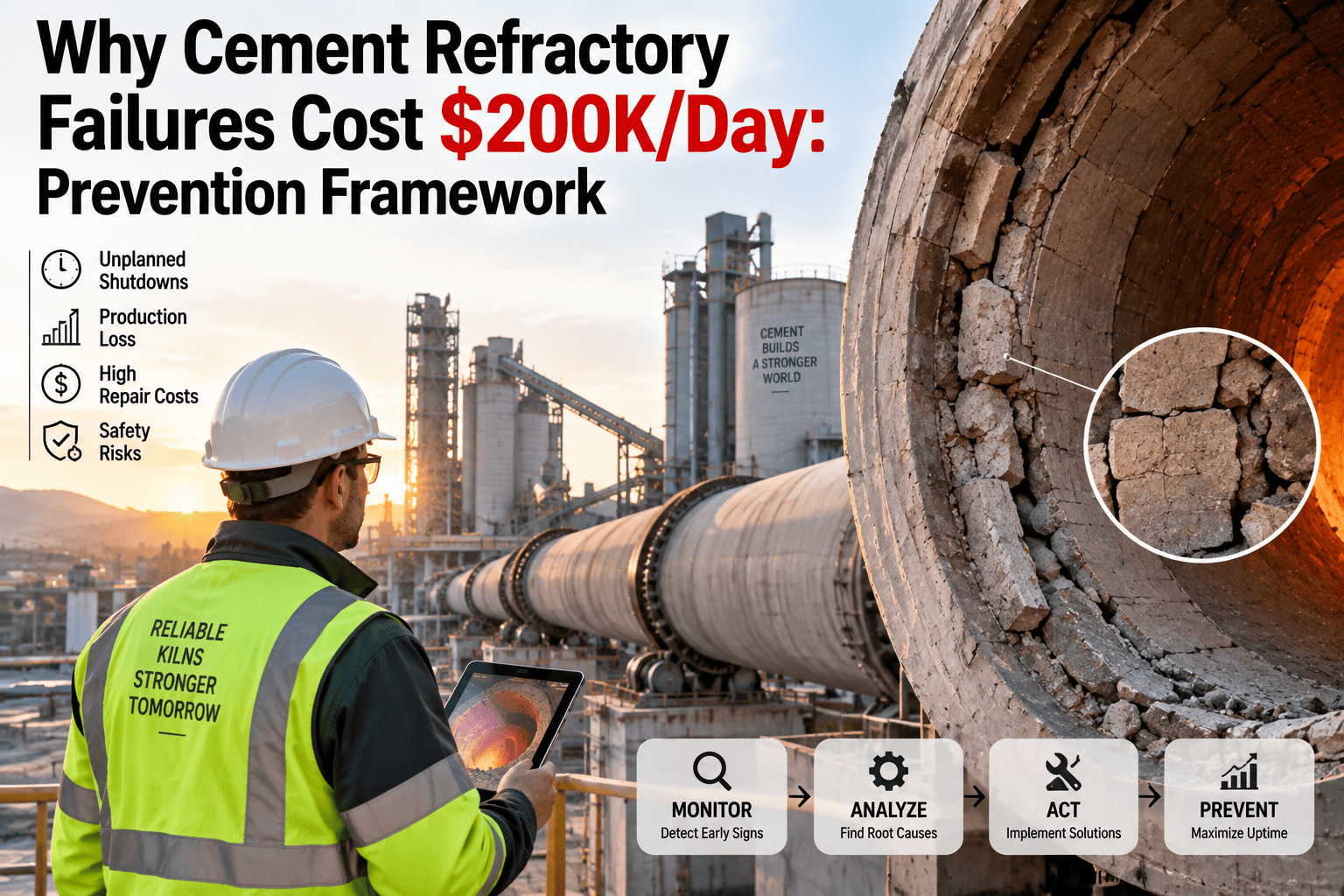
Alternative fuel feeding is rarely blamed for a refractory failure — the post-mortem usually points to "thermal cycling" or "chemical attack" and stops there. But trace most premature brick failures back far enough and the root cause is sitting at the feeder: a weight-feeder that drifted for six hours, a shredded-tyre batch with chunks well past the size limit, a moisture spike nobody adjusted for. One European plant running above 50% thermal substitution lost 40 metres of burning-zone lining eight months early after a chlorine-alkali cycle went unnoticed for three weeks. Sign in to OxMaint to connect feeder, flame, and refractory data into one traceable record, or book a demo to see the feeding-to-brick chain mapped for your kiln.
AF Feeding · Refractory Protection Framework
Poor AF Feeding Doesn't Damage Refractory Instantly — It Erodes It One Bad Batch at a Time
Moisture swings, oversized particles, and feeder drift don't show up as a single alarm. They show up months later as a shortened refractory campaign. OxMaint links fuel quality, feeder consistency, and flame behaviour to brick condition so the pattern is visible before the lining is.
50%+
substitution rate where flame control margin disappears
1.0%
max recommended feed-rate fluctuation over 10 minutes
60mm
particle size above which localized hot spots begin
Months
of campaign life lost to unmanaged chlorine-alkali cycling
The Feeding-to-Failure Chain
Refractory brick doesn't fail because of alternative fuel itself — it fails because of what inconsistent feeding does to flame shape and kiln chemistry, batch after batch. Each stage below compounds the one before it, and every stage is visible in plant data well before the brick shows a crack.
Feed Inconsistency
Weight-feeder drift or volumetric dosing holds a constant feed rate while real calorific value swings — reported heat input no longer matches actual heat delivered to the burning zone.
→
Flame Instability
Wet, low-calorific, or oversized particles produce a longer, softer flame that shifts the burning zone and loses its sharp, controllable shape.
→
Local Reducing Zone
Unburned fuel particles land on the clinker bed instead of combusting in flight, creating localized reducing conditions right against the brick face.
→
Chemical Attack
Chlorine, sulfur, and alkali metals circulate internally and concentrate at brick joints, attacking the bond chemistry that holds refractory together.
→
Spalling & Loss
Coating instability from the unstable flame strips protective clinker buildup repeatedly, exposing brick to direct thermal and chemical cycling until it spalls.
Six Feeding Faults That Quietly Shorten Refractory Life
Most AF feeding problems never trigger a hard alarm. They sit inside acceptable-looking ranges while still doing damage, batch by batch, long before anyone connects them to the next relining bill.
Moisture Swings
RDF moisture can exceed 20–30% in winter batches, cooling the flame and pushing weakly burned material downstream toward the transition zone lining.
Oversized Particles
Fuel chunks above roughly 60mm burn unevenly, creating localized hot spots exactly where they land rather than a distributed flame.
Volumetric Dosing Drift
Volume-based feeding holds physical feed rate steady while calorific value shifts batch to batch — the kiln sees a heat input swing no operator display shows directly.
Chlorine & Alkali Spikes
Municipal solid waste and RDF batches vary widely in chlorine content, feeding a bypass and preheater cycle that also attacks brick bond chemistry.
Sulfur Recirculation
Sulfur from fuel and raw meal concentrates through internal circulation, forming build-ups at the kiln inlet that stress the lining beneath them.
Metal & Ash Contamination
Tyre-derived fuel introduces steel wire and iron that shifts raw mix balance, while biomass ash raises alkali circulation and preheater blockage risk.
Every Batch, Every Feeder, Every Zone — Tracked Against Brick Condition
OxMaint logs calorific value, moisture, chlorine, and particle size against every kiln run, correlates it with flame scanner and feeder data, and flags the exact combination of conditions that has historically preceded refractory wear on your kiln.
Reactive Firefighting vs a Feeding Discipline Framework
The difference between a plant that relines on schedule and one that relines early usually isn't the fuel mix — it's whether feeding variability is caught at the feeder or discovered at the next shutdown inspection. Sign in to OxMaint to see this comparison run against your own kiln's history.
|
Reactive Approach |
OxMaint Framework |
| Fuel quality logging |
Spot checks, inconsistent records |
Every batch logged against the kiln run it fed |
| Feeder consistency check |
Reviewed only after a process upset |
Continuous deviation tracking against the 1% fluctuation guideline |
| Chlorine and alkali cycling |
Noticed at preheater blockage |
Trended continuously, flagged before build-up stage |
| Flame shape monitoring |
Operator visual judgment only |
Flame scanner data linked to feeder and fuel batch records |
| Refractory correlation |
Discovered at next shutdown inspection |
Wear pattern correlated back to specific feeding conditions |
| Corrective action |
Manual, after damage is visible |
Automatic work order at the first sustained deviation |
A Five-Step Feeding Discipline Framework
Protecting refractory campaign life doesn't require abandoning alternative fuel targets — it requires the same discipline applied consistently at every stage between the delivery truck and the burning zone.
01
Log Every Batch
Record calorific value, moisture, chlorine, and particle size at delivery from a mobile inspection form, tied to the kiln run that will consume it.
02
Monitor Feeder Stability
Track weight and volumetric feeder consistency continuously, flagging drift before it compounds into a flame-shape problem.
03
Watch the Flame
Correlate flame scanner readings with the fuel batch feeding at that moment, catching a softening flame before reducing conditions set in.
04
Trend the Chemistry
Track chlorine, sulfur, and alkali circulation trends against historical baselines to catch a cycling build-up while it's still manageable.
05
Correlate to Brick Condition
Match shell thermal scans and inspection findings back to the feeding conditions that preceded them, turning every relining into a lesson for the next campaign.
Frequently Asked Questions
Does poor AF feeding really matter more than the fuel type itself?
Consistency matters more than the fuel category. A well-controlled high-substitution kiln can outperform a poorly controlled low-substitution one, because flame stability — not fuel source — is what protects the coating and brick.
What feed-rate variation is considered safe for refractory protection?
Industry guidance points to roughly 1.0% maximum fluctuation in kiln-feed and fuel dosing over a 10-minute test window as the threshold for stable, refractory-protective operation.
Can this framework work alongside our existing flame scanners and feeder sensors?
Yes.
Sign in to OxMaint to connect existing feeder, flame scanner, and bypass sensor data — no hardware replacement is required to start correlating it.
How early can chlorine-alkali cycling be caught before it damages refractory?
Continuous trending typically surfaces an abnormal cycling pattern weeks before it reaches the build-up or blockage stage, giving enough time to adjust feed composition rather than wait for a shutdown.
What's the fastest way to see this applied to our own kiln data?
Book a demo and walk through your feeder, fuel, and refractory history together to see where the feeding-to-failure chain has already been forming.
The Next Feeding Fault Is Already Loaded on the Belt. Will Anyone Catch It Before the Flame Does?
OxMaint connects fuel quality, feeder consistency, flame behaviour, and refractory condition into one traceable record — so a bad batch shows up as a data point, not a shortened campaign.