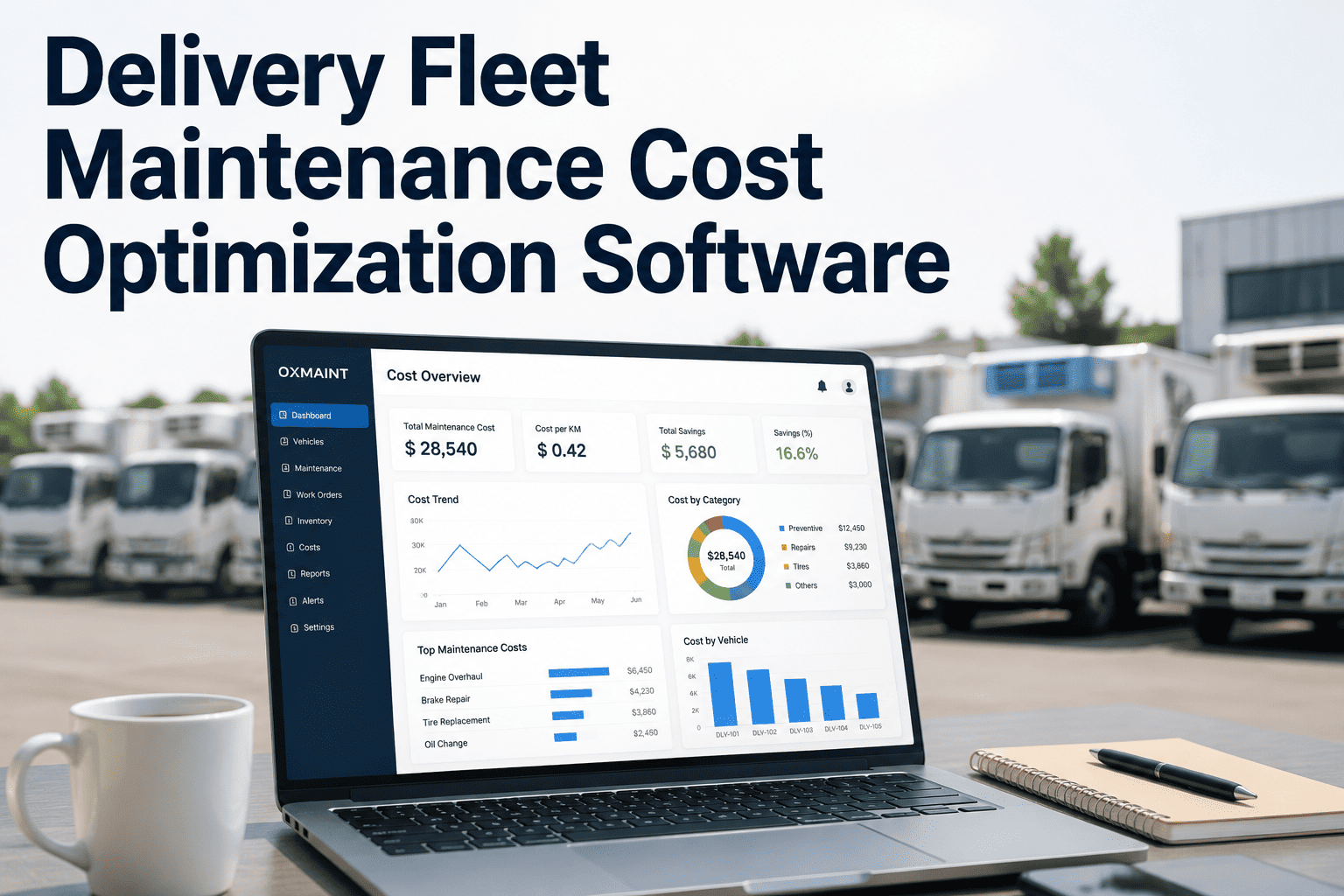
Logistics performance is only as good as the data behind it. Most operations teams are working with delayed reports, disconnected dashboards, and metrics that tell them what happened last week — not what is happening right now or what will happen tomorrow. AI analytics platforms change this entirely. They ingest live operational data, surface performance gaps in real time, and generate actionable intelligence that helps logistics teams make faster, better decisions — on routes, assets, costs, and capacity. See how Oxmaint's AI analytics improve fleet and logistics performance or book a free platform demo to explore what AI intelligence looks like for your operation.
67%
of logistics managers say they lack real-time visibility into operational performance metrics
28%
average cost reduction achieved by logistics operations using AI analytics platforms vs. manual reporting
3.5x
faster decision-making in operations teams using AI dashboards vs. traditional BI tools
$4.1B
projected global market for AI-driven logistics analytics platforms by 2028
Why Traditional Logistics Reporting Fails Operations Teams
Before exploring what AI analytics delivers, it helps to understand the specific ways conventional reporting creates blind spots — and why those blind spots are costly in logistics operations.
1
Data That Arrives Too Late
Weekly and monthly reports summarise what already went wrong. By the time the data reaches a decision-maker, the cost has already been incurred and the opportunity to intervene has passed.
2
Siloed Data Across Systems
Fleet data sits in one platform, maintenance in another, delivery performance in a third. No single view connects asset health to route performance to cost — so root cause analysis takes days, not minutes.
3
Metrics Without Context
Raw KPIs tell you a number — not why it changed or what to do about it. Traditional reporting shows you the outcome without the causal chain that AI analytics surfaces automatically.
4
No Predictive Capability
Conventional dashboards are rear-view mirrors. They cannot tell you which vehicle will underperform next week, which route is becoming unprofitable, or which supplier is trending toward a delivery failure.
Replace lagging reports with live AI performance intelligence
Oxmaint gives logistics and fleet teams real-time analytics across asset health, maintenance compliance, and operational performance — in one connected platform.
Start Free Trial
The 4 Analytics Layers of an AI Logistics Intelligence Platform
A high-performing AI analytics platform does not just display data — it processes it through four distinct intelligence layers, each adding a level of insight that the previous layer cannot provide alone.
L1
Descriptive Analytics
What happened. Real-time and historical performance data — delivery rates, asset uptime, fuel consumption, maintenance compliance — displayed in live dashboards updated continuously.
Real-time KPI dashboards
L2
Diagnostic Analytics
Why it happened. AI analyses performance variances against baselines — identifying root causes of cost spikes, delivery failures, and maintenance overruns without manual investigation.
Root cause intelligence
L3
Predictive Analytics
What will happen. AI models forecast demand patterns, asset failure probability, route performance trends, and cost trajectories — giving teams days or weeks of advance intelligence to act proactively.
Forward-looking forecasts
L4
Prescriptive Analytics
What to do about it. AI generates specific recommended actions — reroute, schedule maintenance, adjust capacity, reallocate resources — ranked by expected impact on cost and performance.
Actionable recommendations
Key Performance Metrics AI Analytics Tracks in Real Time
D
On-Time Delivery Rate
Target: 97%+
Tracked by route, driver, zone, and vehicle. AI flags deteriorating lanes before SLA breaches occur.
F
Fuel Cost Per Stop
Benchmark: Track weekly
AI isolates fuel cost variance by route, vehicle class, and driver behaviour — pinpointing the source of overspend.
U
Fleet Uptime %
Target: 95%+
Real-time asset availability score. AI correlates downtime events with maintenance gaps to surface the root PM failure.
M
Maintenance Cost Per Vehicle
Track monthly trends
AI identifies vehicles with rising maintenance cost trajectories — enabling proactive intervention before cost escalates to replacement decisions.
C
Cost Per Delivery
Benchmark vs. last 90 days
Composite metric combining fuel, labour, maintenance, and time. AI surfaces the exact cost drivers behind any deviation from baseline.
E
Exception Rate
Target: Under 3%
Failed deliveries, late departures, and unplanned stops tracked per driver, route, and zone — with AI trend analysis to catch emerging patterns early.
Track every logistics KPI that matters — in one AI dashboard
Oxmaint connects fleet health, maintenance compliance, and operational performance into a single analytics platform — no manual data pulling, no siloed reports.
Book a Demo
AI Analytics vs. Traditional Logistics Reporting
Traditional Reporting
Weekly PDF report — data is 5 to 7 days old before it reaches the team
KPIs from disconnected systems — no unified performance view
Variance identified but root cause requires manual investigation
No forward-looking forecasts — teams react to outcomes, not signals
Cost analysis done monthly — overspend discovered weeks after it starts
Fleet health and delivery performance tracked in separate tools
AI Analytics Platform
Live dashboards updated continuously from real-time operational data
Unified performance view across fleet, maintenance, and delivery metrics
AI surfaces root cause automatically alongside the performance flag
Predictive models forecast performance trends 7 to 30 days ahead
Cost per delivery and per vehicle tracked daily — deviations flagged instantly
Asset health and operational performance connected in one intelligence layer
Where AI Analytics Creates the Biggest Commercial Impact
| Performance Area |
Without AI Analytics |
With AI Analytics |
Commercial Impact |
| Fuel cost management |
Reviewed monthly — overspend compounds |
Flagged daily by route and driver |
8 to 15% fuel cost reduction |
| Fleet maintenance cost |
Reactive repairs dominate budget |
PM compliance tracked — breakdowns prevented |
30 to 40% lower repair costs |
| Delivery performance |
SLA breaches discovered post-event |
Lane risk surfaced before departure |
On-time rate improvement: 12 to 20% |
| Capacity utilisation |
Over and under-allocation common |
AI demand signals optimise capacity daily |
15 to 25% utilisation gain |
| Operational reporting time |
5 to 10 hours per week for management teams |
AI generates reports automatically |
Near-zero manual reporting overhead |
Results Logistics Operations Achieve with AI Analytics
28%
average operational cost reduction in logistics teams using AI analytics vs. manual reporting processes
3.5x
faster operational decision-making when teams use AI dashboards vs. traditional weekly BI reports
97%+
on-time delivery rate achievable for fleets using AI performance analytics to monitor and correct lane-level trends
How Oxmaint Delivers AI Analytics for Logistics and Fleet Performance
Most logistics analytics tools report on delivery performance but ignore the asset and maintenance layer that drives it. Oxmaint connects fleet health, preventive maintenance compliance, inspection data, and operational performance into a unified AI analytics platform — giving logistics teams the end-to-end intelligence they need to identify performance gaps, trace root causes, and act before costs compound. Start for free and have your first AI performance dashboard live within a day.
Real-Time Fleet Performance Dashboard
Oxmaint surfaces fleet uptime, maintenance compliance, open defects, and PM status in a live dashboard — updated continuously so operations teams always have an accurate picture of asset availability and health.
Maintenance Cost Analytics
AI tracks maintenance spend per vehicle over time — identifying rising cost trajectories, high-frequency repair patterns, and PM gaps that are driving above-average expenditure before they reach budget threshold.
Predictive Asset Health Scoring
Oxmaint's AI models failure probability for each asset using maintenance history, inspection data, and usage patterns — giving fleet managers a forward-looking health score that enables proactive rather than reactive decisions.
Compliance and Inspection Analytics
Inspection completion rates, defect trends, and compliance gaps are tracked automatically — surfacing which vehicles, drivers, or depots are underperforming on inspection adherence before it becomes a regulatory exposure.
Automated Performance Reports
Daily and weekly performance summaries are generated and distributed automatically by Oxmaint's AI — covering fleet health, PM compliance, defect trends, and cost performance without any manual compilation from your team.
Downtime and Reliability Trend Analysis
AI identifies patterns in breakdown frequency, MTBF, MTTR, and repair cost by vehicle type, depot, and maintenance regime — showing exactly where to focus reliability investment for the highest performance return.
Your Logistics Data Has the Answers. AI Surfaces Them in Real Time.
Oxmaint's AI analytics platform connects fleet health, maintenance performance, and operational data into a single intelligence layer — giving logistics teams the visibility, root cause insight, and predictive foresight to reduce costs and improve performance continuously.
Frequently Asked Questions
What is AI analytics in logistics performance optimization?
AI analytics in logistics uses machine learning models to process operational data in real time — surfacing performance gaps, identifying root causes of cost and delivery issues, forecasting future performance trends, and generating recommended actions. Unlike traditional reporting, AI analytics operates continuously and provides diagnostic and predictive intelligence, not just historical summaries.
What logistics KPIs should AI analytics platforms track?
The most commercially important metrics for AI logistics analytics include on-time delivery rate, cost per delivery, fleet uptime percentage, maintenance cost per vehicle, fuel cost per stop, and exception rate. AI analytics platforms connect these metrics across the asset, maintenance, and delivery layers — so performance changes in one area are automatically correlated with their root causes in another.
How does AI analytics reduce logistics operating costs?
AI analytics reduces logistics operating costs through three primary mechanisms: faster identification of cost deviations before they compound, predictive maintenance intelligence that replaces reactive repairs with lower-cost planned servicing, and continuous capacity optimisation that eliminates under-utilisation. Operations teams using AI analytics platforms typically achieve 20 to 30% cost reduction within the first year compared to manual reporting workflows.
How does Oxmaint's AI analytics platform differ from standard fleet management tools?
Most fleet management tools focus on tracking and scheduling. Oxmaint adds an AI analytics layer that connects maintenance history, inspection compliance, asset health scoring, and operational performance — generating predictive insights and automated reports rather than just displaying raw data. This means Oxmaint users identify performance gaps and root causes automatically, rather than manually interrogating disconnected data sources.