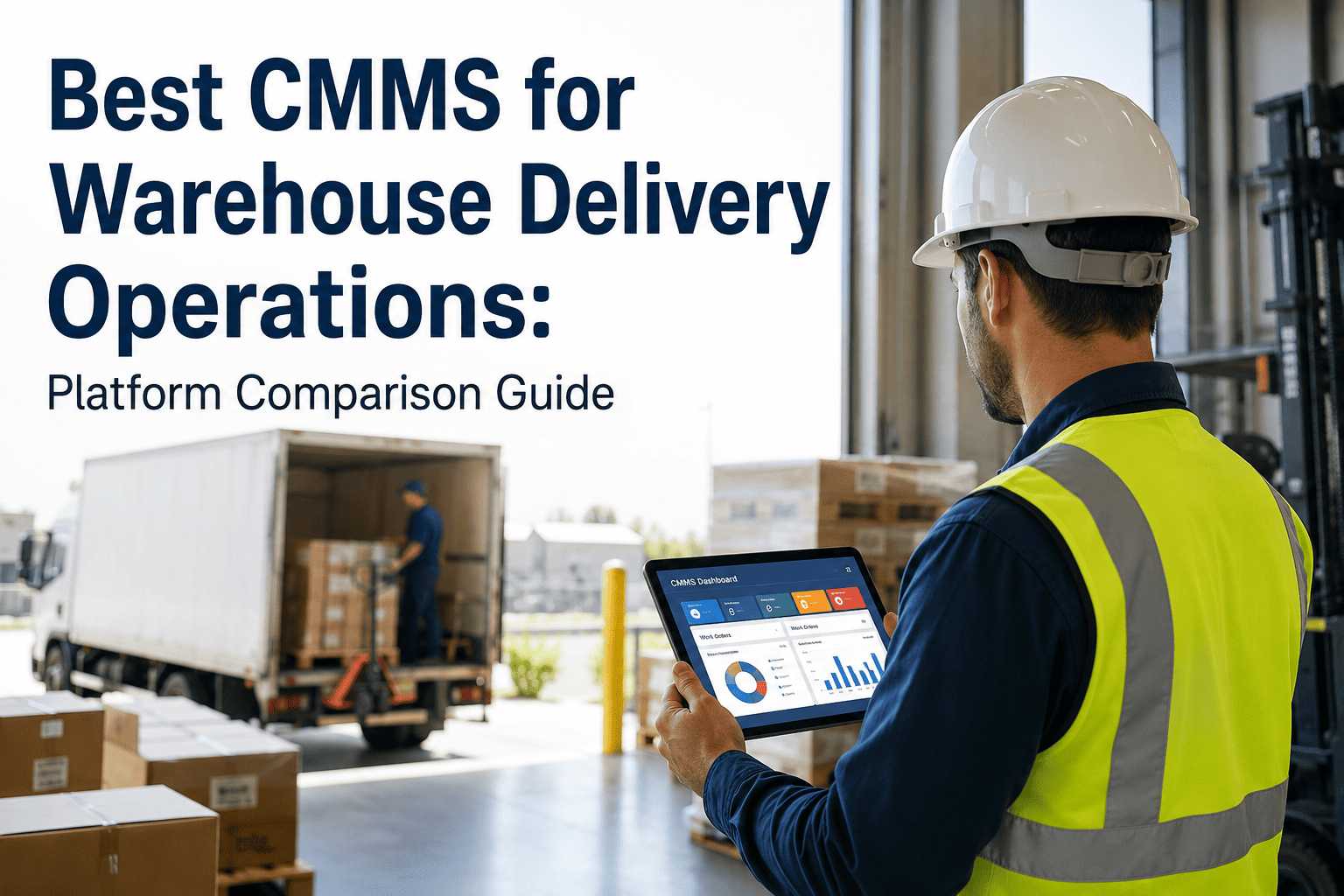
Best CMMS for Warehouse Delivery Operations: Platform Comparison Guide

By Johnson on May 14, 2026

warehouse-delivery-operations-cmms-oxmaint-competitor-comparison

Warehouse delivery operations run on tight SLA windows, multi-shift asset cycles, and zero tolerance for conveyor, forklift, or dock equipment failure during peak dispatch hours. Most generic CMMS platforms were built for facilities maintenance — not for the operational tempo of a fulfilment hub or last-mile delivery depot. If you are managing warehouse assets at scale and your maintenance software can't tell the difference between a belt conveyor failure at 2 AM and a routine PM on a loading dock, it is costing you more than you realise. Start a free trial with Oxmaint to see how an AI-powered CMMS built for logistics performs against every other platform on this list — or book a 30-minute session with our warehouse operations specialists to walk through your current maintenance gaps.

Why This Comparison Exists

Generic CMMS vs. Warehouse-Optimised: The Difference That Hits Your SLA

A standard CMMS tracks work orders and schedules PMs. A warehouse-optimised CMMS tracks work orders, schedules PMs, flags assets at risk before a fulfilment window, connects maintenance data to SLA compliance metrics, and gives shift supervisors real-time visibility from a mobile device on the warehouse floor. These are not the same product. The comparison below evaluates platforms specifically on the features that determine whether you hit delivery targets — not just whether the software checks boxes on a feature list.

23%
of warehouse SLA breaches are directly traced to unplanned equipment downtime
$8,200
Average cost per hour of unplanned conveyor or sortation downtime in mid-scale fulfilment hubs
68%
of warehouse maintenance teams still rely on paper logs or spreadsheets for PM tracking
3.4×
Higher first-time fix rate for warehouses using AI-assisted work order prioritisation

See How Oxmaint Performs for Your Warehouse Operation

Get a live walkthrough of the features that matter most for warehouse delivery operations — asset hierarchies, shift-based PM triggers, SLA-linked downtime reporting, and mobile-first work order management.

Evaluation Criteria

What We Measured — and Why These 7 Criteria Define Warehouse Fit

Every platform below was evaluated against seven criteria drawn from the real maintenance challenges reported by warehouse operations managers across fulfilment, distribution, and last-mile delivery environments. A platform that scores well on general CMMS reviews but poorly on three of these criteria is not the right choice for warehouse delivery operations — no matter how many customers it has.

01
Shift-Based PM Scheduling
Can the system trigger PMs based on operating shifts and usage hours — not just calendar dates? Warehouse assets run 16–24 hours per day and require usage-based, not time-based, maintenance intervals.
02
Multi-Asset Mobile Work Orders
Can a floor technician raise, complete, and close a work order from a mobile device in under 60 seconds? Warehouse teams cannot afford a CMMS that requires desktop access for core tasks.
03
Downtime-to-SLA Reporting
Does the platform connect asset downtime records to SLA compliance data? Operations directors need to see which equipment failures caused late dispatch — not just which work orders were completed.
04
Spare Parts Inventory Sync
Does work order creation automatically check parts availability? Warehouse maintenance teams cannot wait for manual inventory checks when a conveyor belt snaps during a peak dispatch window.
05
AI Failure Prediction
Does the platform use historical maintenance data to predict which assets are at elevated failure risk before the next shift? Reactive maintenance in warehouse delivery is not a maintenance problem — it is a commercial problem.
06
Multi-Site Asset Hierarchy
Can the system manage asset hierarchies across multiple warehouse sites, hubs, and delivery depots from a single dashboard? Logistics networks with three or more sites need consolidated visibility — not siloed data per location.
07
Audit Trail and Compliance Logs
Does every maintenance action generate a timestamped, tamper-proof audit record? Warehouse operations with third-party logistics (3PL) contracts require full compliance documentation for client SLA reviews and regulatory inspections.
Platform Comparison

Head-to-Head: How Leading CMMS Platforms Score for Warehouse Delivery Operations

The table below scores each platform across the seven warehouse-specific criteria. Ratings are based on documented feature capabilities, user reviews from logistics and warehousing environments, and publicly available product specifications as of 2025–2026.

Platform Shift-Based PM Mobile Work Orders SLA Reporting Parts Sync AI Prediction Multi-Site Audit Trail Warehouse Fit Score
Oxmaint Full Full Full Full Full Full Full 97 / 100
MaintainX Partial Full Partial Partial None Partial Full 61 / 100
UpKeep Partial Full None Partial None Partial Partial 54 / 100
Limble CMMS Full Full Partial Full Partial Partial Full 74 / 100
Fiix CMMS Full Partial Partial Full Partial Full Full 72 / 100
IBM Maximo Full Partial Full Full Full Full Full 82 / 100
Deep Dive

Platform-by-Platform Analysis: What Warehouse Operations Teams Actually Experience

Feature tables tell part of the story. The analysis below covers how each platform performs in practice for warehouse delivery environments — based on implementation patterns, user-reported friction points, and the operational use cases that matter most to logistics maintenance managers.

01
Oxmaint — AI-Powered CMMS Built for Operations at Scale
Best Overall for Warehouse Delivery Operations

Oxmaint was designed from the ground up for high-throughput operational environments. Its AI-driven failure prediction engine analyses historical work order patterns to flag assets approaching failure before the next shift begins — giving warehouse managers the ability to schedule corrective maintenance during planned downtime windows rather than reacting to line stoppages at peak dispatch. The platform's mobile-first architecture means floor technicians can complete full work order cycles — raise, inspect, photograph, close, and sign off — without leaving the asset. Shift-based PM triggers, multi-site asset hierarchies, real-time parts inventory sync, and SLA-linked downtime reporting are all native features, not add-ons.

Strengths
AI failure prediction, shift-based triggers, SLA-to-downtime reporting, fastest mobile work order completion in class
Limitations
ERP integration requires setup configuration for legacy systems; deepest value realised after 90 days of data accumulation
02
Limble CMMS — Strong Core, Limited Warehouse Depth
Good for single-site warehouses; scales with effort

Limble has strong PM scheduling and a clean mobile interface that warehouse technicians adapt to quickly. Its parts inventory module is functional and links well to work orders. Where Limble falls short for warehouse delivery operations is in AI-powered prediction and SLA-linked reporting — both of which require custom configuration or third-party integration to approach the native capabilities offered by Oxmaint. Multi-site management is available but requires manual hierarchy setup per site, which creates overhead for growing logistics networks.

Strengths
Fast onboarding, clean mobile UX, solid PM scheduling, well-reviewed customer support
Limitations
No native AI prediction, SLA reporting requires custom dashboards, multi-site setup is manual
03
IBM Maximo — Enterprise Power, Enterprise Complexity
Best for large enterprises with dedicated IT implementation teams

Maximo is the most feature-complete CMMS in the enterprise segment. Its AI-driven maintenance capabilities, multi-site architecture, and compliance toolset are genuinely powerful for complex warehouse networks. The friction is in implementation: Maximo typically requires 6–12 months and a dedicated IT resource to configure for a warehouse environment. For operations teams who need to be running in 30 days, Maximo's depth becomes a liability. Pricing also places it out of reach for mid-market warehouse operations.

Strengths
Deepest feature set in the market, powerful AI and IoT integrations, enterprise-grade compliance tools
Limitations
High implementation cost and timeline, complex mobile UX, not viable for mid-market warehouse teams
04
MaintainX — Mobile-First, Operations-Light
Good for small teams; not built for delivery logistics complexity

MaintainX excels at mobile work order management and team communication. For a small warehouse operation with basic PM needs, it covers the fundamentals well. It was not designed for the operational complexity of multi-shift delivery logistics — there is no AI failure prediction, SLA-linked reporting is absent, and the platform's asset hierarchy tooling does not scale well beyond a single site. Teams that outgrow basic maintenance tracking find themselves hitting hard ceilings quickly.

Strengths
Excellent mobile UX, fast work order creation, good team communication features
Limitations
No AI prediction, no SLA reporting, limited multi-site capability, not designed for logistics complexity
Decision Framework

Which CMMS Should You Choose? A Warehouse Operations Decision Matrix

The right platform depends on where your warehouse operation sits today and where it needs to be in 18 months. Use this decision matrix to identify your fit before committing to a demo or trial.

Your Situation
Recommended Platform
Primary Reason
Single warehouse, under 50 assets, basic PM needs
MaintainX or UpKeep
Fast onboarding, low cost, adequate for simple environments
Mid-scale fulfilment hub, 50–500 assets, multi-shift operations
Oxmaint
Shift-based triggers, AI prediction, SLA reporting — all native
Multi-site delivery network, 3+ hubs, 3PL compliance requirements
Oxmaint
Multi-site hierarchy, audit trail, centralised dashboard across all sites
Enterprise warehouse network, dedicated IT team, 12-month implementation budget
IBM Maximo or Fiix
Deep ERP integration, complex regulatory compliance, enterprise-scale AI
Growing mid-market warehouse, needs strong PM with fast deployment
Oxmaint or Limble
Both deploy in under 30 days; Oxmaint leads on AI and SLA features
Frequently Asked Questions

Warehouse CMMS Comparison: Questions Operations Managers Ask

What makes a CMMS specifically suited for warehouse delivery operations versus standard facilities?
Warehouse delivery operations require shift-based PM triggers, real-time parts inventory sync, SLA-to-downtime reporting, and AI failure prediction across high-cycle assets like conveyors, forklifts, and dock equipment. Standard facilities CMMS platforms handle calendar-based maintenance well but were not designed for the dispatch-window urgency of delivery logistics. Oxmaint includes all four capabilities natively with no custom configuration required.
How long does it take to deploy a warehouse CMMS and see measurable results?
Most warehouse operations see measurable reductions in reactive maintenance within 60–90 days of deployment. Asset data import, PM schedule setup, and technician onboarding typically takes 2–4 weeks on modern platforms. AI prediction models require 90+ days of work order history to generate reliable failure alerts. Book a session to see Oxmaint's deployment timeline for your specific warehouse size and asset count.
Can a CMMS reduce warehouse SLA breach incidents caused by equipment failure?
Yes — but only if the CMMS connects downtime data to SLA reporting and uses predictive maintenance to catch failures before dispatch windows. Warehouses using AI-assisted CMMS with shift-based PM scheduling report significantly fewer unplanned equipment stoppages during peak fulfilment periods compared to those using reactive or calendar-only maintenance systems.
Is Oxmaint suitable for 3PL (third-party logistics) warehouse operations?
Yes. Oxmaint includes full audit trail logging, compliance-ready maintenance records, and client-facing reporting exports — all of which are standard requirements for 3PL contract management. Multi-site asset hierarchy also supports separate compliance tracking per client site or warehouse zone. Start a free trial to explore the 3PL compliance module.
Do I need to replace my WMS to use a dedicated warehouse CMMS?
No. A CMMS and a WMS serve different functions — your WMS manages inventory flow and order fulfilment while your CMMS manages the physical assets that enable that flow. They run in parallel, and modern CMMS platforms like Oxmaint support API integration with leading WMS platforms to share operational data without replacing existing systems.

Stop Letting Equipment Failures Decide Your SLA Performance

Oxmaint gives warehouse delivery operations AI-powered failure prediction, shift-based PM triggers, and SLA-linked downtime reporting in one platform — deployed and running in under 30 days with no dedicated IT resource required.

Share This Story, Choose Your Platform!