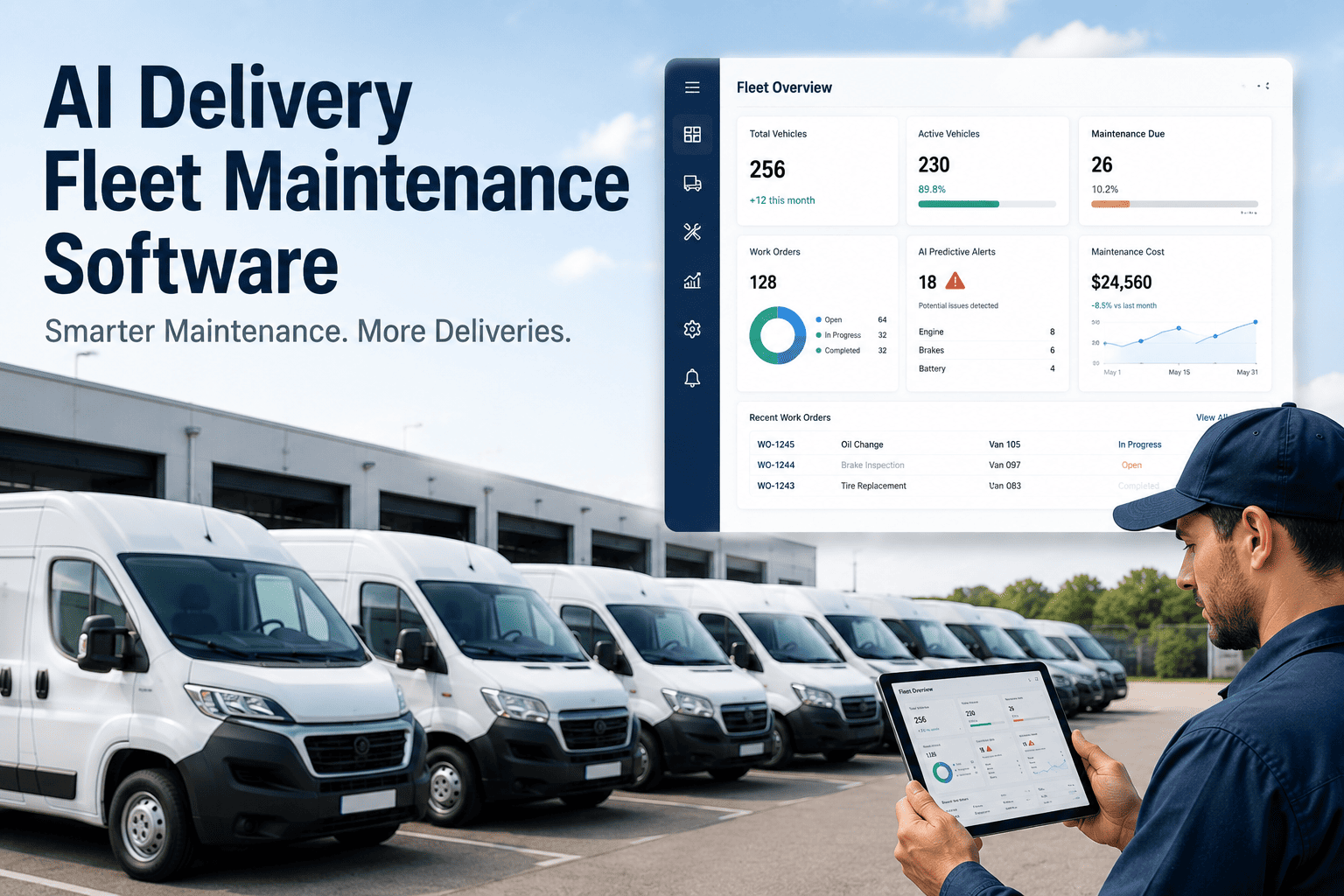
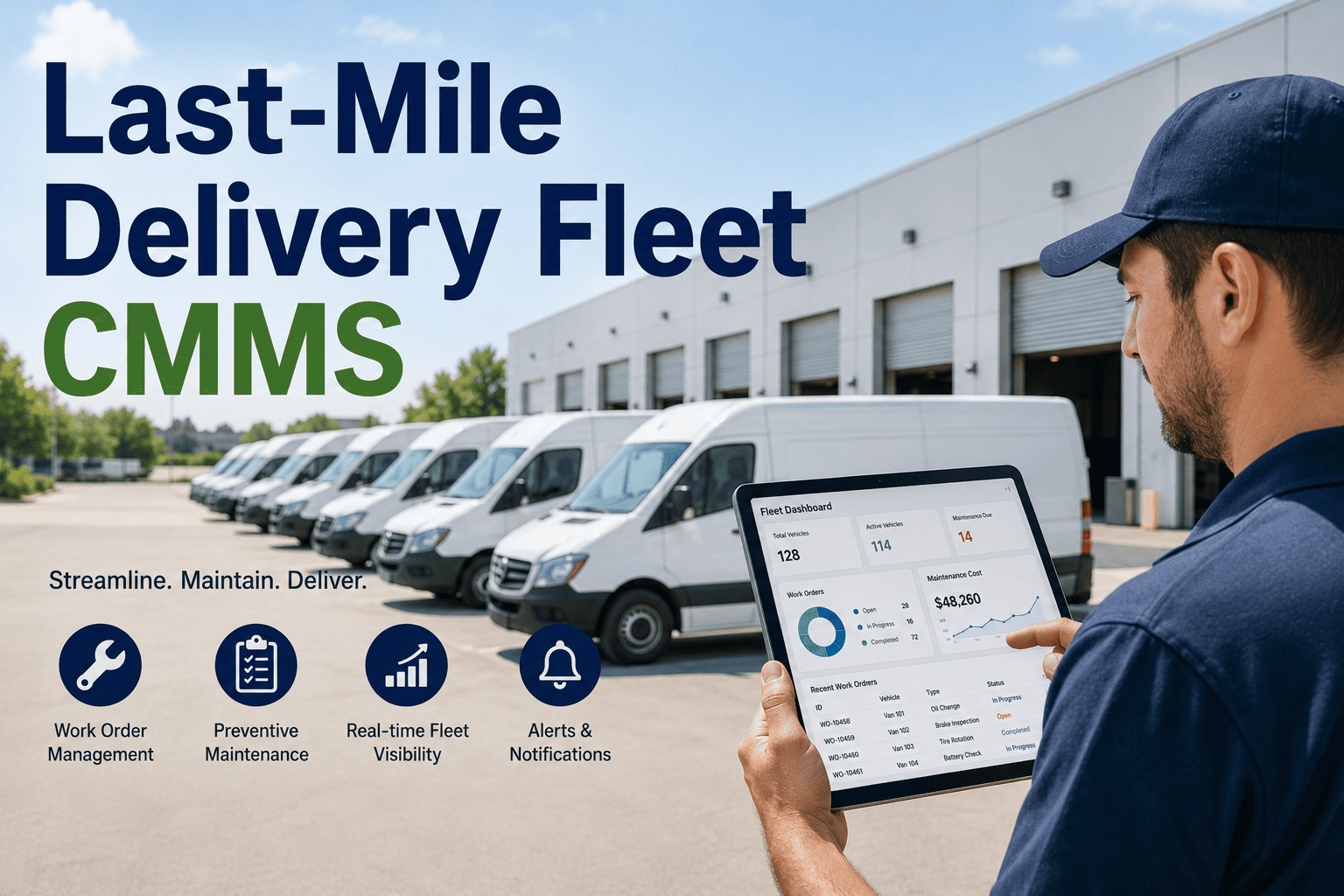
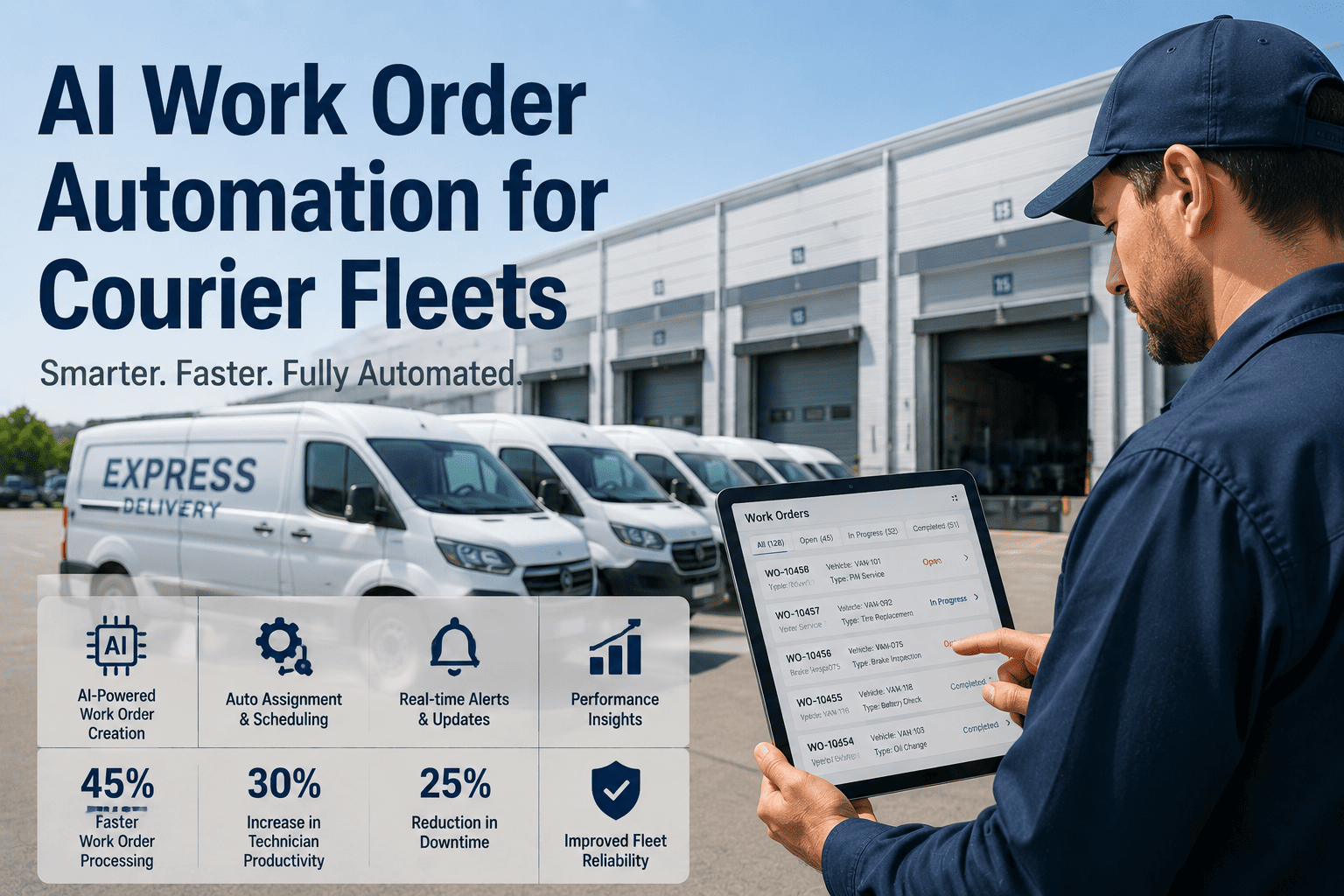
Delivery fleets run on tight margins and tighter schedules. A single van breakdown mid-route doesn't just cost a repair bill — it triggers missed SLAs, rerouting costs, and customer churn that compound well beyond the mechanical failure. Yet most courier and logistics operators still manage vehicle maintenance through driver complaint logs, paper inspection sheets, and reactive repair cycles that guarantee preventable breakdowns. OxMaint AI replaces that fragile system with intelligent, automated fleet maintenance that keeps every vehicle dispatch-ready before the route begins.
Industry Page · AI Delivery Fleet Maintenance
AI Delivery Fleet Maintenance Software That Prevents Breakdowns Before They Happen
Automate inspections, predict failures by vehicle, and keep your courier fleet route-ready — without adding headcount to your maintenance team.
23%
Average reduction in fleet downtime with AI-driven preventive maintenance
4.2x
ROI on AI fleet maintenance software vs reactive repair programs (ATA)
68%
Of delivery fleet breakdowns are preceded by detectable warning signals (FMCSA)
$1,200
Average cost per roadside breakdown event — 6x the cost of preventive repair
Why Delivery Fleets Break Down More Than They Should
The delivery fleet maintenance problem is not a parts problem or a technician shortage. It is a data and workflow problem. Most operators know their vehicles are aging — they don't know which vehicles are highest-risk today, which inspections are overdue, or which defects reported by drivers last week are still unresolved. Without that visibility, maintenance becomes reactive by default.
01
Driver defects go untracked
Drivers report issues verbally or on paper forms that reach the depot hours later. By the time a technician sees the report, the vehicle has already departed on another route.
02
No predictive failure signal
Maintenance intervals are calendar-based, not condition-based. A van doing 180 miles/day gets the same PM schedule as one doing 60 — guaranteeing either over-service or under-service.
03
Repair backlogs build invisibly
Without a digital work order queue, technicians prioritize by instinct. Low-priority jobs that should take 20 minutes get displaced by urgent repairs until they become urgent themselves.
04
No asset health visibility
Fleet managers make dispatch decisions without knowing which vehicles have open defects, pending PM overdue dates, or a history of recurring failures on the same component.
How OxMaint AI Keeps Courier Fleets Route-Ready
OxMaint AI addresses every layer of the delivery fleet maintenance failure chain — from digital driver inspections at the start of shift to predictive failure alerts days before a breakdown, all managed through a single mobile-first platform.
Digital Pre-Trip and Post-Trip Inspections
Drivers complete structured vehicle inspection checklists on the OxMaint mobile app — before and after every shift. Any defect flagged instantly creates a work order in the maintenance queue, routed by priority and vehicle assignment. No paper, no delay, no lost reports.
AI-Driven Predictive Maintenance Alerts
OxMaint AI analyses vehicle maintenance history, mileage patterns, and defect frequency to generate failure probability scores by vehicle and component. High-risk vehicles are flagged for inspection before dispatch — not after breakdown.
Mileage-Based PM Scheduling
PM intervals sync to actual vehicle mileage via telematics integration or manual odometer entry. Vehicles approaching service thresholds are queued automatically — ensuring high-utilisation vans get maintenance at the right interval, not the calendar interval.
Real-Time Fleet Health Dashboard
Fleet managers see every vehicle's current status — dispatch-ready, under repair, awaiting parts, or flagged with open defects — on a live dashboard. Dispatch decisions are made with complete maintenance visibility, not guesswork.
Automated Work Order Routing
Work orders created from driver defects, PM triggers, or AI alerts are automatically assigned to the right technician based on skill, availability, and vehicle location. Managers stop manually dispatching repair jobs and focus on fleet operations instead.
AI Fleet Maintenance · OxMaint
See OxMaint AI Working on a Fleet Like Yours
Book a 30-minute demo with our fleet maintenance specialists. We'll walk through driver inspection workflows, predictive alert setup, and the fleet health dashboard using your vehicle count and route profile.
Reactive vs. AI-Driven Fleet Maintenance: Outcome Comparison
The performance gap between reactive and AI-driven fleet maintenance programs widens as fleet size grows. Below are benchmarks from logistics and courier operators across North America and Southeast Asia.
| Performance Metric |
Reactive Program |
OxMaint AI-Driven |
Improvement |
| Roadside breakdowns per 100 vehicles/month |
8.4 |
2.1 |
75% reduction |
| Mean time from defect report to repair completion |
38 hours |
6.5 hours |
83% faster |
| PM compliance rate |
54% |
96% |
+42 points |
| Vehicle dispatch readiness at shift start |
78% |
97% |
+19 points |
| Average repair cost per vehicle per month |
$620 |
$310 |
50% lower |
| SLA breach rate linked to vehicle downtime |
11.2% |
2.4% |
79% reduction |
Benchmarks compiled from ATA Fleet Maintenance Benchmark 2024, FMCSA Vehicle Out-of-Service data, and OxMaint customer data across 11 courier and logistics operators.
What Fleet Maintenance Experts Say
"The courier fleet sector has the most punishing maintenance environment in commercial transport — high mileage, frequent stops, and zero tolerance for downtime. AI-driven CMMS platforms that connect driver defect reports to automated work orders are the only scalable solution. Manual systems simply cannot process defect volume fast enough to prevent breakdowns at dispatch scale."
JT
James Trelawney
VP Fleet Operations, American Trucking Associations (ATA) — Fleet Maintenance Council
"Predictive maintenance in last-mile delivery is not a luxury — it is a margin protection strategy. Every unplanned breakdown costs the operator the repair bill plus rerouting expense plus SLA penalty. The arithmetic is clear: operators who invest in AI-driven maintenance programs recover that investment within the first quarter through avoided breakdown costs alone."
SR
Sunita Rao
Director of Logistics Technology Research, Gartner Supply Chain Practice
Frequently Asked Questions
Does OxMaint AI work for mixed courier fleets with vans, motorcycles, and cargo bikes?
Yes. OxMaint supports multi-vehicle-type fleets with separate inspection templates, PM schedules, and maintenance protocols per vehicle category. A van, a cargo bike, and an electric two-wheeler each get the correct inspection checklist, appropriate PM intervals, and relevant defect categories — all managed from the same platform without separate systems for each vehicle type.
Start a free trial to configure your vehicle types during onboarding.
How does OxMaint integrate with our existing telematics or GPS fleet tracking system?
OxMaint integrates with major telematics providers including Samsara, Verizon Connect, Geotab, and Webfleet via API. Mileage, engine hours, and fault code data flow directly into OxMaint's PM scheduling engine — eliminating manual odometer entry and enabling condition-based maintenance triggers. For fleets without telematics, driver-entered mileage at inspection time achieves the same scheduling outcome.
Book a demo to discuss your telematics stack.
Can drivers submit defect reports in their own language on the OxMaint mobile app?
OxMaint's driver inspection interface supports multiple languages, with inspection checklist items configurable in the depot's primary driver language. Defect descriptions submitted in any supported language are captured as-entered and attached to the automatically generated work order. Fleet operators with multilingual driver pools find this eliminates the translation delays and miscommunication that occur when drivers report defects verbally through supervisors. The app works offline and syncs when connectivity is restored — important for depot areas with poor signal.
How quickly can a delivery fleet of 50–200 vehicles go live on OxMaint?
For a fleet of 50–200 vehicles, OxMaint implementation typically runs 2–3 weeks: vehicle asset import and configuration in week one, technician and driver onboarding in week two, and PM schedule calibration with first AI alert baseline in week three. Dedicated implementation support is included for all fleet deployments. Most operators report their first AI-generated predictive alert within 10 days of going live — before the first monthly PM cycle has even completed.
AI Delivery Fleet Maintenance · OxMaint
Your Next Breakdown Is Preventable. Start Preventing It Today.
OxMaint AI gives delivery fleet operators digital driver inspections, predictive failure alerts, automated work orders, and a real-time fleet health dashboard — everything needed to keep every vehicle dispatch-ready, every shift.