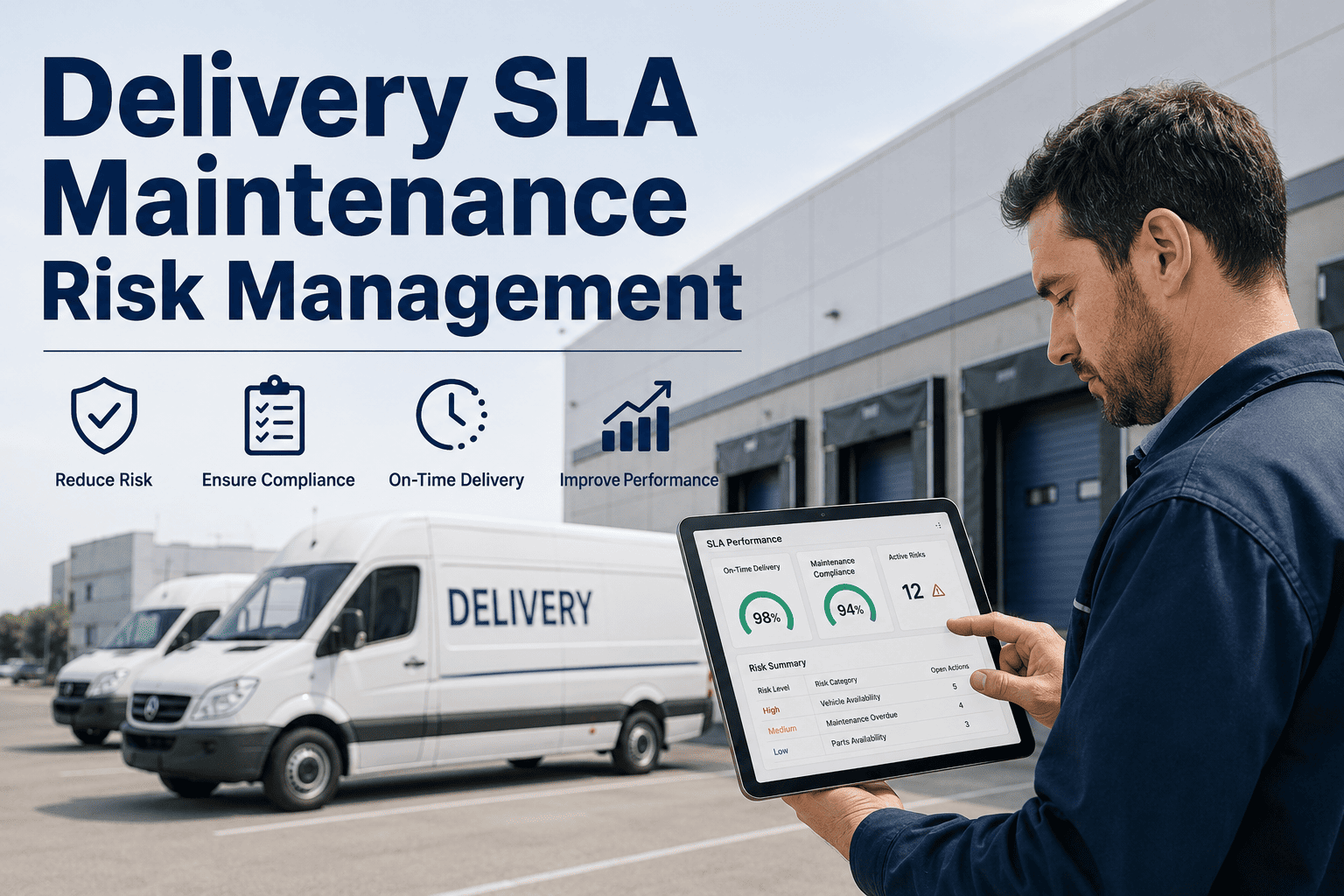
Every delivery SLA your business commits to — same-day, next-day, 2-hour window — is underwritten by the mechanical reliability of your vehicles. When a van breaks down mid-route, the SLA breach is instant, the penalty is real, and the customer trust damage extends far beyond that single delivery. Most courier and logistics operators treat vehicle maintenance and SLA management as separate operational functions. OxMaint AI connects them — making vehicle health a visible, managed input into your delivery performance, not an invisible liability waiting to surface at the worst moment.
Solution Page · SLA Protection · Fleet Maintenance Risk
Delivery SLA Maintenance Risk Management: Protect Every Promised Window
Prevent vehicle downtime from becoming SLA breaches. Prioritize repairs by route impact, track defects to closure, and eliminate maintenance as a delivery risk factor.
The True Cost of a Vehicle Breakdown on SLA Performance
A single roadside breakdown during a delivery shift creates a cascade of compounding costs that most operators significantly underestimate when they budget only for the repair.
Repair Cost
$1,200
avg. roadside breakdown repair
Rerouting Cost
$340
emergency reallocation + driver overtime
SLA Penalties
$800–$4,000
contractual per-breach penalties (B2B)
Customer Churn Risk
12–18%
of affected B2C customers switch providers after 2+ breaches
Source: Last Mile Delivery Risk Report, Retail Logistics Association 2024. B2B penalty range reflects contracts across parcel, cold chain, and pharmaceutical courier segments.
How OxMaint Reduces Maintenance-Driven SLA Risk
OxMaint directly addresses the maintenance behaviours that convert vehicle defects into SLA breaches — through repair prioritisation, defect tracking, and predictive downtime prevention that protects route availability before dispatch.
1
Repair Prioritisation by Route Impact
OxMaint work orders carry route and SLA context. A defect on a vehicle assigned to a same-day pharmaceutical route is automatically prioritised above a defect on a vehicle scheduled for a next-day residential run. Technicians work the highest-SLA-risk repairs first — without needing a manager to sort the queue manually every morning.
2
Defect-to-Closure Tracking with Escalation
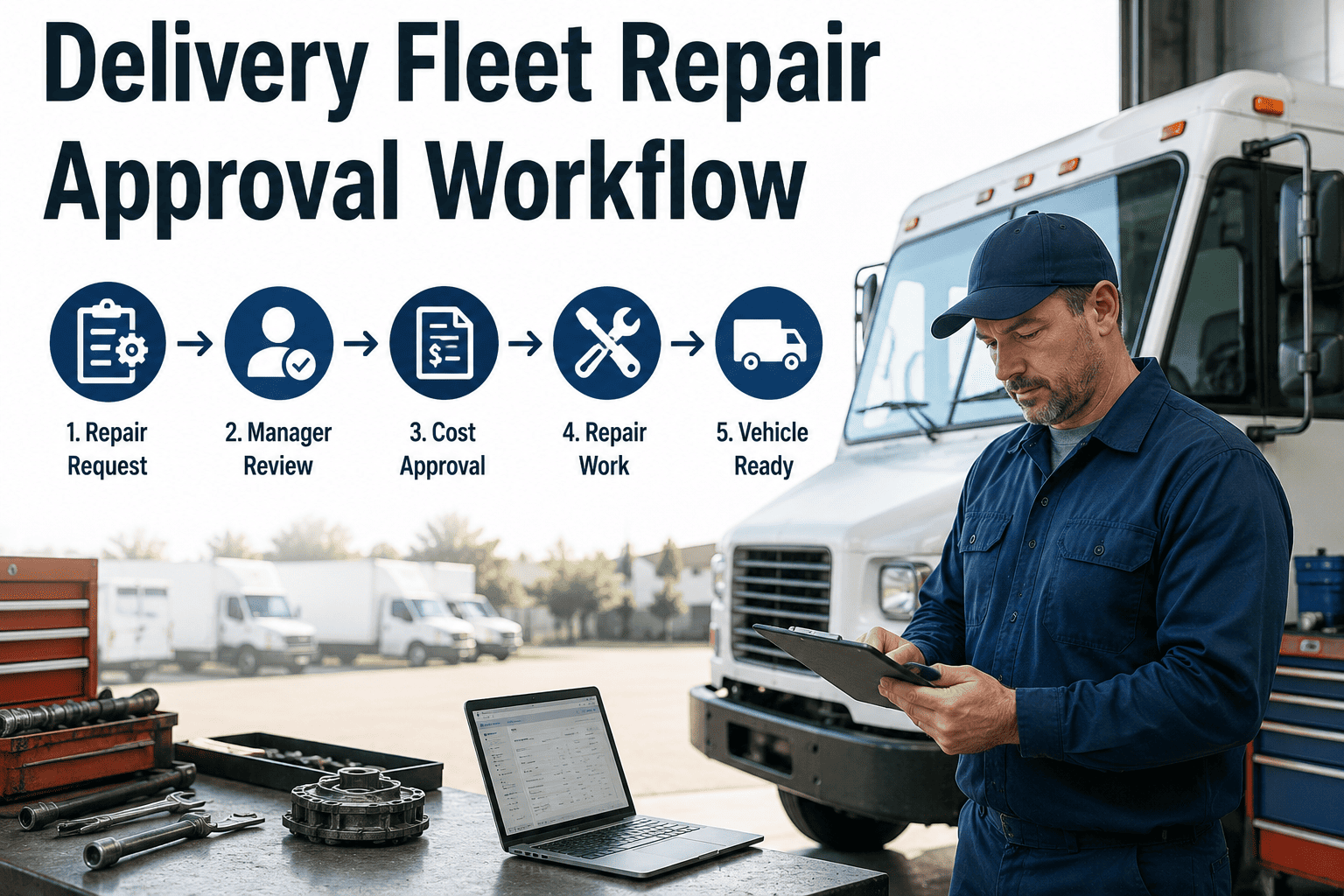
Every defect reported by a driver is tracked from submission through work order creation, repair execution, and vehicle return to service. If a defect work order exceeds its expected resolution time, OxMaint escalates to the fleet manager automatically — before the affected vehicle is dispatched with an unresolved issue.
3
Predictive Downtime Prevention
OxMaint AI analyses historical maintenance data and defect patterns to identify which vehicles are statistically likely to require unplanned downtime within the next 7–14 days. Operators can pre-schedule maintenance during off-peak windows — protecting peak delivery periods from unplanned vehicle loss without reducing route capacity.
4
Dispatch Readiness Gate
The OxMaint fleet dashboard shows dispatch managers which vehicles have cleared digital inspection, which have open defects, and which are flagged by the AI as high breakdown risk. Dispatch decisions are made with complete vehicle health visibility — eliminating the scenario where a vehicle with a known defect is sent out and breaks down on the highest-SLA route of the day.
SLA Risk by Defect Category: What OxMaint Prioritises and Why
Not all vehicle defects carry equal SLA risk. OxMaint's risk-weighting engine scores open defects by their probability of causing route interruption — ensuring the maintenance queue always reflects delivery risk, not just repair sequence.
| Defect Category |
Breakdown Probability (if unresolved) |
Avg. Route Downtime if Fails |
OxMaint Priority Level |
Response SLA |
| Tyre condition (wear/pressure) |
High — 34% failure rate in 7 days |
3.5 hours |
Critical |
Repair before next dispatch |
| Brake system defect |
High — safety-critical, forced OOS |
Full shift + compliance hold |
Critical |
Immediate, vehicle grounded |
| Engine fault code (active) |
Medium-High — 28% within 14 days |
4–6 hours |
High |
Repair within 24 hours |
| Cooling system warning |
Medium — 19% in peak heat |
2.5 hours |
High |
Repair within 48 hours |
| Lighting defect |
Low — regulatory risk only |
Roadside stop, 1–2 hours |
Medium |
Repair within 72 hours |
| Cargo security/load bay issue |
Low mechanical, high SLA risk |
Delivery abort, re-sort required |
High |
Repair before load assignment |
SLA Protection · OxMaint
Stop Letting Vehicle Defects Become SLA Breaches
OxMaint's repair prioritisation, defect tracking, and AI downtime prediction give fleet operators the tools to protect every delivery commitment — not just the ones on their busiest routes.
Expert Perspectives on Maintenance-Driven Delivery Risk
"SLA risk management in last-mile delivery has historically focused on route optimisation and driver performance — ignoring vehicle reliability as a variable. That omission is costing operators real money. A route that is perfectly planned fails entirely if the vehicle carrying it breaks down. Fleet maintenance is an SLA management function, and it needs to be treated as one."
PL
Patricia Lund
Senior Analyst, Last Mile & Urban Delivery, McKinsey & Company Global Logistics Practice
"The courier operators who consistently outperform on SLA metrics share one characteristic that is rarely discussed: they treat their maintenance queue as a delivery risk register. Every open defect is assessed for route impact, not just repair cost. This mental model shift — from 'fix the vehicle' to 'protect the delivery' — is what separates elite operators from average ones."
RK
Rajiv Kapoor
Director of Fleet Risk Management, International Road Transport Union (IRU)
Frequently Asked Questions
How does OxMaint know which vehicle defects are highest-priority for SLA protection?
OxMaint's risk-weighting engine combines three data inputs to determine work order priority: the defect category's historical breakdown probability, the vehicle's assigned route SLA tier (same-day, next-day, etc.), and the defect's current resolution age. Work orders for defects on high-SLA routes are automatically elevated in the maintenance queue, ensuring technicians always see and address the highest delivery-risk repairs first. Fleet managers can adjust the risk weighting parameters to match their specific SLA contract structures.
Start a trial to configure your SLA tiers.
Can OxMaint integrate with our delivery management system to pull route SLA data automatically?
OxMaint supports API integration with major last-mile delivery management platforms including Route4Me, OptimoRoute, Onfleet, and Bringg. When integrated, route SLA classifications flow automatically into OxMaint's vehicle assignment data — so work order priority adjusts dynamically when route assignments change. For operators using proprietary dispatch systems, OxMaint's open API allows custom integration development during the implementation phase.
Book a demo to discuss your dispatch system integration.
How does OxMaint handle the escalation process when a defect work order is taking too long to resolve?
Each work order in OxMaint carries a resolution time target set by the fleet maintenance team. When a work order exceeds its target — typically triggered at 50% and 100% of the expected resolution window — OxMaint automatically notifies the fleet manager via push notification and email, showing the defect details, affected vehicle, next dispatch schedule, and route SLA at risk. The manager can reassign the work order, approve contractor support, or escalate parts procurement — all within the app — before the delay becomes a dispatch problem.
Does OxMaint generate reports showing how maintenance performance affects SLA outcomes over time?
Yes. OxMaint's analytics module generates maintenance-to-delivery performance reports that correlate defect volume, repair completion rates, and PM compliance with route success rates and SLA breach events. These reports give operations directors the evidence needed to justify maintenance investment, demonstrate the ROI of preventive programmes, and identify which vehicle types or depot locations contribute the most maintenance-driven SLA risk. Reports are exportable in PDF and CSV for board-level and client reporting.
Delivery SLA Risk Management · OxMaint
Make Vehicle Reliability a Delivery Strength, Not a Hidden Risk.
OxMaint connects fleet maintenance directly to SLA performance — prioritising repairs by route impact, tracking every defect to closure, and predicting downtime before it disrupts your highest-value deliveries.