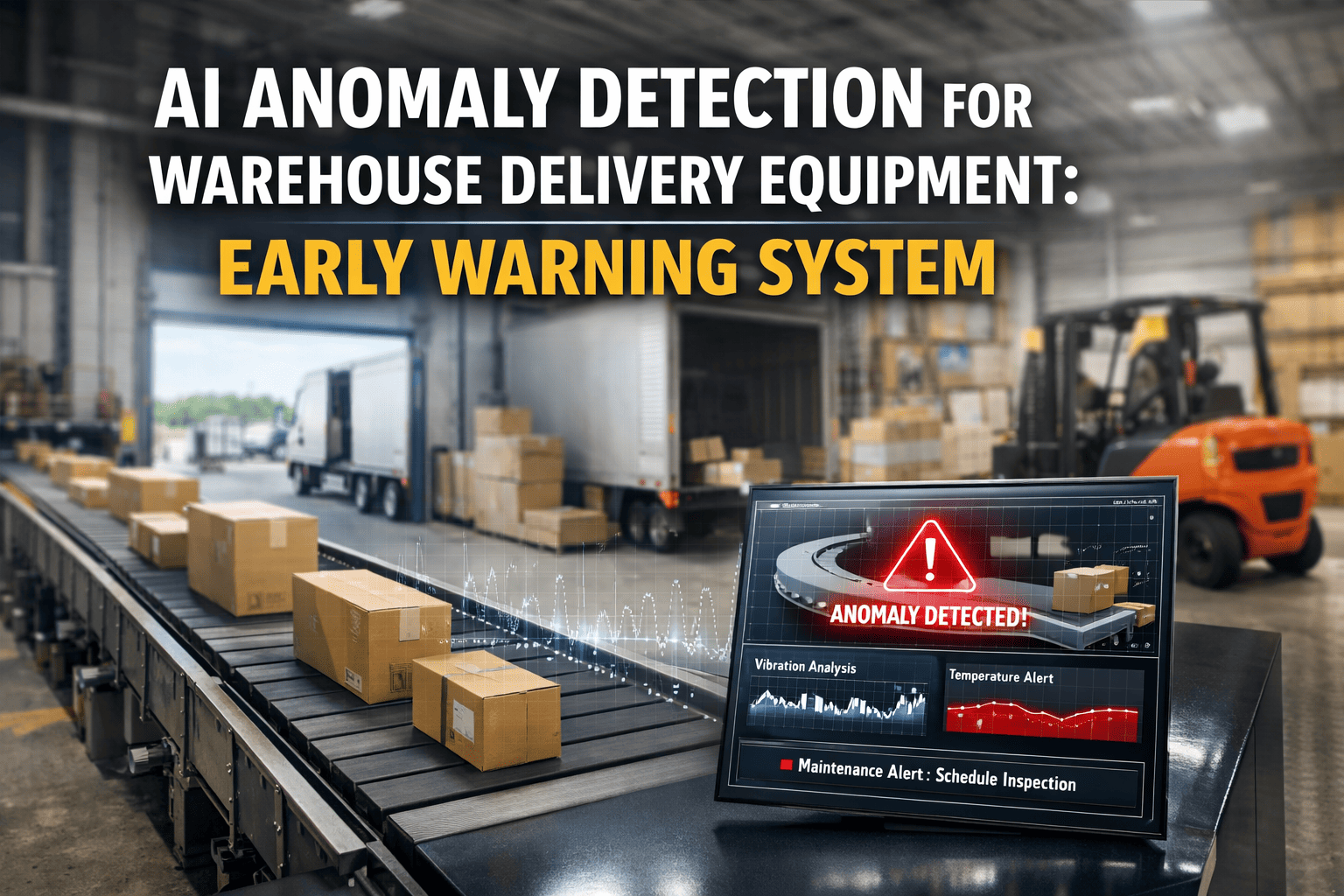
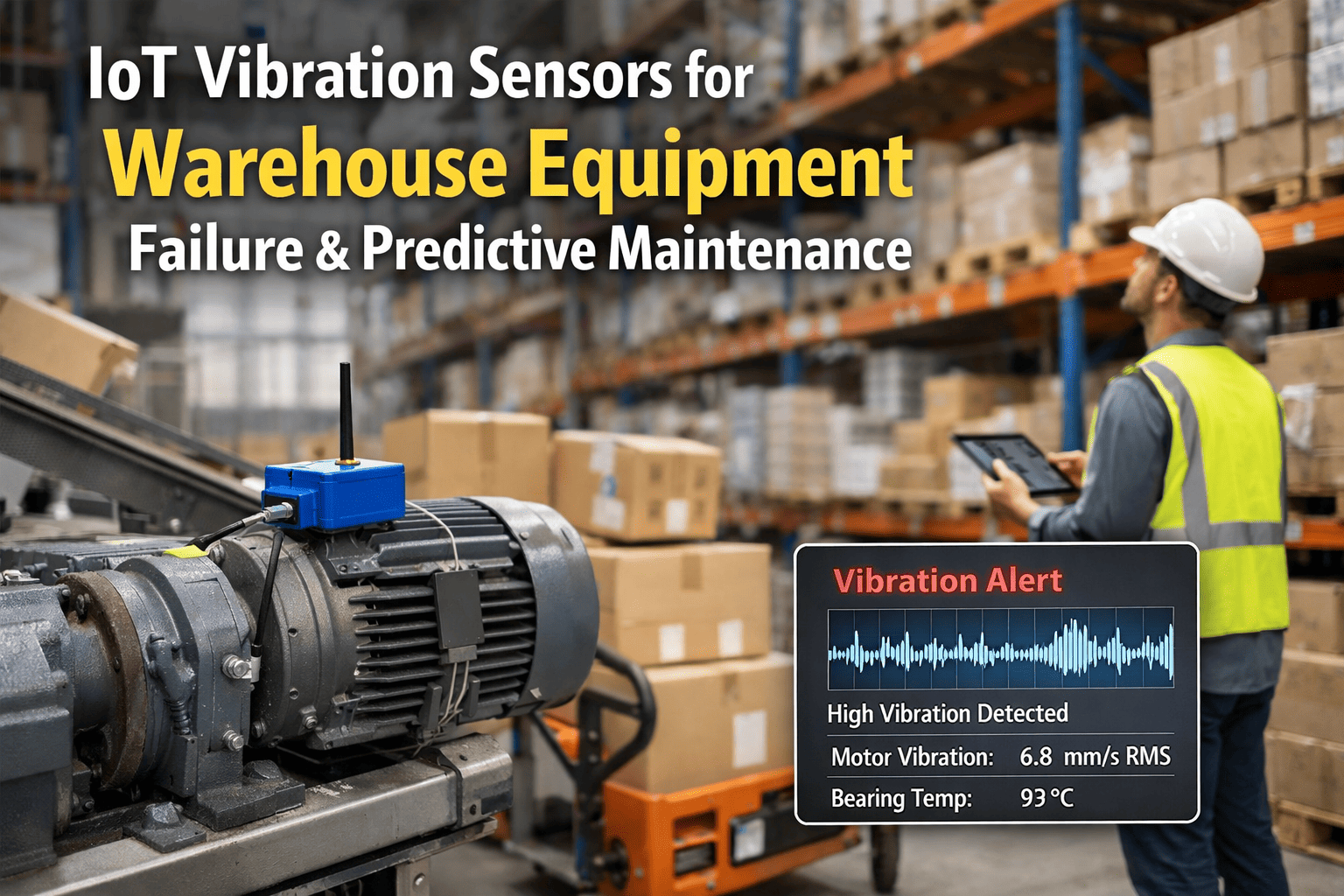
The sortation system at a 520,000 sq ft e-commerce fulfillment center in Columbus processed 54,000 parcels per shift across sixteen outbound lanes. On a Thursday evening in October, at 7:42 PM during the peak holiday pre-season ramp, the main drive motor on the high-speed tilt-tray sorter seized without warning. Fifty-four thousand parcels per shift became zero parcels per shift in under three seconds. The sixteen outbound lanes went dark. Fourteen trailers sitting at dock doors had nowhere to go. The emergency maintenance team diagnosed the failure in 28 minutes — a catastrophic bearing collapse in the primary gearbox that had been developing internally for an estimated 47 days. Replacement gearbox: not in stock. Nearest available unit: a supplier in Milwaukee, 380 miles away, expedited overnight freight at emergency rates. The sortation system was offline for 19.5 hours. In those 19.5 hours, 112,000 parcels that should have shipped sat on accumulation conveyors. Service level agreements with three major retail clients were breached. Contractual penalties totaled $186,000. Overtime labor to catch up over the following weekend: $94,000. Emergency gearbox procurement and installation: $67,000. Customer service escalation handling: $28,000. Total cost of one bearing that nobody was watching: $375,000. The bearing had been generating a distinctive defect frequency signature — a 142 Hz inner race fault tone buried in the vibration spectrum — since day one of its degradation 47 days earlier. An AI predictive maintenance system monitoring that gearbox would have identified the signature on day one, classified it as an inner race defect with 94% confidence by day seven, calculated remaining useful life of 40-55 days by day fourteen, and auto-generated a work order for planned replacement during the next scheduled maintenance window — a $4,200 gearbox swap with zero downtime, zero SLA breach, and zero overtime. Instead, the facility paid $375,000 to learn what a $280 vibration sensor already knew.
Sortation systems are the highest-consequence single points of failure in distribution center operations. Unlike conveyors that can be bypassed or dock equipment that operates independently, a sortation system failure stops all outbound flow simultaneously — every lane, every trailer, every shipment. The mechanical complexity of tilt-tray sorters, crossbelt sorters, sliding shoe diverters, and bomb-bay systems creates hundreds of potential failure points across motors, gearboxes, bearings, actuators, belt drives, and control systems, all operating at speeds between 1.5 and 2.5 meters per second under continuous load. Traditional preventive maintenance — calendar-based inspections and time-based component replacement — catches visible degradation but misses the 60-70% of failures that develop internally without external symptoms. AI predictive maintenance closes that gap by continuously analyzing vibration, temperature, current, and speed data from sensors mounted on every critical sortation component, using machine learning models trained on thousands of failure signatures to detect anomalies weeks before they become failures. When integrated with a CMMS platform, every AI prediction becomes an automatically-generated work order with fault classification, severity score, remaining useful life estimate, recommended repair action, and parts reservation — transforming sortation maintenance from reactive firefighting into scheduled precision. This guide covers exactly how AI predictive maintenance works for sortation systems, what failure modes it catches, and why the financial case makes every other maintenance investment look slow.
$375KAverage total cost of a single unplanned sortation system failure during peak distribution operations
47 daysAverage detectable warning period before sortation component failure — invisible without AI sensor analysis
96.3%AI prediction accuracy for sortation component failure — identifying fault type, severity, and remaining life
Why Sortation Systems Fail Without Warning
Sortation equipment operates under conditions that make traditional maintenance approaches fundamentally inadequate. Unlike stationary equipment with steady loads, sortation systems experience dynamic, asymmetric forces that vary with package mix, throughput rate, and lane distribution — conditions that change by the hour during peak seasons. The failure modes that destroy sortation uptime develop internally, invisibly, and at rates that calendar-based inspection intervals cannot match.
Gearbox Bearing Degradation
34% of all sortation failures
High-speed gearbox bearings operate at 1,200-3,600 RPM under variable radial and axial loads. Internal race defects, cage wear, and rolling element pitting develop over 30-90 days with zero external symptoms — no noise, no vibration detectable by human touch, no temperature rise until the final 48 hours before seizure. AI vibration analysis detects characteristic defect frequencies (BPFO, BPFI, BSF) at the onset of degradation.
Diverter Actuator Wear
22% of all sortation failures
Tilt-tray and sliding shoe diverters cycle 3,000-8,000 times per shift. Pneumatic seals degrade, response times slow by milliseconds, and mechanical linkages develop play that compounds with each cycle. AI models track actuator response time trends and current draw patterns to predict when degradation will cause missorts or mechanical binding — typically 14-30 days before functional failure.
Drive Belt & Chain Elongation
18% of all sortation failures
Drive belts and chains stretch under load over thousands of operating hours. Elongation causes timing drift that degrades sort accuracy before it causes mechanical failure. Speed sensors and AI models detect sub-1% speed deviations between drive and driven components — catching elongation when it affects performance rather than waiting for belt skip or chain jump that damages sprockets and shafts.
Motor Winding Insulation Breakdown
14% of all sortation failures
Electric motor winding insulation degrades from thermal cycling, voltage spikes, and contamination. Partial discharge activity increases months before a winding-to-ground fault causes catastrophic motor failure. AI current signature analysis detects asymmetric phase currents and harmonic patterns that indicate insulation breakdown — providing 60-120 days of warning before a $15,000-$40,000 motor replacement becomes emergency.
Control System Sensor Drift
12% of all sortation failures
Photoeyes, encoders, and proximity sensors that control sort timing drift out of calibration gradually. Missort rates increase slowly — from 0.1% to 0.3% to 0.8% over weeks — without triggering alarms until they cross SLA thresholds. AI models correlate missort pattern data with sensor readings to identify which specific sensors are drifting before sort accuracy degrades visibly.
Every one of these failure modes is invisible to calendar-based inspection and undetectable by human senses until the final hours before failure. AI predictive maintenance makes them visible weeks to months in advance. Schedule a demo to see how AI failure prediction integrates with automated maintenance workflows in OXmaint.
Stop Guessing When Your Sorter Will Fail
AI predictive maintenance tells you exactly which component is degrading, how fast, and when it will fail — 30-90 days before it happens. Replace the guesswork with data.
How AI Predictive Maintenance Works for Sortation
AI predictive maintenance is not a single technology — it is a pipeline that transforms raw sensor data into maintenance decisions through four processing stages, each adding intelligence that the previous stage cannot provide alone.
Stage 01
Multi-Sensor Data Acquisition
Vibration accelerometers sample at 25,600 Hz capturing the full frequency spectrum that contains bearing defect signatures. Temperature sensors track motor and gearbox thermal profiles at 60-second intervals. Current transducers measure motor load patterns at 1 Hz resolution. Speed encoders detect belt slip and timing drift continuously. All sensors transmit through industrial wireless gateways to edge compute nodes located within the sortation equipment footprint.
Vibration: 25,600 Hz samplingTemperature: 60-sec intervalsCurrent: 1 Hz resolutionSpeed: Continuous encoding
Stage 02
Feature Extraction & Signal Processing
Raw sensor signals are transformed into diagnostic features using FFT (Fast Fourier Transform) for frequency decomposition, envelope analysis for bearing defect extraction, wavelet decomposition for transient event detection, and statistical feature calculation (RMS, kurtosis, crest factor, skewness). These features reduce gigabytes of raw data into hundreds of meaningful health indicators per component per day — the diagnostic vocabulary that AI models learn to interpret.
FFT frequency decompositionEnvelope bearing analysisWavelet transient detectionStatistical health features
Stage 03
AI Classification & Remaining Life Estimation
Machine learning models — gradient boosted trees for fault classification and recurrent neural networks for degradation trending — compare extracted features against learned failure signatures. The classification model identifies what is failing (bearing inner race, gear tooth, belt tension). The RUL (Remaining Useful Life) model estimates when it will fail based on degradation rate trajectories calibrated against historical failure data. Confidence scores quantify prediction certainty.
Fault type: 96.3% accuracySeverity: 5-level gradingRUL: +/- 15% precisionConfidence: Per-prediction scoring
Stage 04
Automated CMMS Work Order Generation
Predictions exceeding severity thresholds auto-generate work orders in the CMMS with equipment ID, fault classification, severity score, estimated days to failure, recommended repair action, required parts from the equipment BOM, and suggested scheduling window based on operational throughput data. The planner reviews and approves — the system handles all data population. Zero manual entry. Zero detection delay.
Auto equipment ID mappingParts auto-reservationPriority auto-calculationSchedule recommendation
What AI Catches That Traditional Maintenance Misses
The gap between traditional sortation maintenance and AI predictive maintenance is not incremental — it is the difference between finding failures after they cause damage and finding them before they cause symptoms.
| Failure Scenario | Traditional Detection | AI Predictive Detection | Cost Difference |
|---|
| Gearbox bearing inner race defect |
Found during seizure — 19.5 hrs downtime |
Detected at onset — planned swap, 0 downtime |
$375K vs $4.2K |
| Diverter actuator response degradation |
Found when missort rate exceeds SLA — client penalty triggered |
Response time drift detected 21 days early — calibrated during PM window |
$86K vs $1.1K |
| Drive belt elongation (0.8% stretch) |
Found after belt skips — damages sprockets, 6 hr repair |
Speed deviation detected at 0.2% — belt tensioned same shift |
$28K vs $400 |
| Motor winding insulation failure |
Found during ground fault trip — motor destroyed |
Phase current asymmetry detected 90 days early — motor rewound during planned outage |
$42K vs $8.5K |
| Photoeye sensor drift (sort timing) |
Found when missorts spike — hundreds of packages misrouted |
Calibration drift correlated 14 days early — sensor replaced in 20 min |
$34K vs $280 |
Across these five scenarios alone, AI predictive maintenance reduces failure cost by 89-99% per event. The savings compound across a sortation system with 50-200 monitored components, each generating multiple failure predictions per year. Sign up free to start connecting predictive intelligence to your maintenance workflow.
ROI of AI Predictive Maintenance for Sortation Systems
These figures represent a high-volume distribution center with one primary sortation system processing 50,000+ parcels per shift across 12-16 outbound lanes — a typical e-commerce or 3PL fulfillment hub.
| Savings Category | Annual Impact | Calculation Basis |
|---|
| Avoided unplanned sortation shutdowns |
$750,000 |
2 prevented catastrophic failures x $375K avg total cost per event |
| Missort rate reduction (actuator/sensor prediction) |
$215,000 |
Missort rate reduced from 0.4% to 0.05% — SLA penalties and rework eliminated |
| Maintenance labor optimization |
$128,000 |
45% reduction in PM hours through condition-based replacement of calendar-based tasks |
| Extended component lifecycle |
$94,000 |
Condition-based replacement extends avg component life 30% vs time-based swap |
| Emergency parts procurement elimination |
$67,000 |
30-90 day advance warning enables standard procurement vs overnight emergency freight |
| SLA penalty avoidance |
$186,000 |
Zero throughput disruptions = zero SLA breaches across all client contracts |
| Total Annual Savings |
$1,440,000 |
Single sortation system, 50K+ parcels/shift, 12-16 outbound lanes |
Total AI predictive maintenance deployment cost for a single sortation system: $55,000-$95,000 including sensors, edge compute, AI platform, CMMS integration, and first-year subscription. First-year ROI: 15-26x. Payback period: 2-4 weeks after system commissioning. Schedule a demo to model predictive maintenance ROI for your specific sortation configuration.
Preventive vs. Predictive: The Sortation Maintenance Comparison
| Dimension | Calendar-Based Preventive | AI Predictive Maintenance |
|---|
| Failure detection method |
Scheduled inspection — finds only externally visible degradation |
Continuous AI analysis — detects internal degradation from day one |
| Bearing replacement strategy |
Replace at fixed hours — 30% replaced too early, 20% fail before interval |
Replace when AI detects actual defect — optimal timing every component |
| Diverter actuator management |
Rebuild at fixed cycle count — ignores actual condition variation |
Rebuild when response time trend indicates degradation — zero missorts |
| Unplanned downtime events per year |
3-6 events averaging 8-20 hours each — $200K-$2M annual exposure |
0-1 events — only from failure modes not yet covered by sensor data |
| Sort accuracy impact |
Accuracy degrades between PM windows — missorts accumulate invisibly |
Continuous monitoring maintains accuracy — drift caught within hours |
| Spare parts inventory strategy |
Stock everything — $120K-$280K in sortation MRO inventory |
Predict needs 30-90 days ahead — 35% inventory reduction |
| Annual sortation maintenance cost |
$680K-$1.2M including emergency repairs and SLA penalties |
$180K-$340K with zero emergency events and zero SLA breaches |
Implementation: From Zero Prediction to Full Sortation Intelligence
01
Week 1-2
Critical Component Mapping
Identify all drive motors, gearboxes, diverter actuators, and control sensors on the sortation systemClassify components by failure consequence — which failures stop all lanes vs single laneMap sensor placement locations based on component failure mode analysis (FMEA)Register sortation equipment hierarchy in CMMS with criticality scoring
02
Week 3-5
Sensor Deployment & Baseline Capture
Install vibration, temperature, current sensors on all critical drive units and gearboxesDeploy response time sensors on diverter actuators and sort confirmation photoeyesConfigure wireless gateway network and edge compute for real-time data processingRun 14-21 day baseline learning period — AI models learn normal operating signatures
03
Week 6-8
AI Model Activation & Validation
Activate anomaly detection models — system begins flagging deviations from baselineConfigure CMMS integration for automated work order generation from AI predictionsValidate initial predictions against physical inspection — confirm or correct AI classificationsTune alert thresholds to match your operational risk tolerance and scheduling constraints
04
Ongoing
Continuous Learning & Optimization
Every verified repair outcome trains the AI model — prediction accuracy improves continuouslyRUL estimation precision increases as the model accumulates your specific equipment degradation dataQuarterly reliability reports identify systemic failure patterns for engineering improvementExpand monitoring to secondary systems: conveyors, dock equipment, HVAC, powered trucks
Case Study: E-Commerce Fulfillment Center Achieves 99.7% Sortation Uptime
A major e-commerce fulfillment center in Columbus operating a 520,000 sq ft facility with a 16-lane tilt-tray sortation system had experienced four unplanned sortation shutdowns in the preceding 12 months. Each event averaged 14 hours of downtime and $310,000 in combined repair costs, SLA penalties, overtime labor, and expedited shipping to recover delayed orders. Annual sortation maintenance spend: $890,000 — with 58% classified as reactive or emergency. The maintenance team of 8 technicians spent an estimated 35% of their time responding to unplanned events rather than executing preventive work. Sortation uptime was 94.2%, well below the 99%+ target required by client SLAs.
Over 8 weeks, the facility deployed 68 IoT sensor nodes across all sortation drive units, gearboxes, diverter actuators, and critical control sensors. Total deployment cost including sensors, edge compute, AI platform, and CMMS integration: $82,000. The AI system completed its baseline learning period in 18 days and immediately identified 6 developing faults — including one gearbox bearing with an estimated 35 days of remaining useful life that would have caused a full-system shutdown identical to the October event. All 6 faults were repaired during planned maintenance windows at a combined cost of $18,400. After 12 months of AI predictive monitoring, unplanned sortation shutdowns dropped from 4 to zero. Sortation uptime reached 99.7%. Annual maintenance spend decreased from $890,000 to $340,000. Reactive maintenance dropped from 58% to 6% of total work. Zero SLA penalties incurred across all client contracts.
99.7%
Sortation uptime achieved — up from 94.2% pre-AI implementation
$550K
Annual maintenance cost reduction — from $890K to $340K total spend
Zero
Unplanned sortation shutdowns in 12 months — down from 4 events
52 days
Full payback on $82K sensor and AI platform investment
Critical Sortation Health Metrics to Track
Overall Sortation Uptime
Target: >99.5%Watch: 97-99.5%Critical: <97%
Primary operational KPI — each 0.1% below target represents $35K-$85K in annual throughput loss
Mean Time Between Failures (MTBF)
Target: >4,000 hrsWatch: 2,000-4,000Critical: <2,000 hrs
Reliability trend indicator — declining MTBF signals systemic degradation across components
Sort Accuracy Rate
Target: >99.9%Watch: 99.5-99.9%Critical: <99.5%
Declining accuracy indicates diverter or sensor degradation before mechanical failure occurs
Predicted vs Actual Failures (AI Accuracy)
Target: >93%Watch: 85-93%Critical: <85%
Measures AI model reliability — accuracy improves continuously with verified repair data
Planned vs Emergency Maintenance Ratio
Target: >95% plannedWatch: 80-95%Critical: <80%
The ultimate measure of predictive program effectiveness — emergency work should approach zero
Frequently Asked Questions
How many sensors does a typical sortation system need for AI predictive maintenance?
Sensor count depends on sortation system type and lane count. A 16-lane tilt-tray sorter typically requires 60-80 sensor nodes: 2-3 sensors per drive unit (vibration + temperature + current), 1-2 per diverter actuator (vibration + response time), and sensors on critical control components. A sliding shoe sorter requires fewer diverter sensors but more along the shoe track mechanism. The principle is covering every component whose failure stops more than one lane — single-lane failures are lower priority. Total hardware cost for a full deployment runs $20,000-$40,000 for sensors and $8,000-$15,000 for wireless gateways and edge compute.
How long before the AI system starts making accurate predictions?
The system goes through three accuracy phases. Phase 1 (weeks 1-3): baseline learning — the AI captures normal operating signatures and begins detecting obvious anomalies with 80-85% accuracy. Phase 2 (months 1-3): model refinement — as the system processes its first verified fault detections and repair outcomes, classification accuracy reaches 90-93%. Phase 3 (months 3-12): mature operation — accumulated degradation data enables RUL estimation with 15% precision and fault classification at 96%+ accuracy. The system never stops improving — every verified repair outcome refines the model for your specific equipment operating conditions.
Can AI predictive maintenance work alongside our existing PM program?
Yes — and this is the recommended approach. AI predictive maintenance does not replace all preventive maintenance; it optimizes it. Visual inspections, lubrication schedules, and safety checks remain on calendar intervals because they address failure modes that sensors do not cover (loose fasteners, fluid leaks, guard damage). What AI replaces is the time-based component replacement strategy — instead of swapping bearings at 15,000 hours regardless of condition, you swap them when the AI detects actual degradation. This eliminates both premature replacement waste and the 20% of components that fail before reaching the PM interval. The CMMS coordinates both AI-triggered and calendar-based work orders in a unified schedule.
What happens when the AI makes a wrong prediction?
False positives (predicting a fault that does not exist) result in an unnecessary inspection — typically 30-60 minutes of technician time to verify the component is healthy. This is inconvenient but harmless. False negatives (missing a developing fault) are more consequential but rare — mature systems achieve 96%+ detection rates, meaning fewer than 4% of developing faults go undetected. The system is designed so that false positives decrease over time as the model learns your equipment's specific patterns. Every time a technician inspects a flagged component and finds it healthy, that feedback trains the model to reduce similar false alerts. Within 6-12 months, false positive rates typically drop below 5%.
What is the total cost and payback period for sortation AI predictive maintenance?
Full deployment cost for a single sortation system ranges from $55,000-$95,000. This includes sensors ($20,000-$40,000 for 60-80 nodes), wireless gateways and edge compute ($8,000-$15,000), AI platform and CMMS integration ($15,000-$25,000), and first-year subscription ($12,000-$20,000). Annual renewal: $12,000-$20,000 for platform subscription. Against annual savings of $1.44 million for a 50K+ parcel/shift operation, the payback period is 2-4 weeks. Even for smaller sortation systems processing 20,000 parcels per shift, the payback period is typically under 90 days because a single prevented emergency event ($200K-$375K) exceeds the entire deployment cost.
$375,000 Emergency or $4,200 Planned Swap. The Bearing Decides in 47 Days.
That Columbus fulfillment center paid $375,000 because nobody was monitoring a gearbox bearing that had been failing for 47 days. Your sortation system has bearings degrading right now. Let AI tell you which ones — before they tell you the expensive way.