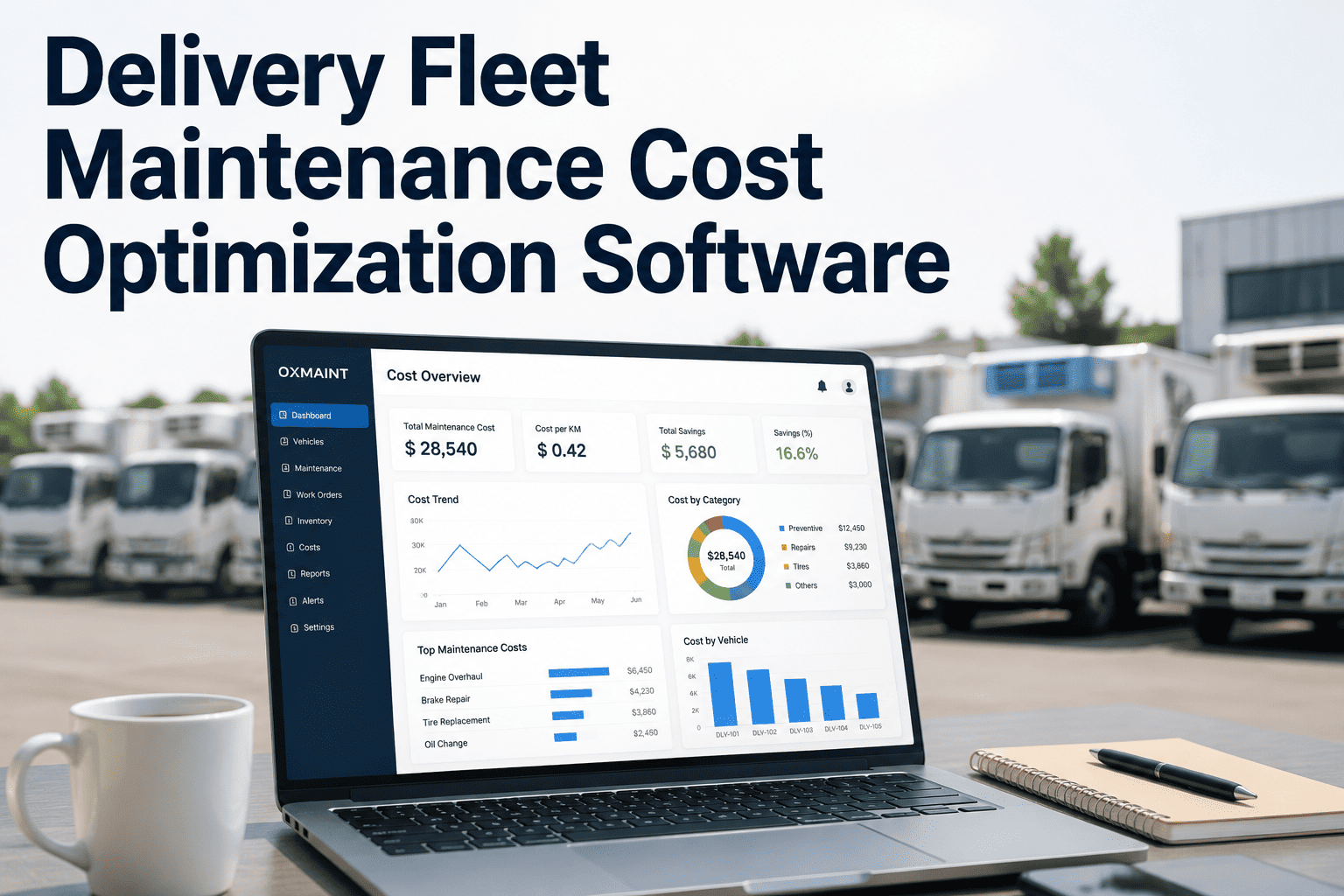
High-volume delivery networks run on margins that leave no room for unplanned downtime. A single vehicle breakdown on a last-mile route costs an average of $750–$1,200 in emergency repairs, missed deliveries, and rescheduling — and in fleets running 500 or more vehicles, reactive maintenance culture quietly drains 15–20% of total operational budgets every year. AI-driven maintenance platforms are now changing that equation, turning unpredictable failure events into scheduled, low-cost interventions that extend vehicle life, reduce total cost of ownership, and give operations leaders the data visibility needed to forecast CapEx with confidence.
4.8x
Higher Cost of Emergency vs. Planned Repairs
Fleet Maintenance Industry Benchmark
25–35%
Reduction in Fleet Maintenance Costs with AI
McKinsey Logistics Operations Report
$740B
Annual Fleet Maintenance Spend — North America
American Transportation Research Institute
78%
of Fleet Failures Are Predictable with Sensor Data
Deloitte Fleet Analytics Study, 2025
What Is AI-Driven Maintenance for Delivery Fleets?
AI-driven fleet maintenance uses onboard telematics, engine diagnostics, and sensor data to continuously monitor vehicle health — applying machine learning models to detect failure patterns before breakdown occurs. Unlike calendar-based oil changes and scheduled inspections, AI maintenance acts on real condition data: engine load cycles, brake wear rates, transmission temperature, tire pressure trends, and fault code histories. The result is a maintenance model that is condition-based, not calendar-based — servicing vehicles only when data confirms they actually need it, while flagging critical issues 30–60 days before they become expensive failures.
Condition-Based Servicing
Vehicles are serviced when real-time sensor data confirms wear thresholds are reached — not based on mileage or calendar intervals that ignore actual operating conditions.
Predictive Fault Detection
Machine learning models trained on fleet failure histories identify fault signatures 30–60 days before breakdown — triggering proactive work orders instead of reactive emergency repairs.
Automated Work Order Creation
When AI detects a developing issue, a work order is automatically generated with vehicle ID, fault type, severity, and recommended repair action — no manual triage or guesswork required.
Fleet-Level Cost Visibility
Real-time dashboards aggregate maintenance cost per vehicle, cost per mile, parts spend, and downtime hours across every depot and route — giving ops leaders complete financial transparency.
Why Delivery Networks Bleed Money on Reactive Maintenance
High-volume delivery operations face maintenance challenges that standard fleet programs are not built to handle. Route density, driver variability, stop-and-start duty cycles, and multi-shift operations accelerate component wear at rates that calendar-based maintenance cannot track. The financial consequences compound quickly across large fleets.
The Hidden Cost Drivers in Reactive Fleet Maintenance
What operations directors discover when they audit their maintenance spend
Emergency Premium
Roadside breakdowns average $750–$1,200 per incident in tow fees, emergency labor, and expedited parts. Fleets with 500+ vehicles running reactive programs absorb 80–120 of these events per month.
Cascading Damage
A neglected bearing failure that costs $200 to fix at the right time can cascade into a $4,500 transmission rebuild if it runs to failure. 67% of major repairs originate from ignored minor fault codes.
Over-Servicing Waste
Fixed interval oil changes and inspections on lightly loaded vehicles waste 30–40% of maintenance budgets on unnecessary labor and parts. Not every vehicle accumulates wear at the same rate.
Zero Cost Visibility
Without asset-level tracking, operations leaders cannot identify which vehicles, routes, or drivers are generating disproportionate maintenance spend — making budget forecasting impossible.
Route Impact
An unplanned vehicle breakdown disrupts 35–60 planned deliveries per day. The downstream cost — redelivery fees, customer penalties, and driver overtime — often exceeds the repair cost by 3x.
Shortened Asset Life
Reactive maintenance cultures replace vehicles 2–4 years earlier than necessary. On a fleet of 500 vehicles at $85,000 average replacement cost, that is $42M–$85M in premature CapEx.
How AI Maintenance Platforms Work in Delivery Operations
AI fleet maintenance integrates with existing telematics and OBD-II systems to transform raw vehicle data into actionable maintenance intelligence — without requiring new hardware on every vehicle. The core process runs across four connected layers.
01
Data Collection at the Vehicle
Telematics units and onboard diagnostics capture engine fault codes, idle time, brake application force, transmission temperature, fuel consumption anomalies, and GPS route data — continuously, across every vehicle in the fleet.
02
AI Failure Pattern Recognition
Machine learning models trained on millions of fleet failure events cross-reference real-time sensor readings with known failure signatures. Deviation from baseline operating parameters triggers a severity-graded alert before breakdown occurs.
03
Automated Work Order Generation
Confirmed fault patterns auto-generate work orders with vehicle ID, fault classification, recommended repair action, parts required, and priority level. Work orders route to the right depot technician — zero manual dispatch required.
04
Maintenance Scheduling Optimization
AI coordinates repair windows with route schedules — queuing non-urgent maintenance during natural vehicle downtime and escalating critical faults for same-shift intervention. Fleet availability is maximized without disrupting delivery capacity.
05
CapEx Lifecycle Forecasting
Remaining Useful Life models calculate per-vehicle replacement windows based on condition scores, accumulated wear data, and failure probability curves — generating rolling 5–10 year CapEx forecasts for each asset and the total fleet.
06
Portfolio Cost Reporting
Maintenance cost per vehicle, cost per mile, parts spend by category, downtime hours, and SLA compliance rates are aggregated across all depots and routes — giving operations directors investor-grade financial visibility.
How Oxmaint Solves Fleet Maintenance at Scale
Oxmaint is purpose-built for multi-site commercial operations — combining AI-powered asset condition tracking with full CMMS work order management designed for teams running high-volume vehicle and equipment fleets.
Oxmaint Fleet Maintenance Platform — Core Capabilities
Built for delivery networks managing 50 to 5,000+ assets across multiple depots
Asset Intelligence
Full Asset Registry with Condition Scoring
Every vehicle and piece of equipment gets a live condition score updated from sensor data, fault history, and completed work orders. Know which assets are healthy, which need monitoring, and which are approaching replacement — across every depot in your network.
Condition ScoreFault HistoryMulti-Site
Predictive Operations
AI Failure Detection and Work Order Automation
AI analyzes telematics and OBD-II data to detect developing failures 30–60 days in advance. Automated work orders are generated with fault type, severity level, recommended repair, and required parts — reducing mean time to repair by up to 52%.
Auto Work OrdersParts LinkingMobile Access
Financial Visibility
Rolling 5–10 Year CapEx Forecasting
Remaining Useful Life models calculate per-vehicle replacement windows from real condition data — not depreciation schedules. Generate portfolio-level CapEx forecasts that give ownership groups and CFOs the budget predictability to plan capital investments with confidence.
RUL ModelsCapEx ReportsInvestor Grade
Multi-Depot Control
Portfolio Dashboard Across All Sites
Cross-depot KPI visibility: maintenance cost per vehicle, cost per mile, downtime hours, SLA compliance, and parts spend — benchmarked across every location. Identify underperforming depots and high-cost vehicles before they impact your P&L.
KPI TrackingCost AnalyticsNOI Reports
Reactive vs. AI-Driven Maintenance: The Numbers That Matter
The financial difference between reactive and AI-driven fleet maintenance compounds at scale. For a delivery network operating 300 vehicles across 5 depots, the cumulative annual impact of switching to condition-based maintenance is measurable within the first quarter of deployment.
Reactive vs. AI-Driven Maintenance — Performance Comparison
Based on delivery fleet portfolio data across North America and Europe
| Metric |
Reactive Maintenance |
AI-Driven (Oxmaint) |
Outcome |
| Emergency Repair Cost |
$750–$1,200 per incident |
Reduced by up to 47% |
Major cost reduction |
| Unplanned Downtime |
12–18 days/vehicle/year |
Reduced by 50–60% |
More delivery capacity |
| Vehicle Asset Life |
6–8 years average |
Extended 2–4 years |
Delayed CapEx |
| Maintenance Budget Accuracy |
Unpredictable, +/- 35% |
Within 5–8% of forecast |
Budget predictability |
| Failure Detection Timing |
After breakdown |
30–60 days in advance |
Zero-surprise operations |
| Technician Productivity |
Reactive, ad-hoc scheduling |
Planned, data-prioritized |
35% efficiency gain |
| Parts Inventory Waste |
High — unpredictable demand |
Reduced by 20–30% |
Lower parts overhead |
| CapEx Forecasting |
Depreciation-based guesswork |
Condition-based RUL models |
Investor-grade planning |
Fleet Maintenance ROI — What AI Delivers in Numbers
For a delivery network running 500 vehicles across multiple depots, switching from reactive to AI-driven maintenance generates measurable, compounding returns across four cost categories. Most operations reach full platform payback within 6–10 months.
47%
Reduction in Emergency Repair Incidents
AI-Monitored Delivery Fleets
$1.4M
Annual Savings per 500-Vehicle Fleet
Avg. Oxmaint Fleet Portfolio
35%
Gain in Technician Productivity
Planned vs. Reactive Work Ratio
2–4 Yrs
Extended Vehicle Asset Lifespan
Condition-Based Lifecycle Data
Before vs. After AI Maintenance — Fleet Performance Impact
Measured outcomes from AI-monitored delivery fleet portfolios
Maintenance Budget Predictability
AI Fleet Maintenance — Act Now
Ready to Cut Emergency Repairs by 47%?
Oxmaint deploys AI failure detection across your entire fleet in under 14 days. No new hardware. No heavy onboarding. Full visibility from day one — across every vehicle, every depot, every route.
Frequently Asked Questions
How quickly does AI fleet maintenance pay for itself in a delivery network?
Most delivery networks operating 300 or more vehicles achieve full platform payback within 6–10 months. Emergency repair reduction alone (averaging 47% fewer incidents) generates the largest share of savings. Combined with extended vehicle life, reduced parts waste, and improved technician productivity, the cumulative annual return typically reaches $1.2M–$1.8M for a 500-vehicle fleet.
Does the platform work with existing telematics and OBD-II systems already installed in our fleet?
Yes. Oxmaint integrates with leading telematics providers including Samsara, Verizon Connect, Geotab, and Omnitracs, as well as native OBD-II diagnostic data. No new hardware is required on most modern vehicles. The AI analytics layer learns baseline performance patterns for each individual vehicle and detects deviations specific to its operating conditions.
How far in advance can AI predict vehicle failures in a delivery fleet?
Detection lead time depends on the failure type. Engine fault patterns are typically identified 30–60 days before breakdown. Brake wear approaching critical thresholds is flagged 14–30 days in advance. Transmission temperature anomalies are detected within hours of development. The system prioritizes alerts by severity so technicians address critical faults within the current service window without disrupting route capacity.
Can Oxmaint generate CapEx forecasts for fleet replacement planning?
Yes. Remaining Useful Life models analyze each vehicle's condition score, fault history, accumulated wear data, and maintenance cost trajectory to generate per-vehicle replacement windows. These feed into rolling 5–10 year CapEx forecasting models across your entire fleet — giving operations directors and CFOs the data visibility needed to plan vehicle procurement, leasing decisions, and capital allocation with confidence instead of guesswork.
Delivery Fleet Maintenance Intelligence
Stop Paying 4.8x More for Repairs That AI Could Have Prevented
Oxmaint deploys AI-powered maintenance across your entire delivery fleet — detecting failures 30–60 days before breakdown, eliminating emergency repair premiums, and extending vehicle asset life by 2–4 years. Full deployment across 50–5,000 vehicles in under 14 days, with no heavy implementation fees and no long onboarding.
AI failure detection 30–60 days in advance
Automated work orders — zero manual triage
Full asset registry with live condition scoring
Rolling 5–10 year CapEx forecasting models
Portfolio dashboards across all depots
Live in 14 days — no implementation fees