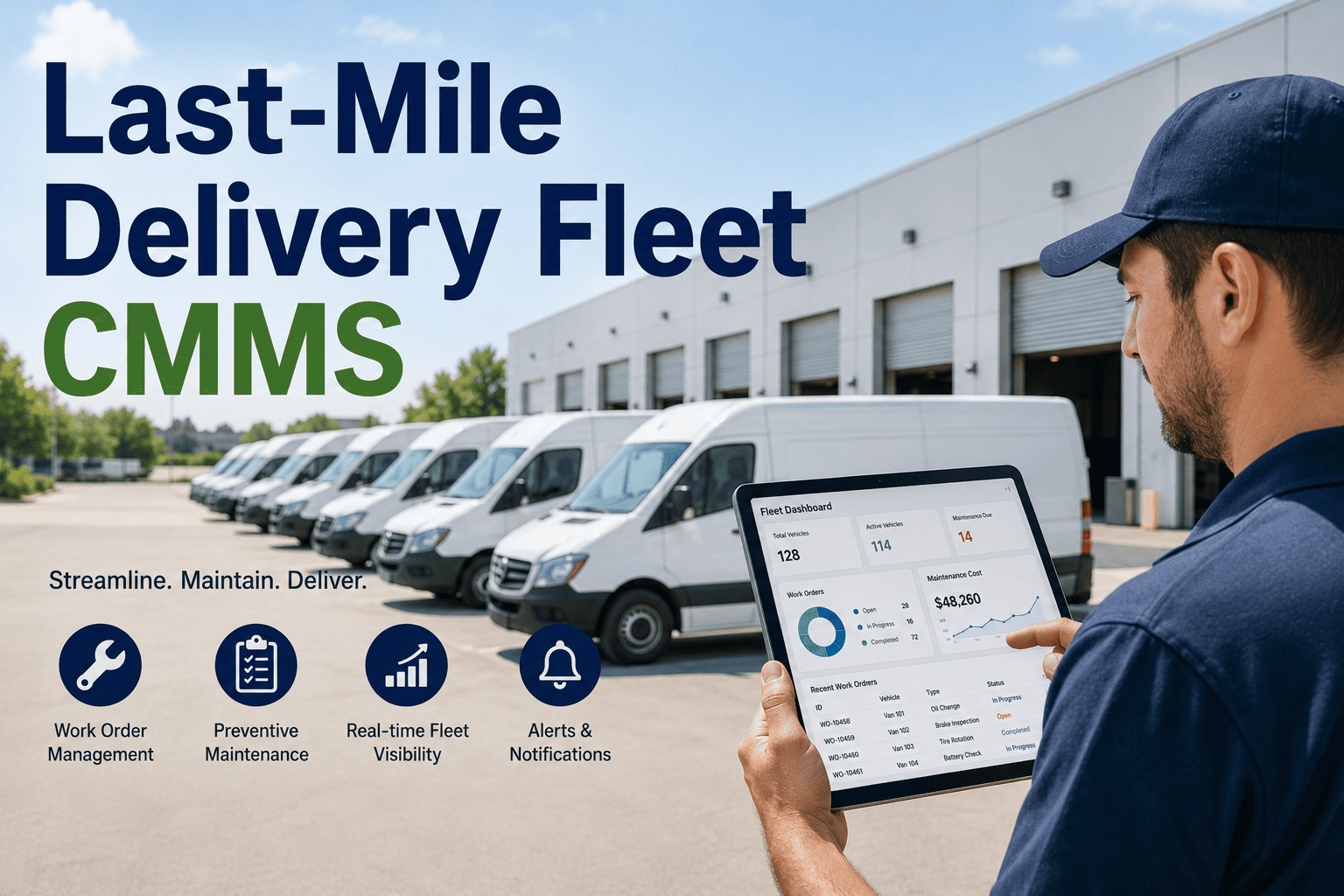
Fleet maintenance software has become the most consequential technology decision a US delivery company makes in 2026 — and also the most confusing one. There are dozens of platforms claiming to be the right choice, from basic inspection apps to enterprise CMMS suites, and the features that matter for a last-mile operation running 150 vehicles across 4 depots are completely different from what a national carrier managing 3,000 vehicles needs. This guide cuts through the noise. It maps what delivery fleets actually need from maintenance software in 2026, what separates AI-powered platforms from legacy systems, and where Oxmaint stands in the US market for delivery operations of every size.
Commercial Comparison · Buyer's Guide 2026
Best Fleet Maintenance Software for Delivery Companies in USA (2026 Guide)
The complete buyer's guide for US delivery fleet operators — what features actually move the needle on uptime, maintenance cost, and SLA compliance, and how leading platforms compare in 2026.
The US Delivery Fleet Maintenance Market — 2026 Snapshot
US Fleet CMMS Market (2026)
$2.1B
Fleets Still Using Spreadsheets
47%
Avg. Annual Downtime Cost (100-vehicle fleet)
$480K
ROI on AI Fleet Software (2 yr)
300–450%
Adoption Growth (AI Fleet Tools)
+34% YoY
What US Delivery Fleets Actually Need in 2026
Most fleet software reviews list features. This guide starts with outcomes — the specific operational problems US delivery companies need software to solve, ranked by the financial impact they have on fleet operations.
01
Prevent Mid-Route Breakdowns
Cost of failure: $1,200–$6,200 per event
The single most expensive maintenance failure for delivery operations. Every mid-route breakdown triggers emergency recovery, route disruption, SLA penalties, and reputation damage. Software must detect faults before dispatch — not after breakdown.
Required: AI pre-failure detection + pre-dispatch health scoring
02
Automate PM Scheduling at Scale
Manual overhead: 15+ hrs/week for 100+ vehicles
Fixed-calendar PM programs create over-servicing and under-servicing simultaneously. Software needs to generate dynamic, per-vehicle service schedules from actual usage and health data — not require a fleet manager to build and maintain them.
Required: Usage-based AI scheduling + work order automation
03
Control Parts Spend and Eliminate Stockouts
Emergency parts premium: 2.6x standard cost
Parts stockouts turn 2-hour repairs into 2-day downtime events. Dead stock locks capital in slow-moving inventory. Software needs to forecast parts demand from upcoming PMs and predictive faults — not require manual stock reviews.
Required: AI parts demand forecasting + auto reorder alerts
04
Deliver Live Uptime Visibility Across All Depots
Data lag with manual reporting: 18–24 hours
Multi-depot operations need real-time fleet health across every location in one dashboard — not end-of-day reports from separate depot systems. Operations directors and dispatch need live vehicle status, not yesterday's summary.
Required: Live multi-depot dashboard + role-based access
05
Generate SLA Compliance and Cost Analytics
SLA penalties: avg. $340 per breach
Commercial teams need maintenance cost per vehicle, SLA breach attribution, and fleet availability trends to defend performance at contract renewals. Software must connect maintenance operations data to commercial outcomes — not just generate work order reports.
Required: Cost analytics + SLA breach root cause reporting
The Buyer's Evaluation Checklist — 10 Features That Separate Good from Great
Before comparing platforms, use this checklist to score any fleet maintenance software against the capabilities that actually move the needle for US delivery operations.
Fleet Maintenance Software Evaluation Checklist — Delivery Operations
Score each platform against these 10 criteria before making a decision
1
AI Pre-Failure Detection
Does the platform predict vehicle failures 15–60 days in advance from telematics data — or only alert after fault codes trigger?
2
Pre-Dispatch Health Scoring
Does dispatch see a live vehicle health status before route assignment — or only a last PM date?
3
Dynamic PM Scheduling
Are service intervals calculated per-vehicle from actual usage and condition data — or are they fixed calendar dates you set manually?
4
Automated Work Order Generation
Are work orders created automatically from fault alerts and PM schedules — or does a manager need to create them manually?
5
Parts Demand Forecasting
Does the platform forecast parts requirements from upcoming PMs and predictive faults — and trigger purchase orders automatically?
6
Multi-Depot Live Dashboard
Can operations directors see real-time fleet health, uptime rates, and work order status across all depots in one view?
7
Telematics Integration
Does the platform integrate with your existing telematics provider (Samsara, Geotab, Verizon Connect) without requiring new hardware?
8
Mobile Technician Access
Can technicians access work orders, vehicle history, and complete job sign-off from mobile on the depot floor — without logging into a desktop?
9
Maintenance Cost Analytics
Does the platform report maintenance cost per vehicle, per depot, and fleet-wide — trended over time with high-cost vehicle flagging?
10
Deployment Speed
Can the platform be deployed across your fleet without a months-long IT project — and show measurable results within the first 30 days?
See how Oxmaint scores on all 10 criteria for your fleet size.
Deployment takes 14 days. No new hardware required. Results visible within 30 days.
Start Free Trial →
Platform Comparison — What US Delivery Fleets Need vs. What's Available
The US fleet maintenance software market splits into three tiers. Understanding which tier fits your fleet size and operational complexity prevents over-buying expensive enterprise systems you will not use — or under-buying basic tools that cannot scale.
Tier 1 — Inspection Tools
Whip Around, Fleetio Go, RTA Fleet
Best fit: Fleets under 50 vehicles with basic compliance needs
Digital vehicle inspections
DVIR compliance tracking
Basic work order management
AI predictive fault detection
Dynamic PM scheduling
Parts demand forecasting
Multi-depot uptime dashboard
Tier 2 — CMMS Platforms
Fleetio, ManagerPlus, Fleet Complete
Best fit: Mid-size fleets needing work order management and reporting
Full work order management
PM scheduling (calendar-based)
Parts inventory tracking
Basic telematics integration
Limited AI fault detection
Dynamic usage-based scheduling
Pre-dispatch health scoring
Tier 3 — AI-Powered Fleet Intelligence
Oxmaint, Trimble TMW, Decisiv
Best fit: High-volume fleets where uptime and SLA compliance are commercial KPIs
AI pre-failure detection (15–60 days)
Dynamic per-vehicle PM scheduling
Pre-dispatch health scoring
AI parts demand forecasting
Live multi-depot dashboard
SLA breach analytics + CapEx forecasting
Deploy in 14 days — no new hardware
Feature-by-Feature: Oxmaint vs. Fleetio vs. Whip Around
| Feature |
Whip Around |
Fleetio |
Oxmaint |
| AI Pre-Failure Detection |
Not available |
Limited alerts |
15–60 day lead, 8 fault types |
| Pre-Dispatch Health Score |
Inspection only |
Not available |
Live score per vehicle |
| PM Scheduling Type |
Calendar/mileage |
Calendar/mileage |
AI dynamic per-vehicle |
| Parts Demand Forecasting |
Not available |
Basic inventory tracking |
AI forecast + auto PO |
| Multi-Depot Live Dashboard |
Basic reporting |
Standard reports |
Live all-depot view |
| SLA Breach Analytics |
Not available |
Not available |
Root cause + trend data |
| Telematics Integration |
Selected providers |
Multiple providers |
Samsara, Geotab, VC, more |
| Deployment Timeline |
Days |
2–4 weeks |
14 days — any fleet size |
| Best For Fleet Size |
Under 100 vehicles |
50–500 vehicles |
50 to 5,000+ vehicles |
Why Delivery-Specific Fleets Choose Oxmaint in 2026
Most fleet maintenance platforms were built for general commercial fleets — trucking, construction, or field service vehicles. Delivery operations have a fundamentally different profile: high cycle counts, tight SLA windows, multi-stop urban routes, and daily dispatch pressure that makes pre-route vehicle screening critical rather than optional.
Built for Delivery
Dispatch-Integrated Health Screening
Oxmaint's pre-dispatch health scoring is built around the delivery dispatch workflow — not bolted on as a report. Every vehicle's live health status is visible at the point of route assignment, grounding critical faults before drivers report for shifts rather than after mid-route failures occur.
Scales to Any Fleet
50 to 5,000+ Vehicles — Same Platform
Oxmaint deploys across fleets of 50 vehicles or 5,000 — across 1 depot or 50 — on the same platform architecture. No tier upgrades, no separate enterprise contracts for multi-depot visibility. Growing fleets do not outgrow the platform and restart the software selection process in 3 years.
Fast to Value
14-Day Deployment, 30-Day Results
Oxmaint integrates with existing telematics infrastructure — no new hardware, no months-long IT projects. Full deployment across fleets of any size in 14 days. Most operations see measurable uptime improvement within 30 days as pre-dispatch screening begins catching faults that previously entered routes undetected.
Commercial ROI
SLA Analytics That Support Contract Renewals
Oxmaint tracks on-time delivery rate, SLA breach count, breach root cause classification, and compliance trends — giving commercial teams the data to defend performance at contract renewals. No other platform in the mid-market connects vehicle fault data directly to SLA breach attribution in a reportable format.
99%
Fleet Availability Achievable
AI pre-failure detection and pre-dispatch health scoring deliver consistent 98–99%+ fleet availability for delivery operations of any size.
25–30%
Maintenance Cost Reduction
Eliminating emergency repair premiums, over-servicing waste, and parts stockout delays delivers 25–30% lower total maintenance spend within 6 months.
14 days
Time to Full Deployment
No new hardware, no complex IT integration. Oxmaint connects to existing telematics and deploys live dashboards and AI monitoring across any fleet in two weeks.
Switching from Fleetio, Whip Around, or spreadsheets?
Oxmaint migrates your existing asset records and work order history as part of onboarding. No data loss, no starting from scratch.
Book a Demo →
Buyer's Guide Summary — How to Choose in 2026
→
Match platform tier to fleet operational complexity: Inspection tools (Whip Around) are sufficient for small fleets with basic compliance requirements. CMMS platforms (Fleetio) cover mid-size fleets needing work order management. AI-powered platforms (Oxmaint) are required for fleets where uptime, SLA compliance, and maintenance cost are active commercial KPIs.
→
AI predictive detection is the decisive differentiator in 2026: Every platform offers work order management and PM scheduling. The gap that matters is whether the platform detects faults 15–60 days before failure — or only alerts you after fault codes trigger or drivers report symptoms. That gap is the difference between a planned depot repair and a roadside breakdown.
→
Pre-dispatch screening is non-negotiable for delivery fleets: Unlike trucking or construction, delivery operations have daily dispatch cycles where every vehicle assignment matters. A platform without live health scoring at the dispatch decision point cannot protect high-SLA routes from breakdown risk.
→
Deployment speed should be part of the evaluation: A platform that takes 4–6 months to deploy is costing you real money during implementation. Prioritise platforms that integrate with your existing telematics infrastructure and can be operational within 30 days.
→
Choose a platform your fleet will not outgrow: Switching fleet maintenance software is expensive and operationally disruptive. Select a platform that scales from your current fleet size to 3–5x growth across multiple depots — without requiring a new platform evaluation in 3 years.
Start Your Free Trial or See Oxmaint in Action
Oxmaint gives US delivery fleets AI pre-failure detection, pre-dispatch health scoring, dynamic PM scheduling, parts demand forecasting, live multi-depot dashboards, and SLA breach analytics — all in one platform, deployed in 14 days. Start free or book a walkthrough tailored to your fleet size and operational setup.
Frequently Asked Questions
What is the best fleet maintenance software for a delivery company with 100–500 vehicles in the USA?
For delivery fleets in the 100–500 vehicle range, an AI-powered platform like Oxmaint is the right choice in 2026. At this fleet scale, the cost of unplanned downtime, SLA penalties, and maintenance inefficiency is large enough that basic CMMS tools leave significant money on the table. The critical features at this scale are AI pre-failure detection, pre-dispatch health scoring, dynamic PM scheduling, and live multi-depot dashboards — capabilities that Tier 1 inspection tools and most Tier 2 CMMS platforms do not offer. Oxmaint deploys in 14 days with no new hardware required and typically delivers measurable uptime improvement within 30 days.
How does Oxmaint compare to Fleetio for delivery fleet operations?
Fleetio is a strong CMMS platform for mid-size fleets needing digital work order management and PM scheduling. The key gaps for delivery operations are the absence of AI pre-failure detection, the lack of pre-dispatch vehicle health scoring, and the calendar-based PM scheduling model that creates over-servicing and under-servicing simultaneously. Oxmaint's AI platform closes all three gaps — detecting faults 15–60 days before failure, providing live health scores at dispatch, and building dynamic per-vehicle service schedules from real usage data. Both platforms offer telematics integration, but Oxmaint's AI analytics layer generates operational intelligence that Fleetio's CMMS architecture was not designed to produce.
Is Oxmaint a good Whip Around alternative for larger delivery fleets?
Yes. Whip Around is an excellent inspection and compliance tool for fleets under 50 vehicles where DVIR compliance and basic work order management are the primary requirements. For fleets above 50 vehicles — or any fleet where uptime, SLA compliance, and maintenance cost are active operational KPIs — Whip Around's inspection-focused architecture does not offer the AI predictive detection, dynamic scheduling, or analytics capabilities needed. Oxmaint covers all of Whip Around's core inspection and compliance functionality while adding the full AI maintenance intelligence layer that growing delivery fleets require as they scale.
What does fleet maintenance software typically cost for a 200-vehicle delivery fleet in the USA?
Fleet maintenance software pricing in the US market ranges from approximately $5–$15 per vehicle per month for Tier 1 inspection tools, $15–$35 per vehicle per month for Tier 2 CMMS platforms, and $25–$60 per vehicle per month for AI-powered Tier 3 platforms with predictive analytics and full automation. For a 200-vehicle fleet, the annual software cost ranges from approximately $12,000 to $144,000 depending on platform tier. The ROI calculation that matters, however, is not the software cost — it is the reduction in unplanned downtime, emergency repair premiums, and SLA penalties against the subscription cost. Most 200-vehicle fleets see the platform pay for itself within 60–90 days of AI maintenance deployment through downtime reduction alone.