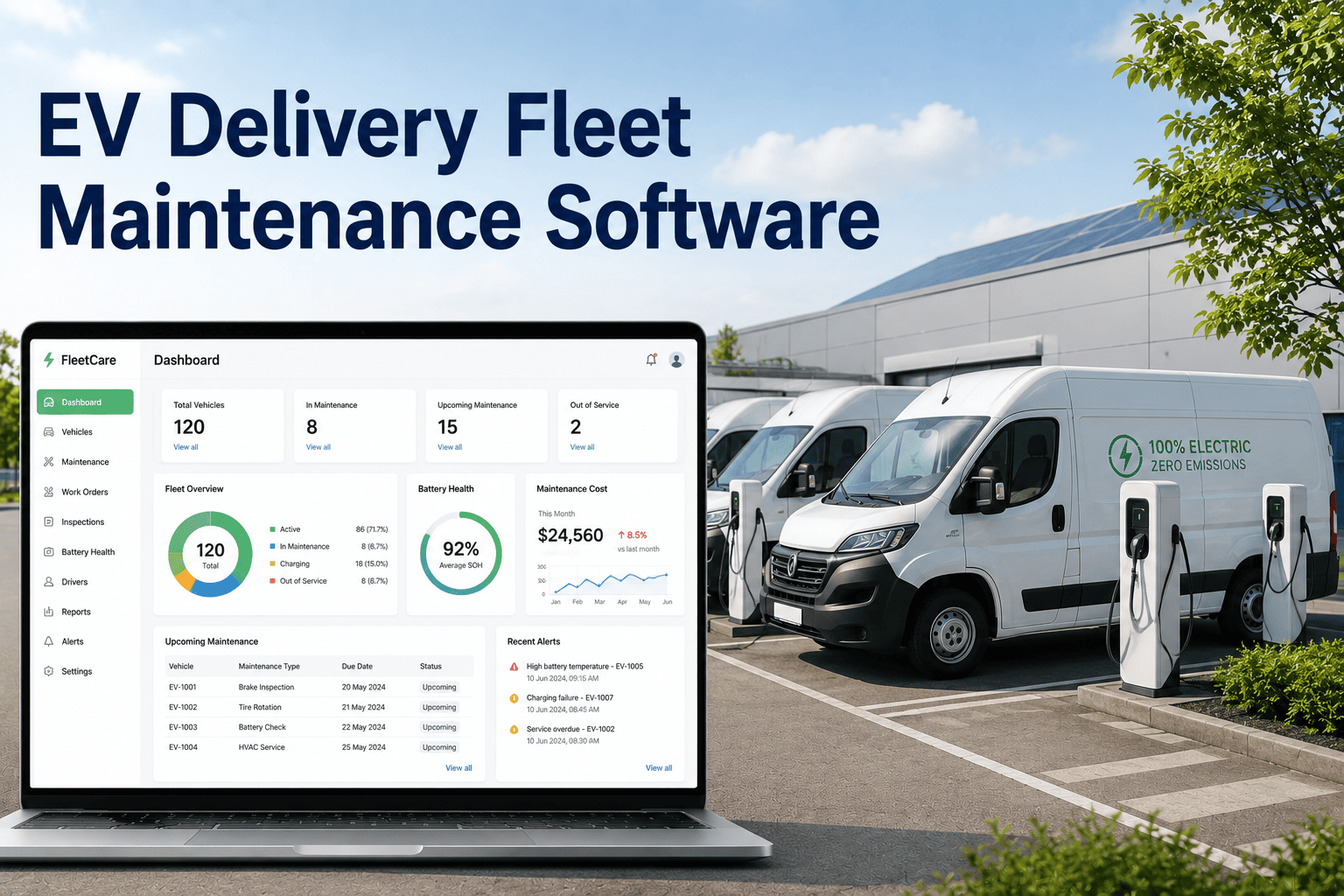
At 04:18 on a Wednesday morning, the night-shift supervisor at a 60-van electric delivery depot in New Jersey noticed something odd on the charging dashboard. Bay 11 showed "Charging" status, but the energy delivered counter had been frozen at 47 kWh for the last forty minutes. A quick walk to the bay confirmed it — the OCPP handshake had locked the session open while the actual contactors had opened from a thermal derate. The van assigned to that bay was scheduled out at 05:30 for a 142-mile multi-stop route. There were two hours to either fix the charger, swap the route to a different van, or pull the dispatch entirely. The supervisor pulled up the maintenance log on his phone, saw the same charger had thrown a "ContactorFault" event three nights earlier that nobody had actioned, and made the call. By 05:45, fourteen depots across the company received the same internal advisory — and the playbook for treating chargers as mission-critical assets, not "infrastructure," was born. Sign in to OxMaint or book a demo to put your EV vans and charger network on one maintenance system.
OxMaint · EV Delivery Fleet Maintenance Software
Track Battery State of Health, Charger Uptime, Inspections, PM Plans & Service Records — All in One Connected System
The Vehicle Side
40 to 60%
lower routine maintenance cost vs equivalent diesel van
30 to 40%
of asset value sits in the HV battery pack alone
10%
extra battery degradation from frequent DC fast charging in hot climates
The Charger Side
$400
average annual maintenance per charger (US DOE benchmark)
98.7% vs reality
reported charger uptime is often far higher than first-time charge success rate
$9.1B to $32.25B
EV fleet management market projected size, 2025 to 2030
Why ICE-Era CMMS Tools Fail on EV Fleets
An EV Delivery Fleet Is Two Asset Classes Running on One Clock — and Most CMMS Tools Only Understand One of Them
Traditional fleet maintenance software was built for oil changes, brake jobs, and mileage-based PM. An electric delivery fleet runs on entirely different physics — battery state of health drives the asset value, charger uptime drives the dispatch board, and OCPP fault codes need to convert into work orders before the next shift starts.
A
No concept of state of health
Legacy CMMS tracks oil hours and odometer mileage. It cannot pull SoH percentage, charging cycle count, or battery pack temperature from telematics APIs — leaving the most valuable asset on each van completely unmonitored.
B
Chargers are treated as fixed infrastructure
A broken charger is the same as a broken fuel pump — it takes vans out of service. Yet most CMMS platforms have no place to log charger faults, no work-order trigger from OCPP errors, and no charger PM schedule.
C
PM schedules are calendar-only, not condition-based
An EV does not need oil at 5,000 mi. It needs HV battery insulation testing every 12 months, coolant change every 80,000 mi, and brake fluid every 24 months — plus condition-based action when SoH drops faster than expected.
D
Range and route data live in different systems
When a van's available range drops 8% over a quarter, the dispatch team wants to know before they assign it to a 140-mile route. Without CMMS-telematics integration, that data is buried in the OEM portal and rediscovered roadside.
Battery Lifecycle
The State of Health Decay Curve — Why Every EV Delivery Fleet Needs It Tracked Per Vehicle
A delivery EV does not lose battery capacity in a straight line. It decays in three phases — each with a different management response. OxMaint pulls SoH data from telematics APIs and triggers the right work order at each phase, before degradation becomes a range problem.
100% to 95% SoH
Year 0 to Year 1 · First 30,000 mi
Break-In Decay
Action — Set the baseline. Log opening SoH, charging cycle count, and average pack temperature. This is the data point every future degradation reading is measured against.
95% to 85% SoH
Year 1 to Year 4 · 30,000 to 130,000 mi
Linear Decay
Action — Track the slope. A van degrading faster than the fleet average is a candidate for thermal investigation, DC-fast-charging audit, or route reassignment to a shorter daily distance.
85% to 75% SoH
Year 4 to Year 7 · 130,000 to 200,000+ mi
Knee-Point Decay
Action — Plan replacement. At ~80% SoH most warranties trigger. OxMaint projects replacement dates 12 to 18 months out so procurement and budget can plan, instead of reacting.
Below 75% SoH
End-of-life · Second-life or disposal
Second-Life Threshold
Action — Document for resale or second-life buyer. Used-vehicle pricing depends almost entirely on documented SoH history — fleets with a clean log get up to 20% better resale value.
Battery replacement on a typical delivery EV costs $8,000 to $20,000 (refurbished to new). Knowing the SoH trajectory three years before that moment is the difference between a planned procurement and an emergency capex line item.
OxMaint · Battery Health Intelligence
Battery telemetry becomes maintenance action — not a dashboard nobody opens. SoH alerts trigger work orders, replacement dates project 12 to 18 months ahead, and resale value gets protected by a clean lifecycle log.
Charger as Mission-Critical Asset
From OCPP Fault Code to Closed Work Order — In Under 15 Minutes
A broken charger does not just lose a kilowatt-hour — it strands the van that was meant to use it. The depots running EV fleets well have stopped treating chargers as "infrastructure" and started treating them as assets with their own PM schedule, fault catalogue, and work-order flow.
1
OCPP Status: Faulted
Charger reports a fault via OCPP — common codes include ContactorFault, GroundFailure, ConnectorLockFailure, EvCommunicationError, OverCurrentFailure, or HighTemperature. The status arrives at the charge-management system in real time.
2
OxMaint Auto-Captures the Event
OCPP fault event flows into OxMaint via API. Charger asset record updates with the fault code, timestamp, and the vehicle ID that was last connected. Asset status switches from Available to Out-of-Service automatically.
3
Work Order Generated With Diagnostic Context
A work order is created with the fault code, recommended remediation, parts pick list (if applicable — e.g. coolant top-up, connector replacement, contactor swap), and routing to the qualified technician. Diagnostic data attached.
4
Dispatch Sees the Impact Instantly
Vehicles assigned to that bay overnight are flagged for re-allocation to alternate bays. Energy delivery forecast for the depot recalculates. If multiple chargers go down, dispatch sees the cumulative shortfall before drivers arrive at 05:30.
5
Closure With First-Time Charge Verification
Technician closes the work order with photos, parts used, and time-on-task. A successful test charge to verify the fix is logged on the asset record. Charger returns to Available status only after first-time charge success.
The Depot Operations View
One Dashboard, Two Asset Classes — How a Depot Supervisor Actually Uses OxMaint at 05:00
The morning view that matters: every van's state of charge, every charger's status, every overnight defect, and every PM due today. Built for the supervisor walking into the depot before sunrise, who has thirty minutes to know whether the day starts on plan.
Vans Ready (SoC ≥ 90%, no critical defects)
51 / 60
Vans Charging (in-progress, ETA before dispatch)
6 / 60
Vans Out-of-Service (open critical work orders)
3 / 60
Chargers Available
28 / 32
Chargers in Fault / Maintenance
4 / 32
SoH Drop Alerts (vans below fleet decay slope)
2 vehicles
PM Due Today (battery insulation, brake fluid, coolant)
5 tasks
First-Time Charge Success Rate (last 7 days)
96.4%
What OxMaint Brings to an EV Fleet
Six Capabilities Purpose-Built for Electric Delivery Operations
Not a generic CMMS with an "EV mode." OxMaint is configured for the specific operational reality of electric delivery fleets — battery telemetry, OCPP integration, condition-based PM, and dispatch-aware reporting.
Battery Telemetry
SoH, SoC, cycles, temperature, range-per-kWh
Eight core data streams pulled from connected EV telematics APIs. Combined with work order history to create a complete battery lifecycle record — current SoH plus the operational conditions that drove the degradation.
Charger Monitoring
OCPP-native fault-to-work-order automation
Every charger treated as an asset with its own record. OCPP fault events convert automatically to work orders. PM schedules per charger type — Level 2 weekly visual, DC fast monthly thermal, all annual electrical inspection.
Condition-Based PM
EV-specific schedules, not ICE templates
HV battery insulation testing, coolant change, brake fluid, brake-pad wear (much lower on EVs due to regen), tyre rotation, charge port inspection, 12V auxiliary battery check — all scheduled per OEM and fleet history.
Driver Mobile
EV-specific pre and post-trip DVIR
Inspection templates configured for electric vans — charge port condition, HV warning indicators, regen brake performance, charging cable check, 12V auxiliary status, plus normal van checks. Critical defects block dispatch.
Parts & Repairs
EV parts inventory and HV-qualified tech routing
Inventory for charger connectors, coolant, contactors, 12V batteries, regen brake pads, charge cables. Work orders requiring HV access route only to HV-certified technicians. Full digital service history per VIN.
Cost & TCO
Cost-per-mile, energy cost, charger ROI
Maintenance cost per mile, energy cost per mile (from charging session data), charger utilization, demand-charge tracking. Total cost of ownership view that makes EV vs diesel decisions data-driven, not theoretical.
The TCO Math
Where the EV Maintenance Savings Actually Land — and Where They Don't
EV fleets save real money on routine maintenance — but only if the battery and charger sides of the equation are managed properly. Here is the cost-line comparison every fleet finance team should see before signing a five-year electrification plan.
| Cost Line |
Diesel Delivery Van |
Electric Delivery Van |
Net Position |
| Routine Powertrain Service |
Oil change every 5,000 mi · $80 to $150 each |
No oil, no spark plugs, no exhaust service |
EV saves 40 to 60% |
| Brake Pad and Rotor Wear |
Replacement every 35,000 to 50,000 mi |
Regen reduces wear · 80,000 to 130,000 mi typical |
EV saves 50%+ |
| HV Battery Coolant Service |
Not applicable |
Every 80,000 to 100,000 mi · $200 to $500 |
EV-only cost line |
| HV Battery Insulation Test |
Not applicable |
Annual · HV-certified tech required |
EV-only compliance |
| Battery Replacement (after 8+ years) |
Engine rebuild $3,000 to $7,000 |
Refurb $8,000 to $15,000 · New $15,000 to $20,000 |
EV higher one-time |
| Charger Annual Maintenance |
Fuel pump and dispenser checks (depot) |
$400 per charger DOE benchmark + OCPP monitoring |
Depot-side new line |
| Energy or Fuel Cost Per Mile |
$0.14 per mile at 25 mpg and $3.50 gal |
$0.04 to $0.06 per mile typical urban depot |
EV saves 60 to 70% |
| Total Routine Maintenance Cost |
Baseline reference |
40 to 60% lower vs diesel equivalent |
EV net winner |
Scroll horizontally to view all columns on smaller screens
Frequently Asked Questions — EV Delivery Fleet Maintenance Software
Does OxMaint pull battery state-of-health data directly from EV telematics?
Yes — OxMaint connects via API to major OEM and aftermarket telematics platforms, pulling SoH, SoC, charging cycles, pack temperature, and range-per-kWh per vehicle. Data flows into work-order triggers automatically.
Start a free trial to map your telematics setup.
Can OxMaint monitor depot chargers using the OCPP protocol?
Yes — OxMaint integrates with OCPP-compliant charge management systems, capturing fault events in real time and converting them into prioritised work orders with diagnostic context attached.
Book a demo to see the OCPP-to-work-order flow.
How is OxMaint different from a generic fleet CMMS for managing an EV fleet?
Generic CMMS tools have no concept of SoH, no OCPP integration, and no charger asset class. OxMaint handles vehicles and chargers as connected asset categories with EV-specific PM templates and HV-qualified work routing.
Sign in to OxMaint to see EV-mode in action.
How quickly can an EV delivery fleet go live on OxMaint?
Most EV fleets are live in 2 to 4 weeks — telematics API connection, charger OCPP integration, vehicle and charger asset import, PM templates configured, and first SoH baseline log. Larger multi-depot setups take 4 to 8 weeks.
Book a demo to scope your timeline.
Does OxMaint help with battery resale value when the vehicle is retired?
Yes — a clean, time-stamped lifecycle log of SoH, charging cycles, and thermal events is the data resale buyers ask for. Fleets with documented battery history routinely achieve up to 20% better resale pricing.
Start a free trial to begin logging from day one.
OxMaint · EV Delivery Fleet Maintenance Software
An EV delivery fleet rewards the operators who manage two asset classes well — vehicles and chargers — and punishes the ones who only watch one. OxMaint runs them on a single platform, with battery telemetry, OCPP fault flow, condition-based PM, and TCO reporting built in.
Battery SoH tracking · OCPP charger monitoring · EV-specific PM templates · HV-qualified work routing · Mobile DVIR for electric vans · Cost-per-mile and TCO dashboards · Resale-grade lifecycle records. Built for electric delivery operations, not bolted on as an afterthought.