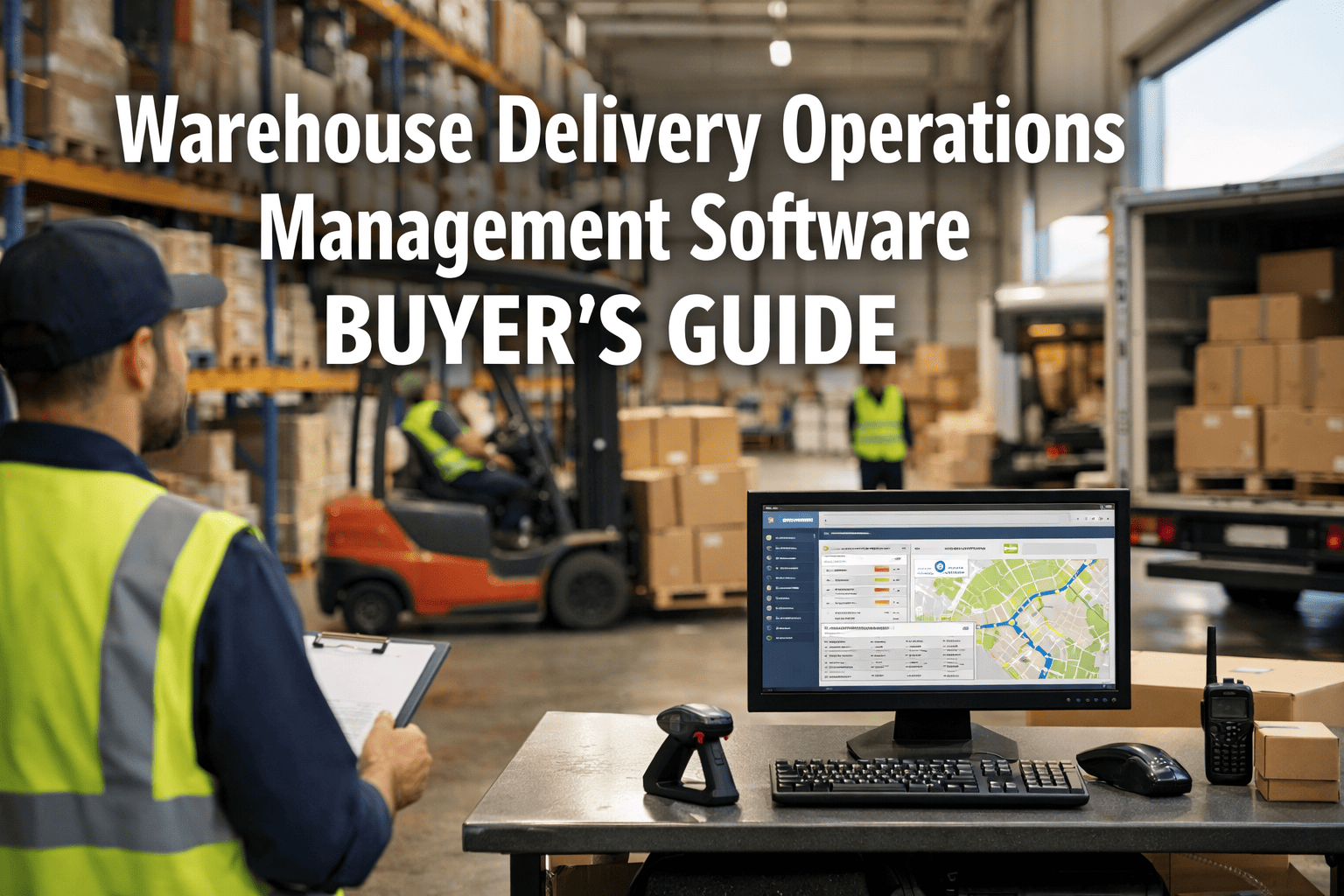
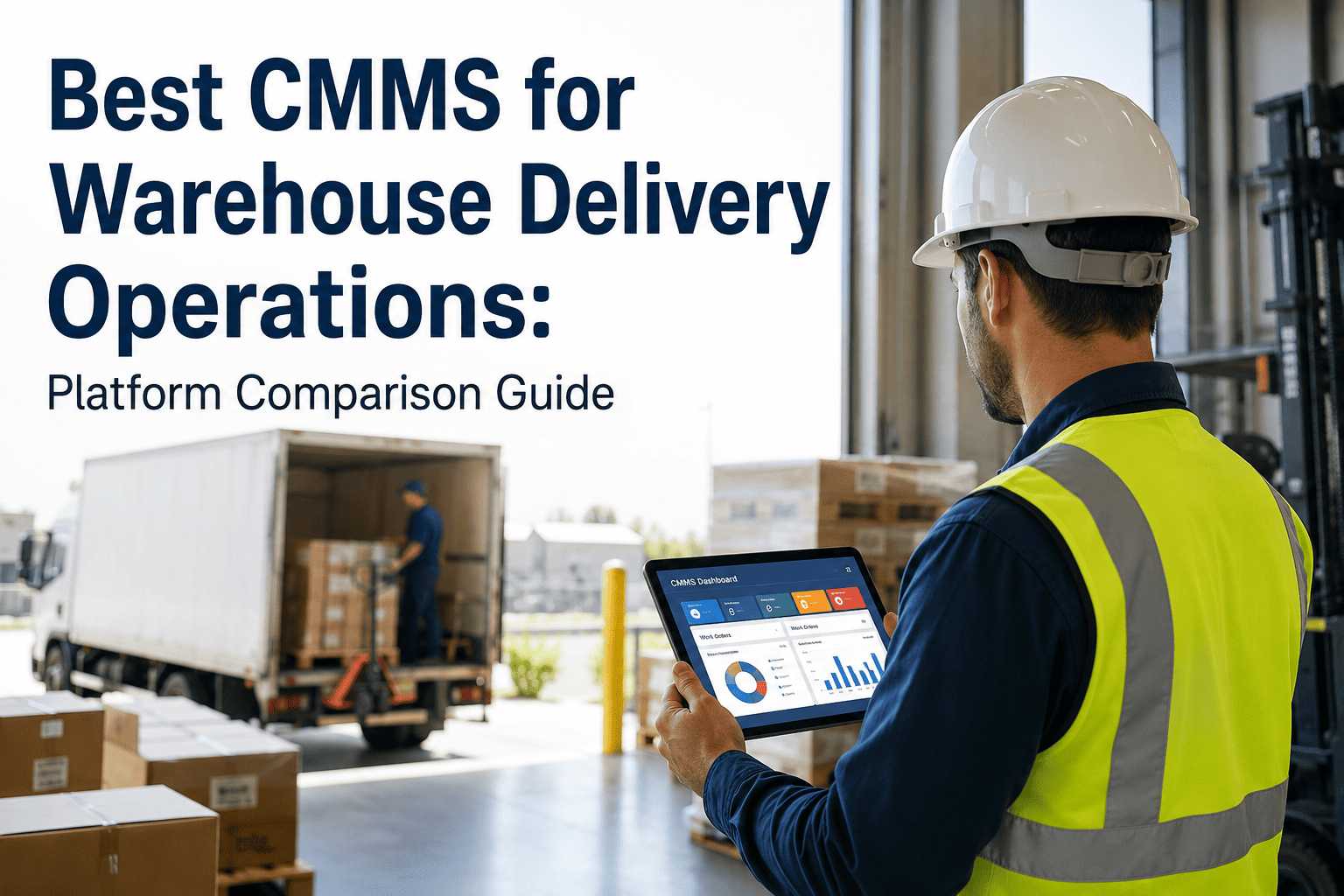
Selecting warehouse delivery operations management software in 2026 is harder than it has ever been. Over 400 warehouse management products compete in the category, entry-level pricing ranges from under $150 per month to enterprise platforms running six figures annually, and the gap between what vendors demonstrate in a slide deck and what their platform delivers in a live peak-season environment is wider than most buyers realize until the implementation is already underway. For maintenance and operations leaders, the stakes go beyond software cost — a wrong choice locks the facility into 3 to 5 years of workflow friction, missed SLAs, and integration debt that is expensive to unwind. This buyer's guide gives you the evaluation framework, the weighted scoring model, and the vendor questions that separate platforms that genuinely run warehouse operations from those that only look good in demos. Book a demo to see how OxMaint handles maintenance, work orders, and asset uptime inside warehouse delivery environments.
Buyer's Guide · Warehouse Delivery Operations · 2026 Edition
Warehouse Delivery Operations Management Software: The Complete Buyer's Guide
Cut through vendor marketing. Evaluate platforms with a weighted scoring framework. Ask the questions that expose platform gaps before you sign — not after.
400+
Warehouse software products competing for your purchase decision
$146-$868
Monthly price range from entry-level to advanced platforms
3-5 yrs
Typical lock-in period once a platform is deployed
$150K+
Enterprise implementation costs before training & integration
Why Most Buyers Choose Wrong
The Real Reasons Warehouse Software Purchases Fail
Most warehouse software buyers follow the same path: shortlist from analyst reports, sit through demos, negotiate price, and sign. The failures that show up 8 to 18 months later are rarely about the software's core features — they come from gaps the evaluation process never tested. The pattern below repeats across hundreds of buyer post-mortems.
Features gated behind premium tiers never disclosed in the sales cycle
Integration scope described as "supported" but needing six-figure custom work
No offline mobile capability — scanning stops when wifi drops
Implementation timeline "depends on your data" with no firm ceiling
Reference customers only from different industries or different size tiers
No clear maintenance module — WMS treats the warehouse as if nothing breaks
Upgrade path requires data migration and production downtime
Clear written list of what is and is not included in your quoted tier
Integration effort quoted in hours, not "subject to scoping"
Offline-first mobile with local queue and automatic conflict resolution
Fixed pilot timeline with explicit go-live and steady-state milestones
Same-size, same-industry reference customers willing to be interviewed
Integrated or tightly coupled maintenance & asset management capability
Versioned upgrade path with zero-downtime deployment pattern
The Weighted Scorecard
Evaluation Framework: How to Score Warehouse Platforms Against Each Other
Equal-weighted feature checklists hide what really matters. A platform with 95% feature coverage and weak integration will lose to one with 80% coverage and seamless ERP connectivity. The framework below weights criteria by their actual business impact — based on 116 WMS buyer surveys and published analyst data — so you can score vendors on what drives outcomes, not on what fills a spec sheet.
Core Operational Fit
Receiving, picking, packing, cycle counts, order profiles match your actual volume
Integration Depth
ERP, carriers, EDI, accounting, ecommerce — pre-built connectors and API quality
Mobile & Offline Capability
Scanning response time, offline queue, device ecosystem, worker UX quality
Maintenance & Asset Uptime
Work orders, PM schedules, asset history, downtime tracking — often overlooked
Implementation & Time-to-Value
Pilot duration, data migration tooling, training burden, go-live support
Total Cost of Ownership
Licensing, implementation, integration, training, ongoing customization
Vendor Viability & Roadmap
Financial stability, release cadence, AI/automation trajectory, customer support
The Buyer Journey
Five Phases From Shortlist to Signed Contract — What Should Happen, and When
Warehouse software purchases that go well follow a recognizable cadence. The phases below are not optional steps — skipping proof-of-concept, for example, correlates more strongly with buyer's remorse than any other single factor in published WMS buyer research.
Day 0–14
Phase 1 · Requirements & Shortlist
Document current workflows, pain points, SKU/lot/serial complexity, and order profiles (eaches vs cases vs pallets). Build a shortlist of 5 to 8 vendors matched to your size tier and industry.
Day 15–35
Phase 2 · Scripted Demos
Send every vendor the same demo script with your actual order types, inventory complexity, and peak-volume scenarios. Compare how platforms handle the same workflows — not generic product tours.
Day 36–60
Phase 3 · Reference Interviews
Request references matching your size and industry. Interview at least 3 per shortlisted vendor. Ask specifically about peak-season behavior, integration failures, and post-sale support responsiveness.
Day 61–90
Phase 4 · Proof of Concept
Run a paid or free 30-day POC with your actual data in a sandbox. This single step is the strongest predictor of a successful go-live. Skipping it is the strongest predictor of post-signing regret.
Day 91–120
Phase 5 · Contract & SLAs
Negotiate around uptime SLAs, data portability, implementation timeline guarantees, and upgrade terms. The contract is where vendor marketing meets legal reality — review it with an integration partner.
Need a Platform That Handles Both Warehouse Operations and Asset Uptime?
OxMaint is the CMMS backbone that warehouse delivery operations rely on for work orders, preventive maintenance, parts inventory, and asset history — the layer most WMS buyers don't realize is missing until equipment starts failing.
Feature Tiers
Must-Have vs Nice-to-Have vs Premium Features
Not every feature deserves equal weight in the decision. The matrix below sorts the most commonly requested warehouse software capabilities into three tiers so you can focus evaluation time where it matters — and resist vendor pressure to pay for premium features you may not actually need.
Tier 1 · Must-Have
Non-negotiable. If missing, eliminate the vendor.
Real-time inventory visibility across all locations
Barcode scanning with mobile device support
Directed put-away & picking workflows
Order fulfillment with pick, pack, ship tracking
Cycle counting & physical inventory management
Multi-warehouse & multi-location support
ERP integration via pre-built connector
Role-based access control & audit trail
Tier 2 · Nice-to-Have
Accelerates ROI. Evaluate based on your scale and complexity.
Labor management & productivity tracking
Wave planning & zone-based order allocation
Cross-docking & flow-through handling
Integrated maintenance & work-order management
Advanced slotting & velocity-based location assignment
Pre-built carrier & EDI integrations
Offline-first mobile with local queue
Real-time dashboards & exception alerts
Tier 3 · Premium
Genuine differentiators. Justify cost against measurable ROI.
AI-powered demand forecasting & slotting
Robot & AMR fleet orchestration
Digital twin simulation & scenario planning
Predictive maintenance on automation assets
Voice-directed picking & augmented reality guidance
Vision AI for quality & package verification
Advanced labor forecasting & staffing models
Multi-tenant 3PL billing & client portals
Total Cost of Ownership
The Real Cost of Warehouse Software — Beyond the Subscription Fee
Published buyer surveys consistently show that the sticker price accounts for less than half of the total 3-year cost of a warehouse platform. The breakdown below reflects typical TCO proportions across mid-market deployments — the categories most vendors underemphasize in pricing conversations are exactly the ones that dominate the invoice in year one.
Software Licensing
Implementation & Consulting
Integration & Customization
Training & Change Management
Ongoing Support & Upgrades
The Hidden Cost Most Buyers Miss
Integration with accounting, shipping, and EDI systems typically represents 18% of 3-year TCO but is frequently quoted as "supported" rather than scoped. Always get a firm integration price before signing.
The Year-One Shock
First-year costs typically run 1.8x to 2.5x the stated annual subscription due to implementation, integration, and training. Year two and beyond normalize closer to the headline subscription price.
Vendor Interrogation
Eight Questions to Ask Every Vendor Before Signing
These are the questions that separate platforms that run warehouse operations in production from those that demo well but fail under real workload. Bring this exact list to every vendor conversation — the answers will expose gaps the sales deck hides.
01
What features in your marketing materials are gated behind premium tiers, and how much does each tier add to our quoted price?
02
Can you give us three reference customers of our exact size in our exact industry who are running the same tier we are evaluating?
03
What does your platform do when mobile devices lose wifi mid-pick — does scanning stop, queue locally, or fail silently?
04
What is the firm fixed price for integrating with our specific ERP, and how many hours will implementation actually take?
05
How does your platform handle equipment maintenance, work orders, and asset downtime — or do we need a separate CMMS?
06
What is your upgrade path, and does any upgrade require production downtime or data migration we have to manage?
07
What are your published uptime SLAs, and what happens financially if you breach them during our peak season?
08
If we terminate the contract in 12 months, how do we get our data out, and what format is it delivered in?
Pricing Reality Check
Warehouse Software Pricing by Tier and Scale
Published pricing data across 400+ warehouse platforms shows clear tier patterns. Use the ranges below to pressure-test any vendor quote — if a mid-market platform is quoting enterprise pricing, or an enterprise platform is quoting below mid-market, you are likely looking at incomplete scope.
| Tier |
Monthly Subscription |
Implementation Cost |
Typical Best Fit |
Expected Go-Live |
| Entry-Level |
$29 – $150/mo |
Under $10K |
Small retail & ecommerce, single warehouse, <1K orders/day |
2 – 6 weeks |
| Mid-Market |
$500 – $2,000/mo |
$10K – $50K |
Growing distributors, 1–5 warehouses, 1K–10K orders/day |
6 – 16 weeks |
| Advanced |
$2,000 – $10,000/mo |
$50K – $150K |
Multi-site operations, 3PLs, complex automation & labor |
4 – 9 months |
| Enterprise |
Custom (6 figures annually) |
$150K – $1M+ |
Global networks, SAP/Oracle backbone, enterprise SLAs |
9 – 24 months |
Frequently Asked Questions
Warehouse Software Buying Decisions — Common Questions
Do we need a separate CMMS if our warehouse software already includes maintenance features?
How long does a typical warehouse software evaluation take from shortlist to signed contract?
Realistic timelines run 90 to 120 days across shortlist, demos, references, proof-of-concept, and contract negotiation. Rushing below 60 days correlates strongly with buyer's remorse within the first year.
Start a free trial to test the workflow yourself.
What is the single biggest mistake warehouse software buyers make in the evaluation process?
Skipping proof-of-concept. Trusting a scripted demo over running the platform against your actual data is the strongest predictor of post-signing regret in published WMS buyer surveys.
Book a demo to start with a structured POC.
Should we prioritize a best-of-breed WMS or an integrated ERP with warehouse management built in?
Best-of-breed typically wins on functional depth and mobile experience. Integrated ERP wins on data consistency and lower integration overhead. Scale, complexity, and existing ERP dictate the answer.
Start a free trial to compare approaches.
How do we validate that a vendor's claimed uptime SLA is real and enforceable?
Request historical uptime data from the last 12 months, specifically during peak periods. Review the contractual remedy — credits that cap at one month's fees are weak; credits tied to business impact are stronger.
Book a demo to discuss SLA structure.
Complete Your Evaluation · OxMaint CMMS · Warehouse Operations
Ready to See the Maintenance Layer Your WMS Shortlist Is Missing?
Most warehouse platforms treat equipment as if it never breaks. OxMaint is the work-order, asset-history, and preventive maintenance backbone that keeps conveyors, AMRs, sortation systems, and dock equipment running through peak season. Book a demo to see where OxMaint fits alongside the WMS you're evaluating — or start a free trial today.