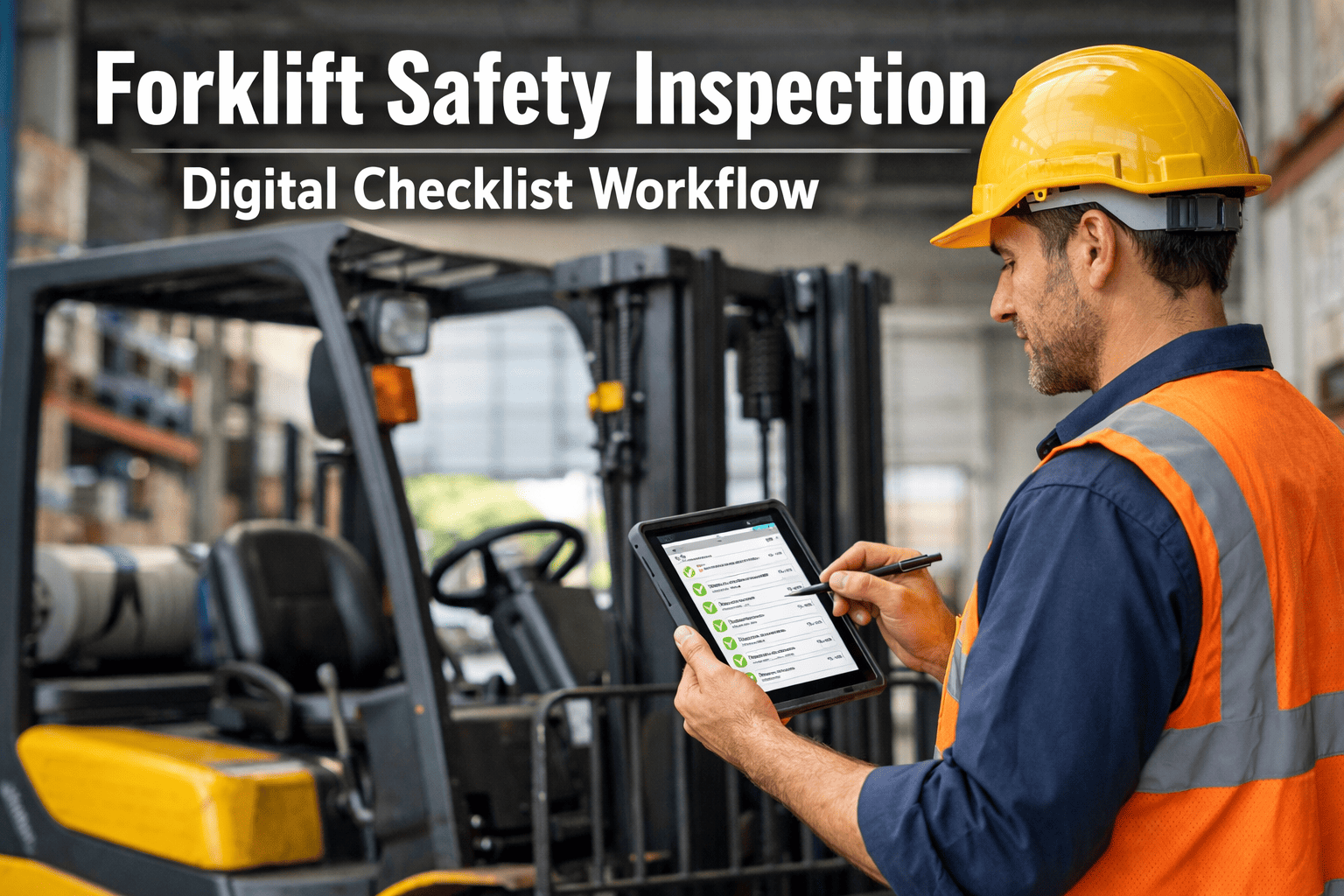
The maintenance supervisor at a beverage distribution warehouse in Jacksonville got the OSHA letter on a Wednesday in September. An inspector had visited the facility the previous week following a complaint. During the walk-through, the inspector asked to see the daily forklift inspection records for the facility's 14 forklifts. The supervisor opened a filing cabinet and pulled out a clipboard with paper checklists. Eleven of the 14 forklifts had no inspection record for the day of the visit. Of the three that did have records, two were filled out in the same handwriting at the same time suggesting they were completed retroactively rather than during an actual pre-shift walk-around. The inspector examined forklift number six on the floor and found a hydraulic leak at the tilt cylinder that had stained the mast assembly with fluid tracking at least two weeks old. The left fork tip was worn to 87 percent of its original thickness, below the 90 percent minimum. The seat belt retractor was jammed. The backup alarm produced no sound. OSHA issued four serious citations under 29 CFR 1910.178: failure to perform daily inspections, failure to remove unsafe equipment from service, failure to maintain inspection records, and failure to ensure operator training included equipment examination procedures. Total proposed penalty: $62,400. The mechanical repairs that would have resolved every defect cost $4,540. A digital inspection workflow that takes five minutes per forklift per shift would have caught every defect on the day it first appeared, generated an automatic work order to maintenance, locked the forklift out of service until repaired, and produced the timestamped audit trail that makes citations impossible.
Powered industrial trucks ranked sixth among OSHA's most frequently cited standards in 2024, with forklift-related citations generating over $15 million in penalties. The daily inspection requirement under 29 CFR 1910.178(q)(7) alone accounted for 172 violations. Across American warehouses, forklifts cause between 35,000 and 62,000 injuries annually, 79 fatalities per year, and an average of 16 missed workdays per injury, double the national average. Seventy percent of these incidents are preventable with proper training and inspection. Paper checklists on clipboards create the appearance of compliance without the substance because they cannot prevent an uninspected forklift from being operated, cannot auto-generate repair work orders, and cannot produce verifiable records that survive OSHA scrutiny. A digital inspection workflow inside a CMMS solves every one of those failures. This guide provides the complete OSHA-compliant digital checklist with checkpoint verification for every inspection zone, severity classifications, and the workflow that turns each failed checkpoint into an immediate maintenance action.
$15M+
Forklift citation penalties in 2024
62,000
Annual forklift injuries in U.S. warehouses
70%
Of incidents preventable with inspection and training
172
Daily inspection violations cited in 2024 alone
16 Days
Avg missed workdays per forklift injury (2x national avg)
Checkpoint Zone A: Tires, Wheels, and Undercarriage
Engine off. Key removed. Parking brake engaged. Begin with a full 360-degree walk-around starting at the left front tire and moving clockwise. Every checkpoint requires a Pass or Fail response in the digital system. Any Critical checkpoint failure triggers automatic forklift lockout.
Tire condition: no cuts, gouges, chunking, or embedded debris on any tire
CRITICAL
Pneumatic tire inflation within manufacturer rated pressure range (check with gauge)
CRITICAL
Solid/cushion tires: no flat spots, bonding separation, or wear below minimum tread
MAJOR
All lug nuts present, tight, and torqued to specification on every wheel
CRITICAL
No fluid puddles or wet stains beneath forklift (oil, hydraulic fluid, coolant)
MAJOR
Axle and wheel mounting hardware: no visible cracks, bending, or corrosion damage
CRITICAL
Checkpoint Zone B: Forks, Mast, and Lift Chains
Fork blade thickness: no wear exceeding 10% of original (measure at heel with caliper)
CRITICAL
Fork straightness: no lateral bending, twisting, or uneven tip height between forks
CRITICAL
Fork heel and root area: no cracks or stress fractures (inspect with flashlight)
CRITICAL
Fork locking pins: present, functional, fully engaged in carriage positioning notch
CRITICAL
Mast rails: no cracks, bends, weld fractures, or missing hardware
CRITICAL
Lift chains: proper tension, no stretched/damaged/corroded links, adequately lubricated
CRITICAL
Chain anchor pins: secure at both carriage and mast attachment points
CRITICAL
Mast rollers: present, rotating freely, no flat spots or seized bearings
MAJOR
Checkpoint Zone C: Hydraulic System
Hydraulic fluid level within operating range on sight glass or dipstick
MAJOR
All hydraulic hoses: no cracking, abrasion wear, bulging, or active weeping
CRITICAL
Lift and tilt cylinder rods: no scoring, pitting, rust, or visible seal leakage
CRITICAL
All hydraulic fittings: tight connections, no drips or moisture accumulation
MAJOR
Hydraulic control levers: move freely, return to neutral, no binding or sticking
CRITICAL
Checkpoint Zone D: Safety Equipment and Operator Protection
Overhead guard: intact structure, no cracks, all mounting bolts present and tight
CRITICAL
Load backrest extension: securely mounted, no damage or missing sections
MAJOR
Seat belt: retracts fully, extends smoothly, latches and releases properly
CRITICAL
Horn: produces audible alert when pressed (test at inspection area)
CRITICAL
Backup alarm: audible at minimum 25 feet when reverse is engaged
CRITICAL
All lights functional: headlights, tail lights, and warning strobe/beacon
MAJOR
Data plate: legible, attached, and matches current equipment specifications
MAJOR
Fire extinguisher (if equipped): present, charged gauge in green, mount secure
MAJOR
Mirrors: present, clean, adjusted for rear and side visibility
MINOR
Every CRITICAL checkpoint failure locks the forklift out of service automatically. No supervisor override. No "I'll report it later." The digital system generates a maintenance work order with the defect photo, forklift ID, operator name, and timestamp the moment a CRITICAL item is marked Fail. Sign up free on OXmaint to deploy these digital checklists with automatic lockout and work order generation across your fleet.
Checkpoint Zone E: Operational Checks (Engine Running)
After all visual checkpoints pass, start the forklift in a designated safe inspection area and verify every dynamic system under power.
Service brake: firm pedal feel, stops within rated distance, no pull to either sideCRITICAL
Parking brake: holds on grade, engages fully, does not slip under rated loadCRITICAL
Inching/deadman brake: disengages smoothly when pressure is releasedCRITICAL
Full left and right lock without binding, grinding, or excessive free playCRITICAL
Power steering fluid adequate, no whine or groaning at full lockMAJOR
Steering response proportional and predictable at slow travel speedCRITICAL
E3
Lift and Tilt Controls
Mast raises and lowers smoothly through full range without hesitation or jerkingCRITICAL
Tilt engages forward and back smoothly without shuddering or delayCRITICAL
No mast drift: forks hold position at height for minimum 10 minutes unloadedCRITICAL
Side shift (if equipped) moves freely in both directions without catchingMAJOR
E4
Engine, Transmission, and Gauges
Engine starts without excessive cranking, runs without misfiring or stallingMAJOR
Transmission engages forward and reverse without delay, grinding, or slippingCRITICAL
No unusual noises, vibrations, or smoke during idle and low-speed operationMAJOR
All dashboard gauges and warning indicators within normal operating rangeMAJOR
Paper Checklists vs. Digital CMMS Inspection Workflow
Operator may skip inspection entirely with zero system consequenceForklift key release requires completed digital checklist before operation
Defects written on paper but no automatic work order generatedFailed checkpoint instantly creates prioritized work order with defect photo
Forms filed in binder nobody reviews until OSHA arrivesReal-time dashboard: inspected, failed, locked out, or awaiting repair per unit
No timestamp verification. Forms easily backdated or batch-completedGPS-stamped, time-stamped, operator-ID authenticated. Cannot be falsified.
Recurring defects invisible without manually reviewing months of handwritten formsTrend analysis flags forklifts with repeat failures for root cause investigation
Operator certification expiration tracked manually. Expired operators discovered during auditsCertification dates tracked with 30-day alerts. Expired operators locked out of checklist
The Escalation Cost of One Skipped Inspection
Step 1: The Skip
$0 apparent cost
Operator bypasses pre-shift checklist. Starts forklift 30 seconds faster. Defect undetected. Estimated to happen at 60-70% of facilities on any given shift when paper is the only control.
Step 2: Defect Worsens
$800 - $4,500
Hydraulic weep becomes pressurized leak. Fork wear drops below 90%. Brake pads reach metal-on-metal. Moderate repair cost. Nobody knows because nobody looked.
Step 3: The Incident
$42,000 average
Brake failure causes collision. Hydraulic failure drops a load onto a worker. Fork fractures under weight. One recordable injury averages $42,000 in medical, lost time, investigation, and administrative costs.
Step 4: OSHA Investigation
$62,400+ citations
Inspector requests records. Records missing, incomplete, or fabricated. Citations for failure to inspect, failure to remove unsafe equipment, failure to document. Average serious citation: $15,625 per violation.
Step 5: Total Impact
$150K - $500K+
Injury + penalties + repair + downtime + workers comp premium increase for 3 years + legal costs + potential management termination. One uninspected forklift. Half a million dollars.
Five minutes of digital inspection prevents five levels of escalating cost. Schedule a demo to see how OXmaint's digital inspection workflow breaks this escalation chain at Step 1.
ROI of Digital Forklift Inspection
Based on a 14-forklift fleet operating two shifts per day, six days per week.
$62,000
OSHA Penalty Avoidance
Documented compliance eliminates daily inspection citation risk entirely
$84,000
Injury Cost Reduction
Early defect detection prevents 2 recordable incidents per year at $42K each
$48,000
Downtime Elimination
Defects caught at inspection prevent 6-8 mid-shift breakdowns per year
$38,000
Extended Equipment Life
Fluid leak and wear detection extends forklift lifecycle 15-25%
$28,000
Workers Comp Savings
Documented inspection program reduces experience mod rate 8-15%
Implementation Timeline
Fleet Registration and Checklist Build
Register every forklift with make, model, serial, capacity, fuel type. Upload operator certifications with expiration dates. Configure digital checklists per forklift type. Set auto-lockout rules for Critical failures.
Training and Pilot Shift
Train operators on digital checklist including photo documentation. Run one shift with digital and paper in parallel. Validate work order routing from failed checkpoints. Tune notification timing for maintenance response.
Sign up free to start configuring now.
Full Fleet Digital Rollout
Expand to all forklifts, all shifts. Eliminate paper completely. Enable auto-lockout enforcement. Launch supervisor dashboard for real-time fleet status at shift start.
Continuous Compliance
100% completion rate monitoring. Quarterly defect trend analysis. Annual checklist template update for OSHA changes. 30-day certification expiration alerts with automatic operator lockout.
Frequently Asked Questions
What does OSHA require for daily forklift inspections?
OSHA standard 29 CFR 1910.178(q)(7) requires that industrial trucks be examined before being placed in service each shift. If conditions are found that would make the equipment unsafe, the forklift must be removed from service until corrected. OSHA does not prescribe a specific checklist format, but inspectors look for systematic evidence that inspections actually occur, that defects are identified and corrected before operation, and that records are maintained. In 2024, daily inspection violations accounted for 172 citations, and powered industrial trucks ranked sixth overall among OSHA's most-cited standards. The standard also connects to operator training requirements under 1910.178(l), which require that operators be trained in equipment examination procedures as part of certification.
What happens if a CRITICAL checkpoint fails during digital inspection?
When a CRITICAL checkpoint is marked Fail in the digital system, three things happen immediately. First, the forklift is automatically locked out of service, meaning no operator can complete the checklist and release the unit for operation until the defect is repaired. Second, a maintenance work order is auto-generated with the specific defect, the checkpoint that failed, the operator's photo of the defect, the forklift ID, and the timestamp. Third, the maintenance team receives an immediate notification with the work order details so they can prioritize the repair. The forklift remains locked out until a qualified technician completes the repair, documents the correction in the CMMS, and the unit passes a post-repair inspection. This cycle creates a complete, auditable defect-to-resolution record for every Critical failure.
How long does a digital forklift inspection take?
A complete digital pre-operation visual inspection takes 3 to 5 minutes per forklift. The operational checks with the engine running add 2 to 3 minutes. Total time is 5 to 8 minutes per forklift per shift. Digital checklists are actually faster than paper because they use pass/fail toggles instead of handwritten descriptions, auto-populate forklift data and operator identity, and require photo documentation only for failed items rather than written narratives. At 5 to 8 minutes of prevention versus $42,000 per recordable injury or $62,400 in OSHA citations, the inspection delivers the highest return-per-minute of any warehouse activity.
What ROI can a facility expect from digital forklift inspections?
A 14-forklift fleet can expect approximately $260,000 in annual savings from OSHA penalty avoidance ($62K), injury cost reduction ($84K), unplanned downtime elimination ($48K), extended equipment life ($38K), and workers compensation premium savings ($28K). Against a digital platform cost of $8,000 to $18,000 per year, the ROI is 14 to 32x. The highest single-impact item is injury cost reduction because forklifts cause 35,000 to 62,000 injuries annually and the average recordable injury costs $42,000, with 70 percent of those incidents preventable through proper inspection and training programs.
$62,400 in Citations. $4,540 in Repairs. Five Minutes That Change Everything.
That Jacksonville warehouse paid $62,400 because 11 of 14 forklifts had no inspection record when OSHA arrived. Every mechanical defect that triggered those citations cost $4,540 total to fix. Five minutes of digital inspection per forklift per shift would have caught every defect, generated every work order, locked out every unsafe unit, and produced the audit trail that makes penalties impossible. Your forklifts are starting uninspected right now.