A G2P system that delivers 800 totes per hour during peak operations is not just automation — it is the backbone of every SLA you have committed to. When a shuttle stops, a lift jams, or a tote conveyor backs up, every pick station downstream goes idle, and your order fulfillment rate drops to zero at exactly the moment it cannot afford to. OxMaint CMMS gives maintenance teams a structured, data-driven programme to protect G2P uptime — with preventive maintenance schedules, condition-based work orders, and full asset history for every shuttle, lift, conveyor zone, and workstation in your system.
Warehouse Fulfillment / CMMS Strategy
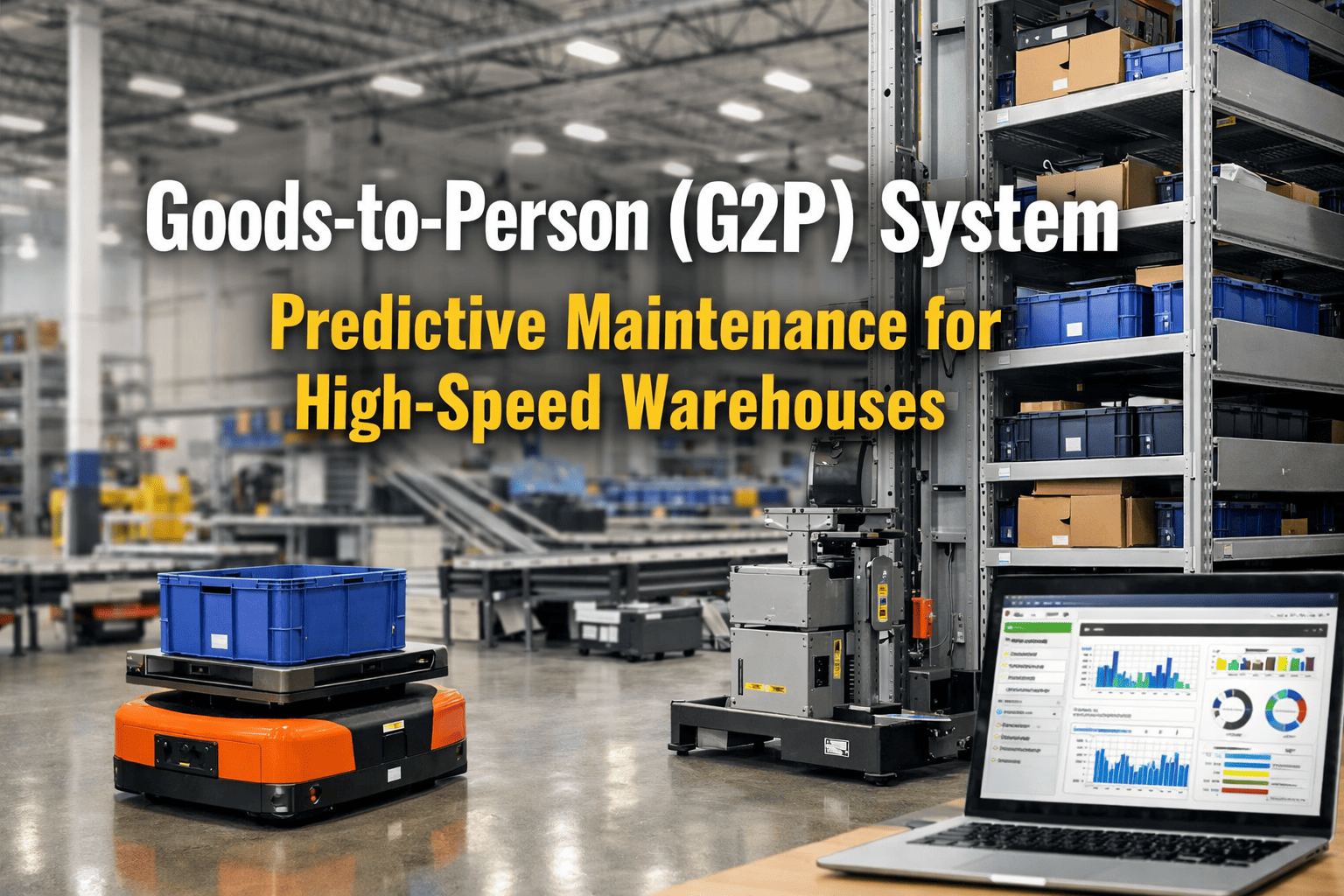
Goods-to-Person (G2P) System Predictive Maintenance for High-Speed Warehouses
Prevent pick-line disruptions, protect SLA commitments, and achieve 97%+ uptime across your G2P infrastructure — with CMMS-managed maintenance built for the complexity of automated fulfillment systems.
$1.5B
G2P robotics market 2023 — growing to $5.9B by 2032
70%
of order picking time in manual warehouses is walking — G2P eliminates it
30–40%
downtime reduction achievable with structured predictive maintenance programmes
97%+
uptime target for high-throughput G2P systems operating across multiple shifts
Why G2P Systems Demand a Different Maintenance Approach
A traditional warehouse that breaks down loses productivity. A G2P warehouse that breaks down loses its entire operational model — because there is no manual fallback when shuttles stop retrieving and pick stations go dark. The interdependence of components that makes G2P systems so efficient is the same interdependence that makes their failure so acute. A single failed lift takes offline every aisle it serves. A backed-up tote conveyor stops every workstation it feeds. G2P maintenance is not about fixing individual machines — it is about protecting a connected, high-velocity system where every component is in the critical path.
Critical Failure Zone
Shuttle Retrieval Units
A shuttle failure mid-aisle locks the aisle and makes every tote stored in that zone inaccessible. In aisle-based G2P systems, a single shuttle failure typically halves the throughput of its aisle section immediately. Battery degradation, drive wheel wear, and extractor mechanism fatigue are the leading failure modes — all detectable weeks in advance.
Critical Failure Zone
Vertical Lifts
Lifts are the only path from aisle storage to the conveyor system. When a lift fails, every shuttle in its aisle that has retrieved a tote has nowhere to deliver it. Lift failures cascade immediately — the aisle fills with retrieved totes with nowhere to go, and throughput collapses to zero for that section. Chain stretch, motor torque decline, and encoder drift are the primary failure precursors.
High Impact Zone
Tote Conveyor System
The conveyor network sequences totes from lifts to pick stations in the correct order. Motorised roller failures, belt tracking issues, and divert mechanism jams cause tote sequencing errors — meaning the wrong totes arrive at the wrong workstation, forcing manual intervention to restore order integrity. Conveyor failures are often tolerated until they escalate because individual zone failures are absorbed by the system — until they cannot be.
High Impact Zone
Pick Station Hardware
Pick-to-light controllers, barcode scanners, weight verification scales, and tote return conveyors are maintained less frequently than storage and retrieval hardware — but a failed workstation reduces total pick capacity by a calculable percentage per station. In operations with six to twelve active workstations, a single failed station represents an 8–16% capacity reduction during peak periods.
Monitored Zone
Charging Infrastructure
For shuttle-based systems, charging rail wear, contact point oxidation, and charging station electronics affect shuttle battery state across the entire aisle. Degraded charging causes shuttles to return to charging more frequently, reducing their available retrieval time per shift — a slow, invisible throughput erosion that appears first in shift-level throughput data rather than obvious fault alarms.
Monitored Zone
Software and Controls
Warehouse Control System (WCS) and Warehouse Management System (WMS) database fragmentation, communication latency between control layers, and PLC firmware drift cause phantom stops, sequencing delays, and task assignment errors that appear as equipment problems. Scheduled database maintenance, firmware update management, and network latency monitoring belong in the CMMS maintenance programme alongside mechanical PM tasks.
Structure Your G2P Maintenance Programme in OxMaint
Asset-level PM schedules for shuttles, lifts, conveyors, workstations, and charging infrastructure — with work order routing, spare parts management, and MTBF tracking built in for G2P-scale operations.
The G2P Maintenance Frequency Matrix
Each component category in a G2P system has a different failure mode profile, failure lead time, and optimal maintenance interval. This matrix maps the critical maintenance tasks by frequency — providing the structure for a CMMS-managed PM programme that covers the full G2P asset inventory without over-maintaining low-risk components or under-maintaining high-risk ones.
Scroll to view full table
| Component |
Daily Check |
Weekly PM |
Monthly PM |
Quarterly PM |
Annual PM |
| Shuttle Units |
Battery state, error log review, drive wheel visual |
Wheel wear measurement, extractor mechanism test, sensor cleaning |
Drive motor current draw, bearing vibration baseline |
Full drive system inspection, battery capacity test, firmware check |
Complete mechanical overhaul, replace wear items per OEM schedule |
| Vertical Lifts |
Chain tension visual, error code review |
Chain lubrication, guide rail inspection, safety brake test |
Motor torque measurement, encoder accuracy verification |
Chain elongation measurement, load cell calibration |
Chain replacement assessment, full mechanical inspection |
| Tote Conveyors |
Jam log review, divert mechanism function check |
Motorised roller condition, belt tracking inspection |
Roller current draw trending, divert timing calibration |
Full belt/roller inventory assessment, photoeye cleaning |
Belt replacement assessment, full electrical termination check |
| Pick Workstations |
Scanner function test, put-to-light indicator check |
Scale calibration verification, barcode scanner window cleaning |
Tote return conveyor condition, wiring inspection |
Full controller diagnostic, UPS battery state check |
Full station electrical audit, controller firmware update |
| Charging Rails |
Contact point visual (oxidation, arcing marks) |
Contact resistance measurement per station |
Full rail continuity test, brush wear measurement |
Rail alignment check, voltage drop test under load |
Full rail replacement assessment, contact replacement |
| WCS/Controls |
System log error count review |
Database query response time check |
Database maintenance and defragmentation |
Network latency audit, PLC firmware version review |
Full control system audit, backup restoration test |
What Predictive Maintenance Actually Looks Like on a G2P System
Predictive maintenance on G2P systems is not a single technology — it is a layered combination of data sources, each providing different failure signals with different lead times. The most effective programmes combine three detection layers.
Layer 1
Native System Telemetry
Every modern G2P system generates rich operational data — shuttle cycle counts, motor torque readings, error code frequency, task completion times, battery discharge curves, and throughput per aisle per shift. This data is available without additional sensor hardware. The problem is that most facilities do not have a structured programme to extract it, trend it, and act on it before it becomes a failure. OxMaint work orders triggered by telemetry thresholds — not just calendar intervals — convert this existing data into proactive maintenance actions.
Lead time: 2–8 weeks before failure
Layer 2
External Condition Sensors
Vibration accelerometers on lift motors and shuttle drive units, temperature sensors on motor housings and charging contacts, and current transformers on conveyor motor circuits provide independent condition signals that complement native telemetry. These sensors detect mechanical degradation — bearing fatigue, winding insulation breakdown, mechanical looseness — that may not yet appear in the G2P system's native error logs. Sensor alert thresholds trigger
OxMaint work orders automatically at the point of detection, with the fault type and asset ID pre-populated.
Lead time: 4–12 weeks before failure
Layer 3
Throughput and Performance Trending
Throughput degradation — totes per hour per aisle declining over a shift — often precedes measurable mechanical failure by weeks. When a shuttle is mechanically degrading, its cycle time per retrieval increases marginally. Across a full shift, this manifests as declining aisle throughput that is visible in WCS reports before any fault alarm fires. Monitoring throughput trends per aisle in OxMaint against a baseline — and triggering investigation work orders when deviation exceeds a defined percentage — catches degradation that neither telemetry nor sensors detect early enough.
Lead time: 1–4 weeks before impact
How OxMaint Manages G2P Maintenance Complexity
A typical mid-size G2P installation has 40–120 individual asset records — shuttles numbered per aisle, lifts per section, conveyor zones, workstations, and charging stations. Managing PM schedules, work order histories, spare parts, and requalification triggers across this asset population manually is not sustainable. OxMaint provides the structure.
Asset Registry
Every G2P component registered as an individual asset in OxMaint — with manufacturer, model, serial number, installation date, OEM maintenance schedule, and parent-child relationship to the system it belongs to. Shuttle 14-A in Aisle 14 has its own work order history, MTBF, and PM schedule, separate from Shuttle 14-B.
Sign in to build your G2P asset registry.
PM Schedule Management
Preventive maintenance schedules built per asset class — not per individual unit — then applied across the full population. One schedule update to the Shuttle PM template propagates across all 40 shuttles in the system. Schedules trigger on calendar intervals, cycle counts, or runtime hours depending on what the OEM and operating experience indicate is the most reliable trigger for each PM type.
Spare Parts Inventory
Critical G2P spare parts — shuttle drive wheels, lift chains, motorised rollers, conveyor belts, scanner units — tracked in OxMaint with minimum stock levels, reorder triggers, and allocation to open work orders. When a PM work order requires a drive wheel, OxMaint confirms stock availability before the work order is dispatched.
Book a demo to see spare parts management for G2P systems.
Work Order History and MTBF
Every corrective and preventive work order completed against an asset builds its history. OxMaint calculates MTBF per asset and per asset class — identifying which shuttles are failing more frequently than average, which lift has had three unplanned interventions this quarter, and which conveyor zone generates the most reactive work orders. This data drives PM interval optimisation.
Technician Certification Routing
G2P maintenance requires different skill levels — electrical certification for controls work, mechanical certification for shuttle drives, and software access for WCS maintenance. OxMaint routes work orders to technicians based on the skill requirement of the task, ensuring that a controls PM is never assigned to a mechanical technician and that safety-critical work is only dispatched to certified personnel.
Peak Period Freeze Windows
G2P maintenance cannot be performed during peak fulfilment windows. OxMaint maintenance scheduling respects defined freeze windows — Black Friday week, Q4 peak, promotional periods — holding PM work orders until the window clears, then releasing them in priority order. No maintenance team is surprised by a PM work order that should have waited.
Sign in to configure maintenance blackout windows in OxMaint.
G2P Uptime by the Numbers: What a Structured Maintenance Programme Delivers
40%
reduction in unplanned downtime reported by facilities that move from reactive to structured predictive maintenance across conveyor and shuttle systems
30%
reduction in total maintenance cost when maintenance intervals are data-driven rather than fixed calendar-based — eliminating both over-maintenance and under-maintenance
87%
first-time fix rate when technicians arrive at a failure with pre-populated fault information, confirmed spare parts availability, and asset history — versus responding to an alarm with no context
16.5%
CAGR of the global G2P robotics market through 2032 — the investment already made in G2P automation makes protecting it with structured maintenance non-negotiable
Frequently Asked Questions
How do you schedule G2P maintenance without disrupting pick operations?
G2P maintenance must be scheduled during defined low-activity windows — shift changes, overnight periods, and non-peak receiving windows — and never during committed fulfilment cycles. OxMaint supports maintenance blackout windows that prevent PM work orders from being dispatched during defined high-priority operational periods, releasing them automatically when the window clears. The key is planning maintenance weeks in advance with confirmed spare parts, so that when the window opens, execution is immediate and controlled rather than improvised.
Sign in to configure maintenance scheduling windows in OxMaint.
What is the most common cause of unplanned downtime on G2P shuttle systems?
Drive wheel wear and battery degradation are the two most frequent causes of unplanned shuttle downtime in aisle-based G2P systems. Drive wheels wear at a rate determined by the number of cycles, load weight, and rail surface condition — and the wear is measurable during weekly PM inspections before it reaches failure threshold. Battery degradation is similarly predictable: capacity decline follows a curve that is visible in discharge data weeks before a shuttle starts returning to charging mid-aisle. Both failure modes are entirely preventable with structured PM programmes managed in a CMMS.
Book a demo to see shuttle PM scheduling in OxMaint.
How many spare parts should a G2P operation carry for maintenance?
Critical spare parts strategy for G2P systems follows a risk-based model: components with long lead times and high failure impact (shuttle drive assemblies, lift chains, conveyor belt sections) should be held on-site at a minimum of one full replacement set. Components with short lead times but high failure frequency (motorised rollers, scanner units, photoeyes) should be held based on a calculated minimum stock derived from MTBF and lead time. OxMaint tracks spare parts consumption per asset class and generates reorder alerts before stock falls below the safety level.
Sign in to build your G2P spare parts register in OxMaint.
Does G2P maintenance need to cover software and controls as well as mechanical components?
Yes — and this is one of the most underserved areas in G2P maintenance programmes. WCS database fragmentation, accumulated error log data, and firmware version drift cause phantom stops, sequencing errors, and task assignment delays that appear as equipment problems but are actually software maintenance deficits. Monthly database maintenance, quarterly firmware review, and annual backup restoration tests should be formal work orders in the CMMS with assigned owners and completion records, held to the same documentation standard as mechanical PM tasks. Software failures are often the cause of the most mysterious and frustrating G2P stoppages that take hours to diagnose.
Start Today
Your G2P System Is Only as Reliable as Its Maintenance Programme
OxMaint gives you asset-level PM schedules, condition-based work orders, spare parts management, technician routing, and MTBF tracking — across every shuttle, lift, conveyor zone, and workstation in your G2P installation. Built for the complexity of high-speed automated fulfilment.