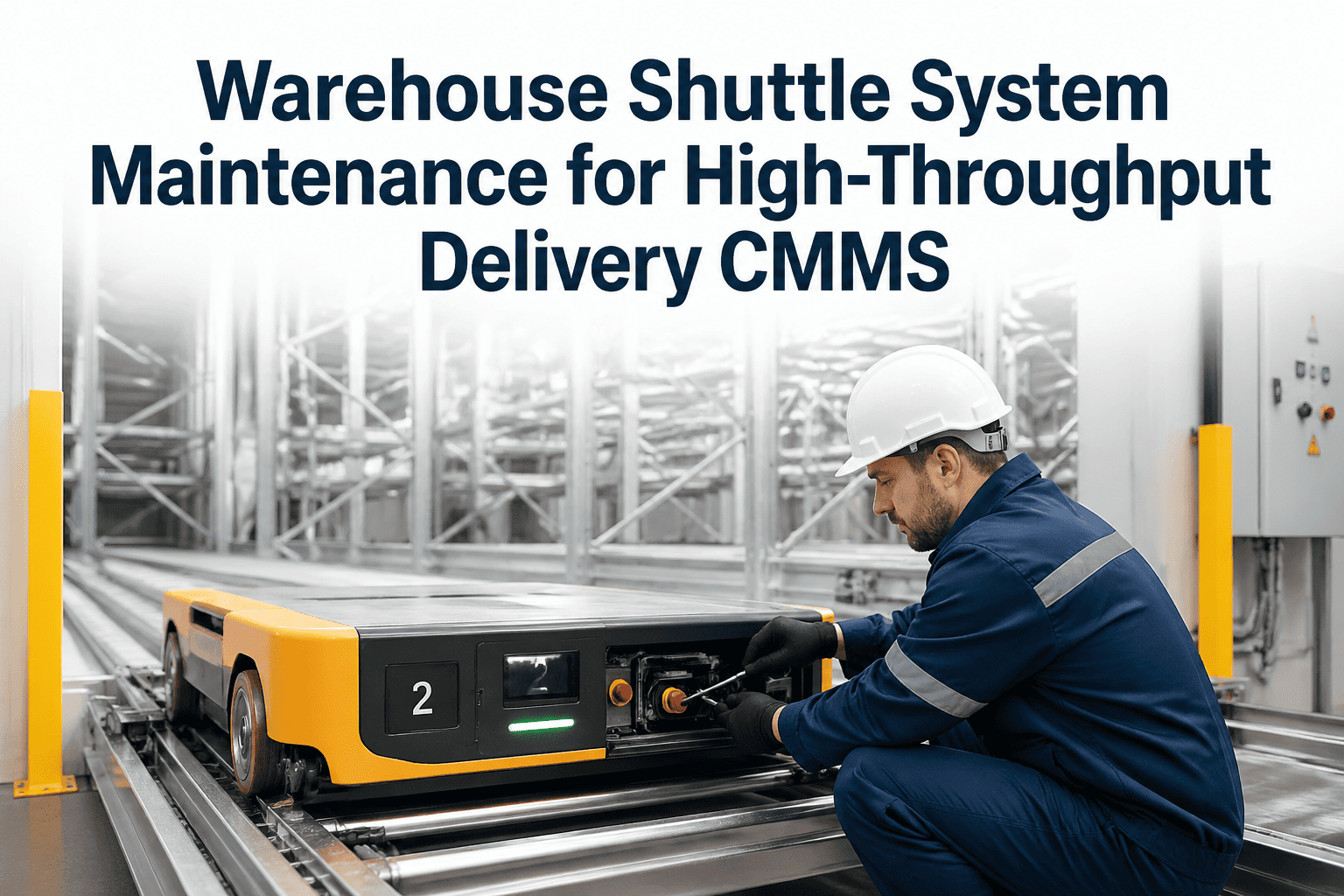
A single shuttle failure in a mini-load AS/RS system doesn't stop one picker — it halts an entire storage aisle holding 2,000+ SKU locations. When your high-density storage depends on automated shuttles, cranes, and conveyors running at 400+ cycles per hour, downtime compounds faster than manual operations ever could. One jammed shuttle blocks access to 40% of your fast-moving inventory. One crane rail misalignment cascades into a 12-hour emergency repair during peak fulfillment windows. CMMS predictive maintenance turns these single points of failure into monitored, maintained, and managed assets where problems get caught in the warning zone — not the breakdown zone. Oxmaint tracks every shuttle cycle, crane movement, and conveyor transfer in your AS/RS system and triggers maintenance work orders before throughput drops — or schedule a 30-minute demo to see predictive AS/RS maintenance on your own warehouse data.
Mini-Load AS/RS Maintenance Intelligence
When Your Shuttle Jams, 2,000 SKU Locations Go Dark
High-density automated storage delivers 5x the storage capacity of manual racking — but automation density creates maintenance criticality. A single component failure doesn't slow operations, it stops them. CMMS predictive maintenance monitors shuttle health, crane performance, and conveyor integrity to keep every aisle running at design throughput.
400+
Shuttle cycles per hour
99.7%
Required system uptime
2000+
SKUs per aisle at risk
Quick Definition
Mini-load AS/RS (Automated Storage and Retrieval Systems) use computer-controlled shuttles and cranes to store and retrieve totes, trays, and small cartons in high-density racking configurations. Systems typically handle items under 100kg with throughput rates of 200-600 cycles per hour per aisle. CMMS integration monitors shuttle motors, crane rails, conveyor transfers, and control system health to predict failures before they halt operations.
The Five Critical Failure Points in Mini-Load AS/RS Systems
Mini-load AS/RS architecture concentrates multiple failure modes into compact, high-speed mechanical systems. Unlike manual warehouses where one broken component affects one operator, AS/RS failures cascade across entire storage aisles. Understanding the five critical failure points is the first step toward predictive maintenance that keeps storage density from becoming operational liability.
01
Shuttle Motor & Drive System
Impact: Complete aisle shutdown affecting 1,500-2,500 storage positions
Early Warning Signs:
Increased cycle time variation above 8% from baseline indicates motor bearing wear or drive belt slippage starting to develop
Current draw spikes during acceleration phases suggest motor winding deterioration or controller calibration drift
Shuttle positioning errors requiring retry cycles point to encoder misalignment or rail contamination
CMMS Prevention: Monitor motor current signatures and cycle time consistency — schedule bearing replacement and drive belt inspection when variance exceeds 12% threshold before complete failure occurs.
02
Crane Vertical Hoist Mechanism
Impact: Multi-aisle access loss if shared crane services multiple storage zones
Early Warning Signs:
Cable tension imbalance detected through load cell asymmetry warns of pending cable strand failure
Brake wear indicators showing reduced holding torque before visible brake pad consumption
Hoist motor temperature climbing 15-20°C above normal operation suggests bearing degradation or brake drag
CMMS Prevention: Track cable tension balance, brake holding force, and motor temperature trends — automatic work orders triggered when any parameter exceeds 85% of safe operating limits.
03
Transfer Conveyor Interface
Impact: System bottleneck reducing total throughput even when storage cranes operational
Early Warning Signs:
Tote transfer rejection rates increasing from baseline 0.2% to 0.8% indicates roller misalignment developing
Photoelectric sensor false positives suggest dust accumulation or LED output degradation
Conveyor motor current draw variability points to bearing wear in transfer rollers or belt drive systems
CMMS Prevention: Monitor transfer success rates and sensor reliability metrics — trigger conveyor alignment checks and sensor cleaning when rejection rates exceed 0.5% rolling average.
04
Rail Guidance & Positioning System
Impact: Gradual throughput degradation followed by catastrophic derailment requiring multi-day recovery
Early Warning Signs:
Positioning retry frequency climbing indicates rail wear or guidance wheel deterioration
Vibration amplitude increasing in specific rail sections shows developing rail surface defects
Encoder position corrections becoming more frequent suggests rail alignment shifting from foundation settling
CMMS Prevention: Vibration monitoring and positioning accuracy tracking per rail section — inspection work orders scheduled when position corrections exceed 3 per 100 cycles in any zone.
05
Control System & Network Communication
Impact: Intermittent system freezes or complete control loss across entire AS/RS installation
Early Warning Signs:
Network packet loss rates creeping above 0.01% indicate switch degradation or cable connection issues
PLC scan time increasing suggests processor loading or memory leak conditions developing
Communication timeout events rising in frequency point to network infrastructure approaching capacity limits
CMMS Prevention: Network health monitoring integrated with CMMS — automatic alerts when packet loss exceeds 0.05% or PLC scan time increases beyond 15% of rated capacity.
From warning signal to maintenance action
Your Shuttle Current Draw Just Spiked. Oxmaint Already Opened the Work Order.
Sensor data without maintenance action is just expensive monitoring. Oxmaint connects AS/RS performance metrics directly to CMMS work orders — when shuttle cycle times drift, crane vibration increases, or conveyor transfer rates drop, maintenance gets scheduled automatically before the performance degradation becomes a system failure.
Maintenance Cycle Time vs System Throughput Impact
AS/RS maintenance isn't scheduled by convenience — it's scheduled by throughput mathematics. Every hour of shuttle downtime removes 400+ storage/retrieval cycles from your daily capacity. The relationship between maintenance window duration and lost throughput is non-linear because AS/RS systems operate as integrated networks where one component failure creates cascading capacity loss across adjacent systems.
| Component |
Planned Maintenance Window |
Emergency Repair Duration |
Throughput Impact During Downtime |
Recovery Time to Normal Operations |
| Shuttle Motor Replacement |
2-3 hours scheduled off-peak |
8-14 hours emergency callout |
100% aisle loss (2,000 SKUs inaccessible) |
Immediate upon restart |
| Crane Rail Alignment |
4-6 hours during maintenance shift |
18-36 hours with derailment recovery |
100% multi-aisle loss if shared crane |
2-4 hours recalibration testing |
| Conveyor Belt Replacement |
3-5 hours planned shutdown |
10-16 hours emergency sourcing |
70% system capacity (bottleneck at transfer) |
1-2 hours tension settling |
| Hoist Cable Replacement |
6-8 hours scheduled window |
24-48 hours with safety inspection |
100% crane-served zones offline |
4-8 hours load testing certification |
| Control System Update |
1-2 hours off-peak deployment |
6-12 hours rollback and troubleshooting |
100% system freeze during fault |
Variable based on fault complexity |
The Predictive Maintenance Data Sources for AS/RS Systems
Effective AS/RS predictive maintenance requires integrating data from multiple sources — equipment sensors, warehouse management system logs, and operator input — into one CMMS platform that can correlate patterns across different data streams and predict failures before they manifest as throughput loss.
Real-Time Sensor Data
Motor current draw, vibration amplitude, temperature, position accuracy, cycle time, speed profile, brake force, cable tension
Collection Frequency: 1-10 Hz continuous streaming
Predictive Value
Detects developing mechanical issues 2-6 weeks before failure — enables planned maintenance scheduling during low-volume windows instead of emergency stops during peak operations
WMS Performance Logs
Cycle completion rates, error codes, retry attempts, task queue depth, throughput per hour, pick accuracy, system availability percentage
Collection Frequency: Per-transaction logging with hourly aggregation
Predictive Value
Identifies operational pattern changes that correlate with equipment degradation — rising retry rates signal positioning problems before they cause jams or collisions
Maintenance History Records
Component replacement dates, failure modes, parts consumed, labor hours, downtime duration, root cause analysis findings
Collection Frequency: Per-maintenance-event documentation in CMMS
Predictive Value
Builds component life expectancy models specific to your operating conditions — adjusts vendor MTBF estimates to actual warehouse throughput and environment
Environmental Conditions
Ambient temperature, humidity, dust levels, power quality, voltage stability, harmonic distortion
Collection Frequency: 5-minute interval sampling
Predictive Value
Correlates equipment failures with environmental stressors — high dust periods accelerate bearing wear, temperature swings affect rail alignment, power quality impacts control system stability
Shuttle Fleet Health Monitoring Across Multiple Aisles
In multi-aisle mini-load installations, comparing shuttle performance across the fleet reveals developing problems faster than monitoring individual units in isolation. A shuttle showing 15% higher motor current than fleet average is degrading even if it's still within manufacturer specs. CMMS dashboards that normalize performance metrics across the entire shuttle fleet enable condition-based maintenance that catches outliers before they fail.
Cycle Time Consistency
Aisle A4
±14.2%
Service Due
Motor Current Draw vs Fleet Average
Aisle A4
+19%
Service Due
Aisle A4 shuttle showing cycle time variance and elevated current draw — both metrics exceed maintenance thresholds. CMMS automatically generated inspection work order prioritized for next low-volume window. Aisle A3 shows cycle time degradation but normal power consumption — indicates positioning system issue rather than motor wear.
AGV Integration Points and Maintenance Coordination
Modern mini-load AS/RS installations increasingly integrate with AGV fleets for horizontal transport between storage aisles and packing stations. This integration creates maintenance coordination requirements — AGV charging infrastructure failures impact AS/RS throughput even when shuttles and cranes operate normally. CMMS systems must track both AS/RS equipment and supporting AGV infrastructure as interconnected maintenance domains.
AGV Battery Management
Challenge: Fast-charge cycles during peak hours accelerate battery degradation. AGV fleet capacity drops unpredictably during high-demand periods.
CMMS Integration: Monitor charge cycle counts, capacity fade, and cell voltage balance across entire AGV fleet. Schedule battery replacements during planned maintenance windows before capacity drops below operational minimum.
Transfer Station Coordination
Challenge: AS/RS cranes deposit totes at transfer stations where AGVs collect them. Transfer station downtime creates backup queues that reduce AS/RS effective throughput.
CMMS Integration: Track transfer station conveyor health and AGV docking mechanism wear as linked maintenance items. Coordinate maintenance windows to service both AS/RS and AGV infrastructure simultaneously.
Navigation Infrastructure
Challenge: Floor marker degradation or reflector contamination causes AGV navigation errors. Failed pickups at AS/RS transfer points create order fulfillment bottlenecks.
CMMS Integration: Preventive maintenance schedules for floor cleaning, marker replacement, and reflector inspection tied to AGV navigation error rates logged in warehouse control system.
Frequently Asked Questions
What sensors are required for AS/RS predictive maintenance?
Most mini-load systems already include motor current sensors, position encoders, and basic temperature monitoring. Enhanced predictive maintenance adds vibration sensors on crane rails and shuttles, load cells for cable tension monitoring, and integration with existing PLC data streams.
Oxmaint works with your existing sensors and identifies gaps during implementation.
How much does AS/RS downtime actually cost per hour?
Direct costs include lost throughput valued at your average order margin times cycles per hour. A 400 cycle/hour shuttle generating $8 margin per pick costs $3,200/hour when offline. Indirect costs include overtime labor, expedited shipping to meet SLAs, and customer satisfaction impact. Total impact typically ranges $5,000-$15,000 per unplanned downtime hour.
Can CMMS predict shuttle failures before they happen?
Yes, when integrated with real-time performance data. Motor current trends, cycle time degradation, and positioning retry frequency predict mechanical failures 2-6 weeks before complete breakdown. CMMS systems like
Oxmaint automatically generate work orders when these leading indicators cross defined thresholds.
What is the typical maintenance interval for mini-load AS/RS components?
Varies by throughput and operating conditions. Shuttle drive belts typically require inspection every 2,000-3,000 operating hours. Crane hoist cables need tension checks every 6-12 months. Conveyor rollers require replacement every 12-18 months under normal loads. Condition-based maintenance adjusts these intervals based on actual equipment health rather than calendar schedules.
High-density storage, high-reliability maintenance
Your AS/RS Runs at 400 Cycles Per Hour. Your Maintenance Should Keep Pace.
Oxmaint monitors shuttle motors, crane systems, conveyor transfers, and control network health in real time — comparing actual performance against baseline metrics and automatically scheduling maintenance when degradation exceeds safe thresholds. Keep your high-density storage operating at design throughput without emergency breakdowns derailing order fulfillment.