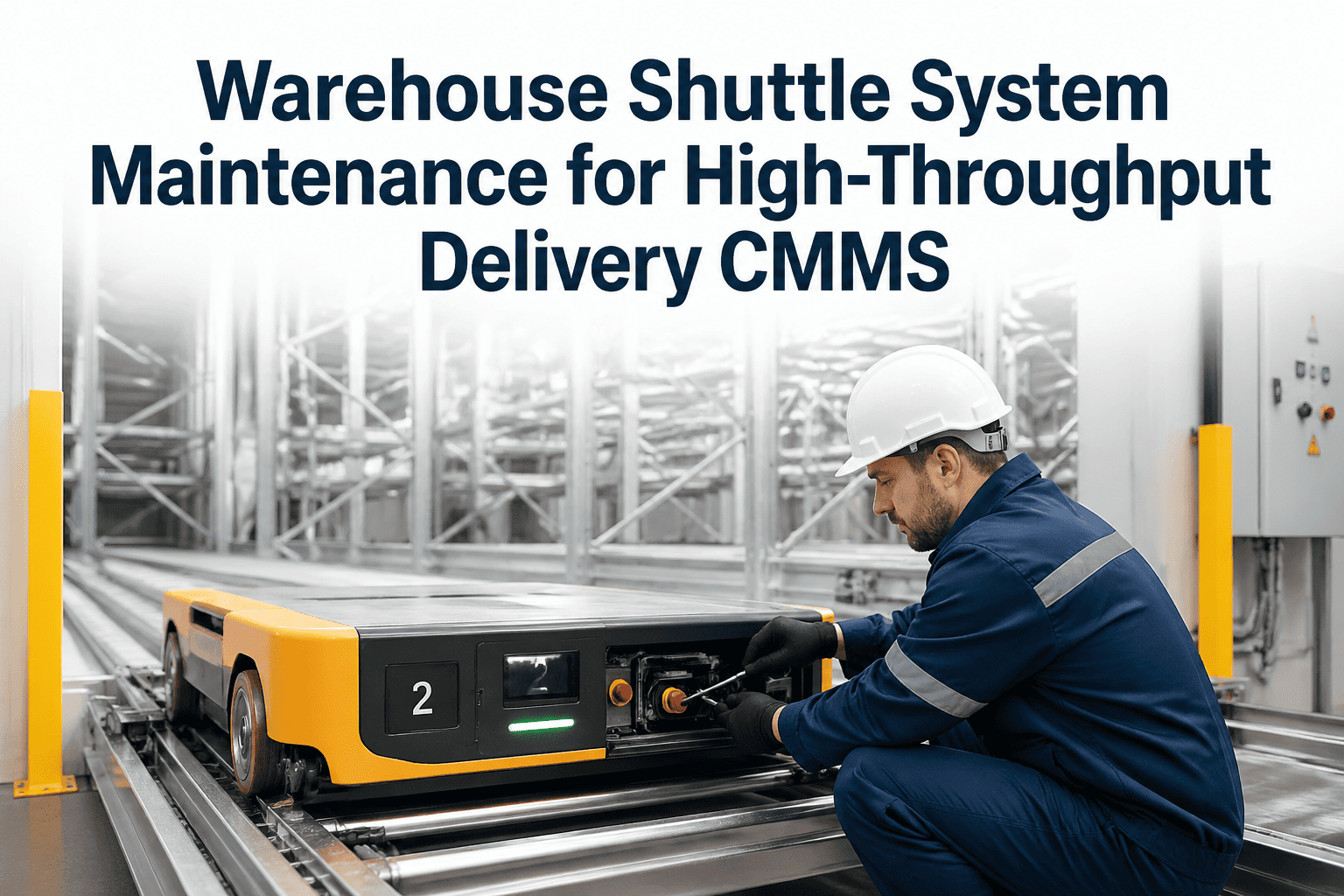
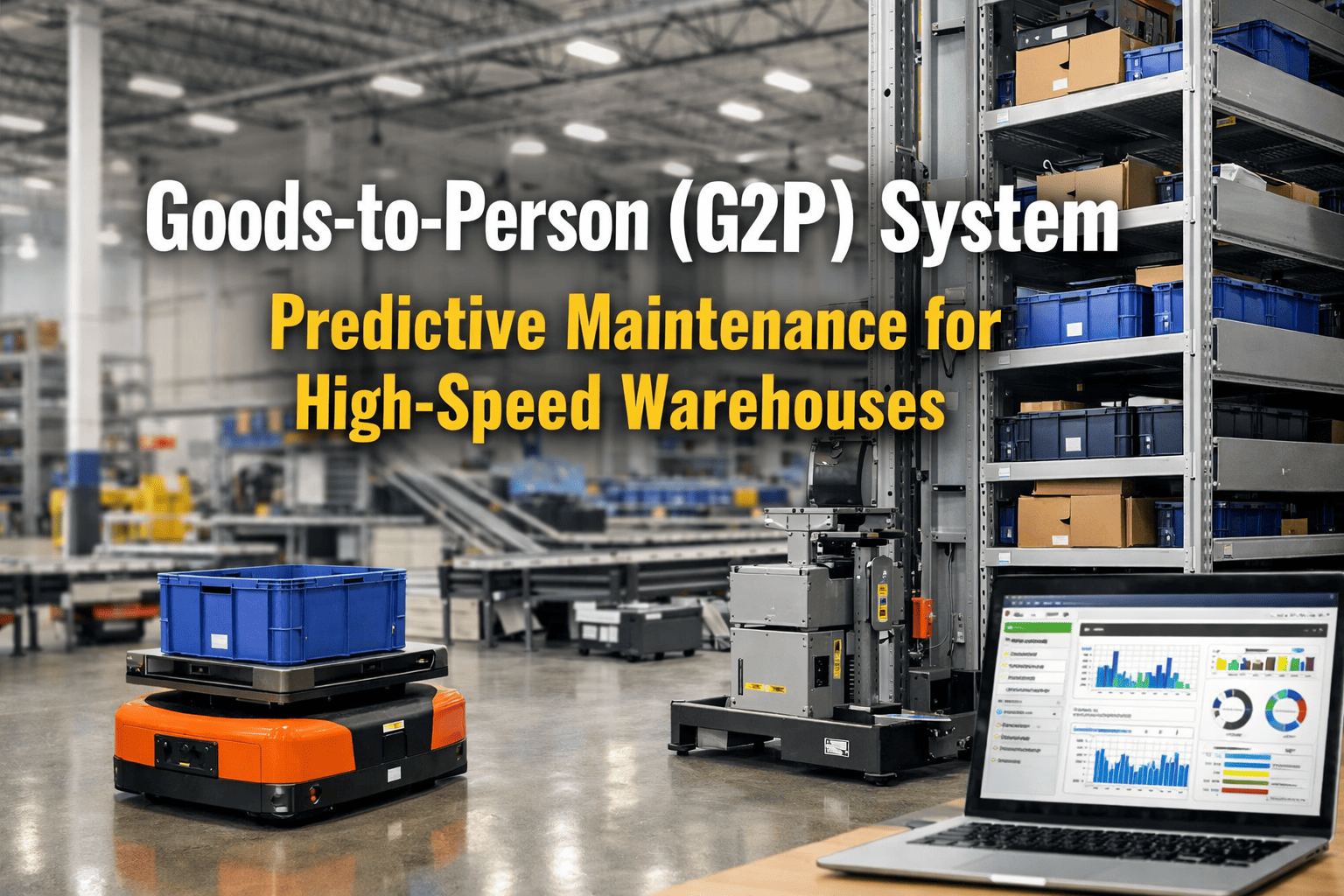
A single shuttle stalled in aisle 7 does not look like a crisis at 11:47 AM. By 12:15 PM, the put-to-light wall behind it is two waves deep, the conveyor merge upstream is back-pressured, and three carriers are standing at the dock with cut-off times bleeding away. Shuttle systems are the high-throughput backbone of the modern automated warehouse — a single high-density aisle can move 1,500 load carriers per hour at full tilt, and when one shuttle goes dark, every order line routed through that aisle queues up behind it. The sensor data was already telling the story: a drive wheel encoder jitter of 4% above baseline, a lift motor temperature drift of 6°C, a battery cycle count past the replacement threshold. None of it crossed an alarm threshold. None of it was on a work order. Predictive CMMS maintenance is what closes that gap — turning shuttle component telemetry into scheduled interventions during low-volume windows so the same shuttle never stalls during the peak wave. Oxmaint runs that loop continuously across every shuttle, lift, and aisle controller in your fleet, so the failure window closes before the order queue opens. Book a demo to see how Oxmaint keeps your shuttle fleet running through every peak wave.
1,500
Load carriers per hour each shuttle aisle moves at peak — every minute of stall is roughly 25 lines of fulfillment delay queued behind one robot
11,000
Pallet movements per week a single pallet shuttle handles in a forklift-free racking structure — a duty cycle that wears wheels, encoders, and lift cables on a predictable curve
70%
Reduction in unplanned downtime achievable when condition-based predictive maintenance replaces reactive break-fix cycles on automated material handling assets
$30B
Global warehouse automation market size in 2026 — a category projected to nearly double by 2030 as e-commerce volume continues to outrun manual fulfillment models
Oxmaint's Position
Predictive shuttle maintenance is not a single sensor or a single dashboard. It is a closed loop: shuttle controllers stream component telemetry into the CMMS, the CMMS scores each shuttle against drift, wear, and cycle-count thresholds, and the work order generator schedules the intervention into the next low-volume window before the failure crosses the alarm line. Oxmaint embeds this loop into the same workflow your maintenance technicians already use — work orders, spare parts, PM schedules, and shuttle-level KPIs in one system. No separate analytics tool. No exported PDFs that nobody opens. Every shuttle event becomes the data that prevents the next one.
Why a Single Shuttle Failure Stalls a Whole Outbound Wave
Shuttle systems are dense and fast — and that density is exactly what makes a single robot's failure a system-level event. Understanding the failure pathways is the first step to preventing them.
01
Aisle Lockout — When One Shuttle Stops, the Aisle Stops
In a traditional case shuttle architecture, every shuttle owns a level of an aisle. When that shuttle faults, every storage location on that level becomes inaccessible until the shuttle is recovered or removed. Inventory mirroring across multiple aisles is the workaround — and it is the reason shuttle systems demand more storage locations and more capital than alternative architectures. A single shuttle stall does not just delay one order; it strands every SKU stored on that shuttle's level until the recovery is complete.
02
Lift Bottleneck — Vertical Throughput Becomes the Constraint
Shuttles move horizontally on their level; lifts move totes between levels. A single lift typically serves multiple shuttle levels in an aisle. When a lift faults — drive belt slippage, position sensor drift, brake wear — the entire aisle's vertical throughput drops to zero regardless of shuttle availability. Multi-lift aisle configurations exist to mitigate this, but the lift remains the single point of failure most often responsible for whole-aisle stoppages.
03
Battery and Charging Contact Degradation
Shuttle batteries and supercapacitors run continuous charge-discharge cycles through inductive or contact-based charging stations. Charging contact wear and battery capacity fade do not produce hard failures — they produce reduced cycle counts, slower acceleration, and shuttles that complete fewer moves per shift. The throughput loss is distributed and invisible until shift-level fulfillment numbers miss target.
04
Encoder Drift and Position Sensor Faults
Drive wheel encoders, lift position sensors, telescopic fork sensors — every shuttle has a dozen position-critical sensors that determine whether the robot picks the right tote from the right slot. Encoder drift from contamination, vibration, or shock impact shows up first as misaligned tote handoffs and rejected picks at the workstation, then as escalating exception rates, then as the shuttle being taken out of service for recalibration during prime fulfillment hours.
05
Drive Wheel and Bearing Wear
Drive wheels carry the shuttle's full weight plus the load weight thousands of times per shift. Wheel surface wear, bearing degradation, and motor torque creep are the most common mechanical wear pathways — and the most predictable. Vibration signature, motor current draw at typical speeds, and stall count per shift all trend before catastrophic failure. The detection window exists; the question is whether it gets converted into a work order.
Your Shuttle Fleet Is Already Sending the Failure Signal — Oxmaint Listens
Encoder jitter, motor current creep, lift belt slippage, battery cycle counts past threshold. Every signal exists in your shuttle controller telemetry. Oxmaint converts each one into a work order before the queue forms behind a stalled robot.
Component-Level Predictive Signal Map
Every shuttle component has a measurable degradation signal. The work of a CMMS is to convert each signal into the right intervention at the right time — not to wait for the alarm threshold that arrives the moment the order wave crests.
Drive Wheel + Bearing
Vibration RMS, motor current at speed, stall count per shift
Detection window: 4–8 weeks before catastrophic failure
Action: Schedule wheel-and-bearing replacement during scheduled maintenance window. Plan spare in stock 3 weeks before the wear curve crosses replacement threshold.
Lift Drive Belt
Belt slippage events, position sensor delta, lift cycle time creep
Detection window: 2–4 weeks before slip-related lift fault
Action: Belt tension inspection on a shortened PM interval triggered by slippage event count threshold. Belt replacement on cycle-count basis, not break-fix.
Drive Encoder
Encoder jitter percentage, position error rate, recalibration frequency
Detection window: 1–3 weeks before exception rate impacts throughput
Action: Encoder cleaning and recalibration as a scheduled task — or housing replacement when contamination is recurring. Track recalibration frequency as a leading indicator of housing seal failure.
Telescopic Fork + Gripper
Tote pick exception rate, fork extension cycle time, motor current creep
Detection window: 3–6 weeks before exception escalation
Action: Fork lubrication interval shortened in response to cycle-time creep. Gripper finger replacement on cycle-count threshold rather than after pick failure.
Battery + Supercapacitor
Cycle count, capacity fade, charge cycle time creep, temperature delta
Detection window: 6–12 weeks before throughput impact
Action: Battery replacement on cycle-count basis aligned with manufacturer specification. Charging contact cleaning on schedule, not on charge-failure event.
Aisle Controller + Network
Communication retry rate, command latency, controller temperature
Detection window: variable — often 1–2 weeks of degradation before drop
Action: Network diagnostic PM trigger on retry rate threshold. Controller fan and thermal inspection scheduled on temperature drift, not on thermal alarm.
The Closed-Loop CMMS Workflow for Shuttle Fleets
A predictive maintenance program lives or dies on the loop between data, decision, and work order. Oxmaint runs that loop continuously — six steps, all in the same workspace, no exports between systems.
Step 1
Telemetry Ingestion from Shuttle Controllers and WCS
Shuttle controllers, lift PLCs, and the warehouse control system stream component telemetry into Oxmaint — encoder readings, motor currents, lift position deltas, battery state, exception counts, and cycle counts. Data is ingested per shuttle, per lift, per aisle, with timestamps tied to the shift and wave context the failure occurred in.
Step 2
Threshold Scoring Against Shuttle-Specific Wear Curves
Each component is scored against the wear curve calibrated for its shuttle model, duty cycle, and operating environment. Cold storage shuttles wear differently than ambient-temperature units. High-cycle aisles wear differently than buffer aisles. The threshold engine reflects the specific operating conditions of each asset.
Step 3
Automated Work Order Generation with Intervention Window
When a component crosses its predictive threshold, Oxmaint generates a work order with assigned technician, required spare parts, estimated duration, and a scheduling target inside the next low-volume window. Work orders are routed by skill — encoder cleaning to one team, drive wheel replacement to another, lift belt to a third.
Step 4
Spare Parts Pre-Stage and Inventory Sync
When the work order is generated, Oxmaint reserves the required spare parts from inventory and triggers reorder if the safety stock level is breached. The technician arrives to find every part needed already pulled and staged — no parts hunt, no return trip, no shuttle out of service longer than the actual repair time.
Step 5
Closure Evidence and PM Interval Feedback
Work order closure captures the actual component condition, the intervention performed, and any deviation from the predicted wear state. That data feeds back into the threshold model — tightening the prediction window over time as the platform learns the specific wear behavior of your fleet rather than relying on generic OEM guidance.
Step 6
Fleet-Wide Pattern Detection Across Sister Shuttles
When a wear pattern emerges on one shuttle, Oxmaint scans every other shuttle of the same model, duty cycle, and operating conditions for the same signature. If a drive wheel wear pattern is identified on shuttle 12, every other high-cycle shuttle running the same wheel type receives a risk flag — preventing the same failure from recurring across the fleet before the first repair is even closed.
From Reactive Aisle Recovery to Predictive Throughput Protection
Oxmaint transforms shuttle maintenance from a 2 AM phone call to a scheduled task in the next low-volume window. Same shuttles. Same fleet. Same workforce. A different uptime curve.
Implementation Path — From Reactive to Predictive in One Quarter
Oxmaint deploys shuttle predictive maintenance capability in four phases, building the data foundation, calibrating the prediction engine, and activating fleet-wide alerts without disrupting ongoing fulfillment.
Phase 1 — Weeks 1–2
Asset Registry and Telemetry Connection
Every shuttle, lift, and aisle controller registered in Oxmaint with model, duty cycle, deployment date, and current PM schedule. WCS and shuttle controller data feeds connected. Existing maintenance history imported from prior CMMS or maintenance logs. Spare parts master synchronized with current inventory.
Outcome: Full shuttle fleet visible in Oxmaint with telemetry feed live and historical maintenance data loaded.
Phase 2 — Weeks 2–4
Wear Curve Calibration and Threshold Tuning
Component wear curves calibrated against your fleet's actual operating conditions — temperature zone, cycle count per shift, load profile. Predictive thresholds tuned per shuttle model with input from your maintenance team's existing knowledge of common failure modes. False-alarm threshold set to balance early warning against work order noise.
Outcome: Prediction engine calibrated to your fleet with thresholds tuned for actionable alerts, not noise.
Phase 3 — Weeks 4–6
Workflow Activation and Team Onboarding
Maintenance team trained on Oxmaint mobile work order workflow. First predictive work orders generated and executed with full team review of accuracy and timing. Spare parts pre-stage workflow validated across at least three shuttle interventions. Shift handover dashboard configured for daily fleet health review.
Outcome: Maintenance team operational on the predictive workflow with first cycle of predictive work orders completed.
Phase 4 — Month 2+
Continuous Learning and Fleet-Wide Pattern Alerts
Prediction engine continuously refines wear curves based on closure data. Fleet-wide pattern alerts active — when one shuttle exhibits a new wear signature, every comparable shuttle is scanned automatically. Monthly fleet health KPI review covering shuttle availability, mean time between failures, work order closure rate, and predictive accuracy score.
Outcome: Continuous learning loop active with fleet-wide pattern detection and monthly KPI reporting.
Oxmaint Predictive Shuttle Maintenance vs. Reactive Break-Fix
The difference between predictive and reactive maintenance is not philosophical. It is measured in shuttle availability, work order closure rate, peak-wave throughput, and the cost of every unplanned recovery event.
| Capability |
Oxmaint Predictive |
Reactive Break-Fix |
Time-Based PM Only |
| Shuttle component telemetry into work order workflow |
Yes — automated |
No |
No |
| Wear curve calibration to fleet-specific operating conditions |
Yes — per shuttle |
Not applicable |
Generic OEM intervals |
| Spare parts pre-stage tied to predicted work orders |
Yes — automated |
Reactive pull |
Schedule-based stocking |
| Intervention scheduled in low-volume window |
Yes — by design |
Whenever failure occurs |
Fixed PM calendar |
| Fleet-wide pattern detection across sister shuttles |
Yes — automated |
No |
No |
| Continuous learning from closure data |
Yes |
No |
Manual interval review only |
| Work order generation tied to component drift threshold |
Yes |
After failure |
Calendar-driven |
| Mobile-first technician workflow |
Yes |
Varies |
Varies |
| KPI dashboard — fleet availability, MTBF, closure rate |
Yes |
Manual reporting |
Limited |
| Typical impact on unplanned downtime |
70%+ reduction |
Baseline |
15–30% reduction |
Measured Outcomes — What Predictive Shuttle Maintenance Delivers
70%
Reduction in Unplanned Shuttle Downtime
Achievable when condition-based predictive maintenance replaces reactive break-fix on automated material handling assets — measured against baseline downtime in the 12 months prior to predictive workflow activation. The reduction comes primarily from converting slow-degrading wear signals into scheduled interventions before they cross the alarm threshold.
30–50%
Increase in mean time between failures (MTBF) typical of an effective condition-based predictive program — extending the productive life of every shuttle and lift in the fleet.
20–40%
Reduction in mean time to repair (MTTR), driven by advance work order generation that lets the technician arrive with the right spare parts staged and the right diagnosis loaded.
15–30%
Reduction in maintenance cost per operating hour — from fewer emergency callouts, fewer overtime shifts, and fewer unscheduled spare parts orders at premium pricing.
300%
Order fulfillment speed increase reported by warehouses running fully orchestrated robot-powered automation — protected only when the underlying maintenance loop holds shuttle availability above 98%.
Unplanned Shuttle Downtime Reduction
Maintenance Cost Per Hour Reduction
Spare Parts Inventory Optimization
Frequently Asked Questions
How does Oxmaint connect to our existing shuttle controllers and warehouse control system?
Oxmaint integrates with shuttle controllers, lift PLCs, and the WCS through standard industrial protocols and API connections. Most deployments are live within 4–6 weeks, including data feed validation, wear curve calibration, and team onboarding.
Do we need to replace our existing shuttle hardware or sensors to use predictive maintenance?
No. Oxmaint works with the telemetry your shuttle controllers already produce — encoder readings, motor currents, lift position data, exception counts. Additional sensors are optional and only added where a critical signal is missing from the existing controller output.
How accurate is the predictive engine compared to a senior reliability engineer?
Predictive accuracy improves continuously as Oxmaint learns the wear behavior of your specific fleet. Initial deployment uses calibrated wear curves; closure data refines the engine over the first 90 days until predictions match or exceed senior engineer judgment for routine wear modes.
Can Oxmaint handle a mixed shuttle fleet with multiple vendors and shuttle generations?
Yes. Wear curves are calibrated per shuttle model and duty cycle, so a fleet mixing different vendors and generations is managed as a set of model-specific predictive profiles in the same Oxmaint instance.
How does Oxmaint secure shuttle telemetry and maintenance data?
All telemetry and maintenance records are encrypted at rest with AES-256 and transmitted over TLS 1.3. Role-based access controls restrict shuttle operational data to authorized maintenance, operations, and IT personnel. Full audit trails log every work order, threshold change, and PM interval update.
What is the typical payback period on predictive shuttle maintenance with Oxmaint?
Most warehouses see payback within 6–9 months from a combination of avoided unplanned downtime, reduced overtime, smaller emergency spare parts spend, and extended shuttle component life. Larger fleets and higher-throughput operations typically see faster payback.
Stop the Stalled Shuttle Before It Stalls the Wave
Predictive shuttle maintenance, fleet-wide pattern detection, and automated work order generation — live in your warehouse within 6 weeks. Every shuttle event becomes the data that prevents the next one.
Predictive Shuttle Maintenance
Fleet-Wide Pattern Detection
Automated Work Orders
Spare Parts Pre-Stage