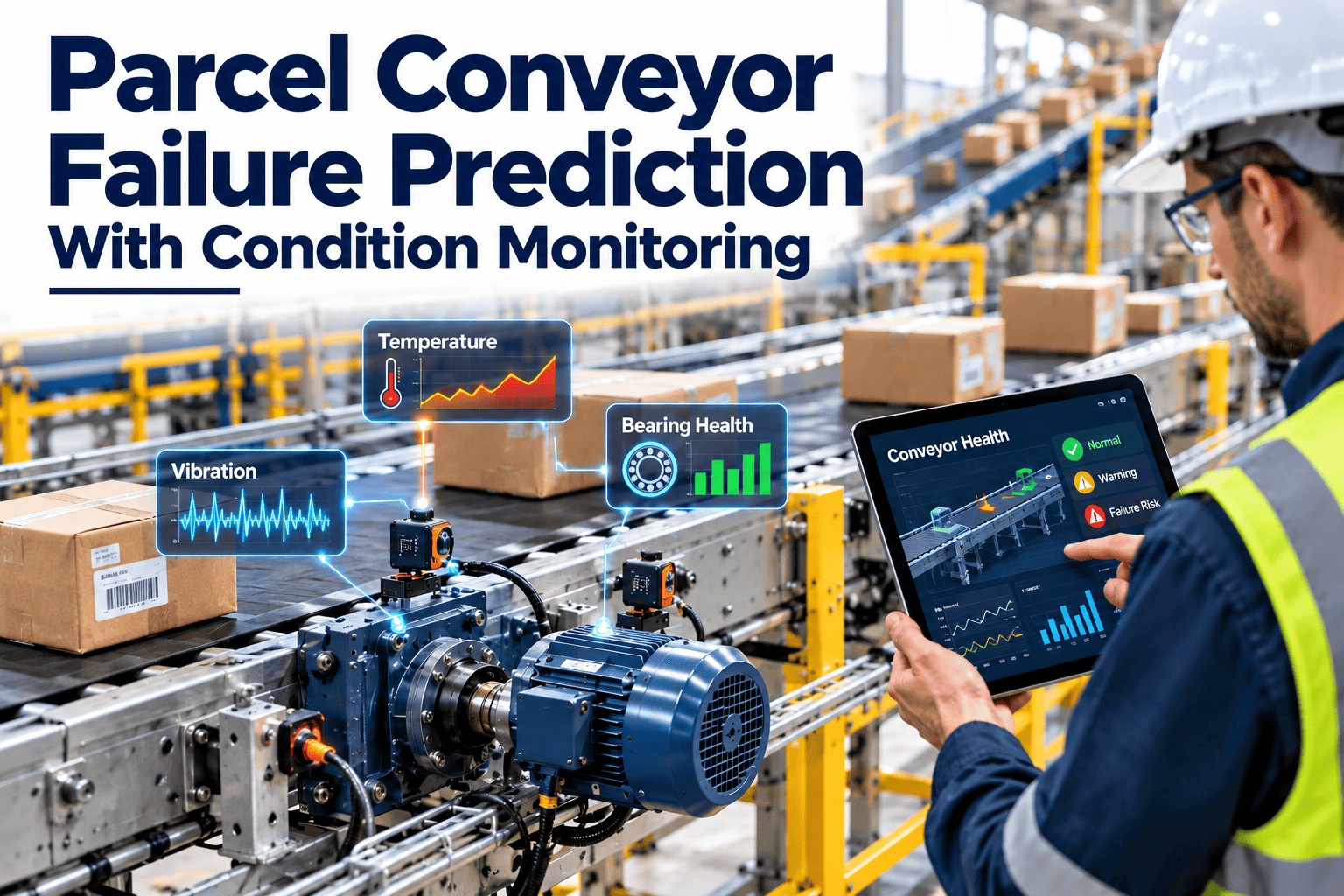
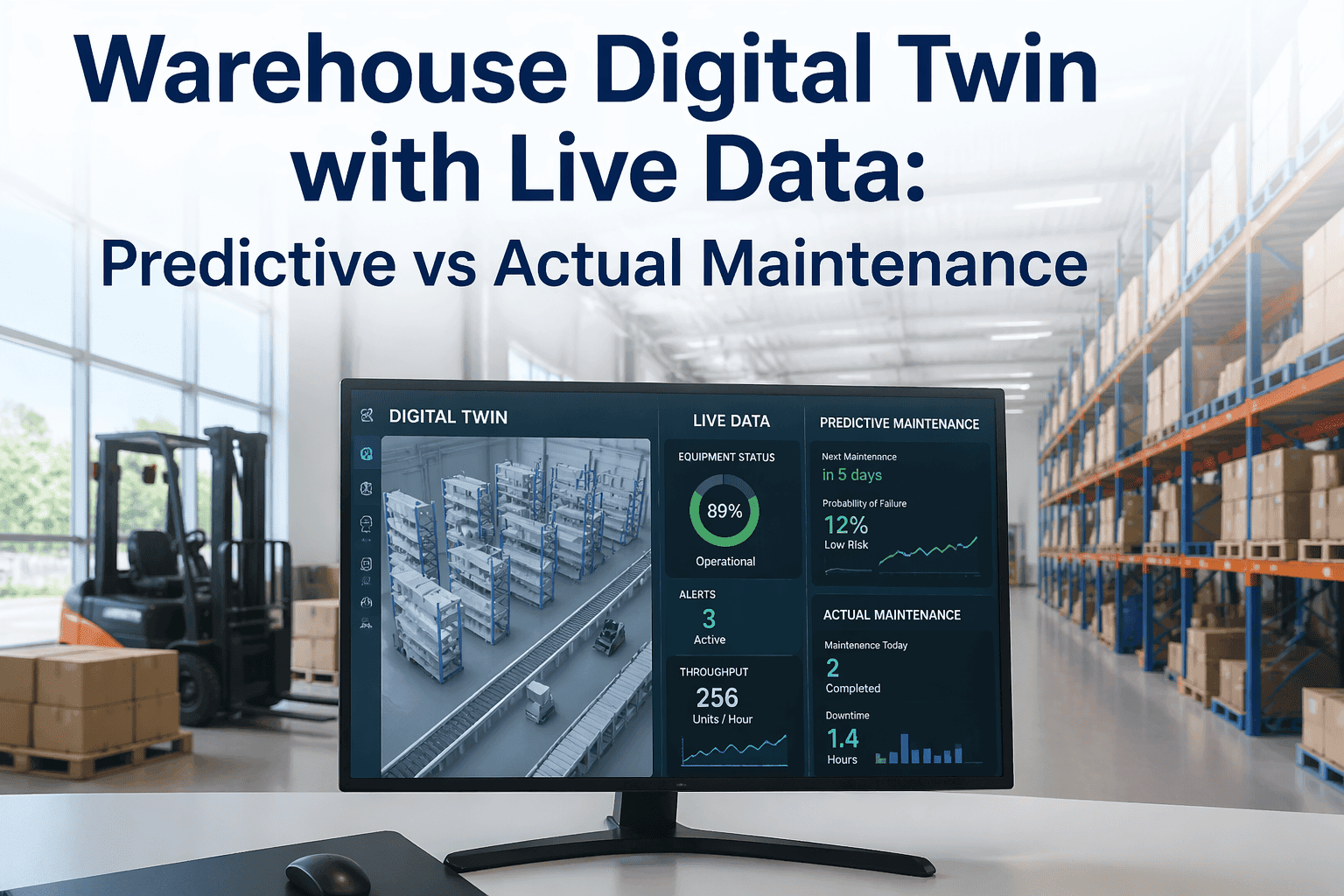
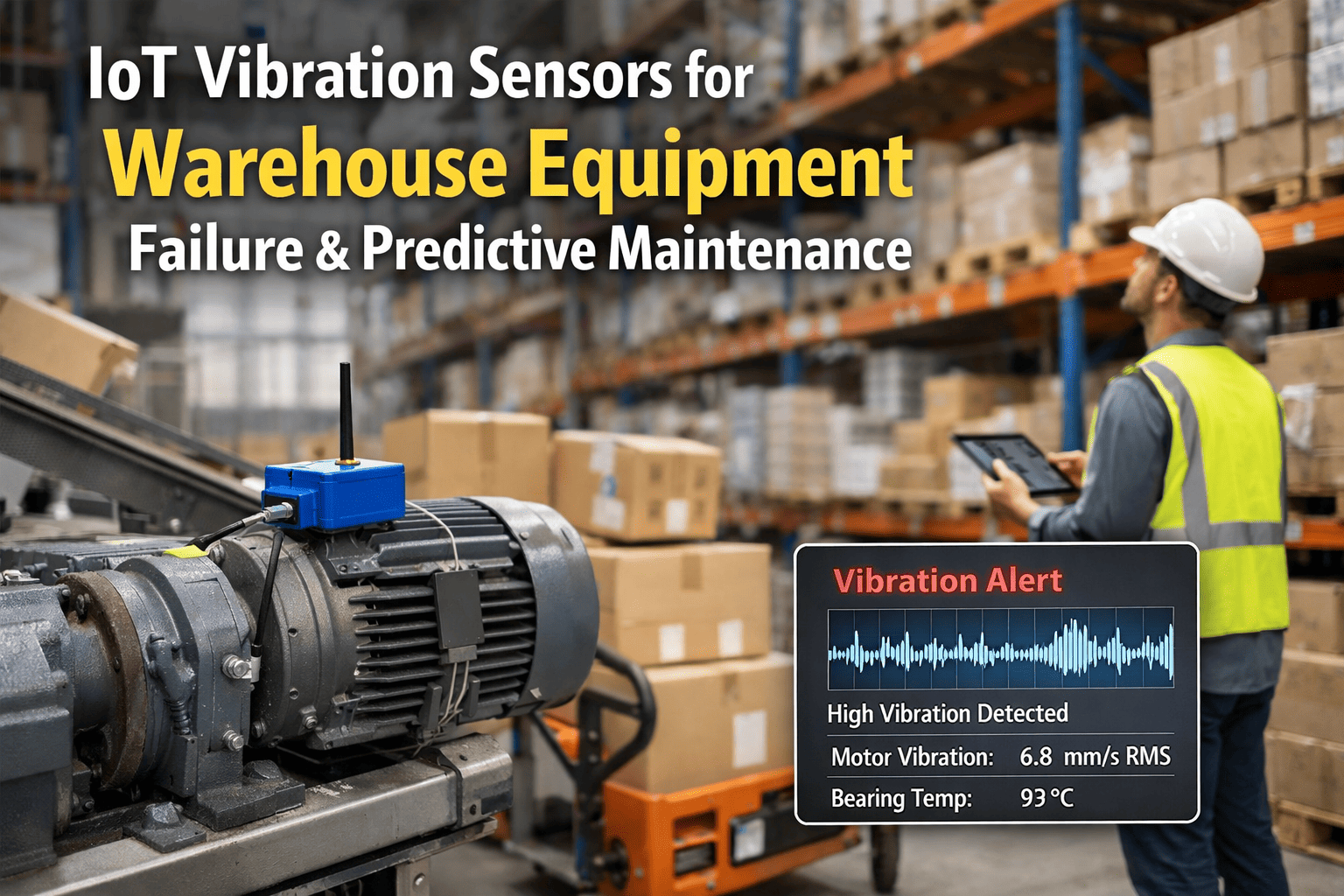
The conveyor belt in Zone 4 of a 380,000 sq ft distribution center outside Atlanta had been making a noise for three weeks. Not a loud noise — a faint, rhythmic clicking that the night shift team noticed around 2 AM when the building was quieter. They mentioned it during shift handover. The day shift supervisor walked past the conveyor, listened for ten seconds, and decided it was "just the rollers settling." Nobody wrote it down. Nobody opened a work order. Three weeks and two days after the first click, the conveyor's drive motor seized at 11:22 AM on a Thursday during peak outbound operations. The bearing had been failing for 47 days — long before the clicking started. A $14 vibration sensor mounted to the motor housing would have flagged the bearing degradation at day three, when vibration amplitude crossed 0.35g and entered the "investigation recommended" range. Instead, the motor seizure shut down the primary sortation feed line for 6.5 hours. Emergency motor replacement cost $4,200. Lost throughput during the outage: 23,400 packages that missed their carrier cutoff times. Expedited shipping to recover the backlog over the following two days cost $67,000. Late delivery penalties from three major retail customers totaled $41,000. Customer service handled 340 "where is my package" inquiries. Total cost of ignoring a noise that a $14 sensor would have translated into a work order 44 days earlier: $112,200. That is a single conveyor motor, at a single facility, on a single Thursday in October.
Distribution centers move fast and break things — sometimes literally. Conveyor systems in modern fulfillment operations run 16 to 20 hours per day, processing thousands of packages per hour through a network of belts, rollers, diverters, merges, and sortation modules that collectively contain hundreds of motors, bearings, gearboxes, and drive components. Every one of these components generates measurable signals — vibration patterns, thermal signatures, electrical load profiles, and acoustic emissions — that telegraph impending failure days or weeks before anything breaks. IoT sensors capture these signals continuously, convert them into structured data, and feed that data into maintenance management systems that generate predictive alerts, auto-create work orders, and schedule repairs during planned downtime windows instead of emergency shutdowns. In 2026, the sensor hardware costs less than a single emergency service call. The wireless connectivity is plug-and-play. The analytics platforms run on cloud infrastructure that requires zero on-site IT. The only thing standing between your distribution center and predictive conveyor maintenance is the decision to start. This guide covers everything: sensor types, placement strategy, data architecture, CMMS integration, ROI modeling, and implementation roadmaps for distribution operations of every size.
$260K
Average cost per hour of unplanned downtime in distribution and manufacturing facilities
45%
Reduction in unplanned downtime achieved by organizations using IoT predictive maintenance
70%
Decrease in equipment breakdowns reported with continuous IoT condition monitoring programs
55.7B
IoT devices connected globally in 2025 — industrial monitoring is the fastest-growing segment
What IoT Sensors Actually Measure on Conveyors
Every conveyor component generates physical signals that change as the component degrades. IoT sensors translate these invisible signals into digital data that maintenance teams can act on. Understanding what each sensor type measures — and what those measurements mean operationally — is the foundation of any effective conveyor monitoring program.
Vibration
What It Measures
Acceleration (g-force), velocity (mm/s), and displacement across three axes. Captures bearing wear signatures, shaft imbalance, misalignment, looseness, and gear mesh anomalies through frequency domain analysis using FFT (Fast Fourier Transform).
Placement on Conveyors
Drive motor housing (radial and axial), gearbox casing, head/tail pulley bearings, idler roller brackets on high-speed sections, and sortation diverter actuators.
Alert Thresholds (ISO 10816)
0–0.28g Good
0.28–0.7g Investigate
0.7g+ Immediate Action
Temperature
What It Measures
Surface and ambient temperature using thermocouples, RTDs, or infrared sensors. Detects bearing overheating, motor winding degradation, belt friction increases, VFD overload conditions, and lubrication breakdown across all conveyor drive components.
Placement on Conveyors
Motor housing surface, gearbox oil sump, bearing housings on head/tail pulleys, VFD heat sinks, belt contact surface at drive pulleys, and electrical panel interiors.
Alert Thresholds (Motor/Bearing)
Below 70C Normal
70–85C Elevated
85C+ Critical
Current / Power
What It Measures
RMS current draw, power factor, harmonic distortion, and startup inrush profiles using split-core CT sensors. Detects motor degradation, belt tension changes, conveyor overloading, mechanical binding, and VFD output anomalies before thermal or vibration signatures appear.
Placement on Conveyors
Motor power feeds inside MCC or local disconnect, VFD output cables, and main distribution panel feeders serving conveyor circuits. Non-invasive clamp-on installation.
Alert Thresholds
Within 10% of baseline
10–25% deviation
25%+ or trending up
Acoustic / Ultrasonic
What It Measures
Airborne ultrasound (20–100 kHz) and audible frequency patterns. Detects bearing defects earlier than vibration analysis, compressed air leaks near pneumatic diverters, electrical arcing in motor connections, and belt tracking issues through friction sound signatures.
Placement on Conveyors
Near bearing housings on critical drives, adjacent to pneumatic actuator assemblies, at belt tracking points, and near electrical junction boxes serving conveyor motors.
Alert Thresholds
Baseline dB level
8–12 dB above baseline
12+ dB above baseline
A single wireless sensor node combining vibration, temperature, and current monitoring costs $80–$250 per point — less than the hourly cost of a single conveyor breakdown. When connected to a CMMS, each sensor becomes an automated maintenance watchdog that never takes a break, never ignores a noise, and never forgets to write it down. Schedule a demo to see how sensor data flows directly into predictive maintenance workflows.
Sensor-to-Action: How IoT Data Becomes a Work Order
Raw sensor data is worthless without a system that turns it into maintenance action. The architecture below shows how IoT conveyor monitoring translates physical measurements into predictive work orders — from the sensor on the motor to the technician's mobile device.
01
Sensor Layer
Wireless vibration, temperature, and current sensors mounted on conveyor drives, bearings, and gearboxes. Battery-powered with 3–5 year life. Sampling every 15 min for trending, triggered high-frequency capture for anomaly investigation.
02
Edge Gateway
Local gateway aggregates data from 50–200 sensor nodes per zone. Performs initial threshold filtering and anomaly flagging at the edge — reducing cloud bandwidth by 90% while ensuring critical alerts transmit in under 5 seconds.
03
Analytics Platform
Cloud-based ML models analyze vibration spectra, temperature trends, and current signatures against equipment-specific baselines. Identifies bearing wear stages, belt degradation curves, and motor winding insulation breakdown weeks before failure.
04
CMMS Integration
Predictive alerts auto-generate work orders in your maintenance management system with equipment ID, failure mode, severity rating, recommended action, and estimated time to failure. Technician receives mobile notification with full context — no manual data entry, no lost alerts.
The entire chain — from sensor reading to work order on a technician's phone — takes under 60 seconds for critical alerts. That is 44 days faster than waiting for someone to hear a noise and decide to mention it at shift handover. Sign up free to connect IoT sensor alerts with automated maintenance workflows.
Conveyor Components: What Fails, Why, and What Sensors Catch It
Not every conveyor component needs a sensor. Effective IoT monitoring targets the components with the highest failure probability, highest replacement cost, and highest operational impact when they fail. This matrix maps conveyor components to their primary failure modes and the sensor types that detect degradation earliest.
| Component |
Primary Failure Mode |
Best Sensor Type |
Detection Lead Time |
Cost if Missed |
| Drive Motor Bearings |
Progressive wear, lubrication breakdown, contamination |
Vibration Temp |
30–90 days before seizure |
$4,000–$12,000 |
| Motor Windings |
Insulation breakdown, phase imbalance, overheating |
Current Temp |
14–60 days before burnout |
$6,000–$18,000 |
| Gearbox / Reducer |
Gear mesh wear, oil degradation, shaft misalignment |
Vibration Acoustic |
45–120 days before failure |
$8,000–$25,000 |
| Belt / Chain |
Stretch, tracking drift, splice failure, material fatigue |
Current Vibration |
7–30 days before breakage |
$2,000–$8,000 |
| Head / Tail Pulleys |
Bearing failure, lagging wear, shaft deflection |
Vibration Temp |
30–60 days before failure |
$5,000–$15,000 |
| Sortation Diverters |
Actuator fatigue, pneumatic seal failure, sensor drift |
Acoustic Current |
10–30 days before malfunction |
$3,000–$10,000 |
| VFD (Variable Freq. Drive) |
Capacitor aging, fan failure, overheating |
Temp Current |
14–45 days before trip |
$4,000–$14,000 |
Reactive Monitoring vs. IoT Predictive Monitoring
Most distribution centers still operate conveyors in reactive mode — running equipment until it fails, then scrambling to fix it. Here is what that approach actually looks like compared to IoT-enabled predictive monitoring integrated with a CMMS.
Failures discovered by operators hearing noises or seeing stoppages
Emergency repairs at 3–5x planned maintenance cost
Spare parts expedited overnight — premium freight charges
6–12 hour average downtime per conveyor failure event
No failure pattern visibility across equipment fleet
Maintenance team in constant firefighting mode
Annual conveyor maintenance cost: $180K+ per facility
VS
Degradation detected 30–90 days before functional failure
Planned repairs scheduled during wave gaps — zero throughput impact
Parts pre-ordered based on predicted failure timeline
Average downtime per event: under 45 minutes (planned swap)
Fleet-wide analytics reveal chronic failure patterns by model and zone
Maintenance team focused on planned, proactive work
Annual conveyor maintenance cost: $65K–$95K per facility
The difference is not technology — it is information. The conveyor tells you it is failing. IoT sensors listen. A CMMS acts. Sign up free and start building the predictive maintenance program your conveyors are asking for.
ROI: The Numbers Behind IoT Conveyor Monitoring
Based on a mid-size distribution center: 250,000 sq ft, 2.4 miles of conveyor, 85 monitored motor points, running 18-hour operations with 40,000+ packages per day throughput.
| Savings Category |
Annual Value |
Calculation |
| Avoided emergency conveyor downtime |
$312,000 |
45% downtime reduction x avg 3.2 events/mo x $18K avg cost per event |
| Planned vs. emergency repair cost savings |
$87,000 |
Planned repairs at 30% cost of emergency — labor, parts, expediting eliminated |
| Extended motor and bearing life |
$54,000 |
20% lifecycle extension through condition-based replacement timing |
| Reduced spare parts inventory |
$38,000 |
Predicted failures enable just-in-time parts ordering — 25% MRO reduction |
| Eliminated SLA penalties from throughput disruption |
$95,000 |
Zero missed carrier cutoffs from unplanned conveyor failures |
| Maintenance labor reallocation |
$42,000 |
30% less time on emergency response — redeployed to planned PM and improvements |
| Total Annual Savings |
$628,000 |
250K sq ft facility, 85 monitored points |
Sensor hardware and platform costs for 85 monitoring points: $28,000–$45,000 year one (hardware + subscription), $12,000–$18,000 annually thereafter. First-year ROI: 14–22x. The payback period is measured in weeks, not years. Book a demo and we will model the ROI for your specific conveyor footprint.
Sensor Placement Strategy by Conveyor Zone
Not every motor needs a sensor on day one. The highest ROI comes from instrumenting the components where failure creates the greatest operational impact. This priority matrix guides sensor deployment for maximum value with minimum investment.
Tier 1 — Deploy First
Sortation System Drives
Failure stops all outbound — highest throughput impact per motor
Main Trunk Line Motors
Feeds entire conveyor network — single point of failure for all zones
Induction Zone Drives
Connects picking to sortation — failure creates immediate backlog cascade
Tier 2 — Deploy Month 2-3
Merge Point Drives
Multiple lines converge — failure affects upstream feeding capacity
Incline/Decline Conveyors
Higher mechanical stress — accelerated bearing and belt wear patterns
Diverter Actuators
High-cycle pneumatic components with progressive seal degradation
Tier 3 — Full Coverage
Accumulation Zone Drives
Lower throughput impact but still affect zone capacity and flow balance
Takeaway Conveyors
End-of-line systems — failure impacts loading dock throughput
Idler Rollers (Spot Check)
Portable sensors for periodic idler health assessment on long runs
Implementation Roadmap: Zero to Predictive in 10 Weeks
Weeks 1-2
Asset Audit & Sensor Selection
Map all conveyor drives, gearboxes, and critical components
Classify each point by failure impact (Tier 1/2/3)
Select sensor types per component based on primary failure mode
Register all monitored assets in CMMS with baseline specifications
Weeks 3-4
Sensor Installation & Network Setup
Install Tier 1 sensors on sortation, trunk line, and induction drives
Deploy edge gateways — 1 per zone for full wireless coverage
Validate sensor connectivity and data flow to cloud platform
Configure CMMS integration for automated alert-to-work-order pipeline
Weeks 5-7
Baseline Learning & Threshold Calibration
Collect 3+ weeks of baseline data under normal operating conditions
ML models establish equipment-specific normal operating signatures
Calibrate alert thresholds — eliminate false positives while catching real anomalies
Deploy Tier 2 sensors on merge points, inclines, and diverter actuators
Weeks 8-10
Predictive Operations Go-Live
Activate predictive alerting with auto-work-order generation in CMMS
Train maintenance team on alert response workflows and mobile tools
Establish weekly sensor health review and monthly trending analysis
Plan Tier 3 expansion based on initial program ROI data
Case Study: 320,000 Sq Ft DC Cuts Conveyor Downtime 52%
A regional e-commerce fulfillment center processing 55,000 packages daily had been averaging 4.7 unplanned conveyor failures per month, each costing an average of $22,000 in combined downtime, emergency repairs, and throughput recovery. Annual conveyor-related losses exceeded $1.24 million. The maintenance team of six technicians spent an estimated 40% of their time on reactive conveyor repairs.
They deployed 92 wireless vibration-temperature sensor nodes across all Tier 1 and Tier 2 conveyor components over a 3-week installation window. Total hardware cost: $31,000. Sensors connected to their existing CMMS through a cloud analytics platform with API integration. After a 4-week baseline learning period, predictive alerting went live. Within the first 90 days, the system detected and flagged 14 bearing degradation events, 3 belt tension anomalies, and 2 VFD capacitor aging conditions — all repaired during planned maintenance windows with zero throughput impact. After 12 months, unplanned conveyor failures dropped from 4.7 to 2.3 per month — a 52% reduction. Average downtime per event dropped from 5.2 hours to 38 minutes (planned component swaps). Annual conveyor maintenance costs decreased from $1.24M to $540K. The maintenance team reallocated 30% of their time from reactive firefighting to proactive improvement projects. Book a walkthrough to see how this applies to your operation.
52%
Fewer unplanned conveyor failures in 12 months
$700K
Annual savings in conveyor maintenance and downtime costs
38 min
Average repair time vs. 5.2 hours before IoT monitoring
22x
First-year ROI on $31K sensor hardware investment
Key Metrics for Conveyor Health Monitoring
RMS-V
RMS Vibration Velocity
The single most important bearing health indicator. Track trending over time — a steady upward slope predicts failure timeline with high accuracy.
Target: Below 4.5 mm/s for conveyor drives
dT
Temperature Delta from Baseline
Relative temperature change matters more than absolute reading. A 15C rise above established baseline signals lubrication failure or increased friction load.
Alert: 10C+ above baseline triggers investigation
I-RMS
Motor Current Draw (RMS)
Current trending reveals mechanical load changes invisible to other sensors. Rising current at constant speed means something downstream is binding, stretching, or degrading.
Alert: 10%+ above nameplate triggers review
MTBF
Mean Time Between Failures
Track per equipment category and per individual asset. Declining MTBF signals systemic issues — wrong lubricant, environmental contamination, or chronic overloading.
Benchmark: 2,400+ hours for conveyor drives
PF
P-F Interval Capture Rate
Percentage of failures detected between potential failure (P) and functional failure (F). Measures how effectively your sensor network catches degradation before breakdown.
Target: 85%+ of failures detected in P-F window
FA%
False Alarm Rate
Percentage of alerts that do not result in actual maintenance action. High false alarm rates erode technician trust in the system. Continuous threshold tuning keeps this below 10%.
Target: Below 8% after 90-day calibration period
Track these metrics in your CMMS alongside traditional maintenance KPIs to build a complete picture of conveyor fleet health across your distribution network. Sign up free to start centralizing sensor data with work order execution in a single platform.
$14 Sensor or $112,000 Thursday. Your Conveyors Are Talking.
That Atlanta facility paid $112,200 because nobody translated a bearing's vibration signature into a work order. Your conveyor motors are generating the same signals right now. IoT sensors cost less than a single emergency service call. The CMMS turns every alert into scheduled, planned, zero-impact maintenance. Stop listening with your ears. Start listening with data.
Frequently Asked Questions
How many sensors does a typical distribution center conveyor system need?
Sensor count depends on conveyor complexity and monitoring strategy. A typical 250,000 sq ft distribution center with 2–3 miles of conveyor requires 60–120 sensor nodes for comprehensive monitoring. Tier 1 deployment (sortation, trunk lines, induction zones) typically covers 25–35 points and captures 70% of the failure risk with 30% of the total sensor investment. Most facilities start with Tier 1 and expand based on ROI data from the first 90 days. Each sensor node typically monitors vibration on three axes plus temperature, giving you six data channels per point. Multi-parameter sensor nodes that add current monitoring cost slightly more but eliminate the need for separate electrical monitoring devices.
Do IoT sensors require a dedicated IT infrastructure or network?
Modern industrial IoT sensor networks operate independently from your corporate IT infrastructure. Most conveyor monitoring systems use dedicated wireless protocols — LoRaWAN, Bluetooth mesh, or proprietary industrial wireless — that transmit to edge gateways connected to the cloud via cellular (4G/5G) or a single Ethernet drop. This means zero impact on your warehouse WiFi network, no firewall changes, no IT security reviews for sensor traffic, and no dependency on your corporate network being operational. Edge gateways provide local buffering so data is never lost even if internet connectivity drops temporarily. The entire sensor network can be deployed and operational without involving your IT department beyond a single network port for the gateway.
How long does it take for predictive maintenance to start catching failures?
The system begins detecting threshold-based anomalies (absolute vibration or temperature limits) immediately upon installation. True predictive capability — detecting subtle trending patterns that forecast failure timelines — requires a baseline learning period of 3–6 weeks under normal operating conditions. During this period, the analytics platform establishes equipment-specific normal operating signatures that account for load variations, ambient temperature changes, and operational cycles unique to your facility. After the baseline period, the system progressively improves detection accuracy as it accumulates more operating data. Most facilities report their first "predictive catch" — a failure detected and prevented that would have been missed without sensors — within the first 30–60 days of active monitoring.
What is the battery life of wireless conveyor sensors and how are they maintained?
Current-generation industrial wireless vibration sensors typically offer 3–5 year battery life at standard sampling intervals (every 10–15 minutes for trending data). High-frequency sampling modes used for detailed vibration analysis consume more power but are only triggered on demand or when anomalies are detected, preserving battery life for routine monitoring. Battery replacement is a simple field swap that takes under 2 minutes per sensor — no tools required on most industrial models. The CMMS tracks battery voltage for every sensor and generates replacement work orders automatically when voltage drops below threshold, preventing data gaps from dead batteries. Some facilities include sensor battery checks in their quarterly PM rounds as a standard task item.
Can IoT sensor data integrate with our existing CMMS or SAP system?
Yes — most IoT conveyor monitoring platforms provide API-based integration with all major CMMS platforms and SAP Plant Maintenance. The integration typically works through a middleware layer that translates sensor alerts into the work order format your CMMS expects — including equipment ID, failure mode code, priority classification, and recommended action. For SAP environments, sensor data can feed into PM notifications that auto-generate maintenance orders following your existing workflow configuration. For cloud CMMS platforms like OXmaint, the integration is typically pre-built and configurable without custom development. The key architectural decision is whether sensor alerts create notifications (requiring human review before work order creation) or automatically generate work orders based on severity — most facilities use automatic generation for critical alerts and notification-only for lower-severity trending warnings.
Your Conveyors Generate Data Every Second. Are You Listening?
Every bearing, every motor, every gearbox in your conveyor network is broadcasting its health status right now. IoT sensors translate those signals into maintenance intelligence that prevents the $112,000 Thursdays, eliminates the midnight emergency calls, and turns your maintenance team from firefighters into strategists. The sensor costs less than the pizza you order during the next emergency shutdown.