Every hour a delivery vehicle sits idle costs your operation money — in missed deliveries, emergency repairs, idle driver pay, and customer trust. For logistics companies running tight margins and tighter schedules, unplanned vehicle downtime is not just an inconvenience. It is a direct hit to profitability. The good news: AI-powered fleet maintenance has proven, in real operations, to cut delivery vehicle downtime by up to 50%. This guide shows you exactly how — and what changes when you make the shift.
Problem-Solution Guide · Delivery Operations Management
How to Reduce Delivery Vehicle Downtime by 50% Using AI
Stop losing revenue to unexpected breakdowns. Here is the proven AI framework that keeps your fleet moving — and your deliveries on time.
50%
Reduction in unplanned downtime
$18K
Avg. cost per breakdown incident
40%
Lower total maintenance spend
3x
Faster failure detection vs. manual
The Real Cost of Delivery Vehicle Downtime
Fleet managers often track repair invoices — but that is only a fraction of what downtime actually costs. The true financial impact is layered across your entire operation, and most of it never appears on a single line item.
When a delivery vehicle breaks down mid-route, the cascading costs begin immediately: driver idle time, emergency towing, expedited parts sourcing, rental vehicle fees, and the ripple effect of delayed deliveries across the rest of your route schedule.
For a fleet of 50 vehicles averaging just two unplanned breakdowns per vehicle per year, that is a six-figure problem — before accounting for customer churn and SLA penalties.
True Cost Breakdown: One Unplanned Breakdown
Emergency roadside repair
$3,500 – $8,000
Towing and vehicle recovery
$800 – $2,200
Driver idle pay (4–8 hrs)
$200 – $600
Missed delivery penalties
$500 – $5,000
Rental vehicle replacement
$400 – $900/day
Total per incident
Up to $18,000+
Why Traditional Maintenance Fails Delivery Fleets
01
Calendar Schedules Miss Real Wear
Servicing every 5,000 miles or 90 days ignores how routes, loads, weather, and driving patterns actually age your vehicles. A van running urban stop-and-go routes wears brakes 3x faster than one doing highway runs — but gets the same PM schedule.
02
Paper Logs Create Blind Spots
When maintenance history lives in notebooks, spreadsheets, or driver memories, fleet managers have no visibility into emerging patterns. Repeat failures on the same vehicle go undetected until the third or fourth breakdown.
03
Reactive Teams Are Always Behind
Teams that only respond after failure spend their entire day firefighting. There is no bandwidth to plan, optimize, or prevent — just an endless loop of emergency calls, overtime hours, and expensive rush orders for parts.
04
No Cross-Fleet Learning
When Vehicle 12 shows the same pre-failure pattern as Vehicles 7 and 19 did last quarter, manual systems never connect those dots. AI does — and alerts you before Vehicle 12 becomes another breakdown statistic.
Still managing your fleet on spreadsheets or paper logs?
Every week without digital records is data your AI models will never have. Start building your foundation today.
Start Free Trial
The AI Approach: How It Actually Cuts Downtime by 50%
Step 1
Continuous Vehicle Health Monitoring
Telematics and OBD-II sensors stream real-time data — engine temperature, brake pressure, battery health, transmission behavior, tire pressure — into a central platform. Every vehicle is monitored around the clock, not just during scheduled inspections.
Step 2
Anomaly Detection Before Failure
Machine learning models analyze incoming sensor data against historical failure patterns. When a vehicle's engine temperature trend or vibration signature matches a known pre-failure profile, the system flags it — 2 to 6 weeks before breakdown would occur.
Step 3
Condition-Based Work Orders
Instead of calendar triggers, work orders fire automatically when a vehicle crosses a condition threshold. The right repair is scheduled during a low-impact window — not after a breakdown on a Tuesday delivery run.
Step 4
Smart Parts and Technician Dispatch
AI checks parts inventory, identifies the right-fit technician, and recommends the repair window that minimizes route disruption. Parts arrive before the vehicle does — eliminating the 3-day wait that turns a $1,200 repair into a $9,000 emergency.
Step 5
Fleet-Wide Learning Loop
Every repair outcome feeds back into the model. When a transmission fix on Vehicle 22 reveals a failure pattern, the system applies that knowledge to every similar vehicle in your fleet. Your predictions get sharper with every repair cycle.
Before vs. After: What Changes in Your Fleet Operation
| Situation |
Without AI |
With AI Fleet Maintenance |
| Brake failure warning |
Driver notices on route |
Flagged 3 weeks early |
| Engine overheating |
Roadside breakdown |
Scheduled repair, zero downtime |
| Parts availability |
Emergency sourcing, 2–5 day wait |
Pre-ordered, in stock on repair day |
| Fleet manager's day |
Firefighting emergencies |
Strategic oversight and planning |
| Repeat failures |
Same vehicle, same problem |
Pattern detected and eliminated |
| Annual repair cost |
Highest — unpredictable |
35–40% lower, fully forecastable |
The 4 Highest-Impact Areas to Target First
Brakes
Brake System Monitoring
Brake failures are the leading cause of mid-route breakdowns in delivery fleets. Continuous pressure and pad-wear monitoring can predict brake issues up to 4 weeks out — and keeps DOT compliance intact.
Up to 80% fewer brake-related breakdowns
Engine
Engine and Cooling Health
Engine failures are the most expensive breakdowns, averaging $6,000–$15,000 per incident. Real-time oil pressure and coolant temperature monitoring detects early degradation patterns before catastrophic failure.
$6,000–$15,000 saved per avoided failure
Tires
Tire Pressure and Wear
Underinflated tires cut fuel efficiency by 0.5–1% per vehicle and increase blowout risk significantly. TPMS integration with your maintenance platform turns tire health into an automated, fleet-wide workflow.
3–5% fuel savings across the fleet
Battery
Battery and Electrical
Dead batteries are the single most common cause of delivery vehicle no-starts. Voltage trend monitoring identifies batteries approaching end-of-life 2–3 weeks before they fail — especially critical for EVs and refrigerated vehicles.
No-start incidents virtually eliminated
"Fleets that implement AI-driven predictive maintenance see an average 47% reduction in unplanned downtime within the first 12 months — with the greatest gains in the first 90 days after activation."
— 2026 Fleet Technology Trends Report, American Trucking Associations
Getting Started: Your 90-Day Downtime Reduction Plan
Days 1–14
Digitize Everything
Move all maintenance records, vehicle history, and work orders into a centralized CMMS. Eliminate paper logs. Every future AI prediction depends on this data being clean, complete, and accessible.
CMMS setup
Asset registry complete
Digital work orders live
Days 15–45
Connect Telematics and Sensors
Integrate your existing telematics platform (Samsara, Geotab, Verizon Connect) with your CMMS. Deploy OBD-II sensors on your 20 highest-risk vehicles. Begin streaming live health data into the platform.
Telematics integrated
Live sensor feeds active
Condition alerts configured
Days 46–90
Activate Predictive Work Orders
With 60+ days of sensor history, activate condition-based work order triggers. Predictive alerts begin firing. Emergency repairs drop sharply. Measure your baseline downtime vs. current performance — the ROI becomes visible within weeks.
Predictive WOs active
Emergency repairs declining
ROI measurable at day 90
See this in action for your fleet size and vehicle mix.
Get a 30-minute walkthrough tailored to your operation — no generic demos.
Book a Demo
ROI That Fleet Managers Can Take to the CFO
$360K
Saved annually (50-vehicle fleet)
Based on reducing breakdowns from 100 to 30 per year at $5,100 avg. cost each
98%
Fleet uptime achievable
vs. 82–88% industry average for reactive-managed fleets
6 mo.
Typical payback period
Most fleets report full ROI within 6 months of AI maintenance activation
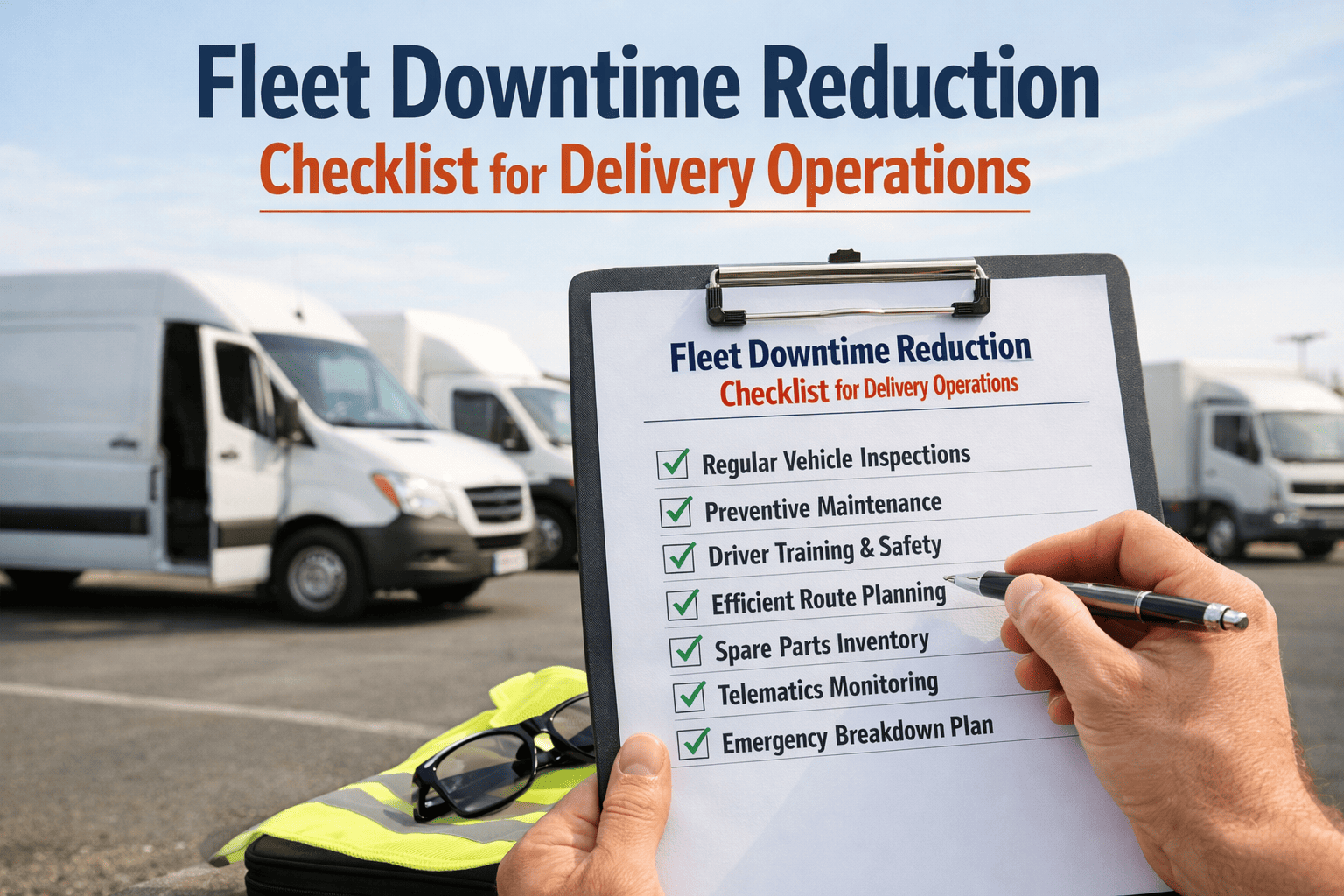
Downtime Reduction Checklist: Are You Doing These?
→All maintenance records digitized: Paper logs and spreadsheets cannot feed AI models. A centralized CMMS is non-negotiable as the foundation.
→Telematics data flowing into your CMMS: Telematics alone is not enough. The value comes from connecting health data to maintenance workflows and work order automation.
→Condition-based alerts configured: Replace calendar PMs with threshold-based triggers for your highest-failure-risk components — brakes, engine, battery, tires.
→Parts inventory linked to predictions: Pre-ordering parts based on predicted failures eliminates the most expensive element of unplanned breakdowns — the wait.
→Downtime KPIs tracked and reported: If you are not measuring baseline downtime hours and cost per vehicle, you cannot prove ROI — or know what is actually working.
Cut Your Fleet Downtime in Half — Starting This Week
OxMaint gives delivery fleet operators real-time vehicle health monitoring, AI-driven work orders, telematics integration, and full maintenance analytics — in one platform. Start with a free account and see your first condition-based alerts within days.
Frequently Asked Questions
How quickly can AI reduce fleet downtime after implementation?
Most delivery fleet operators see measurable downtime reduction within 60–90 days of activating condition-based monitoring. Initial wins come from catching the most obvious pre-failure patterns — engine and brake anomalies — while the predictive models mature over the first 90 days using accumulated sensor data.
Do I need to replace my existing telematics hardware?
No. OxMaint integrates with major telematics providers including Samsara, Geotab, and Verizon Connect via open API. Your existing hardware continues to work — the platform simply connects those data streams to automated maintenance workflows and predictive analytics.
What fleet size is AI predictive maintenance suitable for?
AI fleet maintenance delivers ROI at almost any fleet size, but the payback accelerates significantly at 20+ vehicles where cross-fleet pattern learning becomes powerful. Enterprise fleets of 200+ vehicles often see the most dramatic results because the AI has more data to learn from across the entire portfolio.
What is the first step to reducing delivery vehicle downtime with AI?
The single most important first step is digitizing your maintenance records into a cloud-based CMMS. Without clean, centralized asset and work order data, predictive models have nothing to learn from. This step can be completed in days and immediately reduces downtime through better scheduling, faster technician dispatch, and elimination of missed PMs.
How does AI fleet maintenance handle mixed-vehicle fleets?
Modern AI fleet platforms include pre-built failure models for major vehicle types including cargo vans, box trucks, refrigerated units, and semi-trucks. The system calibrates predictions per vehicle based on its specific telemetry history, so mixed fleets are managed without manual configuration for each vehicle type.