Few supply chain decisions are as hard to reverse as whether to deliver with your own fleet or hand the work to a third-party logistics provider. The cost per delivery on a quote is only the beginning. Control over customer experience, flexibility in peaks, capital tied up in vehicles and depots, and the maintenance and compliance burden all shape the real answer. This guide compares 3PL and in-house delivery on cost, control, service and risk, explains hybrid models, and gives you a scorecard to replace gut feel. If you run or oversee a fleet, you can also see how Oxmaint tracks fleet records for either model.
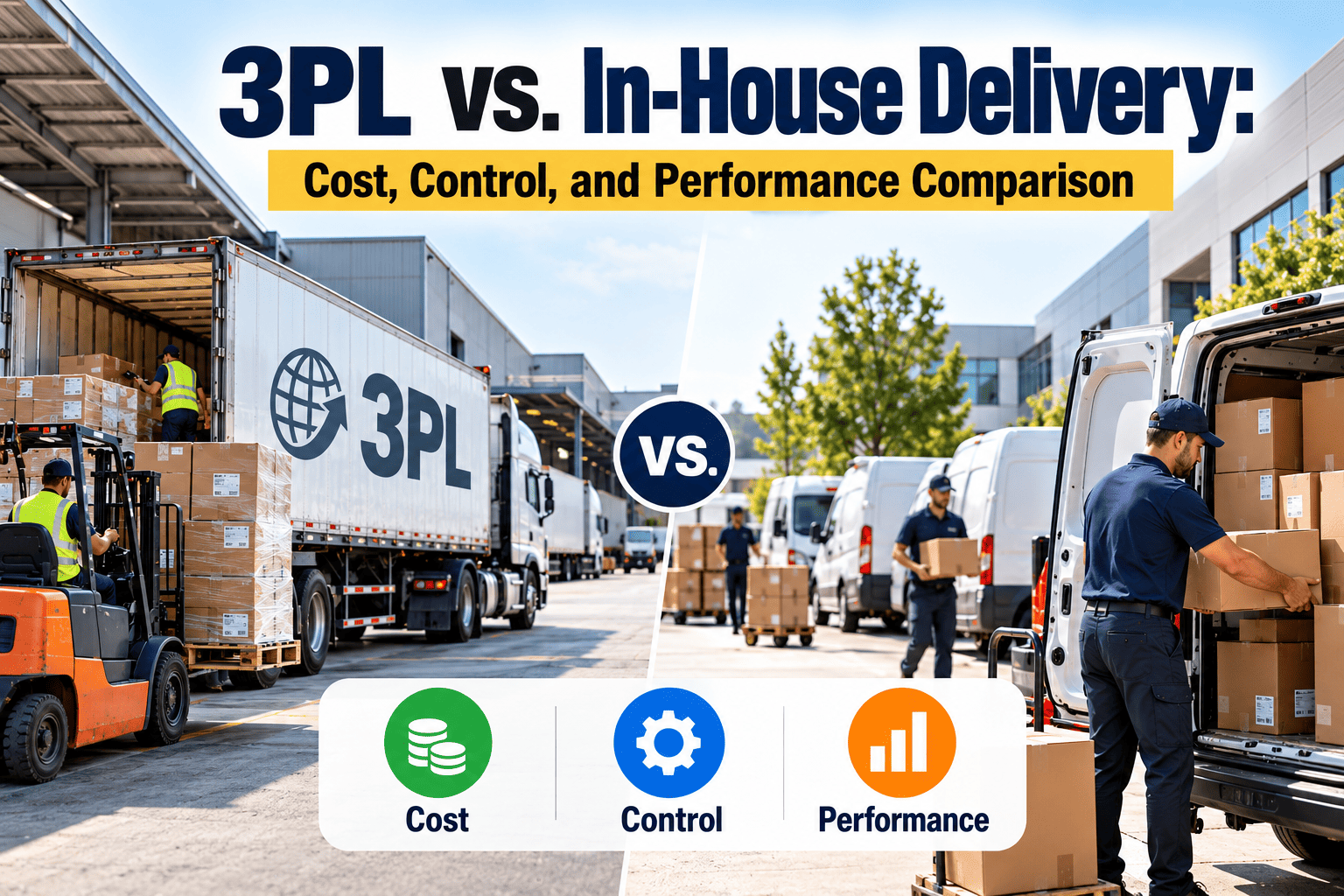
3PL vs. In-House Delivery: Cost, Control, and Performance Comparison
Compare the full cost, the control you keep and the risks you carry under each model, then decide with a weighted scorecard instead of a quote.
The decision on one page
| Factor | 3PL delivery | In-house delivery |
|---|---|---|
| Cost structure | Mostly variable, priced per parcel, stop or route | Mostly fixed: vehicles, drivers, depots, technology and maintenance |
| Speed to start | Fast, using existing network and capacity | Slow, needing vehicles, hiring, depots and systems |
| Control over service | Shared, governed through contract and reporting | Direct, with full authority over process and standards |
| Customer experience | Depends on provider drivers, branding and communication rules | Can be fully branded and consistently managed |
| Flexibility in peaks | Scales with provider capacity, sometimes at surcharge | Limited by fleet and labor unless supplemented |
| Capital needs | Low upfront investment | High for vehicles, facilities and equipment |
| Data and visibility | Depends on integration and what the provider shares | Full access to operational and fleet data |
| Compliance and liability | Shared, but the shipper still carries reputational risk | Fully owned, including vehicle and driver compliance |
| Exit difficulty | Contract terms and switching effort | Asset disposal, lease commitments and redundancy costs |
Neither model wins every row. The right answer depends on which rows matter most to your business over the next three to five years, and the weighting should be agreed with finance, operations and customer teams before any quote is requested.
Build the full cost model, not the quote comparison
In-house costs people forget
- Vehicle depreciation or lease, insurance, registration and tolls.
- Maintenance, tires, spare vehicles and downtime cover.
- Driver recruitment, training, overtime, absence and turnover.
- Depot rent, utilities, equipment and security.
- Routing, telematics and management software.
- Management time for scheduling, safety and compliance.
3PL costs people forget
- Surcharges for peaks, fuel, residential delivery and failed attempts.
- Minimum volume commitments and onboarding fees.
- Claims handling effort and uncompensated damage.
- Integration, reporting and governance staff on your side.
- Customer service load when delivery quality slips.
- Exit and re-tender costs if the relationship fails.
Model volume scenarios
Run the comparison at low, expected and high volume, including peak weeks. Fixed in-house costs look expensive at low volume and efficient at high volume, while 3PL pricing often moves the other way. The crossover point is the number leaders most need to see.
The control and flexibility spectrum
Outsource the tail, own the core
Keep dense, high-value routes in-house and give sparse or remote areas to a regional carrier whose network already covers them.
Own the premium, outsource the rest
Run white-glove, same-day or scheduled delivery with your own drivers, and use a 3PL for standard parcels.
Own the base, rent the peak
Size the fleet for normal demand and buy surge capacity from partners in busy weeks to avoid idle assets.
Own a fleet or oversee partners? Keep the records in one place
Oxmaint helps in-house fleets manage preventive maintenance, inspections and downtime, and helps teams track the compliance records of equipment they depend on.
Service quality: what changes when someone else drives
Risks with a 3PL
- Drivers carry several brands and may not follow your delivery standards.
- Priorities shift in peak weeks when the provider serves everyone at once.
- Data arrives late or in a different format, limiting your visibility.
- Issues are resolved through escalation, not direct instruction.
Risks with in-house
- Quality depends on your ability to hire, train and retain drivers.
- Vehicle breakdowns hit your customers directly with no backup network.
- Peak demand can overwhelm a fleet sized for average weeks.
- Management attention is pulled into non-core operations.
Write service into the contract
If you use a 3PL, define on-time targets, first-attempt success, damage rates, proof-of-delivery standards, data feeds, escalation steps and remedies. A contract with vague service language leaves you responsible for results you cannot control.
The maintenance and compliance dimension
If you keep delivery in-house
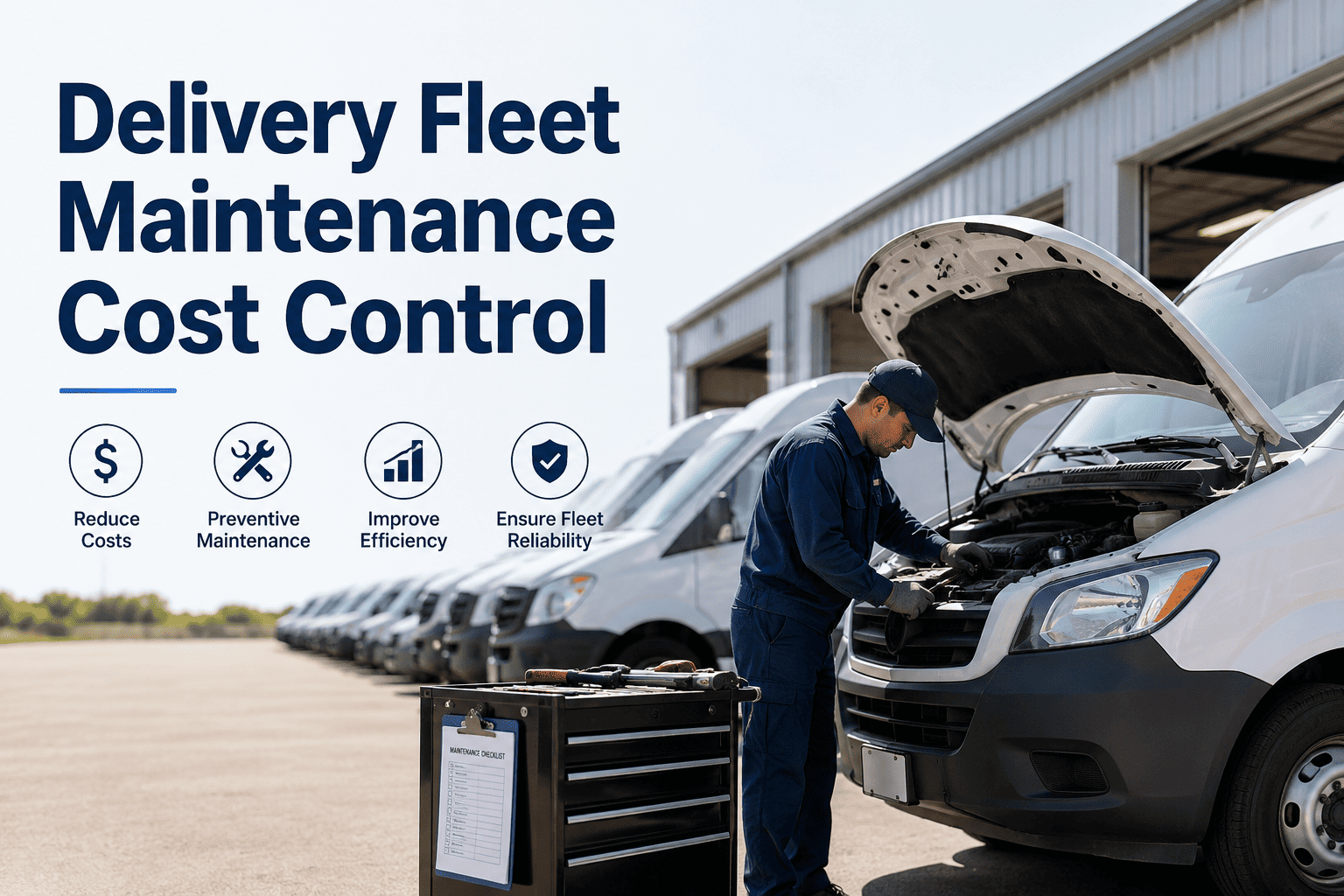
- Vehicle availability becomes your service level, so preventive maintenance and inspections are core operations.
- Breakdowns require spare vehicles or rapid repair, which adds cost that quotes from carriers do not show.
- Inspection and maintenance records are your evidence in audits, insurance claims and incident reviews.
- Older vehicles need more attention, so replacement planning belongs in the business case.
If you outsource
- The provider maintains vehicles, but you still depend on their discipline for on-time performance.
- Ask what inspection, maintenance and safety records they keep and how they would share them.
- Review their fleet condition and breakdown rates in regular service meetings.
Questions to put to a provider
- How is preventive maintenance scheduled and verified?
- What share of routes are covered by spare vehicles on a breakdown day?
- How are driver pre-trip inspections recorded?
- Can you report vehicle availability for our routes?
- What happens to our parcels if a vehicle fails mid-route?
A weighted scorecard to replace the gut call
| Criterion | Weight you assign | 3PL score | In-house score | What to base the score on |
|---|---|---|---|---|
| Total cost at expected volume | Set 1 to 5 | Score 1 to 5 | Score 1 to 5 | Full cost model with peak and low scenarios |
| Customer experience control | Set 1 to 5 | Score 1 to 5 | Score 1 to 5 | Brand, communication, flexibility of windows |
| Peak flexibility | Set 1 to 5 | Score 1 to 5 | Score 1 to 5 | Surge capacity and surcharge terms |
| Capital and balance sheet | Set 1 to 5 | Score 1 to 5 | Score 1 to 5 | Upfront investment and lease commitments |
| Risk and compliance | Set 1 to 5 | Score 1 to 5 | Score 1 to 5 | Safety record, insurance, regulatory exposure |
| Data and visibility | Set 1 to 5 | Score 1 to 5 | Score 1 to 5 | Integration depth and reporting timeliness |
| Strategic fit | Set 1 to 5 | Score 1 to 5 | Score 1 to 5 | Whether delivery is a differentiator for the brand |
How to use it
Multiply each score by the weight, add the totals, and compare. The point is less the final number than the debate it forces. If executives disagree on the weights, you have found the real strategic question.
Decision path: five questions in order
Is delivery a differentiator for our brand?
If customers choose you for the delivery experience, lean toward control, whether in-house or a tightly managed partner.
Is our volume dense and predictable enough?
High, steady density in a region tends to favor owned capacity. Sparse or highly seasonal volume favors partners.
Can we run and maintain a fleet well?
Honestly assess recruitment, safety, maintenance and technology capability before committing capital.
Can we govern a partner well?
Outsourcing needs contract management, data integration and service review discipline, not just a signed agreement.
Can we pilot before committing?
Test a hybrid in one region first, measure results against the scorecard and expand only if the evidence supports it.
Triggers that should reopen the decision
Volume shifts
Sustained growth or decline moves the crossover point between fixed and variable cost.
Service slippage
Repeated misses on on-time or damage targets, with no improvement after escalation.
Cost drift
Surcharges, fuel adjustments or fleet repair costs rising faster than volume.
Regulation and technology
Low-emission zones, new vehicle types or automation that change the economics.
Keep an exit option alive
Even with a long contract or a big fleet, hold relationships with a second provider or maintain a small in-house capability. A credible alternative improves negotiating position and limits the damage from a failing partner.
Contract terms that protect you when outsourcing
Service levels and remedies
Define targets, how they are measured, credits for misses and the point at which repeated misses allow exit.
Pricing mechanics
Spell out fuel adjustments, peak surcharges, residential and failed-delivery fees, and annual review rules.
Data and integration
Specify tracking feeds, event timing, proof-of-delivery access and ownership of operational data.
Liability and claims
Clarify limits of liability, claims timelines and insurance requirements for vehicles, goods and drivers.
Fleet and driver standards
Require documented vehicle maintenance, inspections, driver training and the right to audit them.
Capacity commitments
Agree how peak demand will be forecast, how capacity is reserved and what happens when it cannot be met.
Brand and customer rules
Set expectations for communication, delivery behavior, uniforms and handling of complaints.
Exit and transition
Define notice periods, data return, handover support and any restrictions on moving volume away.
Different customers, different answers
| Delivery segment | What matters most | Model that often fits |
|---|---|---|
| High-value or white-glove | Handling quality, scheduled windows, installation or setup, brand presence | In-house or tightly governed specialist partner |
| Dense urban consumer parcels | Cost per stop, speed, failed-delivery rate | Either, depending on density and volume stability |
| Rural and remote areas | Coverage and cost of long distances with few stops | Usually a partner with an existing regional network |
| B2B scheduled replenishment | Reliability, dock appointments, relationship continuity | Often in-house or dedicated contract fleet |
| Seasonal peak overflow | Rapid scalable capacity without idle assets afterward | Partner capacity layered over an owned base |
| Temperature-controlled goods | Equipment condition, monitoring records, compliance documentation | Depends on who can prove maintenance and monitoring discipline |
If you decide to change model: a transition outline
Baseline and design
Document current cost, service and volume by region. Define the target model and success measures before anything moves.
One region first
Move a contained set of routes, run both models in parallel where possible and compare results to the baseline.
Expand in stages
Add regions only after service stabilizes, integrations work and the team has capacity to manage the next wave.
Review and adjust
Hold regular service reviews, track KPIs against targets and revisit the model when the triggers listed above appear.
Protect service during the change
Customers feel transitions as missed windows and unclear tracking. Keep a manual fallback, brief customer service teams early and avoid moving volume during the busiest weeks.
Common mistakes in the 3PL versus in-house decision
Comparing a quote with a partial cost
In-house figures that leave out maintenance, spare vehicles and management time make owned delivery look cheaper than it is.
Treating outsourcing as abdication
The shipper still owns the customer relationship. Without governance, quality drifts and no one is accountable.
Deciding on peak anxiety
A bad season can push leaders to a permanent change. Look at a full year of data before switching.
Ignoring switching costs
Redundancies, lease exits, re-tendering and customer disruption can outweigh years of savings.
Assuming all 3PLs are alike
Providers differ in density, technology, driver model and fleet condition. Evaluate each on your routes.
Skipping the pilot
A contained trial exposes integration and service issues before they affect the whole network.
How Oxmaint supports each model
For in-house and hybrid fleets
- Preventive maintenance scheduled by date, mileage or usage.
- Vehicle and driver inspections with photos and sign-off.
- Work orders, parts and downtime tracked per vehicle.
- Dashboards for availability, backlog and maintenance cost.
- Records ready for audits, insurers and incident reviews.
For teams overseeing partners
- Track depot and handling equipment you own that partners rely on.
- Keep your own cost and downtime baseline to compare with provider reports.
- Maintain compliance records for any vehicles you lease to partners.
- Use consistent KPIs when reviewing in-house against outsourced routes.
Frequently asked questions
Is 3PL delivery always cheaper than in-house?
No. At low or uneven volume it often is, but dense, steady volume can favor owned capacity. Compare full costs at several volume scenarios before deciding.
What is a hybrid delivery model?
It combines owned capacity for core or premium routes with partners for peaks, remote zones or standard parcels. It balances control with flexibility.
How does fleet maintenance affect the decision?
Owning vehicles makes availability your responsibility, with spare and repair costs to match. A system such as Oxmaint helps control those costs.
How do I keep control of quality when using a 3PL?
Set measurable targets in the contract, require regular data feeds and hold service reviews with clear remedies. Pilot before scaling.
Can we move from 3PL to in-house later?
Yes, but plan for lead times on vehicles, hiring and depots. You can book a demo to see how fleet maintenance can be set up early.
Decide with the full picture, then run it well
Whichever model you choose, reliable vehicles and clear records protect service. Oxmaint helps delivery teams manage preventive maintenance, inspections and downtime across owned and hybrid fleets.