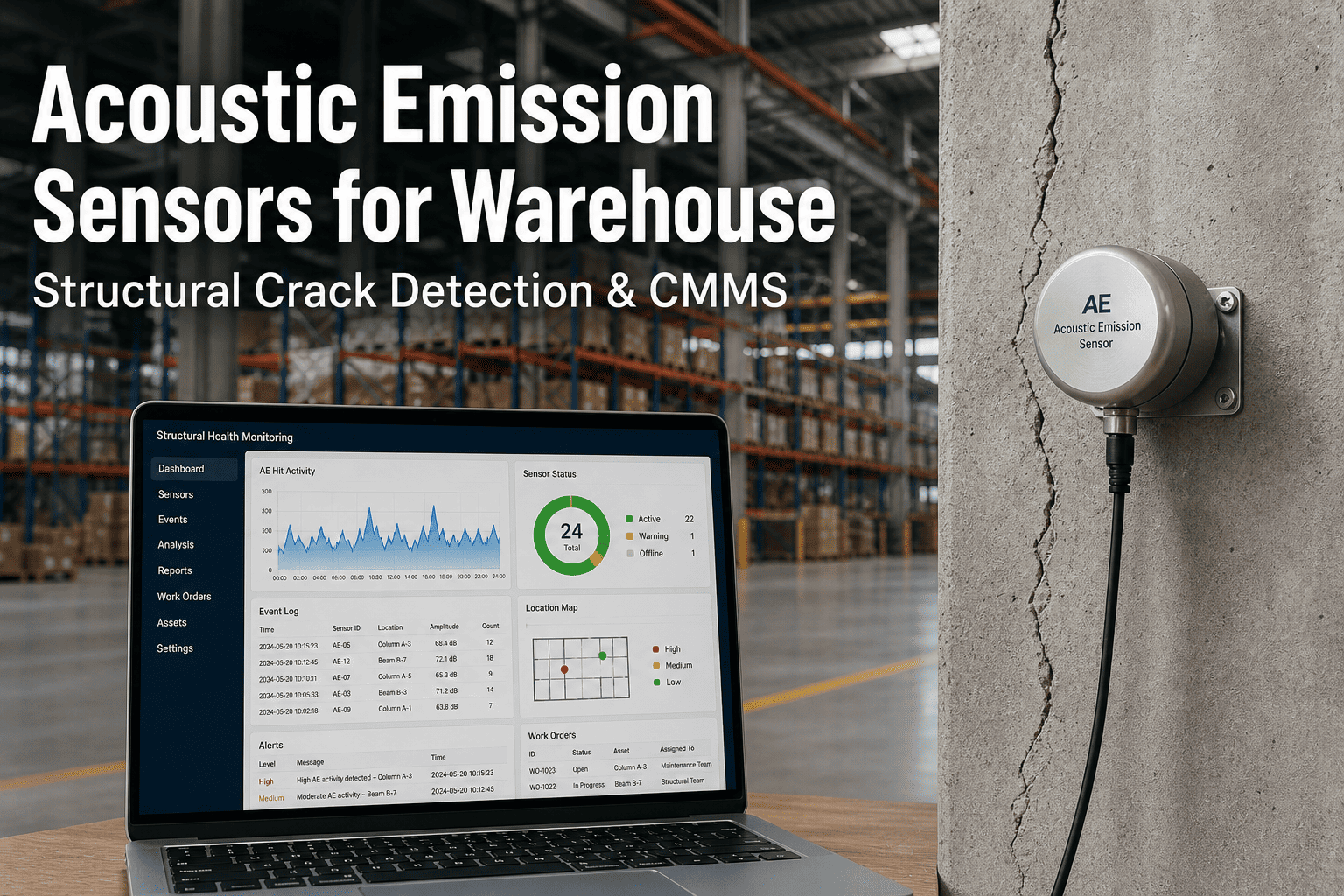
Structural failures in warehouses rarely announce themselves with obvious warning signs. Pallet racking that looked solid on last month's visual inspection can carry micro-cracks in its welds that, under sustained load and vibration, will propagate silently for weeks — until a section collapses during a busy receiving shift. Dock edge beams, conveyor support frames, and mezzanine supports are among the most critically loaded structures in warehouse and logistics facilities, and they are almost always inspected visually on a calendar schedule that has no relationship to actual stress accumulation or early damage progression. Acoustic emission (AE) sensor technology changes this entirely — detecting the ultrasonic stress waves that materials emit when micro-cracks form or propagate, in real time, across every critical structural member. When integrated with a CMMS platform like OxMaint, AE detection auto-generates inspection and intervention work orders the moment anomalous acoustic signatures appear — giving maintenance teams a structural health timeline instead of a reactive repair log.
Acoustic Emission Sensors: Detecting Warehouse Structural Cracks Before They Become Collapses
How AE sensor networks — integrated with CMMS — give warehouse operators real-time structural health data across racking, dock frames, and conveyor infrastructure, weeks before visible damage appears.
Why Visual Inspection Alone Cannot Protect Warehouse Structures
Visual inspection is the most common structural safety method in warehouses — and the least reliable for detecting what actually causes collapses. Here is what it consistently misses.
Micro-cracks originating at weld toes, bolt holes, or internal stress concentrations are invisible to the naked eye until they propagate to the surface — at which point structural integrity is already compromised. AE sensors detect the stress wave energy released during crack initiation, not the crack itself.
A weekly visual inspection will not capture stress accumulation from a single overloaded pallet event on a Tuesday. AE monitoring is continuous — every high-stress load event is recorded and correlated to structural response, building a cumulative damage picture that scheduled inspection cannot replicate.
High-bay racking at 10–12 meters, dock edge interfaces, and enclosed conveyor frame joints are physically inaccessible for routine visual checks. AE sensor networks cover every monitored location continuously without requiring physical access to each joint.
Visual inspection produces a pass/fail opinion, not a structural risk score. AE monitoring generates quantified emission rate data, signal amplitude trends, and hit frequency patterns that can be compared against baseline values to produce objective condition ratings per structural member.
How Acoustic Emission Detection Works in Warehouse Environments
AE technology is not new to heavy industry — but its application in warehouse structural monitoring, integrated directly with maintenance management workflows, represents a significant advancement in logistics safety infrastructure.
Piezoelectric AE sensors are bonded to racking uprights, cross-bracing connection points, dock beam undersides, conveyor support columns, and mezzanine floor plate edges. Sensor arrays are positioned to triangulate the location of any detected emission source to within centimeters.
AE systems monitor in the 20kHz–1MHz frequency range — well above audible noise — detecting the transient stress waves produced when crack surfaces rub, when dislocations move, or when bond interfaces slip under load. Background noise from warehouse operations is filtered by signal processing algorithms trained on facility-specific ambient profiles.
Collected AE data is analyzed for hit rate, amplitude distribution, signal energy, and rise time characteristics. Anomalous clusters — those deviating from the established structural baseline — are classified by severity: benign friction events, active micro-crack propagation, or accelerating damage requiring immediate inspection.
When AE analysis classifies an anomaly above the intervention threshold, the integration layer pushes a work order directly into OxMaint — populated with the sensor ID, structural member location, anomaly classification, historical emission trend, and recommended inspection action. No manual translation required between sensor alert and maintenance response.
Technicians complete inspections against the work order, log findings with photos, and close out the record in OxMaint. The structural health history — AE data, work orders, inspection results, and repairs — accumulates as a complete per-member timeline, available for engineering review and regulatory audit at any time.
Warehouse Structures Where AE Monitoring Delivers the Most Value
Not every structural element carries equal risk. AE deployment should be prioritized by load criticality, inspection accessibility, and consequence of undetected failure.
| Structural Asset | Primary Failure Mode | AE Detection Advantage | Advance Warning Window |
|---|---|---|---|
| High-Bay Racking Uprights | Weld toe fatigue, impact damage propagation | Detects crack growth before column buckle risk | 4–8 weeks |
| Dock Edge Beams | Cyclic load fatigue from truck dock impacts | Tracks cumulative fatigue cycles, not just visual corrosion | 3–6 weeks |
| Mezzanine Floor Plates | Weld joint separation under dynamic point loads | Identifies joint slip before plate deflection is visible | 2–5 weeks |
| Conveyor Support Frames | Vibration-induced fatigue at anchor connections | Distinguishes normal vibration from crack-related acoustic events | 3–7 weeks |
| Cold Storage Panel Frames | Thermal cycling fatigue at bracket connections | Detects micro-fractures in thermally stressed welds | 5–10 weeks |
OxMaint's sensor integration layer accepts condition data from AE monitoring systems and converts anomaly alerts into structured work orders — with full asset context, historical data, and technician assignment built in. No custom development required.
AE Sensors vs Vibration Sensors vs Visual Inspection: What Each Detects
Facility managers often ask how acoustic emission differs from vibration monitoring — and why the two are not interchangeable for structural crack detection.
What the CMMS Integration Workflow Produces — Step by Step
The value of AE monitoring multiplies when it feeds directly into a structured maintenance management workflow. Here is how OxMaint closes the loop from sensor signal to documented resolution.
Sensor array records accelerating hit rate and amplitude deviation from structural baseline on dock beam connection joint B-14.
OxMaint receives AE system alert, creates HIGH priority inspection work order with sensor data, location map, and last three inspection records attached.
Assigned structural inspector receives mobile notification with full work order context. No re-entry of data. Inspection checklist pre-loaded in OxMaint app.
Inspector confirms surface micro-crack at weld toe. Photos and crack gauge readings uploaded on mobile. Repair work order triggered automatically. Area flagged for load restriction.
Weld repair completed and documented. OxMaint closes the full chain — AE alert, inspection, repair, and return-to-service — as a single auditable structural health record.
Frequently Asked Questions
Stop Waiting for Cracks to Become Visible
OxMaint connects acoustic emission monitoring, inspection workflows, and structural repair records into a single platform — giving warehouse safety teams and maintenance managers the advance warning and documentation they need before a structural event becomes a regulatory or safety crisis.