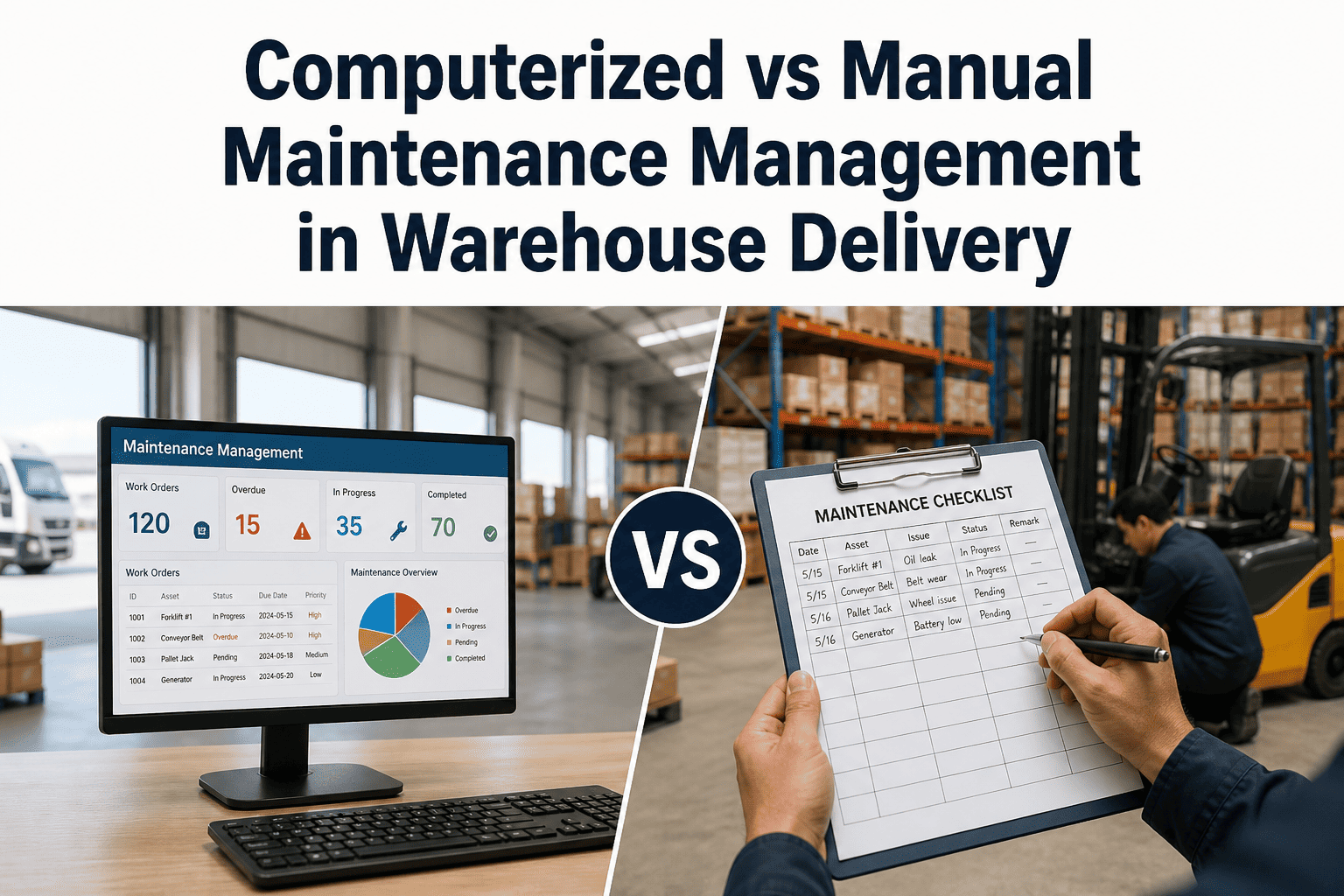
Warehouses running on manual maintenance processes are operating on borrowed time. Every missed inspection, every handwritten work order lost in a pile, every reactive repair that could have been prevented — these aren't isolated incidents. They are the slow accumulation of risk that eventually shows up as conveyor downtime, failed regulatory audits, and driver delays that cost clients. A single unplanned forklift failure during peak dispatch can cascade into missed delivery windows, damaged customer relationships, and emergency repair costs that dwarf the entire monthly maintenance budget. The gap between computerized and manual maintenance management in warehouse and delivery operations is no longer a technology preference — it is a performance and survival gap. Warehouses that have moved to a computerized maintenance management system like OxMaint are reporting 40% fewer asset breakdowns, 32% lower maintenance spend, and compliance documentation that takes minutes instead of weeks to produce.
Computerized vs Manual Maintenance: The Real Performance Gap in Warehouse & Delivery
Why warehouses clinging to spreadsheets and logbooks are losing ground — and what switching to a CMMS actually looks like on the floor.
Where Manual Maintenance Breaks Down in Warehouse Operations
Manual maintenance feels manageable until the moment it isn't. These are the six failure points that warehouse managers consistently report — each one preventable with a CMMS.
Technicians only find problems when they physically inspect — or when something breaks. CMMS-connected sensors detect temperature anomalies, vibration spikes, and pressure drops before failure occurs.
On a spreadsheet, overdue preventive maintenance sits silently. There are no alerts, no escalations, no visibility into accumulating risk. CMMS surfaces every overdue task with aging status and priority ranking.
What the outgoing crew knew about an in-progress repair, a recurring fault, or a part on order — gone at shift change. CMMS asset timelines persist across every shift with full repair and fault history attached.
Technicians walk to the storeroom not knowing if the part exists. Emergency procurement delays extend every repair. CMMS integrates with inventory, auto-ordering parts when stock drops below threshold.
Preparing documentation for OSHA, fire safety, or forklift certification audits means pulling logbooks, chasing technicians for sign-offs, and manually compiling records. CMMS generates audit-ready reports instantly.
Manual systems report what was spent. They cannot tell you which conveyor line consumed 35% of your maintenance budget, or whether contractor labor matched the quoted scope. CMMS gives real-time cost attribution by asset.
Head-to-Head: Computerized vs Manual Maintenance
This is how the two approaches compare across every dimension that affects warehouse performance, safety, and cost.
| Performance Dimension | Manual Maintenance | CMMS (OxMaint) |
|---|---|---|
| PM Compliance Rate | 40–55% | 90–97% |
| Failure Detection Speed | After failure occurs | Before failure — sensor-triggered |
| Mean Time to Repair | 12–20 hours average | 5–8 hours average |
| Audit Preparation Time | 100–300 hours | Under 2 hours |
| Maintenance Cost Variance | ±25–35% | ±5% |
| Parts Stockout Frequency | High — no auto-replenishment | Low — threshold-based reordering |
| Technician Productive Time | 28–35% wrench time | 55–65% wrench time |
| Asset History Availability | Incomplete or unavailable | Full digital history per asset |
OxMaint is used by warehouse operators, 3PL providers, and delivery hubs to eliminate reactive maintenance — with mobile-first work orders, automated PM scheduling, and compliance records generated without any manual effort.
What the Switch Actually Looks Like: A Warehouse Scenario
Abstract comparisons are less useful than a concrete example. Here is how the same maintenance event unfolds in a manual warehouse versus one running OxMaint.
KPIs That Tell You If Your Transition Is Working
Once you switch to CMMS, these are the metrics to track monthly. OxMaint generates all of them automatically — no manual data assembly required.
The ROI Case for Warehouse CMMS Adoption
The financial case for switching is not theoretical. These are real cost categories where warehouse operations recover budget after CMMS implementation.
Preventive maintenance driven by CMMS scheduling dramatically cuts emergency call-outs, overtime, and expedited parts procurement.
Technicians spend less time on paperwork, parts hunting, and status updates. More wrench time per shift with the same headcount.
Fewer unplanned stoppages means consistent dispatch throughput, fewer delivery SLA penalties, and no emergency contractor fees.
Audit-ready documentation is generated automatically. No scrambling before OSHA reviews or forklift certification renewals.
Frequently Asked Questions
Your Warehouse Deserves Better Than a Spreadsheet
OxMaint gives warehouse and delivery operations a complete digital maintenance platform — mobile work orders, automated PM scheduling, real-time asset cost tracking, and compliance documentation that generates itself. No IT project required. Most teams are live in under a week.