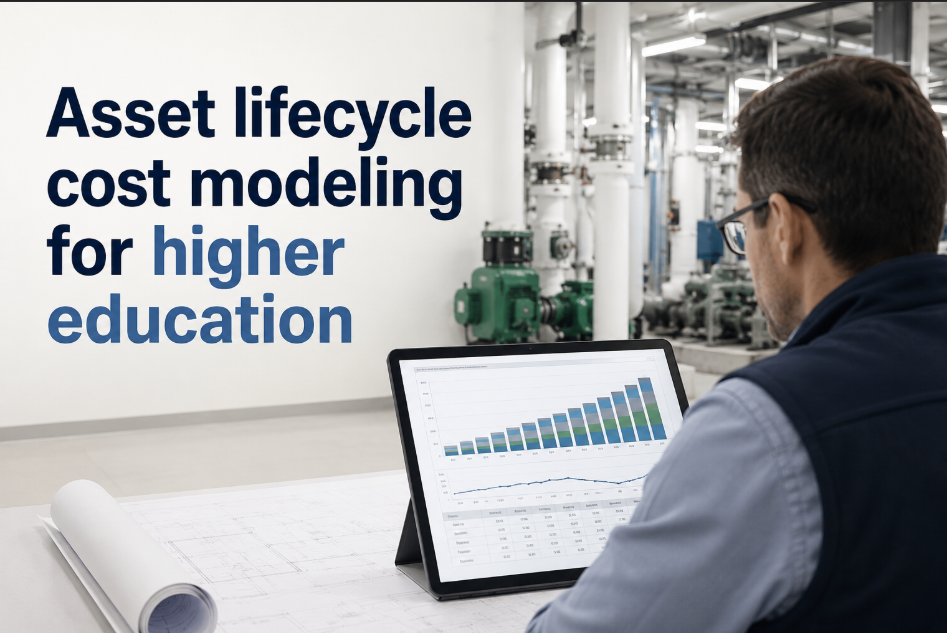
Every year, university asset managers make replacement and renewal decisions worth hundreds of millions of dollars — and most of those decisions are made with incomplete cost information. A roof gets replaced when it starts leaking, not when lifecycle cost modeling shows that year-11 replacement produces the best total cost of ownership. A chiller gets run until failure rather than replaced at year-17 when condition data would have shown the crossover point where continued operation costs more than capital replacement. Lifecycle cost modeling is the discipline that fills this gap — turning asset condition data, failure probability curves, maintenance cost trends, and replacement pricing into defensible, quantitative investment decisions. Universities that deploy CMMS-driven lifecycle cost models consistently achieve 28% lower total cost of ownership across their major equipment portfolios compared to those relying on calendar-based replacement schedules or reactive decision-making. If your capital decisions are still driven by when assets fail rather than when it becomes financially optimal to replace them, start a free trial or book a demo to see how OxMaint's asset lifecycle tracking builds this model automatically.
Asset Lifecycle Cost Modeling for Higher Education
How universities use CMMS asset condition data to model total cost of ownership for major equipment — turning replacement decisions from reactive judgments into defensible, data-backed capital investments.
What Lifecycle Cost Modeling Is — and Why Most Universities Do Not Do It Properly
Lifecycle cost modeling (LCM) calculates the total cost of owning an asset from acquisition through disposal — including purchase price, installation, energy consumption, preventive maintenance, reactive repairs, and ultimate replacement cost. The purpose is to identify the financially optimal point at which to replace or renew an asset, rather than running it until failure or replacing it on an arbitrary calendar schedule.
Most higher education facilities teams do not practice true lifecycle cost modeling because they lack the underlying data it requires. A proper LCM calculation needs: accurate installation cost and date, year-by-year maintenance expenditure history, energy consumption trend data, current condition score, failure probability curve for the asset type, and current replacement cost estimates. Without a CMMS, this data exists across multiple systems — or does not exist at all — making systematic modeling impractical.
With OxMaint, every work order, inspection, parts purchase, and condition update is linked to the relevant asset in the hierarchy. Over time, this creates exactly the longitudinal cost record that lifecycle cost modeling requires. After 18–24 months on the platform, universities can model TCO for any tracked asset with a level of accuracy that supports capital board presentations, debt financing applications, and deferred maintenance prioritization decisions. Start building your asset cost record — start a free trial or book a demo with the OxMaint team.
The 6 Components of a Complete Lifecycle Cost Model
Each component of a lifecycle cost model serves a specific role in the total calculation. Missing any one of them skews the model toward underestimating the true cost of ownership — which leads to wrong replacement decisions.
Purchase price plus installation, commissioning, and any required infrastructure modifications. For complex mechanical systems, installation typically adds 35–60% to equipment cost. This is the baseline — every other cost component is measured against it.
Labor, parts, and contractor costs for scheduled maintenance over the asset's life. PM costs typically follow a U-curve: low in early years, rising significantly after the midpoint of expected useful life. OxMaint tracks actual PM cost per asset per year automatically.
Unplanned repair costs that increase as assets age and components approach end-of-life. The crossover point — where annual reactive repair costs exceed 20% of replacement cost — is a reliable signal that replacement is more economical than continued operation.
For HVAC, boilers, chillers, and electrical distribution systems, energy cost often exceeds maintenance cost over the asset's life. Aging equipment loses efficiency — a 20-year-old chiller may consume 40% more energy per ton of cooling than a current-generation replacement, costing $35,000–$60,000 per year in excess energy spend.
The cost of asset failure to university operations — lost lab time, rescheduled classes, temporary equipment rental, and student or research impact. Rarely quantified, but typically 2–4x the direct repair cost for central plant equipment serving multiple buildings.
End-of-life disposal, environmental compliance (refrigerant recovery, hazardous material abatement), and the cost of the replacement asset at future pricing. Applying a 3–4% annual cost escalation to today's replacement price gives a defensible projection of capital cost at any future replacement year.
Lifecycle Cost Benchmarks by Equipment Type
These benchmarks represent typical lifecycle cost patterns for major higher education facilities equipment. Use them as starting points for your own modeling, adjusted for your specific equipment condition and local labor rates.
| Equipment Type | Expected Useful Life | Optimal Replacement Window | Annual PM Cost (% of replacement) | Failure Risk Signal |
|---|---|---|---|---|
| Centrifugal Chiller | 20–25 years | Years 18–22 | 2–4% | Efficiency drop >15% from nameplate |
| Air Handling Unit | 15–20 years | Years 13–17 | 3–5% | Annual repairs exceed 20% of replacement cost |
| Boiler (hydronic) | 25–35 years | Years 22–28 | 1.5–3% | Heat transfer efficiency below 80% of rated |
| Cooling Tower | 15–20 years | Years 12–16 | 4–6% | Basin structural damage or severe scaling |
| Emergency Generator | 20–30 years | Years 18–24 | 2–4% | Load test failure rate above 8% |
| Roof System (TPO) | 20–25 years | Years 18–22 | 0.5–1.5% | Active leaks in 3+ locations per 10,000 sq ft |
| Elevator (hydraulic) | 20–25 years | Years 18–22 | 3–5% | Entrapment rate or callback rate exceeds threshold |
| Switchgear / Distribution | 30–40 years | Years 28–35 | 1–2% | Thermal imaging shows hot spots, parts obsolescence |
How OxMaint Builds the Lifecycle Cost Record Automatically
Lifecycle cost modeling is only as good as the data behind it. OxMaint builds the complete cost record for every tracked asset, automatically, through the normal course of maintenance operations.
Every work order, parts purchase, and contractor invoice is linked to the specific asset in OxMaint's hierarchy. After 12 months, you have a complete year-by-year maintenance cost history for every tracked asset — the foundation of any TCO calculation.
Each digital inspection updates the asset's condition score. OxMaint tracks condition score history over time, revealing degradation rate — which determines where the asset sits on its lifecycle curve and when the replacement window opens.
OxMaint calculates remaining useful life based on asset type, age, and current condition score. Assets approaching end-of-life are flagged automatically and surface in the CapEx forecasting dashboard — so replacements are planned, not surprised.
OxMaint's forecasting engine projects capital replacement costs across 5–10 years for every asset in the registry. The forecast updates automatically when condition scores change — no manual rebuild required. Your capital plan is always current.
Universities that have tracked assets in OxMaint for 24+ months report a fundamental shift in how capital decisions are made: replacement proposals come with data that the board can evaluate objectively — annual maintenance cost per asset, condition score trend, remaining useful life estimate, and projected replacement cost. Political arguments about which building gets funded first give way to data-driven conversations about risk, TCO, and institutional priority. Want to see what your asset cost data looks like in OxMaint? Start a free trial or book a demo to walk through a real asset lifecycle scenario.
What Lifecycle Cost Modeling Delivers
Frequently Asked Questions
How long does it take to build a useful lifecycle cost dataset in OxMaint?
How do we account for energy efficiency improvements when modeling chiller or boiler replacement?
What is the difference between a lifecycle cost model and a deferred maintenance report?
Can lifecycle cost modeling support green bond or sustainability financing applications?
Every Year Without Lifecycle Data Is a Year of Suboptimal Capital Decisions
OxMaint builds the asset cost record, condition history, and CapEx forecasting model that higher education lifecycle cost modeling requires — automatically, through normal maintenance operations. Start building your data foundation today. After 12 months, your replacement decisions will be backed by evidence instead of experience alone. No implementation fees, no data migration complexity, and no consultant required to get started.