Most school districts have buildings that are deteriorating faster than their maintenance budgets can keep pace with — but without a standardized way to measure that deterioration, facility directors walk into board meetings armed with nothing more than anecdotes and gut feelings. The Facility Condition Index changes that. It converts the physical state of every building, roof, HVAC system, and electrical panel in your district into a single, defensible number that boards understand, auditors accept, and state agencies use to allocate capital funding. Districts that track FCI systematically secure 34% more capital funding per application than those presenting narrative-only condition reports. The problem is that most districts calculate FCI incorrectly — either understating their backlog by missing hidden deferred costs, or overstating it in ways that undermine credibility. This guide covers what FCI actually means, how to calculate it correctly, how to benchmark your scores, and how platforms like OxMaint automate the entire process from asset inspection to board-ready reporting. If you want to stop guessing about your buildings and start managing them with data, start a free trial or book a demo to see how facility directors are using OxMaint to build FCI-backed capital cases.
Facility Condition Index Score for Schools: The Complete Explanation
What FCI actually measures, how to calculate it correctly, how to benchmark your district against national standards, and how to use it to win capital funding — with real data and a step-by-step methodology.
What Is the Facility Condition Index?
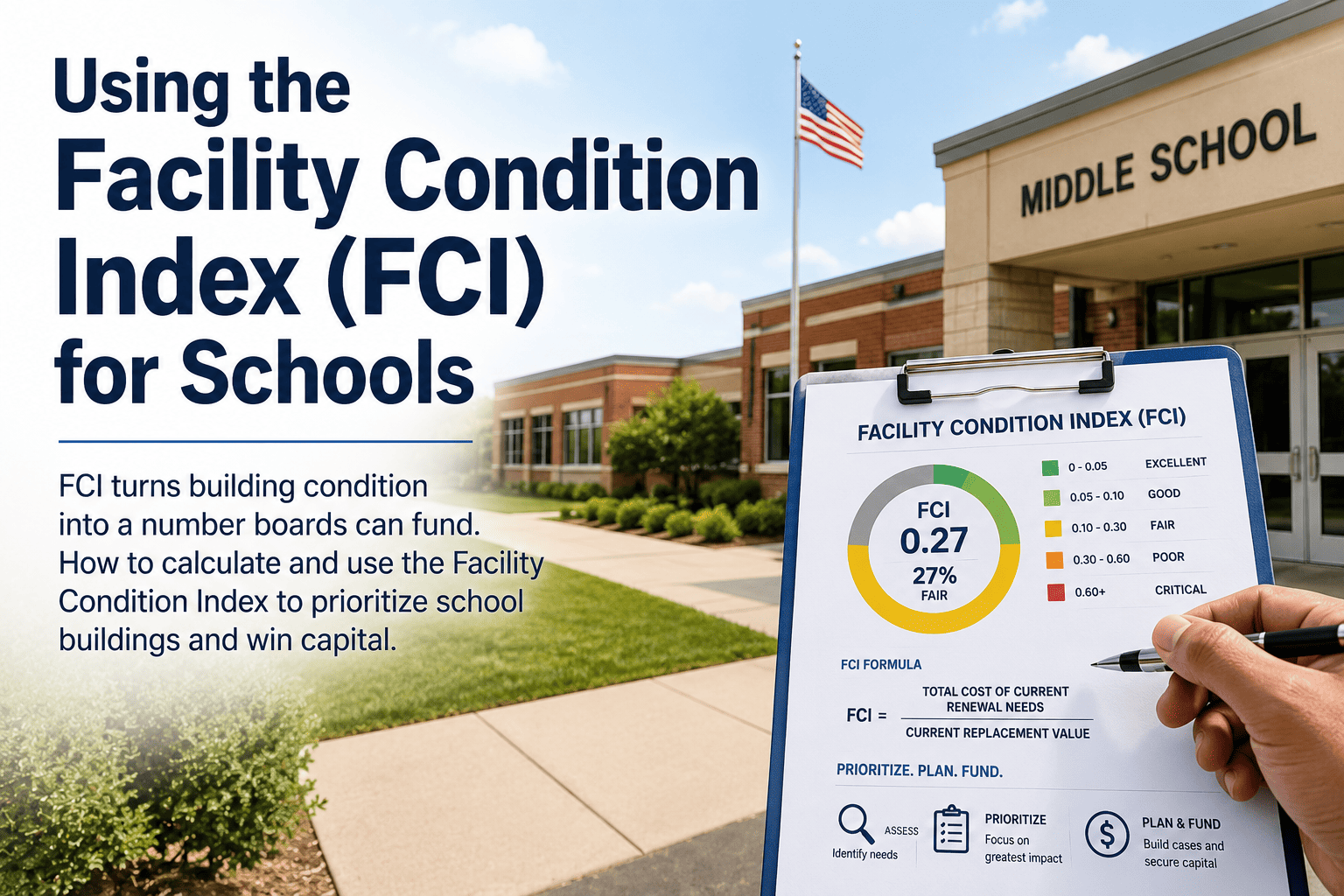
The Facility Condition Index (FCI) is the ratio of deferred maintenance cost to current replacement value of a building or asset. It is the universally accepted standard metric for measuring building health in the public education sector, used by APPA, state education agencies, and the U.S. Department of Education.
FCI was developed by APPA (the Association of Physical Plant Administrators) in 1991 and has since become the baseline language for facility condition assessment across higher education and K-12 districts. A score of 0 represents a building in perfect condition. A score of 1.0 (or 100%) represents a building whose deferred maintenance costs equal its entire replacement value — effectively a total loss.
Understanding your FCI is not just about internal planning. State agencies in 38 states now require or request FCI documentation as part of capital funding applications. Districts with current, auditable FCI data move to the front of the funding queue. Start building your FCI database today — start a free trial or book a demo to see how OxMaint automates FCI tracking at the asset, building, and district level.
FCI Score Ranges: What Your Number Actually Means
APPA defines four condition categories based on FCI thresholds. These benchmarks are recognized by state agencies, bond rating firms, and federal grant programs. Knowing which tier your buildings fall into determines your funding eligibility, urgency of intervention, and capital planning horizon.
How to Calculate FCI Correctly: Step-by-Step
Most districts that calculate FCI incorrectly make one of three errors: they undercount deferred maintenance by missing non-structural systems, they use outdated replacement values, or they calculate only at the building level rather than the system level. Here is the correct methodology.
CRV is the cost to replace the building with a modern equivalent at today's construction costs — not the original build cost, not the insured value. Use RSMeans or a local construction cost index updated annually. For K-12 schools, CRV typically ranges from $280–$420 per square foot depending on region and building type.
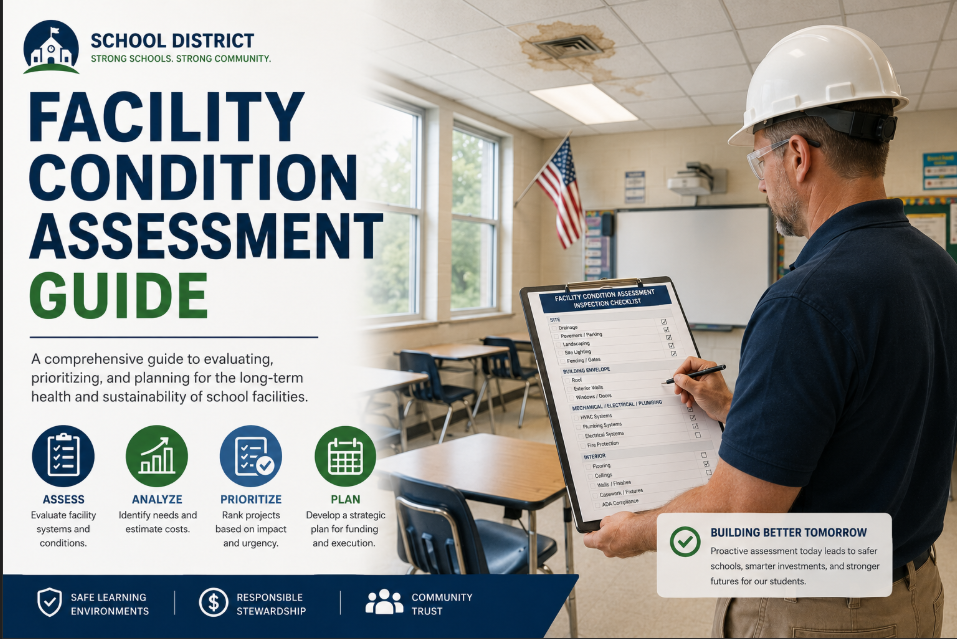
Inspect and score every major building system: roofing, envelope, structural, HVAC, plumbing, electrical, life safety, interior finishes, and site. Each system gets a condition rating and an estimated repair or replacement cost. Do not estimate at the building level — system-level assessment is 3x more accurate for capital planning purposes.
Deferred maintenance includes any repair or replacement that has been identified as needed but not yet funded or scheduled. This includes items from previous condition assessments, work orders closed as "deferred," and end-of-life assets still operating past their replacement year. Every deferred item must have a current cost estimate — not the estimate from when it was first identified.
Calculate FCI at three levels: the individual asset or system level, the building level, and the district portfolio level. System-level FCI identifies which specific systems are driving the backlog. Building-level FCI supports capital prioritization. Portfolio-level FCI is what you present to the board and state agencies. All three are needed for a complete picture.
Raw FCI does not distinguish between a failing roof (critical safety risk, rapid degradation curve) and aging interior finishes (low risk, slow degradation). Apply urgency multipliers to FCI-driving items: safety-critical systems score at 1.5x, systems with active degradation at 1.3x, and cosmetic items at 0.8x. This produces a Risk-Adjusted FCI that better reflects true urgency.
FCI is a point-in-time measurement that goes stale quickly. Buildings in Fair condition should be reassessed every 2–3 years. Buildings in Poor or Critical condition should be reassessed annually. Between formal assessments, your CMMS should continuously update FCI by recording new deferred items from work orders, failed inspections, and expired warranties.
Worked Example: Calculating FCI for Lincoln Elementary School
Here is a real-world style FCI calculation for a 48,000 sq ft elementary school building built in 1978. This is the level of detail required for a credible capital funding application.
| Building System | Condition Rating | Remaining Useful Life | Deferred Cost | System FCI | Urgency |
|---|---|---|---|---|---|
| Roofing | Poor | 2 years | $1,920,000 | 0.111 | Critical |
| HVAC Systems | Poor | 4 years | $1,440,000 | 0.083 | Critical |
| Electrical / Panels | Fair | 8 years | $672,000 | 0.039 | High |
| Plumbing | Fair | 10 years | $384,000 | 0.022 | Moderate |
| Envelope / Windows | Fair | 12 years | $288,000 | 0.017 | Moderate |
| Life Safety Systems | Good | 15 years | $96,000 | 0.006 | Low |
| Interior Finishes | Poor | 3 years | $576,000 | 0.033 | Moderate |
| Site / Grounds | Fair | 6 years | $192,000 | 0.011 | Low |
| Total — Lincoln Elementary | Poor | — | $5,568,000 | FCI: 0.322 | Critical |
The 4 Most Common FCI Calculation Mistakes Districts Make
These errors do not just produce inaccurate scores — they undermine the credibility of your capital case when funding reviewers catch them, which experienced state reviewers almost always do.
Book value (original cost minus depreciation) has no relationship to what it would cost to rebuild the facility today. A school built in 1985 for $3M would cost $14M+ to build today. Using book value as CRV inflates your FCI score by 3–5x — making buildings look far worse than they are and destroying funding credibility.
If your deferred maintenance list only includes items that have been formally reported, you are likely missing 30–40% of your actual backlog. Hidden deficiencies — aging underground plumbing, electrical panel capacity gaps, structural issues behind walls — only surface when systems fail. FCI should include all age-based and condition-based deferred needs, not just reported ones.
An FCI score from 3 years ago is meaningless for today's capital application. Deferred maintenance costs increase an average of 8–12% annually due to construction inflation and condition degradation. A building assessed at FCI 0.08 (Fair) in 2021 may be at 0.14 (Poor) today if no intervention occurred — but without updated data, the district is making funding decisions on a false baseline.
A district-wide FCI of 0.12 tells the board almost nothing actionable. It masks the fact that two schools may be at 0.30 (Critical) while eight others are at 0.05 (Good). System-level and building-level FCI sub-scores are what enable the board to understand which buildings need money first — and they are what state reviewers want to see in capital applications.
How OxMaint Automates FCI Tracking for School Districts
Manual FCI calculation using spreadsheets is a 200–400 hour annual exercise that produces a static snapshot. OxMaint replaces that process with continuous, automated FCI tracking tied directly to your asset condition data and work order history.
Every building system is registered in OxMaint's asset hierarchy with condition score, age, CRV contribution, and remaining useful life. Condition scores update automatically as inspections and work orders are completed.
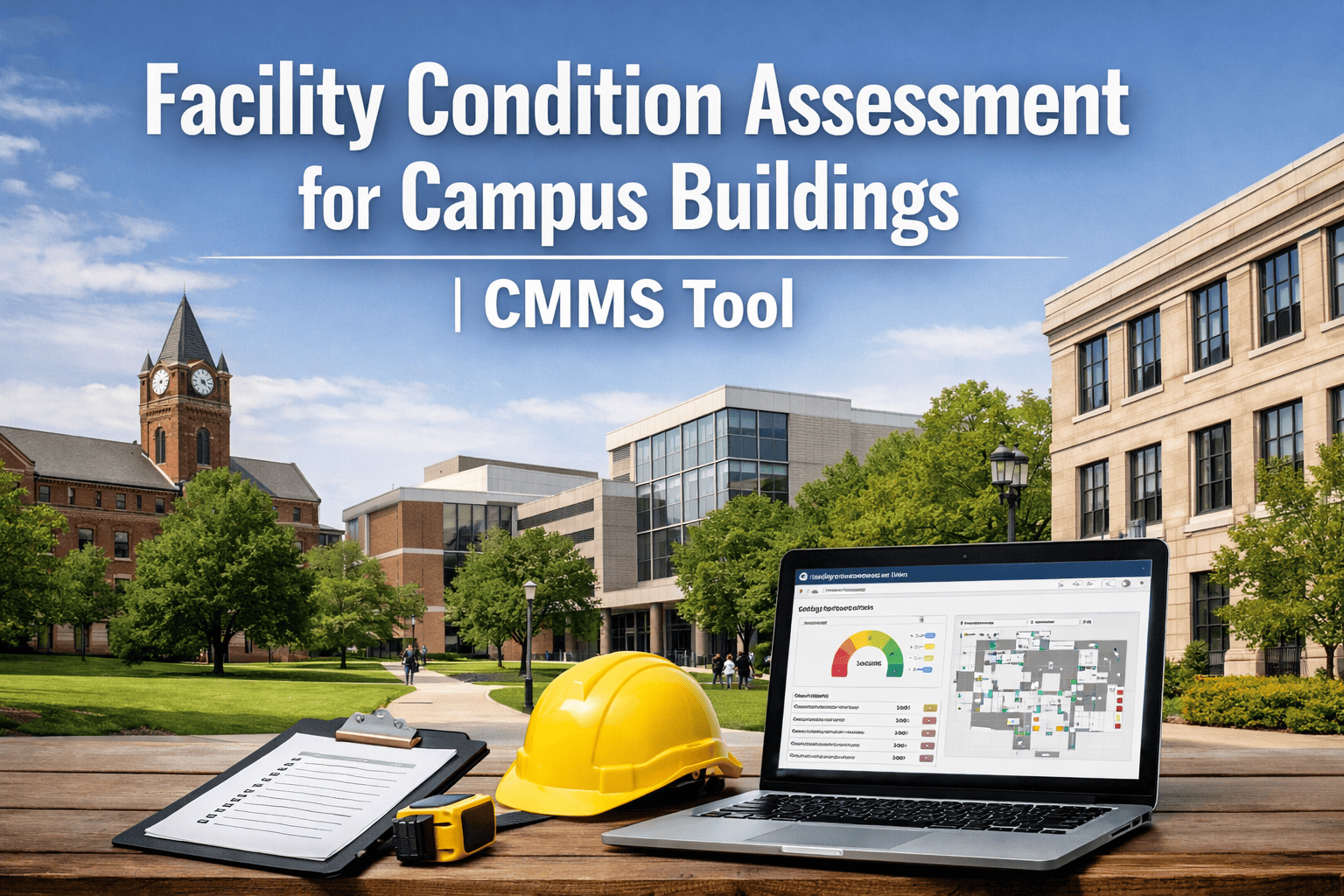
OxMaint calculates and displays FCI at the asset, system, building, and portfolio level in real time. No manual calculation required. Directors see their district's current FCI on a single dashboard — updated every time a technician logs a deficiency.
Every deferred maintenance item is logged with current cost estimate, urgency rating, and system linkage. The backlog updates automatically when items are funded and completed — keeping your FCI numerator accurate without manual reconciliation.
Technicians conduct building system inspections on mobile — rating condition, photographing deficiencies, and logging repair cost estimates in the field. Every inspection feeds directly into FCI calculations with a timestamp and digital signature for audit purposes.
OxMaint uses FCI scores and asset age data to project capital spending needs across a rolling 5–10 year horizon. The forecast shows what happens to district-wide FCI if capital investment is maintained vs. deferred — a powerful tool for board presentations and bond measure planning.
Generate formatted FCI reports at the building or portfolio level in minutes — with condition maps, backlog summaries, urgency rankings, and year-over-year trend data. Reports are formatted for state capital funding applications and board presentation decks.
Districts using OxMaint for FCI tracking report a 78% reduction in condition assessment preparation time and a 34% improvement in capital funding application success rates. The data is always current, always auditable, and always formatted for the audience that matters most — the board and the state agency reviewing your funding request. See how OxMaint builds your district's FCI foundation — start a free trial or book a demo and we will walk you through a live FCI dashboard built from real district data.
FCI Tracking: Manual Spreadsheet vs OxMaint CMMS
The difference between spreadsheet-based FCI and CMMS-driven FCI is not just efficiency — it is the difference between a static annual report and a living capital management tool that updates every day.
| FCI Capability | Manual Spreadsheet | OxMaint CMMS |
|---|---|---|
| Update frequency | Once per year (at assessment) | Continuous — updates with every work order and inspection |
| FCI calculation levels | Building-level only | Asset, system, building, and portfolio levels simultaneously |
| Deferred cost accuracy | Point-in-time, goes stale immediately | Current estimates tied to active backlog tracking |
| CRV updates | Manual, often skipped for years | Annual CRV update cycle with inflation adjustment prompts |
| Board report preparation | 40–80 hours per report cycle | Under 2 hours — auto-generated with charts and trend data |
| State funding application support | Narrative description only | Formatted FCI exports matching state agency requirements |
| Multi-building comparison | Manual across multiple files | Single dashboard showing all buildings ranked by FCI |
| CapEx forecasting from FCI | Not available without consultant | Built-in 5–10 year CapEx projection from FCI and asset age data |
What FCI-Driven Capital Management Delivers
These outcomes come from school districts that replaced manual condition reporting with systematic FCI tracking using CMMS asset data.
Presenting FCI to Your Board: What Works and What Loses the Room
A technically accurate FCI report that the board cannot interpret is useless. Here is how experienced facility directors translate FCI data into board-room language that drives capital investment decisions.
- Lead with the portfolio FCI score and its rating tier — one number, one clear label
- Show the 5-year FCI trend — boards respond to trajectory, not just current state
- Translate FCI into dollar terms: "Our FCI of 0.18 represents a $6.2M backlog against $34M replacement value"
- Show what happens to FCI if the requested capital is approved vs. deferred — the cost of inaction
- Rank buildings by FCI so the board can see which three need funding first
- Include the degradation curve: "Lincoln Elementary's FCI will reach 0.40 in 18 months without intervention"
- Leading with methodology — boards do not need to understand how FCI is calculated
- Presenting building-level FCI without context on what action it requires
- Using FCI as the only data point — pair it with safety risk ratings and system failure probabilities
- Presenting stale FCI data — a 2-year-old assessment undermines credibility immediately
- Showing only the worst buildings — show the full distribution so the board understands scale
- Asking for a lump-sum capital budget without showing FCI-based prioritization of how it will be spent
The most effective FCI board presentations combine the raw score with a visual building heat map, a 5-year cost-of-inaction projection, and a prioritized capital ask tied to specific buildings and systems. OxMaint generates all three of these elements from your existing asset data. If you want to walk into your next board meeting with a data-driven capital case — start a free trial or book a demo and we will show you exactly what that looks like for a district your size.
Frequently Asked Questions
What is a good FCI score for a school building?
How often should we conduct a formal FCI assessment?
Can FCI data support a bond measure or referendum?
What is the difference between FCI and a building condition assessment?
Your District's FCI Should Be a Living Number, Not an Annual Guess
OxMaint gives facility directors a real-time FCI dashboard tied to every asset, inspection, and work order in their district. No more 200-hour assessment prep. No more stale data in board presentations. No more capital requests rejected because the condition evidence was not credible. Build your FCI foundation in your first week — with guided onboarding and no implementation fees.