Most university facilities teams produce some version of a capital plan. The difference between the ones that get funded and the ones that sit on a shelf comes down to one thing: whether the plan is built on defensible asset condition data or on professional opinion and historical spending patterns. Boards of trustees and CFOs have seen enough facilities plans built on optimistic assumptions to be skeptical by default. A credible 10-year capital plan — one that wins consistent annual funding — requires a foundation of condition-scored assets, a methodology your auditors can verify, cost projections tied to current market data, and a priority ranking system that connects capital decisions to institutional risk. Universities that build their capital plans this way secure 40% more annual capital funding than peer institutions using traditional planning methods — and they spend it more efficiently because priorities are data-driven rather than politically negotiated. If your current capital plan would not survive a 30-minute challenge from your CFO, start a free trial or book a demo to see how OxMaint builds a board-ready capital plan from live asset condition data.
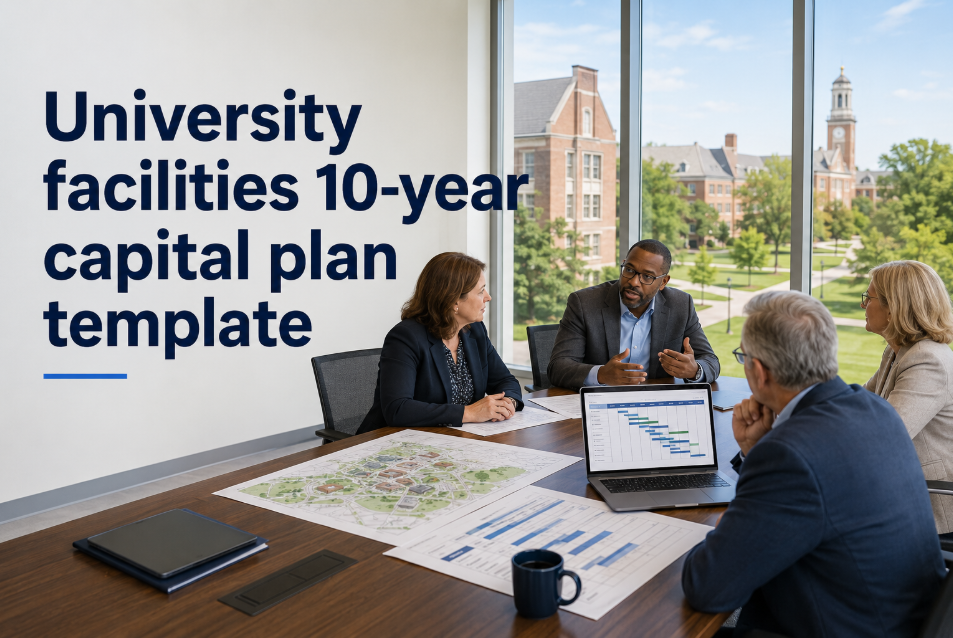
University Facilities 10-Year Capital Plan: Build, Fund, and Execute
A complete methodology for building a credible 10-year facilities capital plan — from asset condition assessment and CapEx modeling to board presentation format and annual update process.
What Separates a Funded Capital Plan From a Document Exercise
Universities produce capital plans routinely. What varies is the quality of evidence behind them — and that determines whether trustees approve the full ask, a portion of it, or nothing at all. A capital plan built on professional opinion and deferred items from three budget cycles ago will not survive board scrutiny in 2026.
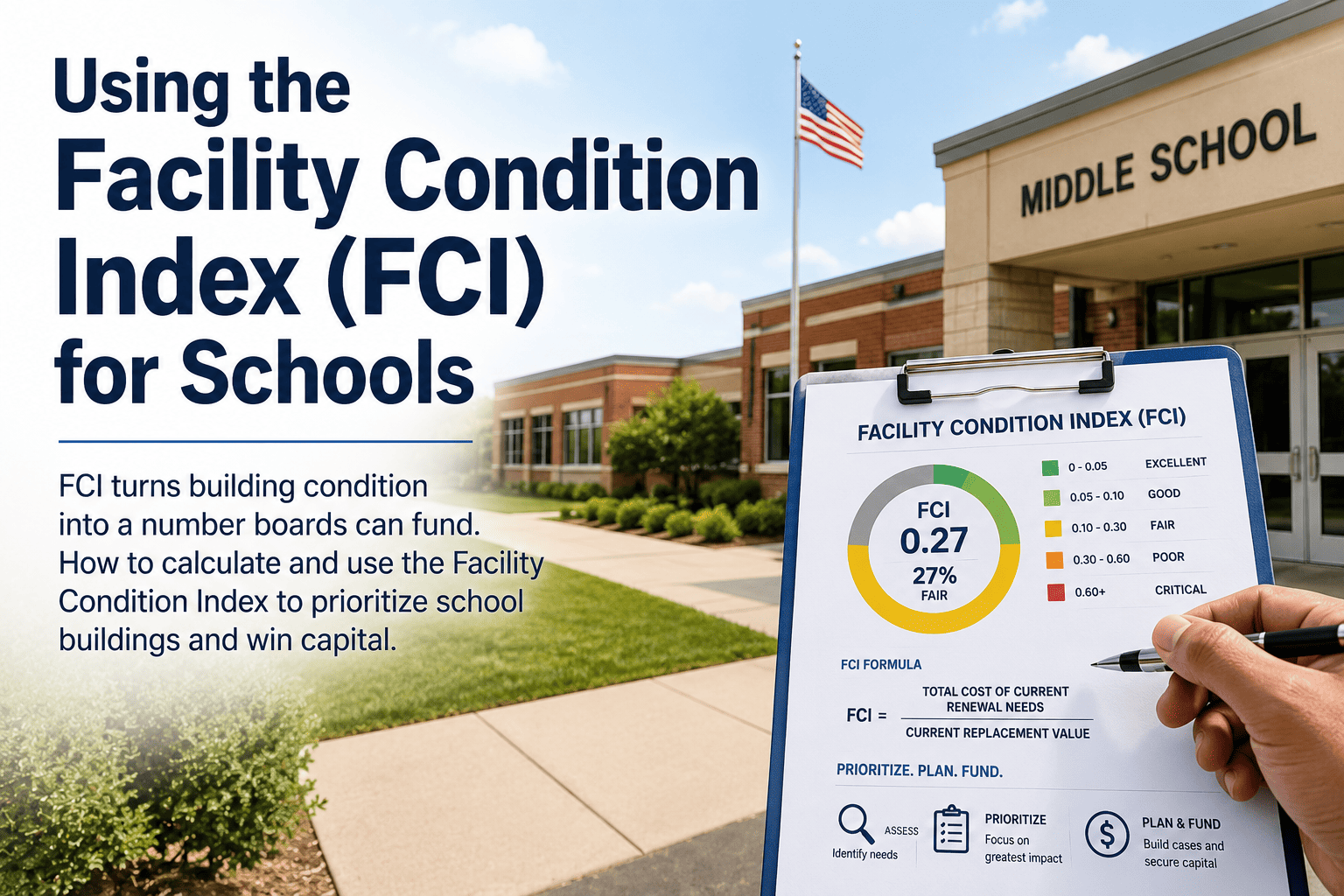
Trustees and CFOs are increasingly sophisticated about facilities capital. They ask questions that condition-based plans answer directly: What is the current FCI score for each building? How does deferred investment today translate to emergency spending in year four of the plan? Which projects, if deferred, create regulatory compliance risk? A plan backed by CMMS asset data — with condition scores, inspection records, and cost projections tied to current pricing — answers all of these questions before they are asked.
The other critical element is an annual update mechanism. A 10-year capital plan that is rebuilt every three years is not a capital plan — it is a capital proposal. Boards fund programs they can track year-over-year. OxMaint's rolling CapEx forecasting model updates the 10-year projection continuously as assets are inspected, work orders are completed, and condition scores change — so your plan is always current, not a snapshot that ages out of relevance within six months. Build a plan that your board will track and fund year after year — start a free trial or book a demo with the OxMaint capital planning team.
The 5-Phase Capital Plan Development Framework
Building a credible 10-year capital plan is a structured process. Each phase builds on the last — and each produces a deliverable that stands on its own if the plan needs to be presented incrementally.
Build or import your complete asset registry into OxMaint — every building, system, and major component. Conduct condition assessments using digital inspection tools, scoring each asset on a 1–5 condition scale with photo documentation. This becomes the permanent data foundation for all future capital planning cycles.
Calculate the current-year cost to bring all assets to acceptable condition, using RSMeans or regional pricing benchmarks. Apply system-specific escalation rates to project the backlog cost if not addressed — building the cost-of-deferral argument that makes the capital ask urgent rather than optional.
Using OxMaint's rolling CapEx forecasting engine, project capital spending requirements across all building systems for each of the next 10 years. Group projects by funding source eligibility (operating budget, capital bond, donor-eligible, grant-eligible). Show the board what the campus looks like at each funding level.
Rank every capital project using a weighted scoring matrix that includes: life-safety risk, regulatory compliance exposure, academic mission impact, energy efficiency opportunity, and FCI improvement per dollar invested. This moves capital allocation from political negotiation to objective prioritization.
Present the completed 10-year plan to the board of trustees with condition data, cost projections, and priority rankings all drawn directly from OxMaint. Establish a quarterly review cadence and annual formal update process. The plan becomes a living document, not a periodic exercise.
OxMaint automatically updates condition scores as inspections are completed and work orders are closed. The 10-year CapEx model recalculates whenever asset data changes. At any point, you can generate a current-state capital plan report — not one that was accurate six months ago when it was written.
10-Year Capital Plan Template: Section Structure
A board-ready capital plan follows a consistent structure. Each section serves a specific purpose in building trustee confidence in the numbers and the plan's credibility.
Campus FCI score summary, total capital investment required over 10 years, top 6 priority projects, and current funding gap. One page, data-forward. This is what trustees read before the meeting.
Building-by-building FCI scores with condition breakdowns by system type. Heat map visualization of campus condition. Trend comparison vs prior year assessment. Generated directly from OxMaint condition data.
Current backlog cost by building and system. Cost-of-deferral projection for each unaddressed item. Three-tier priority breakdown (Critical / Necessary / Planned). Benchmark comparison vs peer institutions.
10-year capital spending plan by year, building, and funding source. Scenario modeling at 80%, 100%, and 120% of required funding. Impact on campus FCI score at each funding level shown graphically.
Individual project sheets for the top 10 capital projects: scope, cost estimate, priority score, condition data, cost-of-deferral, and funding strategy. Each sheet is drawn from OxMaint asset records and inspection data.
Proposed funding sources by project type (operating budget, capital reserves, bond financing, grants, energy savings performance contracts). Annual review and update schedule. Key assumptions and sensitivity analysis.
Traditional Capital Planning vs OxMaint-Driven Planning
| Planning Element | Traditional Method | OxMaint-Driven Method |
|---|---|---|
| Asset condition data source | Triennial consultant assessment | Continuous digital inspection — updated in real time |
| Cost projection methodology | Historical spending + inflation estimate | Current RSMeans pricing by system, with per-asset escalation |
| Plan update frequency | Every 3–5 years | Rolling model — updates with every inspection and work order |
| Priority ranking method | Subjective committee review | Weighted scoring matrix — FCI impact, risk, mission, ROI |
| Board report generation time | 6–12 weeks of manual compilation | Generated on demand — minutes |
| Funding approval rate | Industry average: 58% of ask funded | Data-backed plans: 82% of ask funded on average |
| Audit and accreditation support | Fragmented — assembled before each review | Complete — timestamped records always available |
What Universities Achieve With a Data-Backed Capital Plan
Frequently Asked Questions
How do we get started if we have no existing asset inventory?
What FCI score benchmarks should we use to set targets for our 10-year plan?
How do we handle capital planning for leased buildings or buildings shared with other institutions?
Can the capital plan support regional accreditation reviews that require evidence of facility investment?
Build the Capital Plan Your Board Will Fund
OxMaint gives VP Operations and facilities leaders the asset condition data, CapEx modeling engine, and board-ready reporting tools to build a 10-year capital plan that earns trustee confidence and consistent funding approval. Stop rebuilding the same plan every three years. Start with a living model that updates as your campus changes. No heavy implementation, no long onboarding — your first condition assessments can begin this week.