Asset Lifecycle Management for University Capital Planning
By Jamie lanister on April 7, 2026
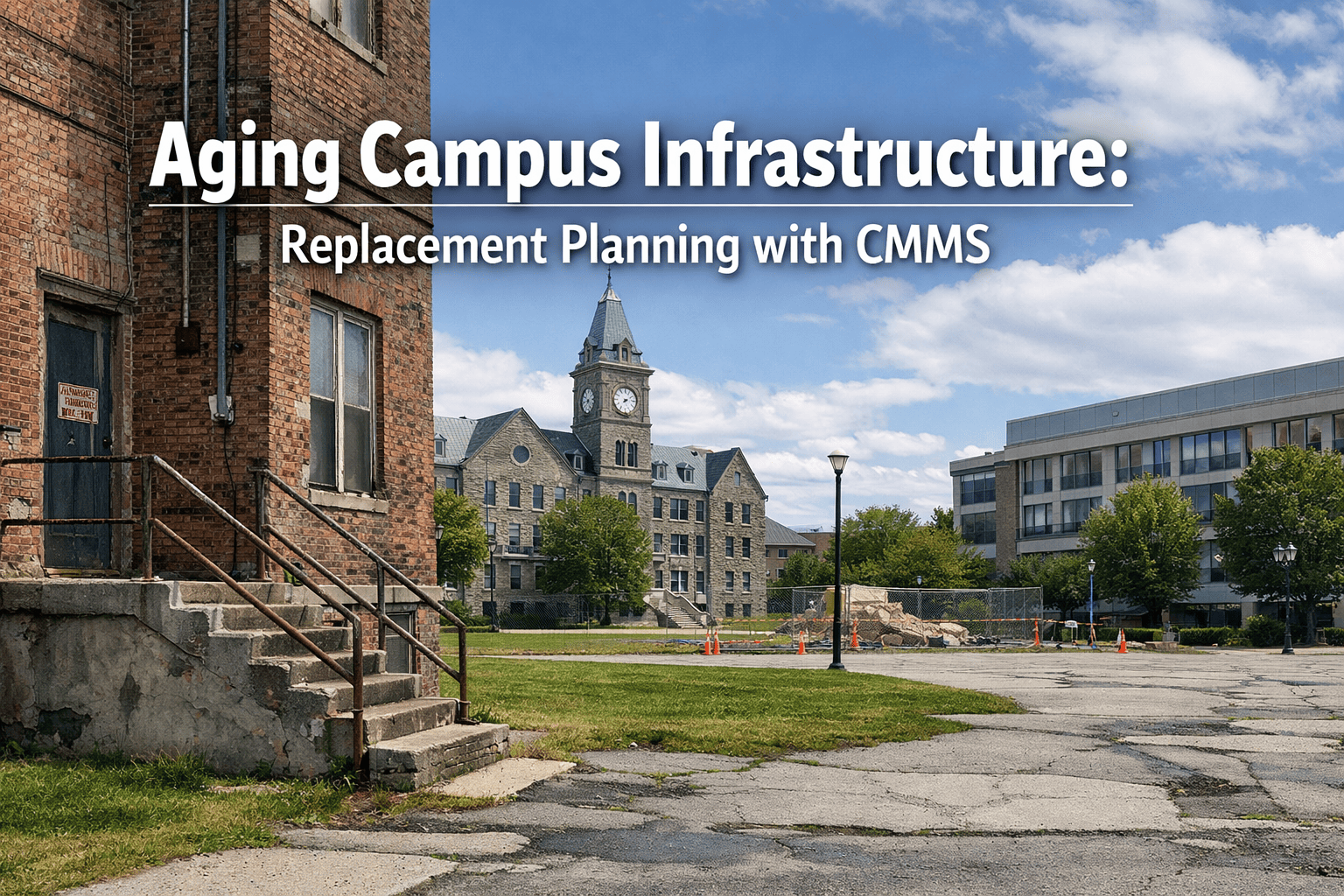
University capital planning committees approve tens of millions of dollars annually in facility replacement projects based on information that is, at best, three years old and, at worst, a facilities director's educated guess written on a whiteboard. A chiller installed in 2001 that "looks fine" but has consumed 40% more electricity per ton of cooling than its nameplate rating for the past four years is not fine — it is a $380,000 replacement asset in the middle of an accelerating failure curve. A roof installed in 2004 with a 20-year design life that has had six repair work orders in the past 18 months is not "still serviceable" — it is two winters away from a $240,000 emergency replacement and a disrupted academic programme. Oxmaint CMMS asset lifecycle management converts the maintenance history, condition ratings, energy consumption trends, and failure frequency data that the CMMS already holds into the evidence-based capital replacement recommendations that school boards and CFOs approve on first review — because the recommendation is supported by five years of documented maintenance data, not a facilities director's judgement under budget pressure.
ASSET LIFECYCLE · UNIVERSITY CAPITAL PLANNING · REPLACEMENT FORECASTING · CMMS · EVIDENCE-BASED
Replace Assets on Evidence, Not Guesswork. Capital Plans That Get Approved First Time.
Condition ratings · Failure frequency · Cost trend analysis · 5-year replacement forecasts — all from Oxmaint CMMS data.
How Oxmaint Builds Capital Evidence from CMMS Data
Repair Cost Trending
Oxmaint tracks all maintenance costs per asset over time. When repair spend exceeds 50% of replacement value in three years, the asset is flagged for capital review — automatically.
Condition Rating Tracking
Condition ratings recorded at each inspection and PM event. Deterioration rate calculated per asset category — HVAC, roofing, electrical — with replacement trigger points defined by asset class.
Design Life Tracking
Installation date, design life expectancy, and warranty end date stored per asset. Replacement forecast generated at 80% of design life — giving 3–4 years of capital planning lead time before end-of-life.
Energy Cost Correlation
HVAC and mechanical assets with rising energy consumption per output unit flagged for replacement evaluation — the chiller using 40% more electricity per ton is quantified, not just suspected.
91%
First-review board approval when capital requests include CMMS maintenance evidence
3×
Higher cost when emergency replacement replaces planned capital renewal
5-year
Capital forecast horizon — asset by asset, building by building, from live CMMS data
"Our board had declined our chiller replacement request twice — they said it looked fine. I came back with the Oxmaint repair history showing $54,000 in maintenance costs over three years on a 23-year-old unit with a 25-year design life, plus the energy efficiency comparison. Approved first reading. The CFO actually thanked me for the quality of the evidence."
VP Facilities · Private Liberal Arts College · Northeast, USA
Frequently Asked Questions
Q1What CMMS data does Oxmaint use to generate capital replacement recommendations?▾
Oxmaint combines installation date, design life expectancy, cumulative maintenance cost, condition rating history, failure frequency, energy consumption trend (where BMS integration exists), and estimated replacement cost to rank assets for capital review. The recommendation is built from actual documented maintenance history, not from age alone.
Q2How does Oxmaint handle assets that are past design life but still functioning?▾
Oxmaint flags assets past design life with increased monitoring frequency — more frequent inspection work orders, energy efficiency tracking, and cost trend acceleration alerts. The capital recommendation includes a remaining useful life estimate based on current condition and maintenance cost trajectory, not just calendar age.
Q3Can Oxmaint generate capital forecasts in the format required for university budget submissions?▾
Yes — Oxmaint exports capital forecast reports in PDF and Excel formats, with asset-level detail and portfolio-level summary views. The generative AI module can draft the accompanying capital justification narrative using the underlying CMMS data, in the language required for board or CFO review.
Q4How does Oxmaint integrate energy consumption data into lifecycle cost calculations?▾
Oxmaint integrates with BMS platforms and energy sub-meters to track kWh per unit of output for HVAC and mechanical assets. When energy consumption per ton of cooling or BTU of heating increases beyond a configurable threshold, the asset is flagged for replacement evaluation with the energy cost delta quantified in the capital recommendation.
Q5How many assets can Oxmaint track for lifecycle management across a multi-campus university?▾
Oxmaint scales to unlimited assets across unlimited campuses and buildings. Multi-campus systems use a single platform with building and campus hierarchy for portfolio reporting — the capital forecast can be generated for a single building, a campus, or the entire university system in one report.
Capital Plans That Get Approved. Backed by Five Years of CMMS Evidence.