Every campus has assets it has lost track of. HVAC systems installed 25 years ago with no documented maintenance history. Roofs patched repeatedly but never scheduled for replacement. Boilers running past their rated lifecycle because no one mapped the install date to a capital plan. The result is a $112 billion deferred maintenance backlog across U.S. higher education — growing at 2 to 4 percent annually from aging alone, even if every current deferral were addressed today. A campus with 150 buildings has thousands of assets on overlapping lifecycle clocks, and without systematic tracking, replacement needs are discovered reactively — as emergencies, not budget line items. Integrated CMMS and asset lifecycle management changes this equation permanently. Sign up for OxMaint free and start tracking every campus asset from installation through retirement — with automated maintenance, condition scoring, and capital planning built in.
Your Campus Has Thousands of Assets.
Most Have No Lifecycle Plan.
OxMaint Fixes That.
From the day a chiller is installed to the day it is decommissioned — every inspection, every repair, every cost, every condition score — tracked in one platform. OxMaint gives education facility teams complete asset lifecycle visibility across every building, every campus, every system.
Why Education Facilities Are Losing the Asset Management Battle
The average campus building contains 200 to 400 maintainable assets per 50,000 gross square feet. Most institutions track fewer than half of them systematically — and the ones they miss are the ones that fail catastrophically.
No Centralized Asset Registry
Equipment records live in spreadsheets, filing cabinets, and the institutional memory of senior technicians approaching retirement. When a 20-year veteran leaves, decades of asset knowledge walks out with them — and the replacement has no documentation to reference.
Reactive Maintenance Dominates
When 70 to 80 percent of maintenance spending is reactive — responding to failures after they occur — the facilities team becomes a firefighting operation. Every dollar of deferred maintenance today becomes 4 to 5 dollars in emergency repair costs within 3 to 5 years. The math compounds relentlessly.
Capital Planning Without Data
Board presentations rely on anecdotal evidence and walk-through assessments that are expensive and immediately outdated. Without continuous condition data on every major asset, capital requests are guesswork — and boards allocate funding based on crisis urgency rather than lifecycle optimization.
The 5 Pillars of Integrated Asset Lifecycle Management
OxMaint manages every phase of the campus asset lifecycle — from procurement and installation through operation, maintenance, condition monitoring, and eventual replacement — in a single connected platform.
Asset Registry and Hierarchy
Every piece of equipment — from central chillers to individual VAV boxes — cataloged with manufacturer, model, serial number, install date, warranty expiration, expected useful life, and location mapped to building, floor, and room. QR code tagging enables instant mobile access to any asset's complete history by scanning a label in the field.
Work Order Management — The Operational Core
Every maintenance action — reactive, preventive, or predictive — flows through digital work orders that capture labor hours, material costs, contractor invoices, completion photos, and technician notes. Self-service request portals let students, faculty, and staff submit issues 24/7 with automatic routing by building, trade, and priority. Mobile-first design means technicians work from the field, not the office.
Preventive Maintenance Scheduling
Automated PM schedules triggered by calendar intervals, runtime hours, or condition thresholds. Pre-built inspection checklists aligned to manufacturer recommendations and regulatory requirements ensure technicians capture every required data point. Academic calendar integration prevents disruptive maintenance during classes and exams while maximizing work during breaks.
Condition Scoring and FCI Tracking
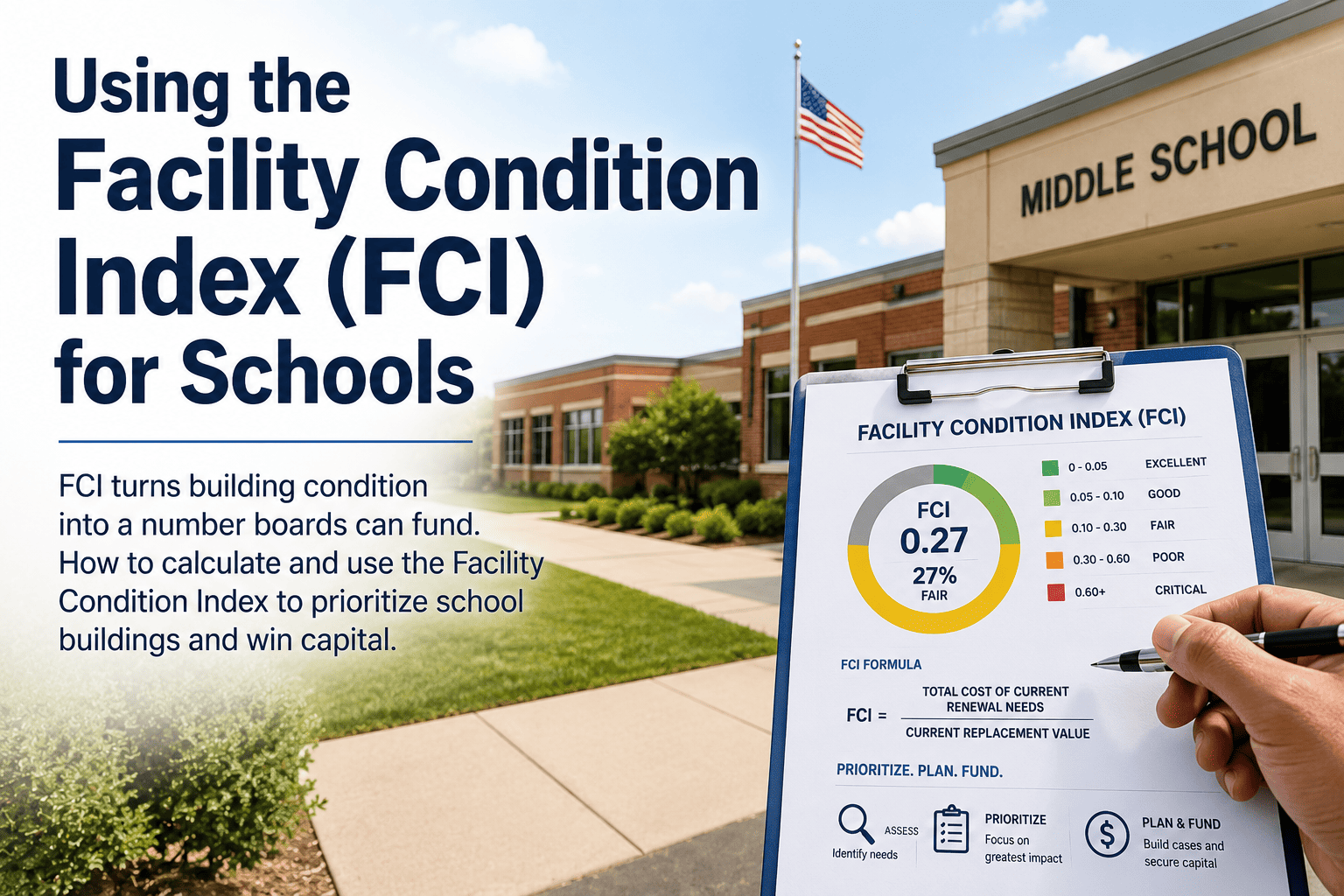
Every asset receives a continuously updated condition score based on age, maintenance frequency, repair cost trends, and inspection results. Building-level Facility Condition Index (FCI) calculations — the industry standard metric — provide standardized comparison across your entire portfolio. FCI under 5% indicates good condition; above 30% signals critical intervention needed.
Capital Planning and Replacement Forecasting
Install dates plus expected useful life plus actual condition data equals accurate replacement forecasting. OxMaint generates multi-year capital plans that show exactly which assets need replacement in which fiscal year, at what estimated cost, with risk scores for deferral. Board presentations become data-driven arguments, not anecdotal requests.
What OxMaint Tracks at Every Stage of Asset Life
Most CMMS platforms manage work orders. OxMaint manages the entire lifecycle — from the moment equipment arrives on campus to the day it is decommissioned and replaced.
Six Asset Categories Where Lifecycle Tracking Delivers the Highest ROI
Not all assets need the same level of tracking. Focus CMMS implementation on these six categories first — they represent the highest failure cost, longest lead times, and greatest budget impact.
What Changes When Every Campus Asset Has a Lifecycle Plan
Deployment Roadmap — 5 Phases
You do not need to inventory every asset on campus before starting. OxMaint's phased implementation begins delivering value from Day 1 and expands systematically over 12 to 18 months.
Digital Work Orders — Immediate Value
Deploy digital work orders across all buildings. From Day 1, every request captures labor, materials, contractor costs, building, and asset. Retire paper logs, spreadsheets, and email-based request systems entirely. Self-service portals go live for students, faculty, and staff. This single action creates the per-building cost data that transforms board presentations from anecdotal to analytical.
Critical Asset Registry — Start Strategic
Inventory high-risk, high-cost assets first: central plant equipment, roofing systems, electrical switchgear, elevators, and fire safety systems. Record install dates, warranty information, and expected useful life. Attach QR codes for mobile field access. Do not attempt a full campus inventory at this stage — focus on the assets whose failure creates the highest cost and disruption.
Preventive Maintenance Activation
Configure automated PM schedules for all registered assets. Align inspection frequencies with manufacturer recommendations and regulatory requirements. Integrate the academic calendar so PMs are scheduled during breaks, not during finals week. Pre-built checklists ensure consistent, complete inspections across all technicians and shifts.
Condition Scoring and FCI Baseline
With 3 to 6 months of work order data, the platform begins generating meaningful condition scores and building-level FCI calculations. Identify which buildings are in good condition (FCI under 5%), which need investment soon (5 to 10%), and which are in critical condition (above 30%). This data becomes the foundation for evidence-based capital requests.
Full Lifecycle Management and Capital Planning
Expand asset registry to all building systems. Generate multi-year capital replacement forecasts. Track total cost of ownership per asset. Integrate with ERP systems (Banner, Workday, PeopleSoft) for financial reporting. Deliver board-ready capital plans with FCI data, cost projections, and deferral risk assessments that justify funding requests with verifiable evidence.
Three Ways OxMaint Connects to Your Campus Ecosystem
OxMaint integrates with existing campus systems so asset lifecycle data flows seamlessly between facilities, finance, and operations — no rip-and-replace required.
ERP Financial Systems
Bidirectional sync with Banner, Workday, and PeopleSoft. Work order costs flow automatically into financial reporting. Purchase orders for parts and contractor services originate from OxMaint and complete in the ERP. No manual data entry between systems — every maintenance dollar is captured and attributed.
Building Automation Systems
Connect to existing BAS platforms via BACnet, Modbus, or API. Equipment fault codes and performance anomalies trigger OxMaint work orders automatically. Energy consumption data feeds asset condition scoring. Technicians receive alerts about HVAC faults before occupant complaints arrive.
Academic Scheduling Systems
Ingest class schedules and room booking data to align maintenance windows with actual building occupancy. The system knows when buildings transition from classes to unoccupied hours, when semester breaks begin, and when summer sessions change patterns — preventing maintenance disruptions during academic operations.
Common Questions About CMMS and Asset Lifecycle Management for Education
How is OxMaint different from the CMMS products that 73% of institutions are dissatisfied with?
Most legacy CMMS platforms were designed for manufacturing or commercial facilities and retrofitted for education. They are overly complex, lack mobile functionality, and require dedicated IT support. OxMaint is built for maintenance professionals — not database administrators. Mobile-first design, intuitive work order workflows, self-service portals for occupants, and zero IT infrastructure requirements. Unlimited user accounts mean cost stays predictable as departments scale, and QR code asset tagging eliminates the training barrier for field technicians.
We have 150+ buildings and thousands of assets. How do we avoid an overwhelming implementation?
You do not inventory everything first. Phase 1 deploys digital work orders across all buildings immediately — capturing cost data from Day 1. Phase 2 registers only your highest-risk, highest-cost assets: central plant equipment, roofing, electrical, elevators, and fire safety. Expand the asset registry over 12 to 18 months as CMMS adoption matures. The platform delivers value from Week 1, not Month 12.
Can OxMaint calculate Facility Condition Index for our buildings?
Yes. OxMaint tracks the cost of deferred maintenance and current replacement value per building to calculate FCI using the APPA standard formula (FCI equals cost of deferred maintenance divided by current replacement value). FCI under 5% indicates good condition. Between 5 and 10% means investment is needed soon. Above 30% signals critical condition. These scores update continuously as work orders and inspections feed new data into the system.
Does OxMaint integrate with Banner, Workday, or PeopleSoft for financial reporting?
Yes. OxMaint connects to common education ERP platforms through standard REST APIs. Work order costs, purchase orders, and contractor invoices sync bidirectionally — so maintenance spending appears in your institutional financial reports without manual data transfer. Budget codes, fund sources, and account strings are configurable per institution.
How does the platform handle multi-campus districts or university systems?
OxMaint provides centralized visibility across all campuses while maintaining local control for site-level managers. System-wide dashboards show asset health, open work orders, and FCI scores across every building and campus. Individual campus managers see only their facilities. Benchmarking between campuses identifies best practices and targets underperforming sites for intervention.
Is this practical for small K-12 districts with limited staff?
Absolutely. OxMaint deploys in under 60 minutes with no on-premises infrastructure. A district with 5 buildings and one facilities manager can begin tracking work orders, building asset records, and scheduling preventive maintenance within the first week. The platform scales from a single school to a 200-building university system without changing tools or migrating data.
Every Asset. Every Building. Every Dollar. Tracked.
Your campus assets are aging right now. Some are approaching failure points that will cost 4 to 5 times more to address as emergencies than as planned replacements. OxMaint gives you the lifecycle visibility to see it coming — and the maintenance platform to prevent it.
Unlimited users. No credit card required. Deploys in under 60 minutes.