School and university dining operations span dozens of kitchens across multi-building campuses, each one running walk-in coolers, combi ovens, dishwashers, ice machines, and steam tables on around-the-clock duty cycles. When a refrigeration failure goes unnoticed for 48 hours in a satellite building, the loss isn't measured only in spoiled inventory — it shows up in HACCP audit findings, health department citations, and direct risk to student health. Multi-building cafeteria maintenance demands practices that scale across geography without doubling headcount or budget. To structure your campus food service PM program with location-aware work orders and equipment-specific schedules, start a free trial or book a demo.
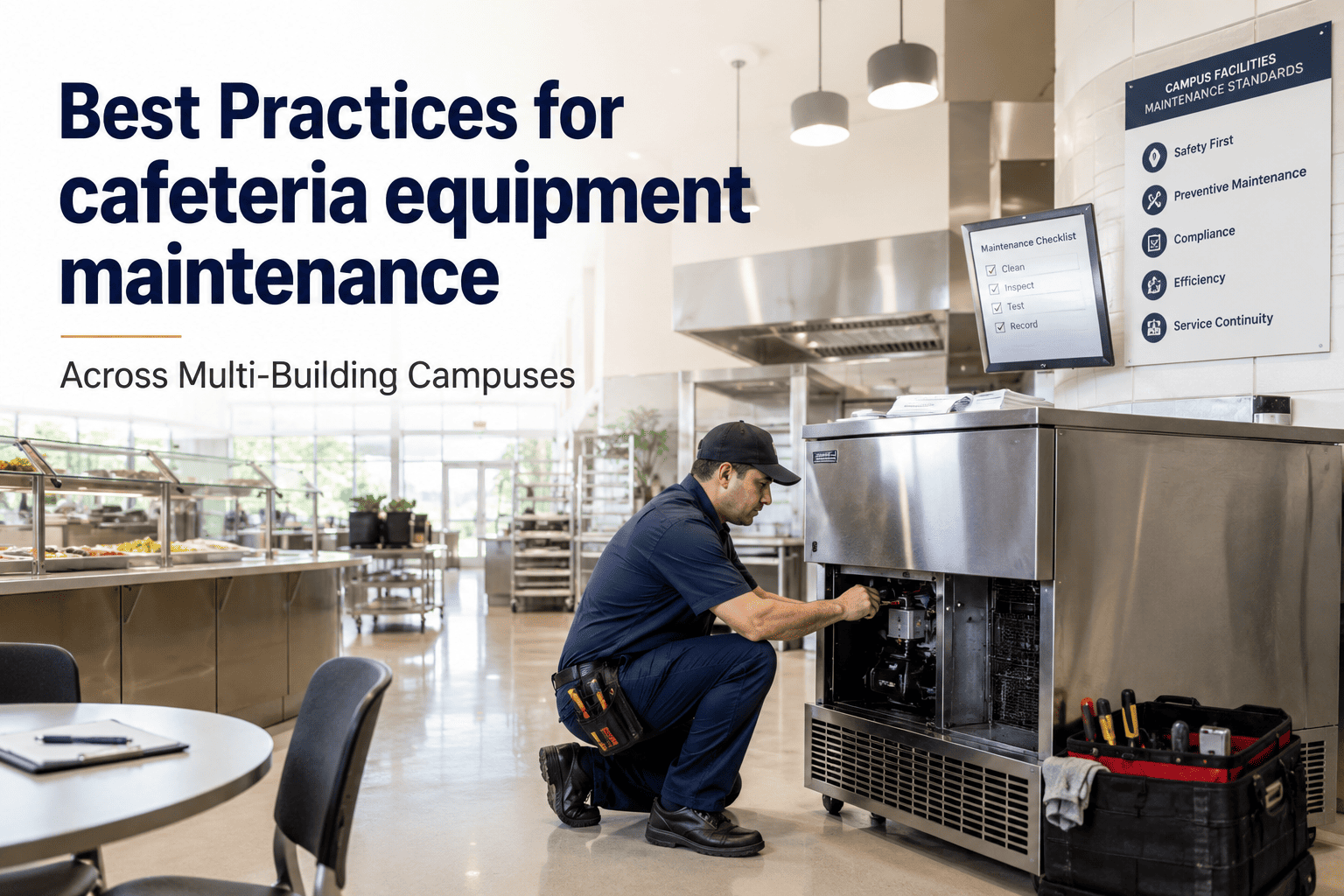
Best Practices for Cafeteria Equipment Maintenance Across Multi-Building Campuses
Walk-in coolers fail. Combi ovens drift out of spec. Dishwasher final-rinse temperatures drop below 180°F. Multi-building campuses can't afford reactive food service maintenance — HACCP, inventory loss, and student safety depend on disciplined PM at every building.
Eight Cafeteria Equipment Categories That Need a Dedicated PM Schedule
Every multi-building food service operation runs the same eight categories of equipment in every kitchen — but with different generations, manufacturers, refrigerants, and service histories. A single PM library that handles all of them across all buildings is the foundation of consistency.
Door gaskets, condenser coils, evaporator fans, defrost cycles, refrigerant pressures. Quarterly PM with monthly temperature log audit prevents the overnight failures that wipe out an entire kitchen's inventory.
Steam generators, descale cycles, door seals, control calibration. Hard-water sites need monthly descale; soft-water sites quarterly. Calibration drift causes undercooked center temps and HACCP failures.
Final-rinse temperature must hit 180°F for high-temp machines or chemical concentration verified for low-temp. Daily log, weekly probe calibration, quarterly tank descale — every cycle is a HACCP record.
Quarterly deep clean and sanitize, semiannual filter replacement, annual condenser coil clean. Ice contamination is a top-5 violation category in school cafeteria health inspections.
Hot-holding must stay at or above 135°F. Element checks, thermostat calibration, gasket inspection. A drifted holding cabinet held below 135°F for two hours is a documented critical-control-point failure.
NFPA 96 mandates semiannual hood cleaning for moderate-volume kitchens; quarterly for high-volume. Ansul/wet-chem semiannual inspection. Grease fires originate where PM logs go missing.
Burner cleaning, pilot inspection, gas-pressure verification, thermostat calibration. Fryers need filter cleaning every shift; oil tested per cycle; tank deep-clean per the manufacturer's interval.
Daily temperature log, monthly gasket check, quarterly condenser coil cleaning, semiannual full PM. Reach-ins are the most-ignored equipment class because they fail slowly until they don't.
What Changes When a Cafeteria Becomes a District Food Service Operation
The same equipment, the same HACCP rules, the same inspection schedule — but executed across multiple buildings with traveling staff and distributed inventory. The challenges multiply faster than the kitchen count.
Six Practices That Make Multi-Building Cafeteria Maintenance Work
One master PM library covering all equipment classes across all buildings. Schedules generated centrally, assigned to building-specific technicians, completed locally — with each completion synced to the central record for instant visibility from any building.
Walk-in cooler in Building C kitchen prep area — not "the walk-in cooler." Asset hierarchy must include building, zone, kitchen, and equipment ID, so reports filter by location and inspectors find specific records in seconds, not minutes.
Daily temperature recording on a mobile checklist with timestamp, user ID, and asset tag. The log is searchable, exportable, and audit-ready in minutes — not a paper binder that mysteriously goes missing the week of an inspection.
When a cooler trends above 40°F, the CMMS opens a corrective work order automatically — before kitchen staff notices the drift. Threshold-based auto-tickets prevent overnight failures from becoming morning food-loss events.
Every combi oven on the campus gets the same quarterly descale, same monthly seal check, same annual deep PM — regardless of building. Standardization removes the question "did we do this kitchen last month?" from every conversation.
Response time, fix rate, repeat-failure rate — tracked per vendor per building. A refrigeration contractor with a 90% same-day SLA in Building A and 4-day responses in Building D is a contract conversation, not a guess.
How Oxmaint Structures Multi-Building Cafeteria Maintenance
Oxmaint organizes campus food service operations as a building-and-zone-tagged asset registry with automated PM scheduling, mobile temperature logging, and threshold-based work order generation — so every kitchen across the campus runs on the same disciplined cadence. To see your district's food service PM library configured, start a free trial or book a demo.
Every walk-in, oven, ice machine, dishwasher, and steam table registered with its specific location in a five-level hierarchy — so any asset in any building is one search away.
Refrigeration, oven, dishwasher, hood, fryer, and ice-machine PM templates with manufacturer-aligned intervals — applied to every matching asset across every building in a single configuration step.
Kitchen staff record temperatures on a tablet or phone — with user ID, timestamp, and asset tag captured automatically. Paper binder data becomes an audit-ready searchable database.
Cooler trends above setpoint, holding cabinet drops below 135°F, dishwasher rinse falls under 180°F — an auto-ticket is open and routed to the assigned technician before the next inspection.
Every external vendor work order tagged with response time, repair time, and outcome — aggregated by vendor and building so contract reviews are data conversations, not anecdotes.
Filter temperature logs, PM completions, and corrective work orders by building, date range, or equipment class — producing the records a health inspector wants in minutes, not days of scrambling.
What Disciplined Multi-Building Cafeteria PM Delivers
Every corrective and PM record tied to a specific building, kitchen, and asset — no generic entries that fail an inspector's location verification request
Cooler drifts trigger an auto-work-order before kitchen open — not after a morning walk-in reveals 200 pounds of compromised inventory across multiple buildings
Inspector arrives, requests two years of cooler temperature logs for three buildings — the report is produced before the conversation moves to the next question
Scheduled PM auto-generates work orders — if a hood cleaning was not completed in Building B last quarter, the overdue ticket is visible immediately, not invisible until the fire marshal arrives
Frequently Asked Questions
How often should cafeteria refrigeration equipment receive preventive maintenance in a multi-building campus?+
What HACCP records does a CMMS need to produce for a school cafeteria health inspection?+
How can a multi-building food service operation reduce overnight refrigeration failures without adding monitoring staff?+
Can Oxmaint be configured for the specific HACCP critical control point temperatures we use in our district?+
How does standardizing PM frequencies across multiple buildings affect overall maintenance cost?+
Every Kitchen on the Campus. Every Asset on a Schedule. Every Record in One Place.
Reactive cafeteria maintenance scales linearly with buildings — ten kitchens means ten emergency callouts a month. Disciplined multi-building PM scales the opposite direction: as PM coverage tightens, emergency work shrinks, food loss drops, and HACCP documentation becomes a one-click export. Give your district food service program the operational discipline it deserves.