Multi-campus school districts with bus depots spread across several facilities face a maintenance coordination challenge that single-depot districts never encounter: the same fleet might be serviced at different locations, compliance records live in different systems, and technicians work across depot sites without shared visibility into what was done where, and when. The districts that handle this well have one thing in common — they treat the entire depot network as a single maintenance operation, not a collection of separate shops. This comparison guide covers the specific practices, systems, and structural decisions that separate high-performing multi-depot district fleets from those constantly firefighting compliance gaps and reactive repairs. If your district operates bus depots at two or more facilities and is ready to bring them under one maintenance operation, start a free Oxmaint account to connect your depots, or book a walkthrough with our district transportation specialists.
Multi-Campus Transportation Guide
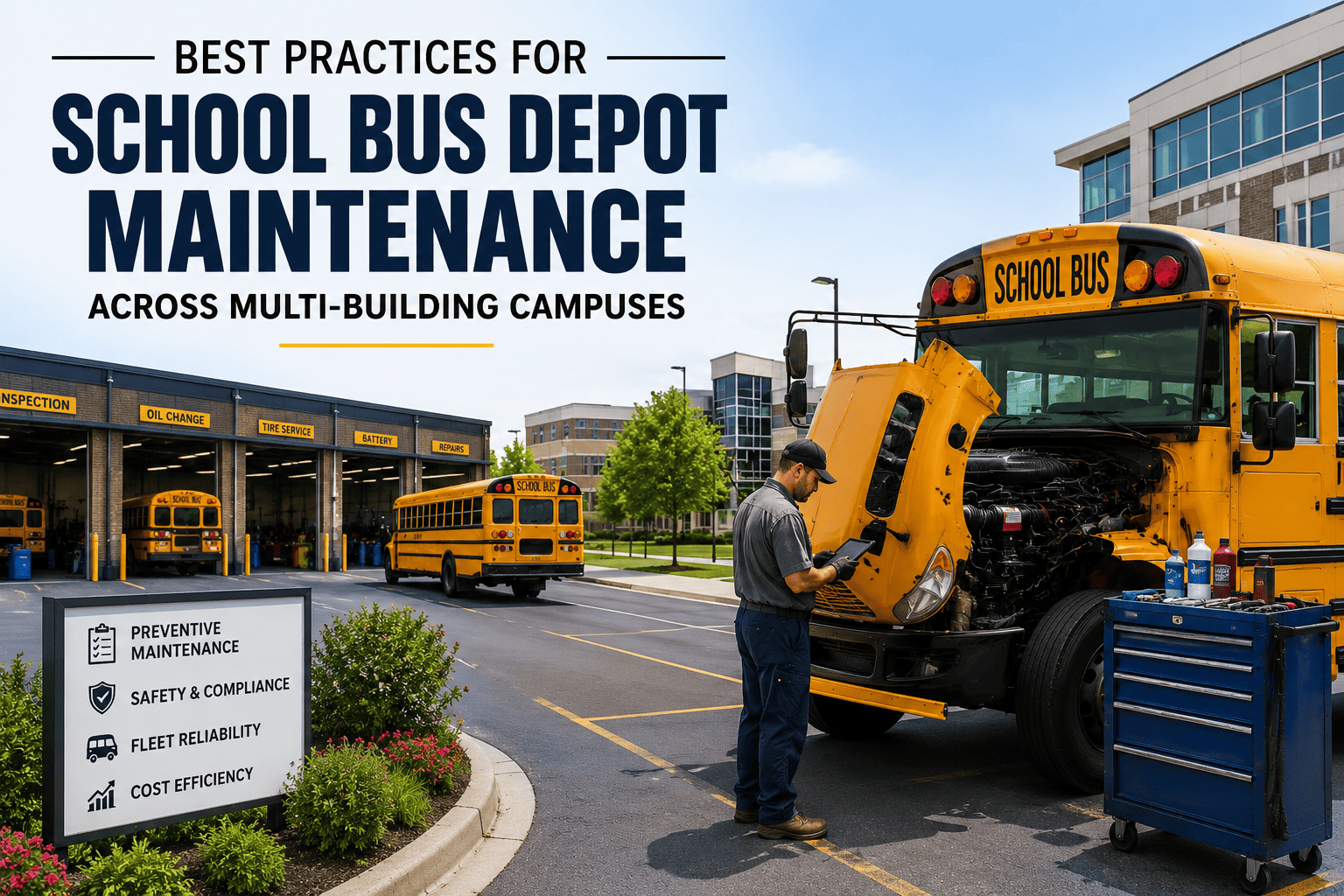
Best Practices for School Bus Depot Maintenance Across Multi-Building Campuses
How district transportation directors unify fleet maintenance across multiple depot locations — without doubling admin overhead or losing visibility between sites.
2.4x
More compliance gaps in multi-depot districts without unified tracking
35%
Of multi-depot reactive repairs trace back to missed cross-site PM handoffs
1 system
All depots, all vehicles, all compliance — in one maintenance platform
The Multi-Depot Maintenance Problem: Where It Breaks Down
Running bus depot maintenance across two or more campus locations creates failure points that single-depot districts simply don't face. Understanding exactly where breakdown happens is the first step to fixing it.
A
Vehicle moves between depots for service
A bus serviced at Depot A for oil change is transferred to Depot B's route area. Depot B technicians have no visibility into what was just done — and may duplicate work or miss the follow-up task.
↓
B
Compliance records stay at the servicing depot
Annual inspection certificate is filed at the depot where the inspection happened. When the district-level compliance audit request comes, gathering records from three locations becomes a multi-day project.
↓
C
No shared parts inventory across depots
Depot A runs out of a critical part and places an emergency order. Depot B has 12 units of the same part on the shelf. No one knows because there is no cross-depot inventory view.
↓
Result
Higher costs, compliance risk, and technician time waste
Each of these breakdowns is individually small. Combined across a fleet and a full academic year, they generate thousands of dollars in avoidable costs and hours of avoidable admin work.
8 Best Practices for Multi-Depot Bus Maintenance Operations
These practices come directly from district transportation directors who have successfully unified maintenance operations across multiple depot locations. Each addresses a specific multi-depot failure mode.
01
One vehicle record — accessible at every depot
Every bus has a single digital record that any technician at any depot can access. Service history, compliance documents, and open work orders travel with the vehicle, not with the depot.
02
Standardized work order categories across all sites
Every depot uses the same work order taxonomy: PM, corrective, inspection, compliance, and driver-reported. Cross-depot reporting becomes meaningful when all data uses the same categories.
03
Depot-level PM ownership with district oversight
Each depot manages its own PM schedule execution, but the district director has a roll-up view showing PM completion rates across all depots simultaneously. Problems at one site are visible before they become audit issues.
04
Compliance calendar owned at the vehicle level, not the depot level
Annual inspections, state certifications, and safety checks are tracked by vehicle VIN, not by which depot is responsible this week. The vehicle's compliance record goes wherever the vehicle goes.
05
Cross-depot parts inventory visibility
Before placing any emergency parts order, technicians can check whether another depot in the district already has the part in stock. Transfer requests can be submitted in the same system. Emergency purchases drop significantly.
06
Shared PM templates with depot-specific overrides
A master PM template covers the common service intervals for the entire fleet. Depots that operate older vehicles or specialized equipment add supplementary tasks without breaking the standard structure. Updates to the master template propagate to all depots.
07
District-level monthly performance comparison
A monthly report shows PM completion rate, reactive work order volume, and compliance status per depot — side by side. The depot with the highest reactive volume gets investigative attention first. Performance improves when data makes the comparison visible.
08
Driver defect reporting consistent across all bus yards
Pre-trip and post-trip defect submission follows the same process at every depot. All defect reports route to the single system queue, tagged by reporting location. No depot operates on a verbal-reporting model while others use digital submission.
Oxmaint is built for multi-depot district operations. Vehicle records that travel with the bus. Cross-depot inventory visibility. District-level compliance dashboards. All depots, one platform.
Single-Depot vs. Multi-Depot Best Practice Comparison
Some maintenance practices that work well in a single depot become liabilities when scaled to multi-depot operations. Here is where the differences matter most.
| Practice Area |
Single Depot |
Multi-Depot (without unified system) |
Multi-Depot with Oxmaint |
| Vehicle service history access |
Available locally — paper or spreadsheet |
Only at the depot where work was done |
Available at any depot, on any device |
| Compliance audit preparation |
1 location to gather records from |
3–5 locations, manual assembly, days of work |
Centralized export — all depots, under 30 minutes |
| Parts shortage response |
Check one bin, place order if empty |
Emergency order without checking other depots |
Check cross-depot inventory, transfer or order |
| PM schedule consistency |
One schedule, consistent execution |
Each depot drifts to its own version over time |
Master template propagates updates to all depots |
| Technician knowledge sharing |
In-person, happens naturally |
Siloed per depot — best practices don't travel |
Work order history and notes visible district-wide |
Fleet Segmentation: Why Every Bus in Your Multi-Depot Network Is Not the Same
One of the most valuable shifts a multi-depot district can make is treating the fleet as segments, not a uniform mass. A 2009 bus with 180,000 miles and a 2021 bus with 40,000 miles should not share the same PM schedule, the same parts budget allocation, or the same downtime risk rating. Segmentation lets you apply the right level of maintenance intensity to each group.
Segment A — High Intensity
Aging Fleet: 10+ years or 150,000+ miles
Monthly PM intervals — not quarterly
Expanded inspection checklist: suspension, brake lines, electrical
Cost-per-vehicle tracking monthly — flag retirement candidates
Assign most experienced technician as primary
Keep one replacement unit available in reserve rotation
Segment B — Standard
Mid-Life Fleet: 4–10 years or 60,000–150,000 miles
Quarterly full PM, monthly fluid and filter checks
Standard inspection checklist, mileage-triggered tasks
Parts stocking at standard minimum quantities
Compliance calendar on standard annual cycle
Monitor for brake and drivetrain wear patterns
Segment C — Low Intensity
New Fleet: Under 4 years or under 60,000 miles
Manufacturer-specified PM intervals — do not over-service
Warranty-tracking tags on all work orders
Document all defects carefully — warranty claim evidence
Reduced parts stock — lower parts consumption expected
Compliance calendar setup from day one of service entry
Oxmaint's fleet dashboard lets you tag vehicles by segment and filter work orders, PM schedules, and cost reports by segment group — so you always know which cohort is driving your maintenance spend and risk.
Multi-Depot Maintenance Calendar: Aligning with the Academic Year
School bus fleets operate on a rhythm that commercial fleets don't — academic calendars create predictable demand peaks and valleys that a well-run multi-depot maintenance program exploits. The depots that schedule maintenance proactively around the academic calendar spend less on emergency repairs and keep more buses available when they are needed most.
August
Pre-Year Fleet Readiness
Full fleet PM completion check — every bus in window before first day
Annual safety inspection completion verified for all vehicles
A/C systems checked — routes start in peak heat
Driver defect reporting QR codes refreshed at all bus bays
October
Winter Preparation
Cooling system antifreeze level and concentration check across fleet
Battery load tests — cold weather accelerates failure in aging batteries
Heating system operation verified before first cold routes
Tire tread depth check — winter minimum standards by state
December
Holiday Break Maintenance Window
2–3 week window with no route pressure — schedule all deferred work
Aging fleet: deep inspection, suspension and brake line checks
Parts inventory audit and reorder before spring semester
Compliance deadline review — anything expiring in Q1 addressed now
March
Spring Semester Mid-Year Check
Mid-year PM completion rate review — all depots compared
Brake system inspections — winter road salt accelerates wear
Air filter replacements after winter heavy-idling period
Begin scheduling end-of-year campaign for May–June window
May–June
End-of-Year Deep Service Campaign
Full fleet serviced across all depots before summer storage or summer routes
Aging Segment A vehicles: comprehensive inspection, retirement recommendation if warranted
Annual compliance calendar reset — all next-year deadlines populated
Year-end fleet performance report generated for district administration
July
Summer Program and Readiness Buffer
Summer school and program buses maintained on active schedule
Storage fleet: monthly start and inspection to prevent non-use degradation
New vehicle onboarding — add to asset register, configure PM schedule
Cross-depot parts inventory rebalance before August rush
Multi-Depot Maintenance Maturity Model: Where Does Your District Stand?
Not every district starts from the same place. This four-level maturity model helps transportation directors assess where their multi-depot operation currently sits — and what the specific next steps are to move to the next level.
Level 1
Reactive
Maintenance is primarily reactive. Work orders are created after failure. PM schedules exist on paper but execution is inconsistent. Compliance tracking is manual and deadline misses occur. Different depots operate independently with no shared visibility. Most districts with paper-based systems are here.
Next step: Digitize vehicle records and activate mobile work orders at all depots. This alone moves you to Level 2.
Level 2
Structured
Digital work orders are in use across all depots. PM schedules are active and completion rates are tracked. Compliance deadlines are in a shared calendar. Vehicle records are centralized. Cross-depot visibility exists but reporting is still mostly manual. Districts who have recently implemented a CMMS often sit here.
Next step: Build standardized work order categories and activate cross-depot performance reporting. Start using data to identify highest-impact reactive issues.
Level 3
Optimized
PM completion rates are consistently above 85% across all depots. Reactive-to-planned ratio is below 0.5:1. Cross-depot parts inventory is visible and managed. Driver defect reporting is active and digitally tracked. Monthly performance reports are reviewed by depot supervisors and the district director. Fleet is segmented by age and intensity.
Next step: Activate AI predictive maintenance to shift from fixed PM intervals to condition-based service triggers. Start building the data case for fleet capital replacement decisions.
Level 4
Predictive
AI predictive maintenance is active — service triggers are based on vehicle condition and usage patterns, not just calendar intervals. Failure predictions are accurate enough to schedule maintenance before the predicted failure window with high confidence. Budget requests are made with 12+ months of actual fleet cost data. The district uses maintenance data to drive capital replacement planning, not just day-to-day repairs.
You are here: Focus on continuous improvement — reducing MTTR, improving technician efficiency, and using fleet data to inform district-wide transportation policy decisions.
Frequently Asked Questions
How do we structure Oxmaint for a district with depots at three different school sites?
Oxmaint supports a location hierarchy — District at the top, with each depot as a child location. Assets are assigned to their primary depot but accessible district-wide. Work orders are depot-specific by default but visible to district-level managers.
Book a walkthrough to see how to configure your specific depot structure.
Can different depot supervisors have separate access without seeing each other's operational data?
Yes. Role-based access in Oxmaint lets depot supervisors see and manage only their site's work orders and assets by default. District administrators have the cross-depot roll-up view. Compliance and vehicle records are accessible across sites to prevent the service history visibility gap that causes duplicate work.
What is the best way to migrate service records from three separate spreadsheet systems into one platform?
Oxmaint supports CSV import for vehicles, assets, and service history. The most practical approach is migrating the asset list and current compliance status first — this gets you operational quickly. Historical service records can be imported in batches over the first 30 days without disrupting active work order operations.
Sign up free to access the import tools.
How does the system handle a bus that is permanently transferred from one depot to another?
A permanent transfer in Oxmaint reassigns the vehicle's primary depot while keeping the full service history intact. Future work orders default to the new depot. PM schedules, compliance calendars, and parts history all carry over automatically. The transfer takes under two minutes in the system.
Can AI predictive maintenance work across a multi-depot fleet?
Yes — and it is more valuable in a multi-depot context because the AI draws on service history across all depots to build more accurate failure predictions. A pattern identified at Depot A becomes relevant for identifying risk at Depot B and C. District-wide data makes predictions more reliable than single-depot data alone.
Start free to see the predictive maintenance features.
Unify Your District's Bus Depot Maintenance — Every Site, One System
Stop managing three depots like three separate operations. Oxmaint gives district transportation teams unified vehicle records, cross-depot inventory, district-level compliance dashboards, and PM scheduling that works consistently at every site.