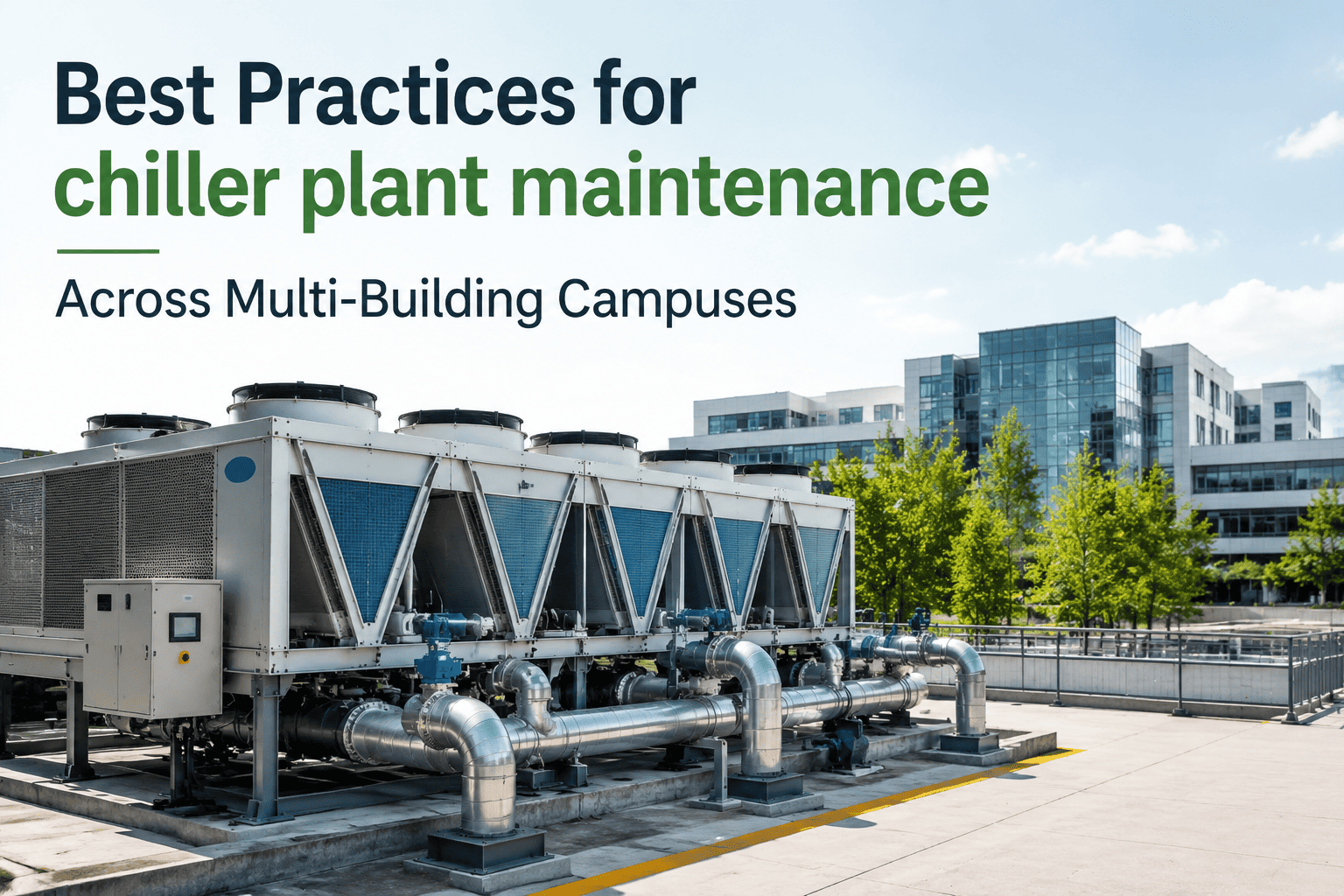
On a multi-building campus, chillers are usually the single largest energy users — and the most expensive thing to run badly. A fouled condenser tube or untreated water loop does not announce itself; it just quietly raises the electric bill and inches toward an unplanned outage on the hottest day of the year. Across several plants in several buildings, those small efficiency losses multiply fast and stay invisible until something fails. A predictive, logged approach keeps every plant honest, and a platform like OxMaint ties each reading to the right asset.
HVAC Maintenance · Campus Chiller Plants
Run Every Campus Chiller Plant at Peak Efficiency
Best practices and a predictive approach for districts and higher-ed teams managing chiller plants across multiple buildings.
20–30%
Efficiency gain from clean tubes and tuned controls
#1
Heat-exchanger cleanliness as an efficiency factor
3–12
Feet per second ideal condenser flow velocity
Quarterly
Water testing and strainer cleaning cadence
Why Campus Chiller Plants Drift Out of Tune
A single chiller in a single building gets watched. Spread cooling across a central plant, two satellite buildings, and a data closet, and the discipline thins out. Logs get kept in one plant and skipped in another. Water treatment is tested on one loop and assumed fine on the rest. Condenser tubes foul gradually, so nobody notices the approach temperature creeping up until the energy bill or an outage forces the issue. The contaminants are always the same — scale, mud, algae, sediment — and they raise thermal resistance until heat transfer falls and the compressor works harder for the same cooling. Across multiple plants, the only reliable defense is the same logged routine applied everywhere.
Reactive, Plant-by-Plant
Tubes cleaned only after performance drops
Water treatment inconsistent between loops
Logs kept on paper, rarely trended
Outages discovered when cooling fails
Efficiency loss hidden in the utility bill
No shared view across buildings
Predictive, Campus-Wide
Cleaning scheduled before fouling bites
Water tested on every loop on one cadence
Daily logs trended for early warning
Drifting readings flag issues before failure
Efficiency tracked per plant, not buried
One dashboard across every building
The Chiller Plant Maintenance Cadence
These tasks are well established across the HVAC industry. The campus challenge is making the same cadence happen in every plant, even when each building has its own operator and its own water conditions.
Standard Cadence — Apply at Every Plant
Hold Every Chiller Plant to the Same Routine
OxMaint schedules logs, water tests, and tube cleaning across every plant, trends the readings for early warning, and shows your team which building is drifting — before the efficiency loss reaches the utility bill or the cooling fails.
Four Practices That Protect Efficiency and Uptime
If a campus team focuses on just four things across every plant, these are the four that return the most in saved energy and avoided outages.
Heat Transfer
Keep Condenser Tubes Clean
Scale, algae, and sediment raise thermal resistance and cut heat transfer. Routine tube cleaning often improves efficiency more than expensive upgrades — and prevents the stress that leads to tube failure.
Water
Run a Real Water Treatment Program
Treated water on every loop slows scale and biofouling between cleanings and protects heat-transfer surfaces. Test quarterly and correct the program rather than assuming all loops behave the same.
Monitoring
Keep Daily Logs and Trend Them
A rising approach temperature or shifting pressures show up in trended logs long before a failure. Daily readings turn troubleshooting from guesswork into an early-warning system.
Operation
Hold Flow and Temperature in Range
Keep condenser flow in the recommended velocity band and entering water as cool as the chiller allows. Too low causes laminar flow; too high erodes tubes — the right range protects both efficiency and hardware.
How OxMaint Brings Predictive Maintenance to Every Plant
The industry is moving from fixed schedules toward demand and predictive maintenance — acting on real condition data instead of the calendar alone. That only works when readings from every plant flow into one place and trigger action automatically.
1
Log Each Plant Against Its Asset
Daily readings — pressures, temperatures, approach, oil — are captured on mobile and tied to the specific chiller, building, and loop, so the history belongs to the equipment, not a clipboard.
2
Trend Readings for Early Warning
OxMaint trends approach temperature and key pressures over time. A slow climb that no single reading would reveal becomes an obvious signal that fouling or a charge issue is developing.
3
Auto-Generate the Work Order
When a trend crosses a threshold, the system raises a work order for tube cleaning, water correction, or inspection — turning a quiet efficiency drift into scheduled action before it becomes an outage.
4
See the Whole Campus at Once
One dashboard shows every plant's status across every building — which are efficient, which are drifting, and which have open work — so a central team runs many plants without losing visibility on any of them.
Frequently Asked Questions
How often should campus chiller tubes be cleaned?
Typically annually, or quarterly where water is hard or conditions are harsh. Condenser log readings during the season show when a repeat cleaning is due.
OxMaint schedules and tracks it per plant so no loop is missed.
How much efficiency does chiller maintenance actually recover?
Clean condenser tubes, tuned controls, and correct refrigerant levels can improve energy efficiency by roughly 20 to 30 percent. Since chillers are often a campus's largest energy user, that gain shows up directly on the utility bill.
Why keep a daily chiller log if nothing seems wrong?
Because failures show up as trends first. A slowly rising approach temperature warns of fouling well before cooling drops.
Book a demo to see how trended logs flag issues across plants early.
Is water treatment really necessary on every loop?
Yes. Untreated water lets scale, algae, and sediment build on heat-transfer surfaces, cutting efficiency and risking tube failure. Quarterly testing and correction on every loop keep all plants protected, not just the one being watched.
Can one team manage chiller plants in several buildings?
Yes, with logged routines and a shared dashboard. Each plant reports its own readings and open work, and the team sees every building on one screen.
OxMaint makes that multi-plant view practical.
Put Every Campus Chiller Plant on One Predictive Standard
OxMaint logs each plant against its asset, trends the readings for early warning, raises work orders before outages, and shows your whole campus on one dashboard. Start free, or book a 30-minute walkthrough with our team.