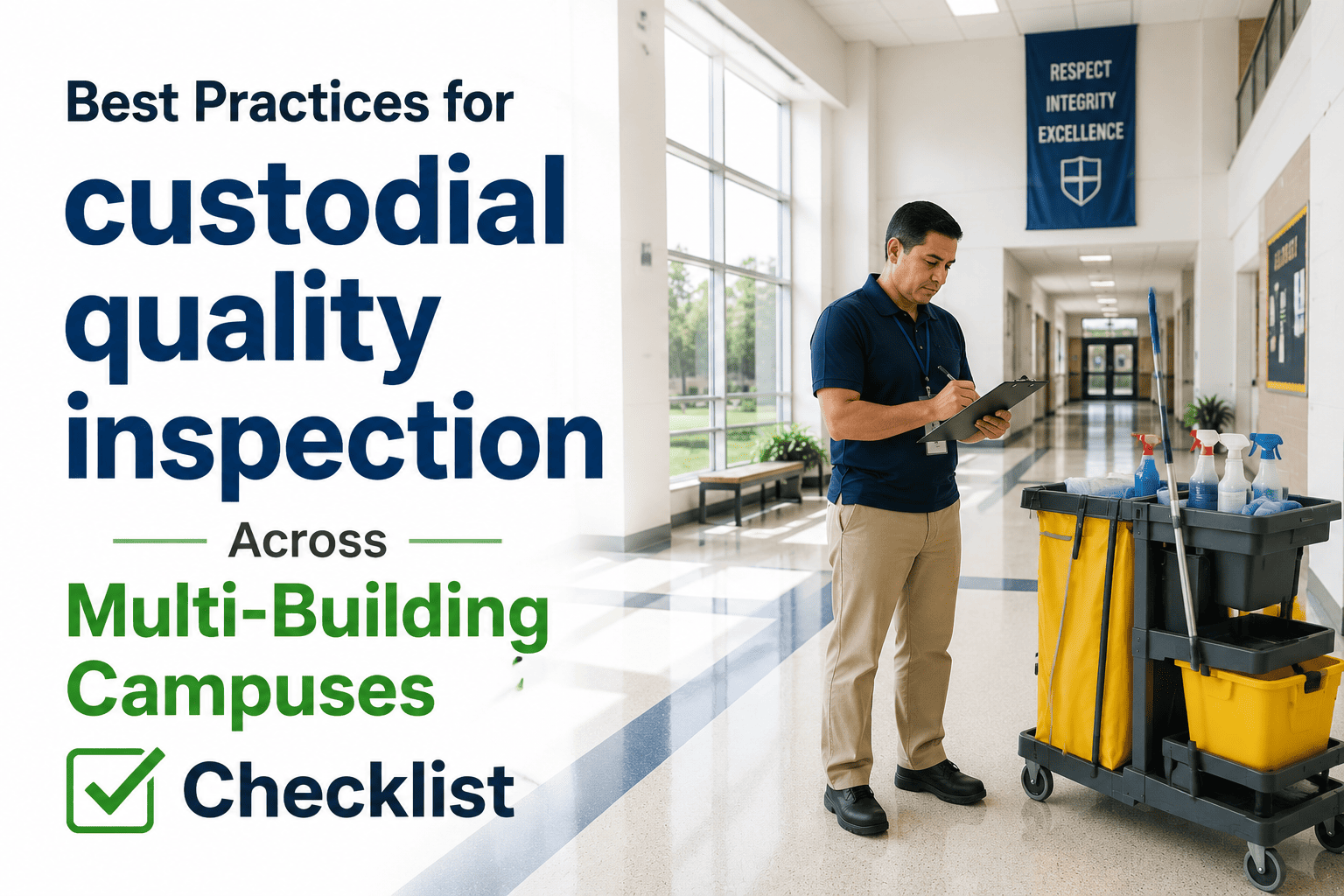
Best Practices for custodial quality inspection Across Multi-Building Campuses Checklist

By Corin Hale on June 25, 2026

best-practices-for-custodial-quality-inspection-across-multi-building-campuses-checklist

Inspecting one building is a checklist. Inspecting twenty across a campus is a system problem. The moment you scale, inconsistency creeps in: each supervisor grades a little differently, scores live in separate binders, a failure in one building never informs another, and leadership has no single view of where quality actually stands. The campuses that hold a consistent standard do it by standardizing forms, centralizing data, and benchmarking buildings against each other. These best practices turn a scattered set of inspections into one comparable, defensible program — all managed in OxMaint.

Campus-Scale Inspections — OxMaint CMMS
One Standard. Every Building. One View of Campus-Wide Quality.
OxMaint standardizes inspection forms across every building, centralizes scores in one dashboard, and benchmarks buildings side by side — so a distributed campus runs on one consistent, comparable quality standard.
What Breaks When You Scale Past One Building
Scoring Drift
Each supervisor grades differently, so scores stop being comparable across buildings.
Scattered Data
Results sit in separate binders and spreadsheets with no single campus view.
Lost Failures
A defect in one building never informs the route, training, or staffing elsewhere.
No Benchmark
Without side-by-side scores, leadership can't see which buildings need help.
The Goal: Comparable Scores, Not Just Clean Buildings
APPA appearance levels give every building a common language from Level 1 Orderly Spotlessness to Level 5 Unkempt Neglect. At campus scale, the value is comparability — being able to say Building A holds Level 2 while Building C is drifting to Level 3, and to act on it. Practices marked Priority are the highest-leverage moves. Practices marked Scale matter most as building count grows.

1. Standardize the Form Across Every Building

Comparability starts with one form library. If buildings are graded on different sheets or different interpretations, their scores can never be compared — and the whole point of a campus program is lost.

01Same Standard, Every Building

2. Centralize Every Score in One Place

Scattered data is the silent killer of multi-building programs. When results land in one system, the whole campus becomes visible and patterns that hide in individual binders finally surface.

02One Source of Truth

3. Route Findings by Building and Zone

At scale, a finding is useless unless it reaches the right person fast. Clear routing by building and zone means corrections happen without a supervisor personally tracking down ownership.

03Findings Reach the Right Hands

4. Sample Intelligently at Scale

You cannot inspect every room in every building every cycle, nor should you. Smart sampling concentrates attention where risk and slipping scores justify it, keeping the program sustainable as buildings multiply.

04Cover More With Less

5. Benchmark Buildings Against Each Other

The unique power of a campus program is comparison. When buildings are scored the same way, you can rank them, find your best-run sites, and copy what works to the ones that are struggling.

05Turn Scores Into Decisions

6. Govern Access and Accountability

A program spanning many buildings and crews needs clear roles. Defined access and accountability keep the data clean and make sure every inspection has a name and a standard behind it.

06Clear Roles, Clean Data
From Scattered to Comparable — OxMaint CMMS
Twenty Buildings, One Standard, One Dashboard You Can Actually Compare.
OxMaint keeps every building on the same form, every score in one place, and every building benchmarked against the rest — so campus quality becomes something you manage by data, not by complaint.

Frequently Asked Questions

If supervisors grade differently, a Level 2 in one building isn't the same as a Level 2 in another, and comparison becomes meaningless. Standardized forms and periodic calibration keep scores comparable. OxMaint holds one form library for the whole campus.
Random area sampling and risk-weighted frequency mean you inspect a representative slice of each building rather than every room. Mobile scoring removes desk re-entry, so existing supervisors cover far more ground per shift.
It shows which buildings hold their target level and which are slipping, so you can copy what your best sites do and target help where it's needed. Book a demo to see campus benchmarking in action.
Each building and zone maps to a responsible custodian or crew, so failed items auto-route to the right owner with a deadline. Overdue corrections escalate automatically, which keeps nothing stalled even across many sites.
Yes. Centralizing scores gives leadership a single dashboard filtered by building, zone, or space type, instead of chasing separate reports. Role-based access lets crews see their work while leaders see the full campus picture.
Start Free — Built for Whole Campuses
Bring Every Building Onto One Standard Without Adding a Single Binder.
From standardized forms to campus benchmarking, OxMaint gives facilities teams one consistent quality program across every building they manage. Free to start, and built to scale from two buildings to fifty.

Share This Story, Choose Your Platform!