A school district with eight buildings has eight playgrounds, each with its own equipment age, surfacing type, and inspection history — and most districts try to run them on a single shared spreadsheet. That spreadsheet fails the moment one site misses a monthly check, because by the time the certified inspector arrives for the annual audit, the depth of the wood chips under the monkey bars at one elementary school has compacted to 1.2 inches. A Colorado district settled a single playground injury case for $210,000 because the last documented fall-zone depth measurement was 28 months old. The fix isn't more inspections — it's a structured three-tier program (daily, monthly, annual) run consistently across every campus with documented evidence per playground, per zone, per date. This page gives you the multi-building best-practice schedule, the per-zone documentation requirements, and the CMMS workflow that ensures no playground in your district goes uninspected. Manage your district-wide playground program in OxMaint or book a demo to see how multi-campus inspection tracking works in practice.
Inspection Management
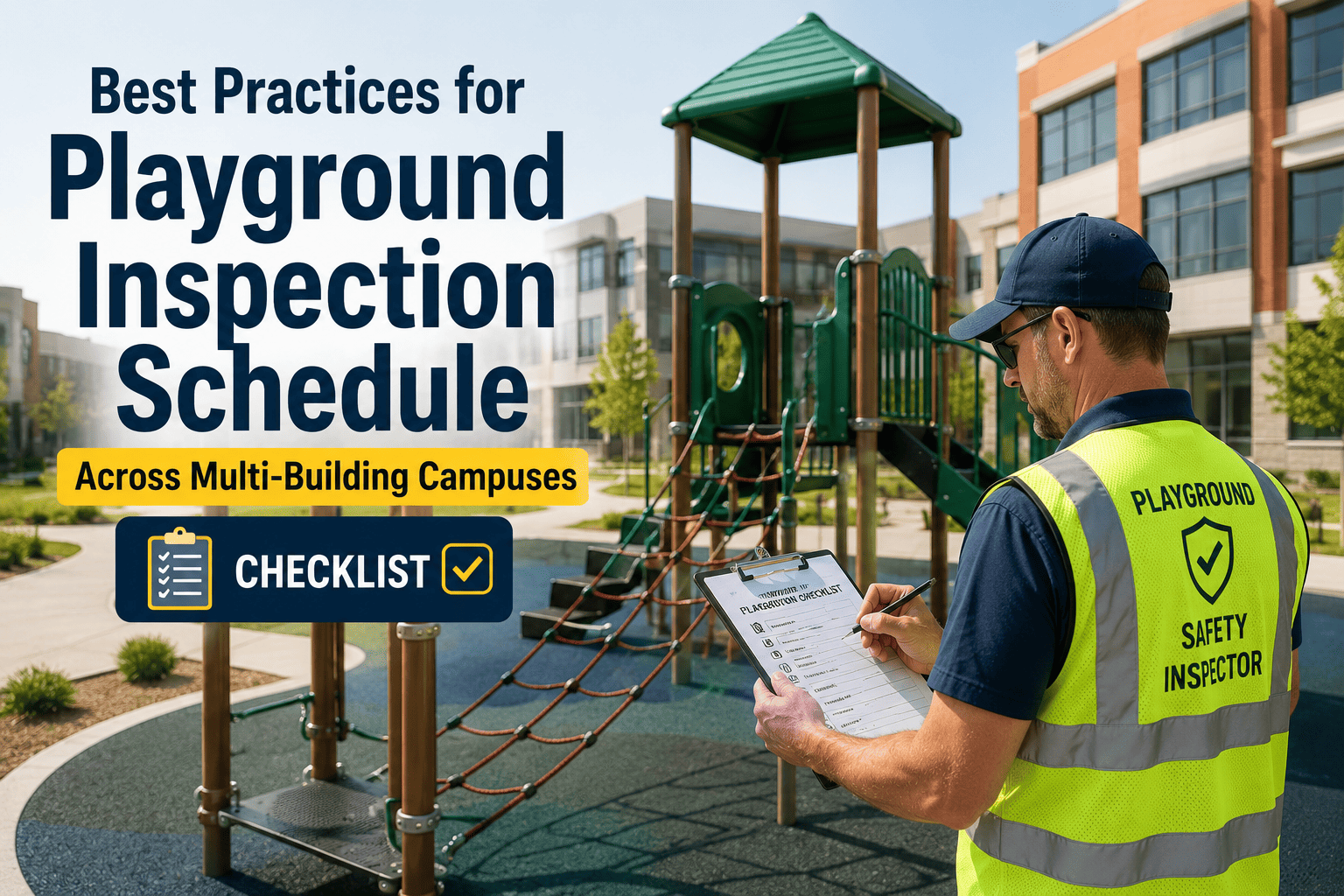
Best Practices for Playground Inspection Schedule Across Multi-Building Campuses
Three tiers, every campus, every month — with documented evidence per playground. The systematic approach that defends against litigation and prevents the injuries first.
79%
of injuries involve falls
3
inspection tiers required
9in
minimum surfacing depth
CPSI
annual audit standard
What This Guide Covers
Before You Begin
CPSC and ASTM F1487 are voluntary standards adopted by most state authorities, insurance carriers, and school boards as the minimum standard of care. Items marked CPSI require a Certified Playground Safety Inspector. Items marked Photo require a date-stamped photo attached to the CMMS work order before sign-off — undocumented inspections offer no legal protection.
01
No Per-Playground Asset Record
When inspections roll up by school instead of by playground, equipment-specific history vanishes. The same swing set fails inspection three years running because no one connects this year's finding to last year's deferred repair.
02
Visual Checks Mistaken for Depth Tests
Surfacing looks fine to the eye but compacts to half its required depth in high-use zones. Visual inspection doesn't catch it. A measured depth check with a probe at every fall zone is the only defensible record.
03
Shared Spreadsheet Between Sites
One building's site lead updates the sheet, another stops checking. By month six, two playgrounds have current data, four are stale, and two have never been entered. No one notices until an injury triggers a discovery request.
04
Annual CPSI Audit Surprises
The certified inspector arrives once a year and flags 30 items that the site team hadn't seen. Most are minor protrusions, hardware wear, or surfacing displacement that monthly checks would have caught — and that capital projects could have absorbed.
Daily — Trained StaffPre-Use Visual Walk
Monthly — Facilities TeamSurfacing Depth and Hardware
Every Playground as an Asset — Across Every Campus
In OxMaint each playground is its own asset with equipment age, surfacing type, critical fall heights, last inspection date, and the prior CPSI report stored against it. Daily, monthly, and annual checklists auto-generate per playground. The facilities director sees which sites are current, which are due, and which are overdue — district-wide in one view.
Annual — Certified InspectorFull CPSC and ASTM F1487 Audit
1
District-Wide Asset Inventory
Every playground across every campus is registered as a separate asset with equipment list, install dates, surfacing type, fall heights, and ADA accessibility status. No single school is allowed to manage its own playground in isolation.
2
Standardised Three-Tier Schedule
The same daily, monthly, and annual cadence runs at every site. Different schools follow the same checklist, on the same frequency, with the same documentation requirement — eliminating inconsistency between principals or site teams.
3
Centralised Dashboard, Site-Level Access
The district facilities director sees compliance status across every site in one dashboard. Each site lead sees only their own playgrounds. Overdue inspections escalate automatically; no school can fall behind quietly.
4
Annual CPSI Across All Sites in One Window
Schedule the certified inspector for every campus in a 4–6 week window, typically during summer break. Single contract negotiation, consistent reporting format, and capital findings consolidated for the next bond cycle.
When Injury OccursDocumentation and Closure
Asset Inventory
Each playground is its own asset with location, equipment list, surfacing type, install date, fall heights, ADA status, and CPSI report archive. Equipment items within each playground can be tracked individually for replacement planning.
Three-Tier Scheduling
Daily pre-use checks, monthly operational inspections, and annual CPSI audits are auto-scheduled per playground. Missed inspections escalate to the facilities director before the gap widens.
Mobile Depth Measurement
Site staff enter loose-fill depth readings on a phone at each fall zone, with a photo of the probe at depth. The system compares against CPSC minimum table for the equipment's fall height and flags any non-compliant zone.
Multi-Site Dashboard
The district facilities director sees compliance status across every playground in every school. Drill from district summary to a single playground in two taps; see overdue inspections, open work orders, and CPSI findings in one view.
CPSI Report Archive
Every annual CPSI report is uploaded against the playground asset with corrective work orders auto-generated from the findings. High-priority items escalate to the director until closed.
Litigation-Ready Export
When an injury or claim arises, the full inspection history, depth measurements, hardware records, and CPSI reports for that playground export in minutes. The most defensible documentation pack a district can produce.
Three tiers are required as best practice and adopted by most insurers. Daily pre-use visual checks by trained school staff, monthly operational inspections by facilities staff covering depth and hardware, and annual full audits by a Certified Playground Safety Inspector (CPSI). Manage all three in OxMaint so every tier runs on schedule.
CPSC requires uncompressed loose-fill surfacing of at least 9 inches under equipment with a 7-foot fall height, scaling up to 12 inches for higher equipment. Engineered wood fibre, shredded rubber, and pea gravel each have specific minimums. Synthetic unitary surfacing must meet ASTM F1292 critical fall height for the tallest equipment in the zone.
An annual CPSI audit is necessary but not sufficient. Most litigation losses involve monthly depth measurements that were not documented, hardware findings that were not closed, or visual checks that were not logged in the months between annual audits. Documented monthly evidence between CPSI audits is the gap that most lawsuits exploit.
Yes. Each playground at each school is an individual asset with its own inspection schedule, depth log, hardware history, and CPSI report archive. The district facilities director sees compliance across every site in one view; site leads see only their own playgrounds. Book a demo to see multi-site dashboards live.
Retain inspection logs, CPSI reports, depth measurements, and work orders for at least the life of the equipment plus the statute of limitations for childhood injury claims in your state — typically the child's age of majority plus 2 years. Permanent retention against the playground asset is the only safe approach. OxMaint stores it all indefinitely.
OxMaint CMMS — Playground Safety
Every Playground, Every Campus, Every Inspection — Documented
Three-tier inspection scheduling, per-zone depth records, CPSI report archive, and a district-wide compliance dashboard — built for school districts running playground programs across many buildings.
Auto-scheduled daily, monthly, and annual inspections per playground
Per-zone depth measurements with CPSC minimum-table validation
CPSI report archive with auto-generated corrective work orders
District-wide dashboard with overdue escalation and litigation-ready export