A generator that starts on a quiet Sunday at 2 a.m. proves only that it starts — not that it can carry the load it would face when utility power drops at 2 p.m. on a Wednesday. That distinction is the whole game in a multi-building campus, where one generator backs a dormitory, another a research lab, and a third a data closet, each with a different criticality and a different authority having jurisdiction watching. Testing them building-by-building, on whatever cadence each site remembers, is how gaps form — and how a Joint Commission or AHJ review turns up the one unit that has not seen a real load in a year. A coordinated program built on consistent best practices is what closes that, and OxMaint's asset management for standby power keeps every building on the same one.
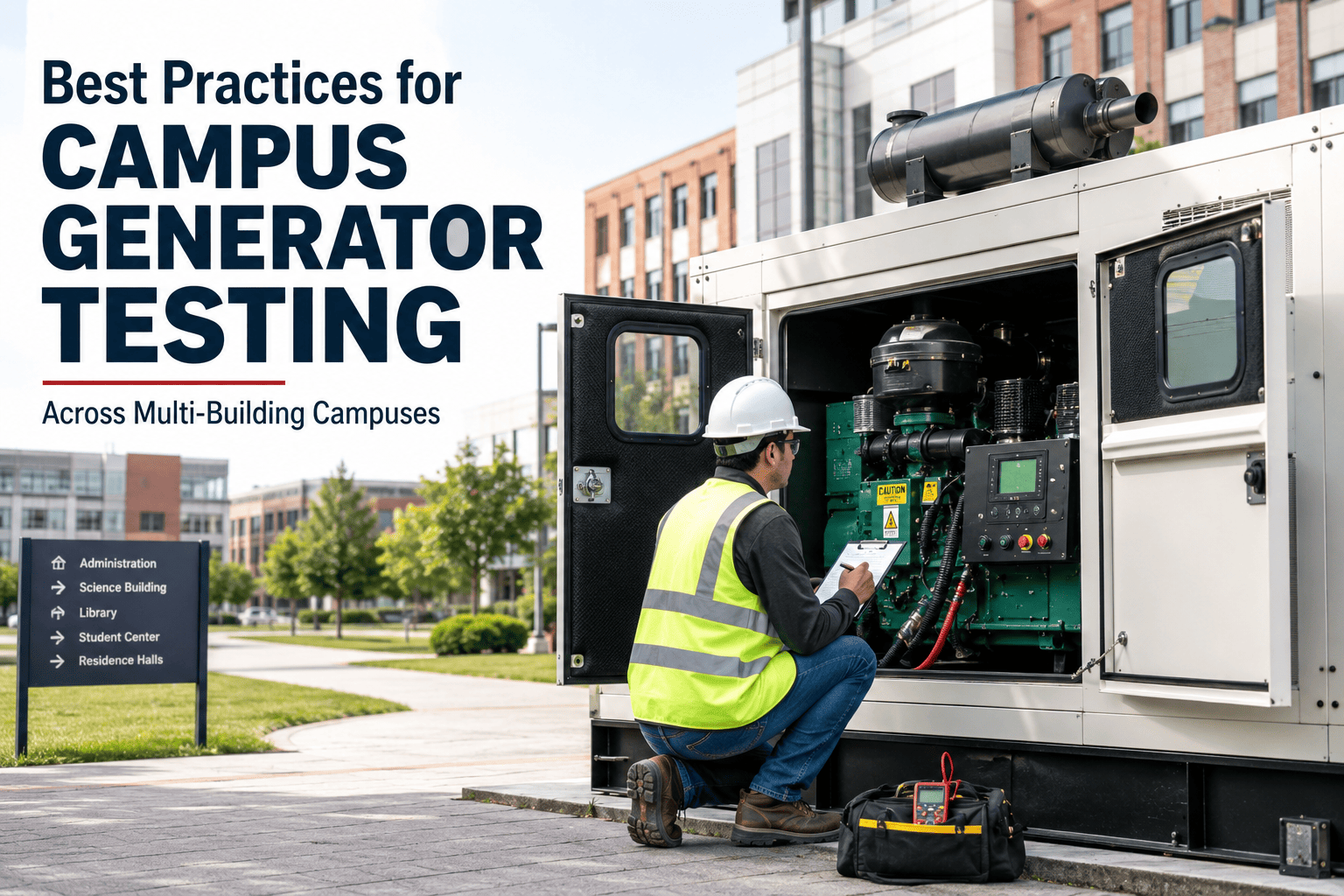
Best Practices for Campus Generator Testing Across Multi-Building Campuses
The practices that turn a scattered, building-by-building habit into one defensible NFPA 110 program — and the gaps that quietly form when each site tests on its own.
10 sec
window a Type 10 system must restore power in — the full load lands in one step, no ramp
Peak
facility load is when tests reveal the truth — a 2 a.m. start proves far less
Per AHJ
each building's authority can set its own requirements on top of the NFPA 110 baseline
Five Best Practices
What a Coordinated Program Does Differently
01
Test under load, at load
Exercise monthly at no less than 30% of nameplate for 30 minutes, and schedule the run during peak facility load where practical — not the quietest hour of the week.
02
Standardize the cadence campus-wide
Every generator on the same monthly, annual load-bank, and triennial full-capacity rhythm — so no building drifts onto its own forgotten schedule.
03
Classify each unit by criticality
A Level 1 generator backing life-safety loads carries stricter testing than an optional-standby unit. Tag each one so its cadence matches its risk and its AHJ.
04
Verify fuel, not just the engine
Light monthly runs cause wet stacking; stored fuel degrades. Pair load runs with fuel-quality checks so the annual load bank confirms real capacity.
05
Document for the AHJ, continuously
NFPA 110 expects a written schedule and retained results available on request. Capture every test as it happens, not in a pre-audit scramble.
The Comparison
Building-by-Building vs One Coordinated Program
| Practice | Building-by-Building | Coordinated Program |
| Testing cadence |
Each site on its own memory |
One standard rhythm campus-wide |
| Load conditions |
Often run at the quietest hour |
Scheduled at peak load where practical |
| Criticality awareness |
All units treated the same |
Cadence matched to Level and AHJ |
| Audit readiness |
Multi-day scramble per building |
Signed records exported on demand |
| Visibility for the director |
No single view of fleet status |
Every generator on one dashboard |
Put every building on the same testing standard
OxMaint schedules each generator's monthly, annual, and triennial tests by criticality, captures results in the field, and rolls fleet status up to one dashboard — so no building drifts out of compliance unnoticed.
The Risk of Drift
How a Single Missed Run Becomes a Finding
A site skips one monthly run because the operator was covering another building that week.
The gap goes unnoticed — there is no campus-wide view showing that generator is now overdue.
Wet stacking builds from repeated light loading, quietly eroding the unit's real capacity.
The AHJ asks for the log and the missing run becomes a documented finding against the campus.
Expert Review
When the transfer switch fires, the generator does not get to ease in — the entire demand lands in one step. A program built around no-load monthly runs at the quietest hour tells you almost nothing about that moment. Across a campus the only reliable safeguard is consistency: the same cadence, the same documentation, and one place where a director can see which units are current and which have started to drift. Coordination is the practice; everything else is detail.
Reviewed by OxMaint's Asset Reliability Advisory Team
FAQ
Frequently Asked Questions
Why does it matter when during the day we test?
A test at 2 a.m. confirms the system starts but not that it handles real daytime demand. Running near peak load where practical reveals weaknesses a quiet-hour test hides.
Should every generator be tested on the same schedule?
The cadence should be standardized, but adjusted by criticality. A Level 1 unit on life-safety loads carries stricter testing than optional-standby equipment.
Book a demo to map yours by Level.
What is wet stacking and why does the program care?
It is unburned fuel building up when an engine runs under light load repeatedly. Proper monthly load runs and an annual load bank burn it off and confirm true capacity.
How does a director see status across every building?
Every generator's schedule and results roll up to one dashboard, so overdue or drifting units surface immediately instead of hiding in a single building's records.
Start free to see it.
Does this satisfy what the AHJ asks for?
NFPA 110 expects a written schedule and retained results available on request. OxMaint keeps both per generator and exports them as signed records, so a review is a report, not a scramble.
One standard, every building, no drift
OxMaint keeps every campus generator on a consistent, criticality-aware testing program with records ready for any AHJ — so the next review confirms reliability instead of exposing the gaps.