Campus combined heat and power plants represent the most complex and highest-value assets in any university's infrastructure portfolio — a single gas turbine CHP unit serving a mid-size campus can deliver 5–25 MW of electrical capacity while capturing 60–80% of waste heat for steam distribution, producing overall thermal efficiencies of 65–85% compared to 33% for grid-purchased electricity. Yet CHP plants also carry the highest maintenance stakes: an unplanned turbine outage costs $8,000–$15,000 per hour in replacement energy purchases, and a missed emissions test can result in EPA fines up to $121,275 per day of violation. Across U.S. higher education, approximately 150 campuses operate CHP systems — and only 41% track turbine/engine PM, heat recovery performance, and emissions compliance in a single integrated platform. The rest manage maintenance through disconnected spreadsheets, paper logs, and legacy SCADA historians that cannot generate the compliance reports regulators require. This guide covers the full scope of campus CHP plant maintenance — from gas turbine and reciprocating engine PM schedules to heat recovery steam generator maintenance, emissions monitoring, and CMMS-tracked compliance documentation. If your campus operates a CHP plant, structured digital maintenance is not optional — it is the difference between a 25-year asset life and a premature, $15M replacement. See how Oxmaint tracks CHP assets, PM schedules, and compliance records in one platform by trying a start a free trial or scheduling a book a demo.
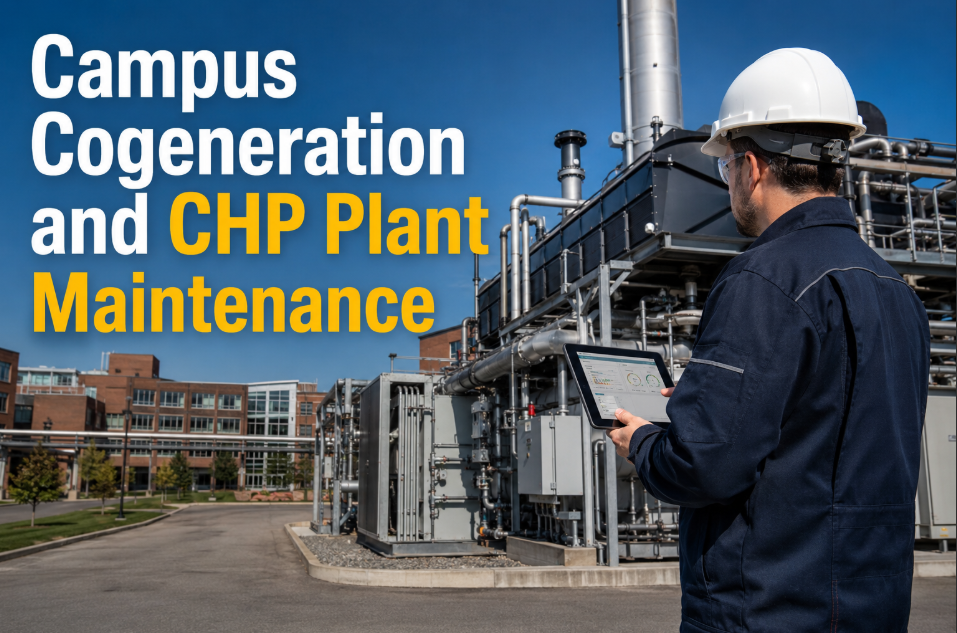
Campus Cogeneration and CHP Plant Maintenance
Turbine and engine PM, heat recovery steam generators, emissions monitoring, operator logs, and CMMS-tracked compliance documentation for university CHP operations.
Track Every CHP Asset From Turbine to Stack
Oxmaint manages the full CHP asset hierarchy — prime movers, heat recovery equipment, emissions systems, and auxiliary equipment — with PM scheduling, operator logs, and compliance reports in one platform. See it in a 30-minute demo.
What Is Campus CHP Plant Maintenance?
Campus CHP plant maintenance is the systematic care of all equipment in a combined heat and power system — the prime mover (gas turbine or reciprocating engine), heat recovery steam generator (HRSG), exhaust treatment systems, electrical switchgear, fuel gas systems, cooling water systems, and all associated controls and instrumentation. Unlike conventional boiler plant maintenance where the primary output is steam, CHP maintenance must simultaneously preserve electrical generation capacity, thermal recovery efficiency, and emissions compliance. A failure in any subsystem cascades across all three outputs. CHP PM schedules are driven by operating hours, not calendar intervals — a turbine running 8,000 hours per year hits its hot gas path inspection interval in 3 years, while one running 4,000 hours gets 6 years. This makes hour-based PM triggers essential, and it is precisely where paper-based systems and generic CMMS platforms without runtime tracking fail.
CHP Asset Hierarchy and PM Requirements
A campus CHP plant contains 200–400 maintainable assets organized into subsystems. Each subsystem has different PM intervals, skill requirements, and compliance implications.
Gas turbines follow OEM-specified maintenance intervals based on equivalent operating hours (EOH) and starts. Typical intervals: combustion inspection at 8,000 EOH, hot gas path inspection at 24,000 EOH, major overhaul at 48,000 EOH. Each interval involves progressively invasive work — from borescope inspection to full rotor removal. Missing a combustion inspection by 500+ hours voids OEM warranty and accelerates blade degradation by 15–20%.
Large reciprocating engines (Wartsila, Caterpillar, Jenbacher) used in campus CHP follow oil change intervals at 1,000–2,000 hours, spark plug replacement at 4,000–8,000 hours, and top-end overhauls at 30,000–40,000 hours. These engines consume 0.3–0.5 g/kWh of lube oil, making oil analysis a critical predictive tool. A single cylinder failure can cost $150,000–$300,000 to repair.
The heat recovery steam generator captures exhaust heat to produce campus steam. HRSG maintenance includes tube bundle inspection for fouling and corrosion, economizer cleaning, feedwater chemistry management, safety valve testing per ASME, and casing/duct inspection for hot gas leaks. Fouled HRSG tubes reduce thermal recovery efficiency by 3–8%, directly increasing the campus steam plant's supplemental boiler fuel consumption.
Campus CHP plants operating under Title V or PSD permits require continuous emissions monitoring systems (CEMS) for NOx, CO, and sometimes VOCs. CEMS require daily calibration drift checks, quarterly cylinder gas audits (CGAs), and annual relative accuracy test audits (RATAs). Missing a RATA or failing calibration drift tolerances can trigger excess emissions events that must be reported to the state environmental agency within 24 hours.
The generator converts mechanical energy to electrical output at 4,160V or 13,800V, feeding campus distribution through protective switchgear. Generator PM includes winding insulation resistance testing (megger), bearing vibration analysis, exciter maintenance, and protective relay testing. Switchgear requires annual infrared thermography, breaker exercise testing, and relay calibration. A generator failure during peak campus load can take 4–8 weeks to repair.
Supporting systems include fuel gas compressors and regulators, cooling tower and closed-loop cooling water systems, instrument air, plant UPS, fire suppression, and the distributed control system (DCS). These "background" systems cause 35% of unplanned CHP outages — a cooling water pump failure or fuel gas regulator malfunction shuts down the prime mover as effectively as a turbine blade failure.
Paper Logs vs CMMS-Tracked CHP Operations
- Operator logs in paper binders — no trending
- PM intervals tracked by calendar, not runtime hours
- CEMS calibration records filed separately from plant ops
- Emissions reports assembled manually before audits
- No predictive trending from oil analysis or vibration data
- Spare parts on informal lists — stockouts during overhauls
- Digital operator logs with automatic parameter trending
- Hour-meter-triggered PM with auto-generated work orders
- CEMS records integrated with plant maintenance timeline
- Compliance reports generated in minutes, not weeks
- Oil analysis and vibration data tracked on asset records
- Overhaul parts kits pre-ordered based on hour projections
CHP Plant Maintenance ROI
Frequently Asked Questions
Can Oxmaint trigger PM work orders based on turbine operating hours?
How does the platform handle emissions compliance documentation?
Does Oxmaint integrate with SCADA or DCS systems?
What about tracking overhaul planning and major maintenance events?
Your CHP Plant Is Too Valuable for Paper Logs
A campus CHP system is a $10M–$40M asset generating millions in annual energy savings. Protecting that investment requires structured, hour-based PM, emissions compliance tracking, and predictive maintenance data — all in one platform. See Oxmaint managing CHP operations in a 30-minute working demo.