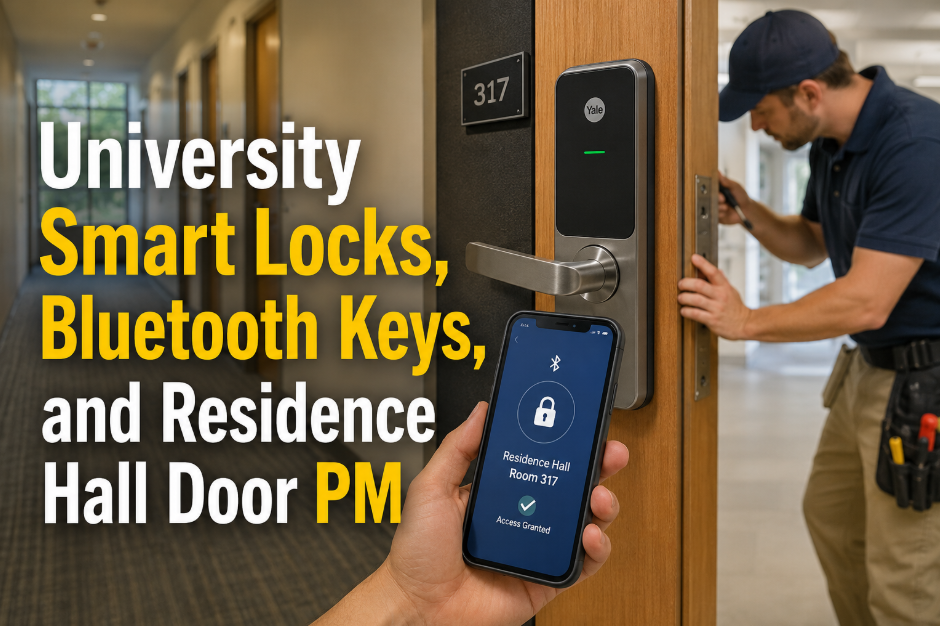
University Smart Locks, Bluetooth Keys, and Residence Hall Door PM
By Jamie lanister on May 25, 2026
University residence halls present one of the most concentrated and operationally demanding access management environments in any facilities portfolio: thousands of students cycling in and out of 200 to 800 rooms across 8 to 12 months of the academic year, with semester and summer turnover events that require systematic credential management, lock inspection, and hardware verification across every single door in the building. Traditional mechanical lock programs — where a locksmith rekeyed every core at move-out and a work order was generated when something failed — are structurally incompatible with the operational reality of modern smart lock systems. BLE-enabled smart locks from ASSA ABLOY, Allegion ENGAGE, dormakaba, and Salto require battery management on a documented cycle, firmware update schedules tied to vendor release cadences, credential revocation that is immediate and audit-documented, and lockout management that connects mobile app failures to physical hardware backup protocols. None of these requirements are met by a reactive work order system. Oxmaint manages residence hall smart lock maintenance as a structured PM program — battery replacement cycles tracked per lock, firmware version audited per building, rekey events linked to academic calendar milestones, and lockout incidents generating immediate work orders with resolution documentation. Institutions ready to put residence hall smart lock maintenance on a systematic footing can start a free trial or book a demo to see the full residence hall door PM workflow configured in Oxmaint.
UNIVERSITY SMART LOCKS · BLE KEYS · RESIDENCE HALL DOOR PM · BATTERY CYCLES · FIRMWARE
University Smart Locks, Bluetooth Keys, and Residence Hall Door PM
Battery replacement cycles, firmware updates, rekey management, and lockout resolution — residence hall smart lock maintenance is a structured PM program, not an ad hoc response function. CMMS-tracked door PM protects students and eliminates the reactive lockout crisis cycle.
Room doors in a large residence hall — each requiring individual battery tracking
Manual tracking of 800 independent batteries is operationally unsustainable
4.8x
Cost premium — emergency lockout response vs scheduled battery replacement
After-hours locksmith + student inconvenience vs $8 battery replaced on schedule
2x/yr
Academic year milestone events requiring mass rekey and credential audit
Fall move-in and spring move-out — each requiring full building door verification
Smart Locks Are Not Simpler Than Traditional Locks — They Are More Complex
A traditional mechanical lock requires a locksmith and a new core. A BLE smart lock requires a battery on a documented replacement cycle, firmware kept current against vendor release schedules, a mobile credential system that must function on every student's smartphone model, a physical backup protocol when the mobile app fails, and a documented lockout management process that protects both student safety and residential life liability. Universities that deploy smart locks without structured PM programs discover these requirements through their first winter break — when 30% of batteries in a 600-room hall hit low-battery threshold simultaneously and the residential life team spends the first week of spring semester responding to lockouts. Oxmaint prevents this by treating every lock as a tracked asset with its own battery cycle, firmware version, and inspection schedule. Start a free trial or book a demo to see residence hall smart lock PM configured for your building count.
The Four Smart Lock Technology Categories on University Campuses
Each technology category has different battery profiles, firmware update requirements, and failure modes. Effective PM treats them as separate asset types — not as a unified "smart lock system" with a single maintenance approach.
BLE
Bluetooth Low Energy Smart Locks
ASSA ABLOY ENGAGE, Allegion ENGAGE, Salto KS
Battery: 4× AA or 4× AAA — 12–18 month cycle
Firmware: OTA via mobile app or hub — quarterly check
Credential: Mobile app — iOS and Android compatibility required
Backup: Physical key override or emergency power pad
PM Risk: Battery depletion, app version mismatch, BLE range issues
NFC
NFC/RFID Proximity Smart Locks
dormakaba Ambiance, Kaba Ilco, HID Mobile Access
Battery: 9V or 4× AA — 18–24 month cycle
Firmware: Handheld programmer or network hub — annual update
Credential: Physical card or mobile NFC — card encoding PM required
The Battery Replacement Crisis Every Residence Hall Avoids With Scheduled PM
Battery depletion in smart locks does not follow a predictable uniform schedule — it varies by door traffic frequency, temperature exposure, firmware efficiency, and credential transaction volume. Without individual battery tracking per lock, residence hall maintenance teams are flying blind until lockout calls start accumulating. By then, the crisis has already begun.
100%
Installed
Battery installed at lock installation or last replacement cycle. Start date recorded in Oxmaint asset record with expected depletion date calculated from usage profile.
→
30%
PM Trigger Point
Oxmaint generates battery replacement work order when projected depletion date is 45 days out — based on installation date and door traffic classification. Technician schedules replacement during next building maintenance round.
→
15%
Low Battery Alert
Smart lock generates low battery notification to the management system. Without scheduled PM, this is the first indication of an impending failure — and replacement must happen immediately, often at an inconvenient time and without the parts staged.
→
0%
Lockout Event
Lock fails to power the BLE radio or the motor actuator. Student is locked out. After-hours emergency response required. Emergency power pad may restore temporary access but the student is displaced until battery replacement is completed.
Battery replacement at the 30% PM trigger point costs $8 in batteries and 10 minutes of technician time. Emergency lockout response at 0% costs $85–$180 in after-hours labor plus student disruption. At 800 rooms, preventing 40% of lockouts through scheduled PM saves $27,000–$57,000 per academic year in emergency response cost alone.
PM Requirements
Six Core Maintenance Tasks for Residence Hall Smart Lock Programs
Battery Replacement Cycle
Every 12–18 months per door (traffic-classified)
Each lock assigned a replacement interval based on door traffic class: high-traffic main entries at 10–12 months, standard room doors at 15–18 months, low-traffic storage and utility doors at 20–24 months. Oxmaint tracks installation date per lock and generates replacement work orders 45 days before projected depletion — with the correct battery type pre-specified in the work order parts list.
Firmware Version Audit
Quarterly check; update on vendor release
Smart lock firmware governs BLE radio behavior, credential parsing, battery reporting accuracy, and security protocol version. Outdated firmware creates credential compatibility issues when the university's access control platform updates its mobile app. Oxmaint tracks firmware version per lock asset and generates an update work order when a new vendor release is available — with the update procedure attached and a post-update verification step required before the work order can be closed.
Semester Rekey and Credential Audit
At each academic year milestone event
Fall move-in, spring move-out, and summer program transition each require: credential deprovisioning for departing occupants, new credential assignment for incoming occupants, master override key accounting, and physical lock function verification per door. Oxmaint schedules each rekey event as a building-level work order triggered 2 weeks before the academic calendar milestone — with room-by-room checklist items and a supervisor sign-off requirement before the building is cleared for the new occupancy period.
Lockout Incident Management
Every lockout event generates a work order
Student lockout events are categorized by root cause: battery depletion, app credential failure, physical lock malfunction, or lost card/device. Each category generates a different work order type in Oxmaint — battery depletion triggers an immediate replacement work order plus a review of that lock's PM schedule; app credential failure triggers a credential system review work order; physical lock malfunction triggers a hardware inspection work order. The categorized data identifies systemic problems (a floor with disproportionate battery lockouts) before they become crises.
Mobile App and Credential System Compatibility
After every platform OS update cycle
iOS and Android major OS updates frequently affect BLE stack behavior — changing how the mobile app connects to the lock's radio. When Apple or Google releases a major OS version, universities typically see a wave of "credential not working" reports within 48 hours. Oxmaint tracks app version and firmware version per lock, making it possible to identify which building-floor combinations are running incompatible version pairs and generate a targeted update work order before students begin reporting failures.
Physical Hardware and Door Alignment Inspection
Annual — tied to summer maintenance program
Smart lock electronics can function correctly while the physical door hardware fails to perform: a clutch mechanism worn from high usage may disengage the motor actuator from the latch bolt; a door sag may cause the latch to miss the strike plate; motor actuator lubrication loss increases current draw and accelerates battery depletion. Annual physical inspection per lock — clutch function, motor actuation, latch engagement, closer alignment — is scheduled in Oxmaint during the summer maintenance program and requires a physical function test sign-off per room.
Oxmaint Solution
How Oxmaint Manages Residence Hall Smart Lock PM
Oxmaint registers every smart lock as an individual asset with its own traffic classification, battery profile, firmware version, and inspection schedule. The PM system generates work orders automatically at battery replacement intervals, firmware update releases, and academic calendar milestone events — making residence hall smart lock maintenance proactive rather than reactive. Institutions ready to bring smart lock PM under structured CMMS management can start a free trial or book a demo to see the residence hall door PM workflow.
Asset Registry
Every Lock as an Individual Asset with Traffic Classification
Register each lock individually: building, floor, room number, lock model, firmware version, battery type, installation date, and traffic class. High-traffic main entry, stairwell, and laundry doors carry shorter battery intervals than standard room doors — each managed separately with its own PM schedule.
Battery PM
Projected Depletion Tracking with 45-Day Advance Work Orders
Oxmaint calculates projected battery depletion from installation date and door traffic class. Replacement work orders are auto-generated 45 days before projected depletion — with the correct battery type in the parts list and the floor plan attached to the work order for efficient technician routing across a building.
Firmware Tracking
Version Recorded Per Lock — Update Work Orders on New Releases
Current firmware version is stored per lock asset in Oxmaint. When a vendor releases a firmware update, a bulk work order is generated for all affected locks in that building — with the update procedure, required tools, and post-update verification checklist included. No lock leaves the update cycle without a verified firmware version record.
Academic Calendar PM
Semester Rekey Work Orders Triggered by Calendar Events
Configure academic calendar milestones in Oxmaint — fall move-in, spring move-out, winter break, summer program start — as trigger events that auto-generate building-wide rekey and credential verification work orders. Each work order includes a room-by-room checklist that must be signed off before the building is cleared for the new occupancy period.
Lockout Tracking
Every Lockout Categorized, Linked, and Analyzed
Lockout incidents are logged as work orders in Oxmaint with root cause categorization: battery, credential, hardware, or user. Pattern analysis across a building or floor identifies systemic issues — a section with disproportionate battery lockouts signals a battery interval that is too long for that door's traffic profile.
Compliance Records
Rekey Completion, Battery History, and Firmware Audit Trail
Every battery replacement, firmware update, rekey event, and lockout incident is archived per lock with technician ID, timestamp, and completion documentation. Residential life directors can produce a complete lock maintenance history for any room during an incident review, student complaint, or housing audit — in under 60 seconds per room.
Before vs After
Reactive Smart Lock Management vs Oxmaint PM Program
Reactive Smart Lock Program
Batteries replaced after lockout calls — no projected depletion tracking
Firmware version unknown for most locks — updates done opportunistically
Semester rekey manual — checklist on paper, completion not fully verified
Lockouts resolved without root cause capture — same rooms lockout repeatedly
Physical hardware inspection never formally scheduled — deferred indefinitely
No unified lock maintenance record — housing audit requires manual reconstruction
Oxmaint Smart Lock PM Program
Battery replacement work order auto-generated 45 days before projected depletion
Firmware version tracked per lock — update work order generated on vendor release
Semester rekey as digital work order — room-by-room sign-off required
Every lockout categorized by root cause — systemic patterns identified and resolved
Annual hardware inspection scheduled in summer program — clutch and motor verified
Complete lock maintenance record per room — retrievable in 60 seconds per audit
Smart Lock PM Program Outcomes
40%
Reduction in Battery-Related Lockouts
Scheduled battery replacement at 30% depletion eliminates the majority of unplanned lockout events — saving $27,000–$57,000/year in after-hours response cost for an 800-room hall
100%
Firmware Version Visibility
Every lock's firmware version known and tracked — OS update compatibility issues identified before students report credential failures, not after
2 wks
Advance Semester Rekey Scheduling
Academic calendar-triggered work orders generate 2 weeks before each milestone — allowing systematic completion rather than a compressed move-in week scramble
60 sec
Lock Maintenance Record Retrieval
Complete battery history, firmware version, rekey record, and lockout history per room — retrieved in under 60 seconds during any housing audit or incident review
Questions
Frequently Asked Questions
How does Oxmaint determine the correct battery replacement interval for each lock when usage varies so much across doors?+
Oxmaint uses a traffic classification system to assign different battery replacement intervals to different door types within the same building. The classification is configured during initial setup based on the university's knowledge of door usage patterns: main building entries and stairwell doors that process 200+ credential transactions daily are classified as high-traffic with 10–12 month intervals; standard residence hall room doors with 5–15 daily transactions are classified as standard with 15–18 month intervals; low-traffic utility and storage doors with fewer than 5 daily transactions are classified as low-traffic with 20–24 month intervals. After the first full replacement cycle, lockout incident data from Oxmaint can be used to refine the classification — if a specific floor is generating disproportionate battery lockouts, that section's interval is shortened. This continuous refinement creates a building-specific battery management model that improves in accuracy with each completed cycle.
What is the correct approach when a smart lock firmware update is released mid-semester and only some rooms have been updated?+
Mid-semester firmware updates create a mixed-version environment that can cause credential compatibility issues if the mobile app is updated to a new version that requires the new firmware. The recommended protocol is to evaluate each firmware release for criticality before scheduling deployment: security patches should be deployed within 7 days as emergency work orders; feature updates and performance improvements should be batched to the next scheduled maintenance round (typically a low-occupancy weekend). In Oxmaint, the firmware version is tracked per lock — when a new release is published, the facilities team can generate a filtered work order for all locks in a specific building or across the full hall system, sorted by floor to enable efficient technician routing. Each completed update requires a post-update credential test (a test card or mobile credential verified at the lock) before the work order can be marked complete, ensuring no lock is left in a failed update state.
How should residence life teams document lockout incidents to build a case for PM program investment?+
The business case for smart lock PM investment is built from three data streams: lockout incident frequency by cause category, after-hours labor cost per incident, and the cost comparison between proactive battery replacement and emergency response replacement. In Oxmaint, every lockout incident is logged as a work order with root cause classification, time of day, technician labor hours, and resolution method. After one full academic year, the filtered report — battery-caused lockouts by building and floor, average resolution cost, total after-hours labor — provides the quantified comparison against the cost of the proactive PM program. Most universities find that preventing 40% of battery-caused lockouts through scheduled replacement recovers the full annual cost of a professional battery replacement program within the first semester of implementation.
What physical door hardware maintenance tasks are most commonly missed on smart lock-equipped residence hall doors?+
The three most commonly missed physical maintenance tasks on smart lock-equipped residence hall doors are clutch mechanism lubrication, door closer adjustment, and latch-to-strike alignment verification. The clutch mechanism in a BLE smart lock converts motor actuator rotation to latch bolt movement — dried clutch lubricant increases motor current draw by 30–50%, which accelerates battery depletion significantly below projected intervals and causes the motor to produce audible grinding noise that students report as a lock malfunction. Door closer drift is the second most common issue — a closer set to too-low force fails to pull the door fully latched against the strike, creating a "door ajar" condition the lock cannot correct electronically. Strike plate misalignment from door frame settlement is the third — a latch bolt that cannot fully engage the strike keeper creates incomplete locking that the smart lock electronics report as secured. All three are detectable in a 10-minute annual physical inspection per door and are addressed with standard locksmith tools — none requiring parts procurement or specialized smart lock equipment.
Every Residence Hall Smart Lock Needs a Battery Cycle, a Firmware Record, and a Rekey Schedule
Smart lock technology does not eliminate door maintenance — it changes the nature of it. Battery cycles, firmware compatibility, credential system integration, and physical hardware alignment all require structured PM programs to deliver the access reliability that residence life operations demand. Oxmaint treats every lock as a managed asset with its own schedule, its own history, and its own compliance record. No heavy implementation. First battery PM work orders configured in week one of your trial.