Universities across North America and Europe have committed to ambitious carbon neutrality targets — and for most campuses, 40–60% of total carbon emissions come from a single source: the HVAC infrastructure that heats, cools, and ventilates academic buildings, residence halls, laboratories, and athletic facilities. The path from fossil-fuel-dependent steam and natural gas systems to electrified heat pumps, geothermal exchange, and low-temperature hot water distribution is not a single capital project — it is a multi-decade infrastructure transformation that requires asset-level tracking, phased retrofit scheduling, and continuous carbon documentation across hundreds of buildings and thousands of HVAC components. Oxmaint provides the CMMS platform that university facilities teams need to plan, execute, and document HVAC decarbonization retrofits building by building, tracking every heat pump installation, every steam-to-hot-water conversion, every geothermal loop commissioning, and every ton of CO2 eliminated — with the data precision that sustainability reporting, accreditation bodies, and campus climate action plans demand. If your campus is navigating the transition from steam to clean heat, want to see how Oxmaint tracks decarbonization retrofits across your building portfolio — start a free trial or book a demo to see the full retrofit tracking workflow.
UNIVERSITY HVAC DECARBONIZATION · HEAT PUMPS · GEOTHERMAL · STEAM-TO-HOT-WATER · CMMS TRACKING
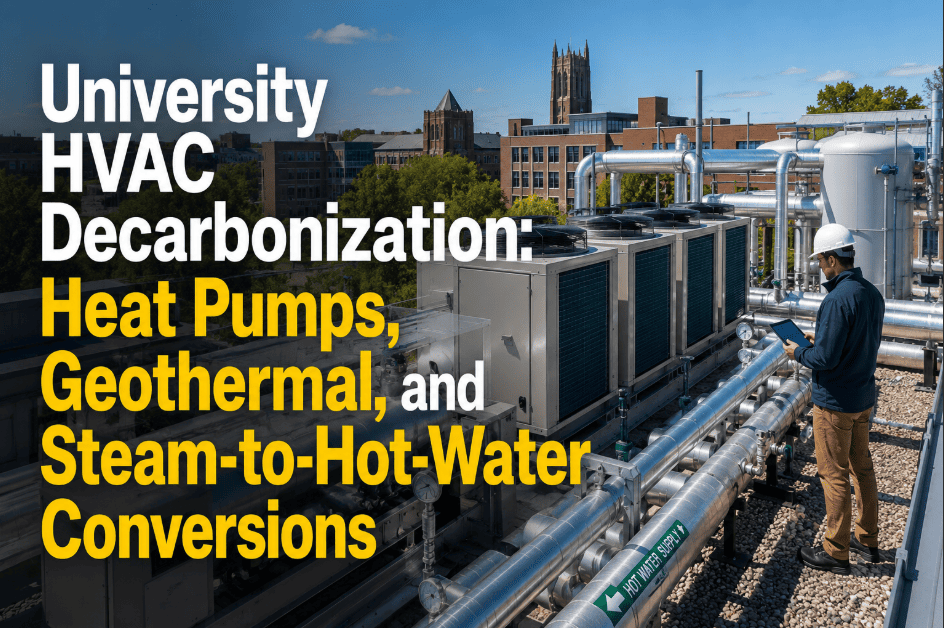
University HVAC Decarbonization: Heat Pumps, Geothermal, and Steam-to-Hot-Water Conversions
Campus HVAC systems account for 40–60% of institutional carbon emissions. Electrification through heat pumps, geothermal exchange, and steam-to-hot-water conversion requires decade-long retrofit tracking and carbon documentation that only a CMMS can sustain.
40-60%
Campus carbon emissions from HVAC systems
Heating is the largest single emissions source
700+
US universities with climate neutrality commitments
Second Nature Climate Commitment signatories
3-4x
COP efficiency gain from heat pumps vs. gas boilers
300-400% efficiency vs. 80-95% combustion
15-25yr
Typical campus HVAC decarbonization timeline
Phased by building age, system condition, and funding
Decarbonization Is Not a Single Project — It Is a 20-Year Asset Transition
Most campuses cannot electrify their heating infrastructure in a single phase. The transition from central steam to distributed heat pumps, ground-source geothermal, and low-temperature hot water distribution happens building by building over 15–25 years, driven by equipment end-of-life timing, capital budget availability, and grid capacity upgrades. Without a CMMS tracking every retrofit phase, every decommissioned boiler, every heat pump commissioning date, and every carbon reduction milestone, the decarbonization plan becomes an aspirational document rather than a managed infrastructure program. Oxmaint gives campus energy and facilities teams the asset-level tracking and carbon documentation they need to manage this transition systematically. See how it works — start a free trial or book a demo to map your campus decarbonization pathway.
Decarbonization Pathways
What Is University HVAC Decarbonization?
University HVAC decarbonization is the systematic replacement of fossil-fuel-based heating and cooling infrastructure — primarily natural gas boilers, steam distribution networks, and gas-fired chillers — with electrified alternatives that eliminate or dramatically reduce Scope 1 and Scope 2 carbon emissions. The three primary technology pathways are air-source and ground-source heat pumps, geothermal exchange systems, and steam-to-hot-water distribution conversions that enable low-temperature renewable heating. Each pathway has different capital costs, different building compatibility requirements, different maintenance profiles, and different carbon reduction yields — and most campuses will deploy all three in different combinations across their building portfolio based on building age, system condition, and site geology.
Technology Pathways
Four HVAC Decarbonization Technologies for Campus Buildings
ASHP
Air-Source Heat Pumps
COP 2.5–4.0 at moderate climates
Lowest capital cost per building retrofit
No ground boring required — rooftop or pad installation
Performance degrades below -10C without cold-climate models
Ideal for: residence halls, admin buildings, student centers
PM needs: filter changes, coil cleaning, refrigerant checks, defrost cycle verification
Carbon reduction: 55–70% vs. gas boiler baseline
GSHP
Ground-Source Heat Pumps (Geothermal)
COP 3.5–5.5 year-round, climate-independent
Highest efficiency — stable ground temperature eliminates seasonal COP drop
Requires bore field or horizontal loop installation
25–50 year ground loop lifespan with minimal maintenance
Ideal for: new construction, major renovations, central plant replacement
PM needs: heat exchanger inspection, loop pressure monitoring, compressor service
Carbon reduction: 65–85% vs. gas boiler baseline
STW
Steam-to-Hot-Water Conversion
30–40% distribution efficiency gain
Converts high-pressure steam distribution to low-temp hot water
Enables heat pump integration — heat pumps cannot feed steam systems
Reduces distribution losses from 25–30% to 5–10%
Ideal for: campuses with aging steam tunnels and pipe infrastructure
PM needs: pipe insulation inspection, valve maintenance, expansion tank service
Prerequisite for most electrification strategies
NET
Ambient Loop / 5th Generation District Energy
Simultaneous heating and cooling recovery
Low-temperature ambient water loop shared across buildings
Each building has its own heat pump — heating waste becomes cooling supply
Eliminates central boiler plant entirely when fully deployed
Ideal for: campuses with diverse building types and mixed heating/cooling loads
PM needs: loop water quality, individual building heat pump service, balancing
Carbon reduction: 70–90% when paired with renewable electricity
Implementation Challenges
Six Barriers That Stall Campus HVAC Decarbonization
01
No Asset-Level Baseline of Current HVAC Systems
Most campuses cannot answer basic questions: how many boilers, what vintage, what fuel type, what condition, what remaining useful life. Without an asset-level HVAC inventory, decarbonization planning is based on building-level assumptions rather than system-level data. Oxmaint's asset registry provides the component-level baseline that every retrofit sequence depends on.
02
Steam Infrastructure Lock-In
62% of US universities with buildings older than 40 years use central steam distribution. Heat pumps cannot feed steam systems — electrification requires steam-to-hot-water conversion first, adding significant cost and complexity. Without tracking which buildings have been converted and which remain on steam, the retrofit sequence cannot be managed systematically across 50-200 buildings.
03
Phased Funding Over Multiple Budget Cycles
No university can fund full campus electrification in a single capital cycle. Projects are phased over 10–25 years across annual budgets, bond proceeds, state grants, and federal incentives. Oxmaint's CapEx forecasting links each retrofit phase to specific buildings, specific systems, and specific carbon reduction targets — making each budget request traceable to the overall decarbonization plan.
04
New Equipment PM Requirements Are Different
Heat pumps, geothermal loop systems, and variable-temperature hot water systems have fundamentally different maintenance requirements than the gas boilers and steam traps they replace. Refrigerant management, compressor service intervals, ground loop pressure monitoring, and low-temperature heat exchanger cleaning require new PM templates and new technician skills — all tracked in CMMS.
05
Carbon Reporting Requires System-Level Data
Sustainability offices need building-level and system-level carbon reduction data to report progress against climate action plan targets. Tracking which buildings have been electrified, which remain on gas, and the measured energy consumption change per retrofit requires asset-level documentation that spreadsheets cannot maintain across a 200-building portfolio over a 20-year timeline.
06
Parallel Operation of Legacy and New Systems
During the transition period — which may last 15+ years — the campus operates both legacy steam/gas systems and new electrified systems simultaneously. Maintenance teams must manage PM for both technology types, track which buildings are on which system, and coordinate the decommissioning of legacy equipment as each building converts. Without CMMS, this dual-system management creates gaps, missed PM, and compliance risk.
Oxmaint Solution
How Oxmaint Manages Campus HVAC Decarbonization
Oxmaint gives university facilities and energy teams the asset-level tracking platform to manage HVAC decarbonization as a 15–25 year infrastructure program — not a series of disconnected capital projects. Every heat pump, every geothermal loop, every decommissioned boiler, and every carbon milestone is documented in a single system that serves both the maintenance team and the sustainability office. Campus facilities teams planning or executing HVAC electrification can start a free trial or book a demo to see the full decarbonization tracking workflow.
HVAC Asset Registry
Every Boiler, Heat Pump, and Loop as a Tracked Asset
Register every HVAC component in Oxmaint's hierarchy: Campus > Building > Mechanical Room > System > Component. Legacy boilers, new heat pumps, geothermal loops, and distribution piping each carry their own specifications, installation dates, condition scores, and PM schedules — giving the decarbonization team complete visibility into what has been converted and what remains.
Retrofit Sequencing
Building-by-Building Conversion Timeline
Plan and track the retrofit sequence using Oxmaint's CapEx forecasting: which buildings convert in which year, which systems are decommissioned, which new equipment is installed, and what carbon reduction each phase achieves. The retrofit timeline updates automatically as projects complete, giving sustainability reporting teams real-time progress data against climate targets.
Dual-System PM
Legacy Steam and New Electrified System Maintenance
During the transition period, Oxmaint manages PM for both legacy gas/steam systems and new heat pump/geothermal systems simultaneously. Each technology type has its own PM templates, test intervals, and checklist requirements. As buildings convert, legacy assets are decommissioned in the system and new asset PM schedules activate automatically — no manual tracking of which buildings are on which system.
Carbon Documentation
Building-Level Emissions Tracking and Reporting
Link each building's HVAC system type to its fuel source and energy consumption data. As buildings convert from gas to electric heat pumps, Oxmaint documents the system change, the conversion date, and the resulting emissions category shift from Scope 1 to Scope 2. Export building-level and campus-level carbon data for AASHE STARS reporting, Second Nature reporting, and board presentations.
Heat Pump PM
Purpose-Built PM Templates for Electrified Systems
Heat pumps require different maintenance than boilers — refrigerant charge verification, compressor oil analysis, reversing valve testing, defrost cycle validation, and coil cleaning on different schedules. Oxmaint provides configurable PM templates for ASHP, GSHP, and hybrid systems with checklist items specific to each technology type and manufacturer recommendations.
Geothermal Loop Tracking
Ground Loop Monitoring and Long-Term Performance
Geothermal ground loops have 25–50 year lifespans but require ongoing monitoring: loop pressure, fluid quality, heat exchanger temperature differentials, and bore field thermal balance. Oxmaint tracks loop performance data over time, schedules fluid quality tests, and documents any anomalies that could indicate loop degradation — protecting the single most expensive component of the geothermal investment.
Before vs After
Spreadsheet-Managed vs. CMMS-Managed Decarbonization Programs
Spreadsheet-Based Program
Climate action plan exists as a PDF — no operational tracking
No asset-level inventory of legacy HVAC systems
Retrofit sequence in a spreadsheet — not linked to asset data
New heat pump PM uses the same boiler templates
Carbon reporting assembled annually from utility bills
Decommissioned boilers still appear in maintenance schedules
Oxmaint CMMS Program
Decarbonization plan linked to building-level asset data
Complete HVAC asset registry with condition and RUL scoring
Retrofit sequence in CapEx forecast — auto-updates as projects complete
Technology-specific PM templates for ASHP, GSHP, and hot water
Building-level carbon tracking linked to system type changes
Legacy assets decommissioned, new assets activated with PM in same action
Decarbonization Outcomes with CMMS-Managed Programs
65-85%
Carbon Reduction per Building
Geothermal heat pump retrofits paired with renewable electricity procurement achieve 65–85% Scope 1+2 reduction per building converted
30-40%
Distribution Efficiency Gain
Steam-to-hot-water conversion reduces distribution heat losses from 25–30% to 5–10%, improving delivered heating efficiency by 30–40%
22%
Lower Lifecycle Maintenance Cost
Heat pump systems have 22% lower 20-year maintenance cost than equivalent gas boiler systems — fewer combustion components, no flue maintenance, no gas leak testing
50yr
Geothermal Loop Design Life
Ground-source loops installed today will serve multiple generations of heat pump equipment — the most durable infrastructure investment on campus
Questions
Frequently Asked Questions
Can heat pumps work in cold-climate campus locations?+
Yes. Cold-climate air-source heat pumps (ccASHP) now operate efficiently down to -25C (-13F), with models from manufacturers like Mitsubishi, Daikin, and Samsung achieving COP values of 2.0–2.5 even at -15C. Ground-source heat pumps are inherently climate-independent because ground temperature remains stable at 8–14C year-round below the frost line. Many northern US and Canadian universities — including the University of Michigan, Cornell, and McGill — are actively deploying heat pump technology in heating-dominated climates. The key design consideration is proper sizing, backup heating integration for extreme cold events, and selecting equipment rated for the local design temperature. Oxmaint tracks the specific model, rating, and performance parameters for each installed unit to ensure PM is aligned with manufacturer specifications.
How long does a typical steam-to-hot-water conversion take per building?+
A single building steam-to-hot-water conversion typically requires 4–8 months of construction depending on building size, piping complexity, and whether the conversion happens during occupied or unoccupied periods. The conversion includes replacing steam radiators or coils with hot water units, installing building-level heat exchangers or heat pumps, modifying or replacing distribution piping, and commissioning the new system. Campus-wide conversion programs that phase one or two buildings per year can take 15–25 years to complete the full portfolio. Oxmaint tracks each building's conversion status, equipment specifications, commissioning dates, and new PM schedules — ensuring no building falls through the cracks during a multi-decade transition.
How does Oxmaint help with carbon reporting for AASHE STARS and Second Nature?+
Oxmaint tracks the HVAC system type, fuel source, and commissioning date for every building in the campus portfolio. When a building converts from gas boiler to electric heat pump, the system type change is documented with the conversion date, creating a clear timeline of Scope 1 emission elimination. The sustainability office can export building-level system type data, cross-reference it with utility consumption data, and produce the emissions inventory required by AASHE STARS Credit OP-1 and Second Nature annual reporting. This asset-level documentation is far more accurate than building-level estimates and provides the audit trail that external reviewers increasingly require.
What maintenance does a geothermal ground loop require?+
Geothermal ground loops require less maintenance than most HVAC components but they are not maintenance-free. Recommended PM includes annual loop pressure testing to detect leaks, annual or bi-annual loop fluid quality testing (pH, antifreeze concentration, corrosion inhibitor levels), heat exchanger inspection and cleaning, and periodic thermal response testing to verify the bore field is maintaining its design heat transfer capacity. Oxmaint schedules all of these as recurring PM work orders linked to the specific ground loop asset record, with digital checklists that capture pressure readings, fluid sample results, and any anomalies. Early detection of loop pressure loss or fluid degradation prevents the most expensive geothermal failure mode: bore field contamination or thermal imbalance.
Your Campus Carbon Targets Require Asset-Level HVAC Tracking
Climate action plans are aspirational documents until they are connected to building-level asset data, retrofit timelines, and carbon documentation. The universities making measurable progress toward carbon neutrality are the ones tracking every boiler decommissioning, every heat pump installation, and every ton of CO2 eliminated in a system that serves both the maintenance team and the sustainability office. Oxmaint is that system — no heavy implementation, first retrofit tracking in week one.