Campus and university facility teams face mounting compliance pressure across dozens of critical systems — cooling towers, fume hoods, biosafety cabinets, eyewash stations, elevators, and emergency generators all carry regulatory inspection requirements that must be documented, tracked, and audit-ready. A missed monthly cooling tower biocide log or an undocumented generator run test is not just a paperwork gap — it is a liability exposure, a potential Legionella event, or a failed inspection that shuts down research operations. Oxmaint gives campus facilities teams a single platform to schedule, execute, and record every inspection with digital checklists, automatic PM triggers, and audit-ready documentation. Want to stop managing inspections from spreadsheets and paper binders? start a free trial or book a demo to see campus compliance PM in action.
CAMPUS COMPLIANCE · COOLING TOWERS · LAB SAFETY · ELEVATORS · GENERATORS · ASHRAE · NFPA · ANSI
University Facility Compliance Inspection Checklists: Cooling Towers, Labs, Elevators & Generators
Six critical campus systems. Six separate regulatory standards. One platform to schedule, execute, and document every inspection — with digital checklists, automatic triggers, and zero paperwork gaps.
89%
Of Legionella outbreaks linked to inadequate water management programs
CDC Morbidity and Mortality Weekly Report
ASHRAE 188
Minimum requirement for university cooling tower water management plans
Mandatory in most US states and Canadian provinces
30 days
Maximum interval between ANSI Z358.1 eyewash activation tests
Non-compliance = OSHA recordable liability
$2.4M
Average institutional cost of a campus Legionella outbreak
Legal, remediation, and reputational impact
Six Systems. Six Standards. One Digital Compliance Platform.
Campus facilities directors managing cooling towers, laboratory equipment, elevators, and emergency power systems cannot afford inspection gaps. Oxmaint gives every inspection a scheduled trigger, a digital checklist, a technician signature, and an audit-ready record — automatically. If your team is still managing these inspections on paper or spreadsheets, start a free trial or book a demo to see how campus compliance PM works in Oxmaint.
Compliance Overview
Why University Facility Inspections Require Digital Tracking
University campuses operate dozens of regulated systems under multiple overlapping standards — ASHRAE 188, ANSI Z9.5, NSF 49, ANSI Z358.1, ASME A17.1, and NFPA 110. Each standard carries specific inspection frequencies, documentation requirements, and corrective action protocols. Manual tracking creates gaps. Digital CMMS eliminates them.
6
Regulatory Standards
Covered in this guide
72%
Of campuses use paper logs
Creating audit exposure
48 hrs
Legionella doubling time
In untreated warm water
100%
Inspection completion rate
With CMMS auto-triggers
Checklist 01 — ASHRAE 188
University Cooling Tower Monthly Inspection Checklist (Legionella Risk)
ASHRAE Standard 188-2018 requires universities to maintain a Water Management Plan (WMP) for all cooling towers. Monthly inspections are the frontline defense against Legionella amplification. Each checklist item below must be documented with pass/fail status, measured values, and technician sign-off. Facilities teams ready to automate this process can start a free trial or book a demo to configure ASHRAE 188 PM workflows.
Visually inspect drift eliminator sections for physical damage, warping, or missing panels
Verify drift eliminator is properly seated with no bypass gaps around edges or seams
Check for biological fouling, scale deposits, or algae growth on eliminator surfaces
Document drift eliminator type (CTI-rated) and confirm it meets 0.001% drift rate specification
Record conductivity reading (target: per WMP, typically 1,000–2,000 µS/cm)
Record pH level (target: 7.0–8.5 per ASHRAE 188 WMP parameters)
Verify biocide dosing pump operation and confirm biocide feed log is current
Confirm oxidizing biocide residual (free chlorine or bromine) is within WMP target range
Confirm non-oxidizing biocide addition was completed on schedule per WMP rotation protocol
Record blowdown rate and confirm automatic blowdown controller setpoint is correct
Collect water sample from basin per WMP sampling protocol and log sample ID and collection time
Submit sample for HPC (Heterotrophic Plate Count) — target below 10,000 CFU/mL
Review previous month Legionella culture results (target: below 1 CFU/mL or not detected)
If Legionella detected above action level, initiate remediation protocol and notify EHS department
Inspect fill media for scaling, biological fouling, and physical degradation or collapse
Check basin for sediment accumulation, algae growth, and debris that can shelter Legionella
Verify distribution nozzles are clear and providing uniform water distribution across fill
Inspect basin float valve and makeup water supply for proper operation and no overflow
Check fan operation, motor amperage, and belt tension (record actual readings)
Confirm cooling tower is included in current ASHRAE 188 WMP with signed annual review on file
Standard: ASHRAE 188-2018 | Frequency: Monthly | Documentation: CMMS work order with technician signature | Regulatory Body: CDC, state health departments
Checklist 02 — ANSI Z9.5
Campus Fume Hood Annual Performance Verification Checklist (ANSI Z9.5)
ANSI Z9.5-2022 requires annual performance verification of all laboratory fume hoods on university campuses. Face velocity testing, sash operation, and alarm verification are the core compliance items. Certification stickers must be current and traceable to CMMS records. Labs managing large fume hood inventories across multiple buildings can start a free trial or book a demo to see multi-building fume hood PM tracking.
Measure face velocity at sash fully open using calibrated hot-wire anemometer (record all grid readings)
Confirm average face velocity meets ANSI Z9.5 minimum (80–120 fpm for general lab hoods)
Verify no individual measurement point deviates more than 20% from average across the face plane
Perform ASHRAE 110 AM 0.1 or AM 1.0 tracer gas test if required by lab safety officer
Operate sash through full range of travel — verify smooth movement, no binding or sticking
Check sash counterbalance weights and cables for wear, fraying, or misalignment
Inspect sash glass or polycarbonate for cracks, crazing, or reduced transparency
Verify sash stops are functioning and sash cannot be raised above safe working height
Test low-flow alarm by simulating reduced airflow — confirm audible and visual alarm activates
Verify alarm setpoint is calibrated to activate before face velocity drops below 80 fpm
Test sash position alarm if equipped — confirm hood alerts when sash exceeds working height during operation
Verify VAV (Variable Air Volume) controller is responding correctly to sash position changes
Affix new certification sticker with test date, technician name, next due date, and recorded face velocity
Upload test report to CMMS asset record linked to fume hood asset ID and building location
Log any deficiencies found and create corrective work orders with priority classification
Submit completed verification report to EHS coordinator and update hood status in laboratory inventory
Standard: ANSI Z9.5-2022 / ASHRAE 110 | Frequency: Annual | Documentation: CMMS asset record with uploaded test report | Regulatory Body: OSHA, university EHS
Checklist 03 — NSF 49
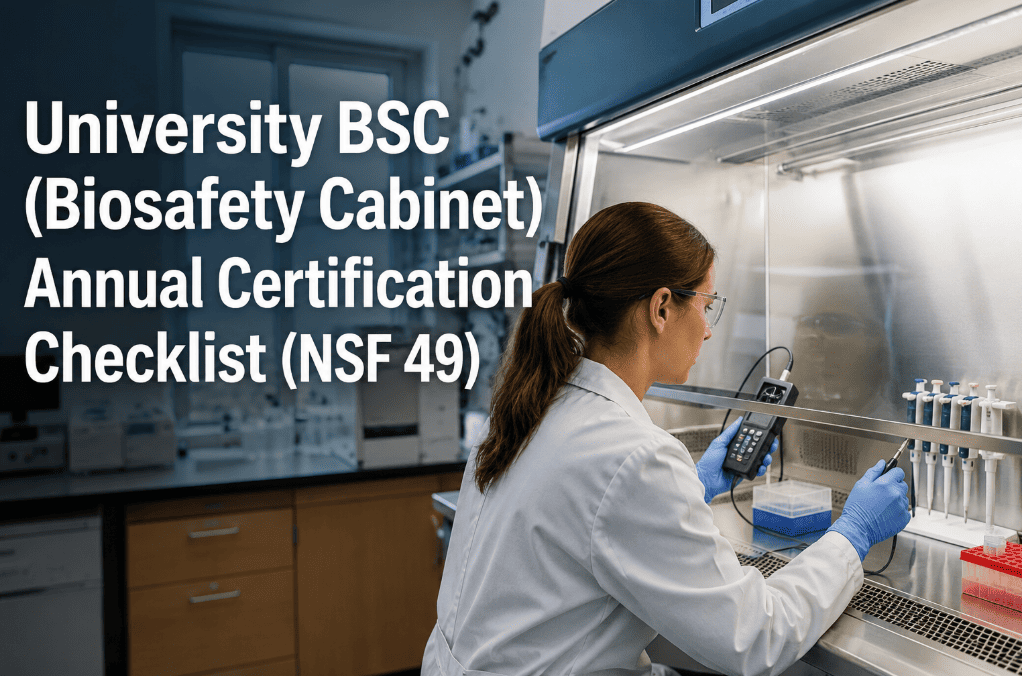
University BSC Annual Certification Checklist (NSF 49)
NSF/ANSI 49 requires annual certification of all Biosafety Cabinets (BSCs) by a qualified field certifier. HEPA filter integrity, airflow profile, and containment performance must all be tested and documented. A BSC with an expired certification is a research compliance failure that can halt laboratory operations. Campus facilities teams tracking large BSC inventories across multiple labs can start a free trial or book a demo to configure automatic annual certification reminders.
01
HEPA Filter Integrity (Leak Test)
Perform PAO (polyalphaolefin) or DOP aerosol HEPA leak test on supply and exhaust filters
Scan entire filter face, frame seals, and surrounding cabinet plenum for penetration above 0.01%
Document upstream challenge concentration and downstream penetration readings for each filter
Mark any failed areas and initiate filter replacement work order if leaks exceed NSF 49 limits
02
Airflow Profile and Velocity Testing
Measure inflow velocity at front access opening (Class II A2: minimum 0.38 m/s inflow)
Measure downflow velocity at 9-point grid across work surface (target: 0.25–0.30 m/s)
Verify inflow-to-downflow ratio provides proper containment without product contamination
Test airflow with smoke visualization to confirm no bypass or dead zones at work area
03
Containment and Personnel Protection
Perform KI (potassium iodide) Michaellis test or equivalent personnel protection factor test
Verify protection factor meets or exceeds NSF 49 minimum requirement for cabinet class
Check sash height at operating position and confirm it matches design specification
Inspect UV lamp (if equipped) — measure intensity and replace if below 40 µW/cm² at 1 meter
04
Electrical, Alarm, and Final Sign-Off
Verify blower motor amperage is within ±10% of rated specification at operating voltage
Test airflow alarm — confirm alert activates when airflow drops 10% below setpoint
Inspect cabinet interior for chemical damage, corrosion, and physical integrity of work surfaces
Affix NSF 49 certification label with certifier name, date, next due date, and all recorded values
Standard: NSF/ANSI 49 | Frequency: Annual (or after relocation, filter change, or service) | Documentation: Field certifier report linked to CMMS asset record | Regulatory Body: CDC BMBL, university IBC
Checklist 04 — ANSI Z358.1
Campus Laboratory Eyewash and Safety Shower Weekly Activation Checklist
ANSI Z358.1-2014 requires all plumbed eyewash stations and safety showers to be activated weekly to verify proper operation and flush stagnant water from supply lines. This is one of the most frequently missed compliance items on university campuses — and one of the easiest to close with CMMS-scheduled recurring work orders. Campus labs that have struggled with weekly compliance can start a free trial or book a demo to see automated weekly inspection scheduling.
EW
Eyewash Station — Activation and Flow
Activate eyewash by pushing the stay-open valve — water must flow within 1 second of activation
Allow water to flow for a minimum of 10 seconds to flush stagnant water from supply line
Verify dual-head pattern provides simultaneous flushing with gentle, non-injurious water flow
Confirm water temperature is tepid — between 60°F and 100°F (15.6°C–37.8°C) per ANSI Z358.1
Inspect dust covers — must be present, intact, and auto-remove upon activation without hands
Check for visible rust, debris, or discoloration in flushed water (flag for plumbing inspection if found)
SS
Safety Shower — Activation and Dispersion
Pull activation handle — verify shower activates within 1 second and valve stays open hands-free
Confirm flow rate meets ANSI Z358.1 minimum of 20 gallons per minute for safety shower coverage
Verify spray pattern covers 20-inch minimum diameter area at working level (60 inches above floor)
Allow 30-second flush to clear stagnant water and confirm water runs clear throughout
Inspect signage — ANSI-compliant sign must be visible from 50 feet with no obstructions in path
Confirm shower area is clear of stored equipment, boxes, or materials blocking the 16-inch clear zone
LG
CMMS Log Entry and Compliance Documentation
Record activation date, time, inspector name, and equipment ID in CMMS work order completion
Note any deficiencies observed — discolored water, low flow, stuck valve, damaged dust cover, missing signage
Create corrective maintenance work order for any deficiency with priority classification and EHS notification
If unit is out of service, apply "Out of Service" tag and notify lab supervisor and EHS immediately
Confirm next week's inspection is auto-scheduled in CMMS — no manual intervention required
Ensure annual plumbed eyewash full inspection (including supply line inspection) is on annual PM calendar
VF
Location and Accessibility Verification
Confirm eyewash is within 10 seconds travel distance from all chemical hazard work areas in the lab
Verify travel path is on the same level with no steps, obstacles, or doors requiring a key to pass through
Confirm unit height is appropriate for users — nozzles 33–45 inches above floor per ANSI Z358.1
Photograph unit location and path for annual compliance documentation submitted to EHS office
Standard: ANSI Z358.1-2014 | Frequency: Weekly activation, Annual full inspection | Documentation: CMMS completion record per unit | Regulatory Body: OSHA 29 CFR 1910.151, university EHS
Checklist 05 — ASME A17.1
Campus Elevator Monthly Operator Inspection Checklist (ASME A17.1)
ASME A17.1 Safety Code for Elevators and Escalators requires documented monthly operator inspections between annual state-mandated inspections. For universities with large elevator inventories across academic buildings, dormitories, and research facilities, a missed monthly inspection creates both compliance and safety liability. Campuses managing 20+ elevators across multiple buildings can start a free trial or book a demo to see multi-elevator PM tracking.
01
Door Operation and Safety Edges
Test door open and close cycle — doors must open and close smoothly without hesitation or reversal
Activate door safety edge — confirm door reverses immediately upon contact with obstacle
Verify light curtain or mechanical edge covers full height of door opening with no blind zones
Check door timing — doors must not close faster than 0.3 ft/sec kinetic energy limit per A17.1
02
Floor Leveling and Landing Accuracy
Check leveling accuracy at all landings — car floor must level within ±0.5 inch of landing floor
Note any floors where leveling tolerance is exceeded and log for service technician follow-up
Verify re-leveling function operates when door is open — critical for ADA compliance at all landings
Document any uneven landing conditions that create trip hazard or wheelchair access barrier
03
Emergency Communication System
Test two-way communication device — must connect to a live monitoring center within 60 seconds
Verify emergency phone or intercom is audible at both ends of the call at normal speech volume
Confirm monitoring center can identify building, elevator number, and car location during test call
Check battery backup for communication device — must maintain 4 hours of operation during power outage
04
Interior Lighting, Signage, and Certificate
Verify car interior lighting — minimum 5 foot-candles at floor level per ASME A17.1 requirements
Test emergency lighting — must illuminate automatically on power failure and maintain 10 ft-candles for 4 hours
Confirm current state operating certificate is posted in car and expiration date is not within 60 days
Inspect capacity placard, floor indicator, direction indicators, and control buttons for proper operation
Standard: ASME A17.1/CSA B44 | Frequency: Monthly operator inspection | Documentation: CMMS work order with car ID, inspector, and date | Regulatory Body: State elevator inspection authority, ADA
Checklist 06 — NFPA 110
University Generator Weekly Run Test Checklist (NFPA 110)
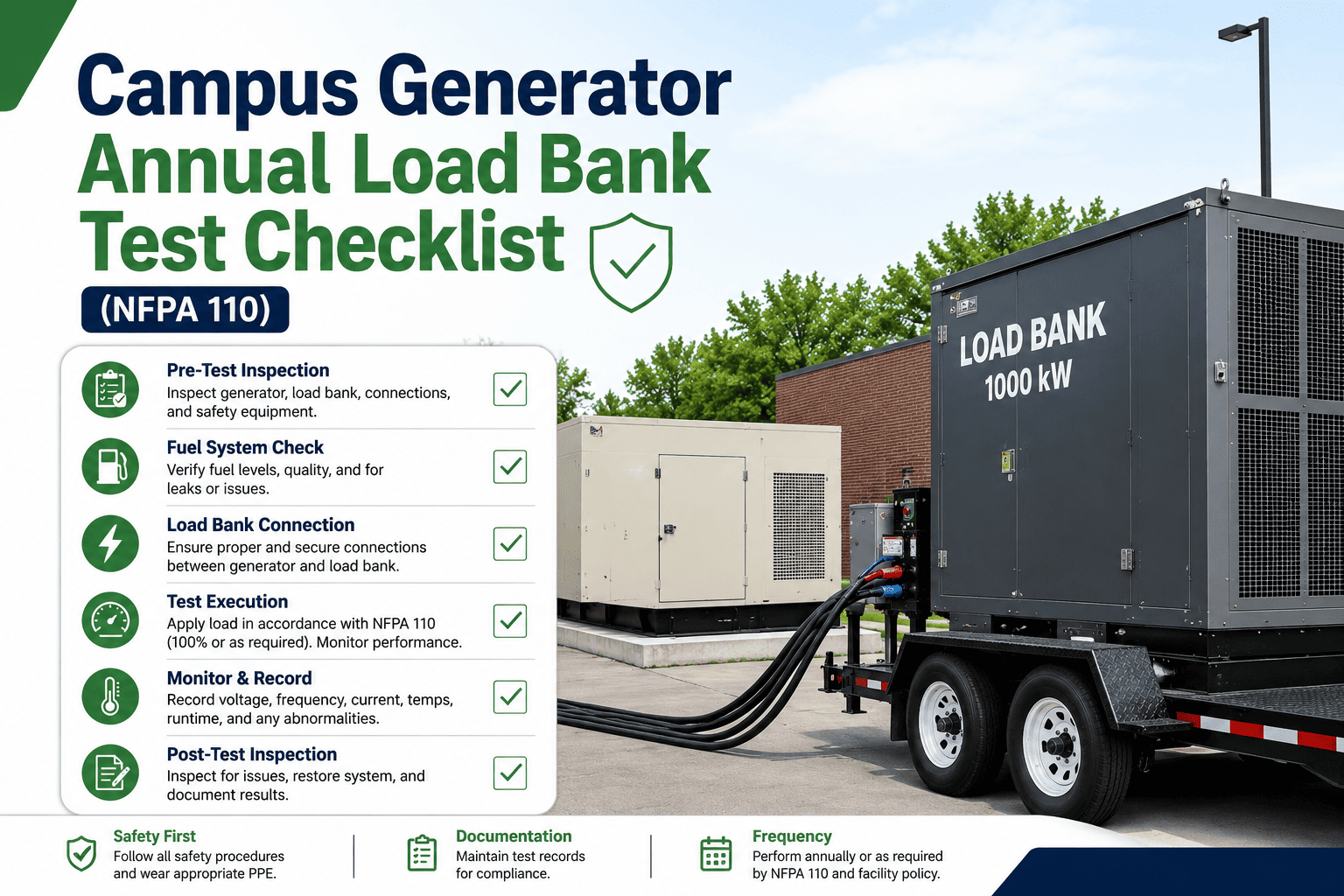
NFPA 110-2022 Standard for Emergency and Standby Power Systems requires weekly generator testing for Level 1 and Level 2 systems — including voltage, frequency, and fuel verification. ATS transfer switch operation must also be verified. Universities with data centers, research freezers, and life safety systems dependent on emergency power cannot afford a generator that fails at power outage. Campuses ready to automate NFPA 110 compliance can start a free trial or book a demo to configure NFPA 110 weekly run test workflows.
Pre-Start Checks
Check engine oil level — verify it is at or above minimum operating level on dipstick
Check coolant level in overflow reservoir and radiator — confirm within operating range
Inspect fuel tank level — diesel generators require minimum 75% fuel level for NFPA 110 compliance
Check battery electrolyte level and terminal connections — verify no corrosion on starting battery
Inspect for fluid leaks (oil, coolant, fuel) around engine, radiator hoses, and fuel lines
Confirm generator room ventilation is clear and exhaust system is unobstructed
Run Test — Electrical Verification
Start generator and record starting time — generator must reach operating voltage within 10 seconds (NFPA 110 Level 1)
Record output voltage on all phases — verify within ±2% of rated voltage (e.g., 480V ±10V)
Record output frequency — verify within ±2 Hz of rated 60 Hz (58–62 Hz acceptable range)
Allow generator to run for minimum 30 minutes under load (or 30 minutes no-load per NFPA 110 Table 8.4.1)
Record oil pressure and coolant temperature at steady-state — confirm within engine manufacturer limits
Verify battery charger is operating — confirm float charge voltage on charger display or panel meter
ATS Transfer Switch Verification
Confirm ATS transfer delay timer is set per NFPA 110 requirements (typically 10–15 second delay)
Verify ATS indicates "Emergency" or "Generator" position during run test — confirm load transferred
Check ATS retransfer delay — confirm utility power monitoring and retransfer settings are correct
Inspect ATS enclosure for overheating, burning smell, or any visible damage to contacts or wiring
Exception Items and CMMS Documentation
Record all readings in CMMS work order — voltage, frequency, oil pressure, coolant temp, fuel level
Log any fault codes, alarm activations, or unusual noises with description and timestamp
Create priority work order for any reading outside acceptable range — escalate to generator service if needed
Confirm 30-minute monthly load bank test (NFPA 110 8.4.2) is scheduled — cannot be substituted by weekly no-load test
Standard: NFPA 110-2022 | Frequency: Weekly (run test), Monthly (load test), Annual (full load test) | Documentation: CMMS work order with all recorded values | Regulatory Body: AHJ, state fire marshal, accreditation bodies
How Oxmaint Helps
How Oxmaint Manages Campus Compliance Inspections Across All Six Systems
Manual scheduling fails. Spreadsheets miss deadlines. Paper logs disappear. Oxmaint gives every regulated campus system its own asset record, automatic inspection schedule, digital checklist, and audit-ready completion history — so no inspection falls through the gap. Campus teams ready to eliminate compliance gaps can start a free trial or book a demo.
Asset Registry
Every Regulated System as a CMMS Asset
Each cooling tower, fume hood, BSC, eyewash station, elevator, and generator is individually registered with its own asset record, building location, and regulatory standard — linked to its PM schedule.
Auto-Triggers
Weekly, Monthly, and Annual PM Scheduling
NFPA 110 weekly run tests, ANSI Z358.1 weekly eyewash activations, and ASHRAE 188 monthly cooling tower inspections are all automatically generated — no manual scheduling required.
Digital Checklists
Regulation-Specific Checklist Items with Pass/Fail Recording
Technicians complete checklists on mobile — entering actual readings for voltage, face velocity, pH levels, and flow rates. Pass/fail status is logged automatically with timestamp and signature.
Corrective Actions
Deficiency to Work Order in One Step
Any failed checklist item automatically generates a corrective maintenance work order with priority classification, assigned technician, and EHS notification — closing the gap between deficiency and resolution.
Audit Documentation
Inspection History Exportable for Regulatory Review
Every completed inspection record — with technician name, date, readings, and corrective actions — is stored in the CMMS asset history and exportable as a PDF report for state inspectors, accreditation reviewers, and EHS audits.
Portfolio View
Compliance Status Across Every Building at Once
Directors of facilities can see overdue inspections, upcoming compliance deadlines, and open corrective work orders across every building on campus — from one dashboard, without calling individual building managers.
Before vs After
Paper-Based Inspection Tracking vs. Oxmaint Digital Compliance
Without Digital CMMS
Weekly eyewash tests missed because no one remembered to schedule them
Cooling tower biocide log maintained in a binder that EHS cannot access remotely
BSC certifications expire because no one tracked next-due dates centrally
Generator run test readings recorded on paper — data unavailable for trend analysis
Elevator certificate expiration discovered during state inspection visit
Deficiencies noted on paper checklists — corrective work orders never created
No portfolio-level visibility into which buildings have overdue inspections
Audit preparation requires days of binder searching and document assembly
With Oxmaint Campus Compliance PM
Weekly eyewash work orders auto-generated every Monday — zero missed activations
Cooling tower biocide log entries recorded in CMMS — accessible by EHS in real time
BSC certification due dates visible 60 days in advance with automatic PM trigger
Generator readings logged digitally — voltage trend visible across 52 weeks
Elevator certificate expiration tracked with 90-day advance alert to facilities director
Failed checklist item creates corrective work order automatically — nothing falls through
Portfolio dashboard shows compliance status across every building in one view
Audit report exported as PDF in minutes — complete inspection history with signatures
Results
Campus Compliance Outcomes with Oxmaint
100%
Inspection Completion Rate
Auto-triggered PM schedules eliminate missed weekly, monthly, and annual inspections across all regulated systems
89%
Reduction in Audit Prep Time
Digital records with technician signatures replace days of binder searching with a single PDF export
$2.4M
Average Legionella Outbreak Cost Avoided
Consistent ASHRAE 188 monthly inspections and documented biocide logs are the primary prevention layer
Zero
Compliance Gaps at State Inspections
Campuses using Oxmaint arrive at every elevator, generator, and life safety inspection with a complete, exportable compliance record
FAQ
Frequently Asked Questions
Does ASHRAE 188 require monthly cooling tower inspections for all university buildings?+
ASHRAE Standard 188-2018 requires a documented Water Management Plan (WMP) for any building cooling tower and mandates that the WMP include regular inspection and monitoring frequencies. Monthly inspections are the industry-accepted minimum for active cooling towers, covering water chemistry, biocide dosing, drift eliminator condition, fill inspection, and Legionella sampling per the WMP sampling protocol. Many state health departments have adopted ASHRAE 188 as the regulatory standard — and several have mandated it explicitly for universities, hospitals, and hotels. The WMP must also include a Legionella risk assessment, action levels for positive cultures, and an annual WMP review signed by a responsible authority. Oxmaint tracks each cooling tower as a separately scheduled asset with monthly inspection work orders auto-generated and Legionella sample results logged to the asset record.
What happens if a campus fume hood fails its ANSI Z9.5 annual performance verification?+
A fume hood that fails its ANSI Z9.5 annual performance verification — meaning face velocity is below 80 fpm, the alarm does not activate, or the smoke test shows containment failure — must be immediately taken out of service and tagged with a visible "Do Not Use" notice. The laboratory PI (Principal Investigator) must be notified, and no chemical work may occur at that hood until corrective action is completed and a passing retest is documented. Common corrective actions include VAV controller recalibration, exhaust fan belt replacement, supply air rebalancing, or sash mechanism repair. Oxmaint automatically creates a corrective work order when a technician logs a failed checklist item during the annual verification — with the hood's asset record, building location, and laboratory contact pre-populated so the response begins immediately.
How often do biosafety cabinets need to be certified under NSF 49, and who can perform the certification?+
NSF/ANSI 49 requires annual certification of all Class II biosafety cabinets, plus recertification after any relocation, HEPA filter replacement, internal repair, or any event that could compromise containment. Certification must be performed by a qualified field certifier — typically a Biological Safety Cabinet Certifier (BSCC) certified by the National Board of Public Health Examiners (NBPHE) or an equivalent qualified technician. The certification includes HEPA filter leak testing, airflow profile measurement, downflow and inflow velocity verification, and personnel/product protection testing. The certifier must provide a written test report with all measured values, which must be retained and linked to the BSC's CMMS asset record. Universities that allow internal staff to perform annual BSC certification without the NSF 49 required qualifications are creating a research biosafety compliance gap.
What does NFPA 110 require for university generator testing beyond the weekly run test?+
NFPA 110-2022 requires a layered testing program beyond weekly run tests. Monthly tests must include a minimum 30-minute load test at 30% or greater of nameplate rating (or per AHJ requirements). Annual tests for Level 1 systems (life safety loads) require a minimum 2-hour test at 75–100% of nameplate kW load or a 4-hour load bank test with specific load step requirements. All tests must be documented with actual measured values — voltage, frequency, oil pressure, coolant temperature, and load — retained in the CMMS for the equipment's operational life. Failure to conduct or document the annual load test is one of the most common NFPA 110 violations found during Joint Commission and state fire marshal reviews of university healthcare and research facilities. Oxmaint schedules all three test tiers — weekly, monthly, and annual — as separately triggered PM events with appropriate checklist fields for each required data point.
Stop Managing Campus Compliance on Paper. Start Managing It on Oxmaint.
Six regulated systems. Six inspection standards. Hundreds of individual units across dozens of buildings. Oxmaint gives your campus facilities team automatic scheduling, digital checklists, corrective work order creation, and audit-ready documentation — for every cooling tower, fume hood, BSC, eyewash station, elevator, and generator on campus. Ready to eliminate compliance gaps for good?