A biosafety cabinet that has passed visual inspection but has never had its HEPA filters leak-tested, its airflow profile verified, or its sash alarm confirmed is not a containment device — it is a ventilated enclosure that provides the appearance of protection without the substance. In university research laboratories, BSC failure does not just create a regulatory finding; it creates an exposure event for researchers working with BSL-2 and BSL-3 agents, a potential loss of valuable biological cultures, and an insurance liability that can follow the institution for years. This checklist gives your EHS, facilities, and laboratory compliance teams a complete NSF 49 certification framework covering HEPA integrity, airflow profile, inflow velocity, UV lamp output, alarm systems, and audit documentation — structured so every verification is traceable in your OxMaint compliance tracking platform with timestamped records that prove your biosafety cabinets are certified, not just tagged, when a biosafety officer, accreditation auditor, or insurance inspector arrives.
University Labs · Safety & Compliance · Biosafety
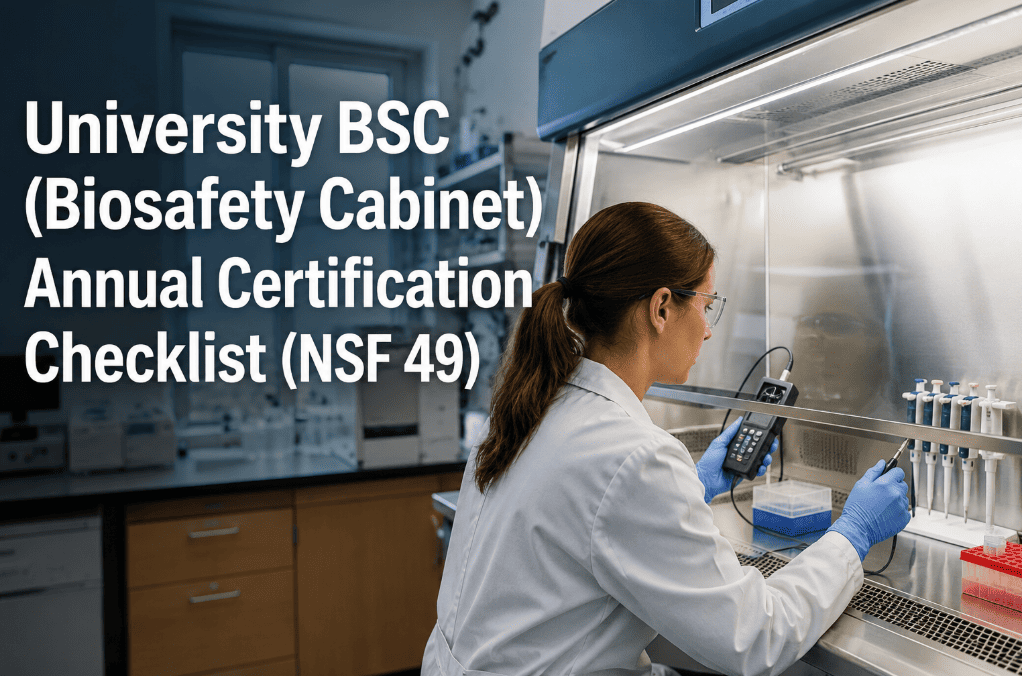
University BSC (Biosafety Cabinet) Annual Certification Checklist (NSF 49)
A system-by-system BSC certification framework covering HEPA leak testing, airflow profile verification, inflow velocity, UV lamp output, alarm function, and compliance documentation — built for university labs where a missed certification creates a personnel exposure risk and an accreditation finding.
7
Certification Categories
50+
Check Points
100%
Compliance Target
P1
Safety Priority
High-Risk BSC Failure Scenarios in a University Lab
HEPA Filter Failure
Undetected pinhole leaks expose researchers to aerosolized biological agents
Airflow Reversal
Insufficient inflow velocity allows aerosol escape into the laboratory environment
UV Lamp Degradation
Lamps below 40 µW/cm² provide false decontamination confidence between experiments
Alarm System Fault
Undetected sash height or airflow alarms leave users unwarned of containment breach
Exhaust Duct Blockage
Restricted exhaust increases positive pressure risk in the cabinet work zone
Expired Certification
Lapsed NSF 49 certification invalidates insurance coverage and accreditation status
DDaily
WWeekly
MMonthly
QQuarterly
AAnnual
Category 01
Pre-Certification Cabinet Condition Assessment
A certifier who arrives at a cabinet with a cracked sash, a disconnected blower, or an unclean work surface cannot perform a valid NSF 49 certification — and a certification performed on an uncleaned or physically compromised cabinet is meaningless. Pre-certification condition assessment by the lab team ensures that every certification visit produces a valid, defensible result rather than a deferred or conditional certificate.
Cabinet work surface, interior walls, and drain pan cleaned and decontaminated with approved disinfectant — certifier cannot begin testing on a surface with biological residue; decontamination record signed by lab supervisor before certifier arrival
ALab Supervisor · Pre-certification decontamination log
Sash glass inspected for cracks, chips, or delamination — a cracked sash compromises the aerosol containment barrier and must be replaced before certification; sash seal condition verified against frame perimeter for gaps or deterioration
AEHS Officer · Cabinet pre-inspection record
Blower motor and belt condition checked — belt-driven cabinets inspected for belt tension and wear; direct-drive cabinets confirmed free of bearing noise; a blower operating below rated RPM will fail airflow testing and must be serviced before the certifier arrives
AFacilities Technician · Blower pre-check log
Cabinet location verified — no obstructions within 300 mm of front grille; cabinet not positioned near HVAC supply diffusers, doors, or high-traffic corridors that create cross-drafts exceeding 0.1 m/s at the sash face and invalidate inflow velocity measurements
AEHS Officer · Cabinet placement verification record
Cabinet model, serial number, BSL classification, and last certification date confirmed against EHS asset register — any discrepancy between the tag on the cabinet and the asset record resolved before certification proceeds; unresolved discrepancies are flagged as a compliance finding
AEHS Officer · Asset register reconciliation log
Category 02
HEPA Filter Integrity — Leak Testing
A HEPA filter rated at 99.97% efficiency against 0.3-micron particles is the single most critical containment component in a biosafety cabinet. A pinhole leak in the filter media, a poorly seated filter frame, or a cracked gel seal allows aerosolized biological material to pass directly into the exhaust airstream or back into the laboratory. NSF 49 requires HEPA leak testing with a photometric aerosol photometer — visual inspection alone is not a substitute and does not satisfy the certification standard.
Upstream aerosol challenge concentration confirmed — PAO (poly-alpha olefin) or equivalent challenge aerosol generated upstream of HEPA filter at concentration sufficient to produce photometer reading of 10–20 µg/L for meaningful leak detection sensitivity at the downstream scan probe
ACertified BSC Certifier · HEPA leak test data sheet
Downstream scan of entire HEPA filter face performed — photometer probe moved at 25 mm/sec across entire filter surface, frame perimeter, and all mounting gaskets; any reading exceeding 0.01% of upstream concentration constitutes a leak requiring filter replacement or resealing before cabinet is returned to use
ACertified BSC Certifier · HEPA scan map with leak locations
Supply HEPA and exhaust HEPA tested independently — Class II Type A2 cabinets have both supply and exhaust HEPA filters; both must pass leak testing; failure of either filter disqualifies the cabinet from use regardless of the other filter's result and requires immediate out-of-service tagging
ACertified BSC Certifier · Dual HEPA test certificate
Filter pressure differential recorded and compared to baseline — supply HEPA differential pressure logged; a reading more than 25% above the clean-filter baseline indicates filter loading and impending airflow reduction; filter replacement scheduled before the next quarter if approaching the manufacturer's replacement threshold
ACertified BSC Certifier · Filter differential pressure log
NSF 49 certifiers don't reschedule — and neither do accreditation auditors. OxMaint tracks every BSC certification due date, captures certifier report uploads, and sends automated reminders 60 days before expiry — giving your EHS team complete, audit-ready biosafety cabinet records on demand.
Category 03
Airflow Profile & Inflow Velocity Verification
An inflow velocity of 0.38 m/s at the sash face is the NSF 49 minimum that prevents aerosol escape from the work zone into the laboratory. A cabinet whose blower has drifted, whose HEPA has loaded, or whose exhaust connection has partially restricted will register below this threshold — and without annual measurement, no one knows. Airflow velocity testing is the measurement that stands between a functional containment device and an undetected exposure source at the research bench.
Inflow velocity measured at sash opening with calibrated velometer — minimum 9-point grid measurement across the full sash width at the certified working height; all individual readings must meet NSF 49 minimum of 0.38 m/s; average calculated and recorded against the cabinet's baseline history
ACertified BSC Certifier · Inflow velocity data grid
Downflow velocity profile measured across work surface — velocity measured at minimum 9 grid points 150 mm above the work surface; average downflow velocity confirmed within NSF 49 nominal range for cabinet class; asymmetric profiles indicate blower or plenum obstruction requiring investigation
ACertified BSC Certifier · Downflow velocity profile map
KI discus smoke pattern test performed — potassium iodide smoke used to visually verify that smoke introduced at the sash edge is captured inward and does not escape into the room; smoke escaping at any point of the sash perimeter constitutes a containment failure requiring immediate cabinet removal from service
ACertified BSC Certifier · Smoke test observation record
Downflow-to-inflow ratio calculated and confirmed — ratio must fall within manufacturer's specification for cabinet class; a ratio outside specification indicates blower speed adjustment or plenum clearing is required before the cabinet is returned to biological work
ACertified BSC Certifier · Airflow ratio calculation sheet
Sash height at which airflow measurements were taken recorded — all NSF 49 airflow measurements must be taken at the certified sash height marked on the cabinet; measurements at non-standard sash heights do not constitute valid certification data and are rejected by accreditation inspectors
ACertified BSC Certifier · Sash height certification record
Category 04
UV Lamp Output & Electrical Safety
A UV lamp that has been in service for 18 months without output measurement may be producing less than half its rated germicidal irradiance — while its pilot light still illuminates and users assume full decontamination is occurring between experiments. UV output measurement is the only verification that determines whether surface decontamination is achieving the intended log reduction, or merely providing the appearance of it while biological contamination accumulates on work surfaces.
UV lamp output measured with calibrated 254 nm radiometer — reading taken at the work surface centre after 5-minute warm-up; minimum acceptable output is 40 µW/cm² at 1 metre; lamps below threshold replaced immediately regardless of hours in service or visual appearance of the lamp tube
ACertified BSC Certifier · UV output measurement record
UV lamp hours of service logged — lamp replacement recommended at manufacturer's rated life (typically 7,500–9,000 hours); cumulative hours tracked in CMMS asset record; labs instructed that UV lamp age alone is not a substitute for radiometric output measurement at the work surface
MLab Supervisor · UV lamp hours log in CMMS
Cabinet electrical supply voltage verified — supply voltage measured at cabinet terminal and confirmed within ±5% of nameplate voltage; low voltage causes blower speed reduction that directly reduces inflow velocity below NSF 49 minimum without triggering any visible alert to the user
ACertified BSC Certifier · Electrical supply measurement record
Ground fault and cabinet grounding continuity verified — cabinet chassis bonded to earth ground; GFCI outlet function tested with test button; ungrounded cabinet in a wet lab environment constitutes an electrical safety violation that is independently enforceable regardless of biosafety compliance status
ACertified BSC Certifier · Electrical safety verification log
Category 05
Alarm Systems & Interlock Verification
A sash alarm that does not activate when the sash is raised above the certified working height, or an airflow alarm that does not trigger when velocity drops below the containment threshold, means that the most dangerous cabinet conditions — those most likely to cause a researcher exposure — are the exact conditions that go unannounced. Alarm verification at the sensor level, not just at the indicator panel, is the only test that validates the complete warning chain from sensor to audible output.
Sash height alarm tested — sash raised to 25 mm above certified working height; audible and visual alarm must activate within 5 seconds; alarm that fails to trigger within specification requires sensor recalibration before cabinet is returned to service with any biological agent
ACertified BSC Certifier · Sash alarm test record
Airflow alarm tested by simulated blower speed reduction — cabinet airflow monitor confirmed to trigger audible alarm when inflow velocity drops to 10% below NSF 49 minimum; alarm setpoint verified against manufacturer calibration data and adjusted if drift exceeds 5% of setpoint
ACertified BSC Certifier · Airflow alarm test record
Blower-UV lamp interlock verified — in cabinets with UV-blower interlock, confirmed that UV lamp cannot be energized while blower is off; UV lamp operating in a static cabinet recirculates ozone without exhaust and creates an inhalation hazard for the next person who opens the sash
ACertified BSC Certifier · Interlock function test record
Fluorescent work light output verified — illuminance measured at the work surface centre with a calibrated lux meter; minimum 650 lux required at the working plane for NSF 49 compliance; lamps below threshold replaced at the certification visit before the cabinet is recertified
ACertified BSC Certifier · Illuminance measurement record
Category 06
Exhaust Connection & Room Pressure Verification
A Type B2 cabinet that is hard-ducted to the building exhaust system depends entirely on the building exhaust fan remaining operational and the duct connection remaining airtight. A duct that has partially disconnected, an exhaust fan running at reduced speed due to belt wear, or a room that has shifted from negative to positive pressure relative to the corridor changes the containment behaviour of the cabinet fundamentally — and none of this is visible to the researcher working at the bench without periodic measurement.
Exhaust duct connection inspected for leakage — duct collar, flexible connector, and first rigid duct section inspected for gaps, disconnected clamps, or visible separation; any leak at an exhaust connection allows volatile chemical vapours and biological aerosols to enter the ceiling plenum unchecked
AFacilities Engineer · Exhaust duct inspection record
Exhaust flow rate measured at the duct and confirmed against design specification — exhaust airflow below design reduces the cabinet's ability to maintain the required inflow-to-downflow ratio; exhaust airflow more than 10% below design triggers a building HVAC investigation before the cabinet is returned to service
ACertified BSC Certifier · Exhaust flow measurement record
Laboratory room pressure differential measured relative to adjacent corridor — BSL-2 labs must maintain minimum −2.5 Pa negative pressure relative to the corridor; positive room pressure means aerosols released from the cabinet can migrate to adjacent spaces upon door opening during an exposure event
MFacilities Engineer · Room pressure differential log
Building exhaust fan operation confirmed before certification test begins — certifier verifies exhaust fan is running at design speed before any airflow tests commence; certification conducted with the exhaust fan off produces invalid results for any ducted cabinet type and must be repeated
ACertified BSC Certifier · Exhaust fan status confirmation record
Category 07
Certification Documentation & Compliance Records
A biosafety cabinet that passed every NSF 49 test but for which no signed certification report exists, no asset record was updated, and no next-due date was entered into the CMMS is a cabinet that cannot be defended to an accreditation body, an insurance surveyor, or a CDC/USDA inspection team. Documentation is not the administrative burden that follows certification — it is the evidence that makes certification real and defensible under regulatory scrutiny.
NSF 49 certification report signed by accredited certifier and filed — report must include cabinet model, serial number, all measured airflow values, HEPA leak test data, UV output reading, alarm test results, and the certifier's NSF/ANSI 49 accreditation number; unsigned or incomplete reports are not valid certification documents
AEHS Officer · NSF 49 certification report file
Certification label affixed to cabinet with test date, next due date, certifier name, and pass/fail status — label placed on the cabinet exterior where it is visible to users without opening the sash; any cabinet without a current label must be taken out of service pending recertification regardless of operational urgency
ACertified BSC Certifier · Cabinet label placement verified
EHS asset register updated with certification date, next due date, certifier agency, and any corrective actions required — CMMS work order generated for any deficiency identified during certification; no cabinet returned to BSL-2 or BSL-3 use with open corrective actions regardless of research schedule pressure
AEHS Officer · CMMS asset record update confirmation
Certification renewal reminder set in CMMS 60 days before expiry — certifier scheduling lead time of 4–6 weeks means a 60-day reminder is the minimum buffer to avoid a lapsed certification; reminder assigned to EHS officer with automatic escalation if not acknowledged within 7 days of the alert
AEHS Officer · CMMS reminder configuration record
Lab user training records confirmed current — all personnel using the BSC confirmed to have completed BSC operation and biosafety training within the past 12 months; training records linked to the cabinet's asset record in CMMS for unified audit evidence during IBC or accreditation review
AEHS Officer · Training completion record cross-reference
Compliance KPIs
Six Metrics That Prove Your BSC Programme Is Certified and Current
| Metric |
How to Measure |
Target |
Frequency |
| BSC Certification Currency |
Cabinets with valid NSF 49 cert / Total installed cabinets |
100% |
Monthly |
| HEPA Leak Test Pass Rate |
Cabinets passing HEPA scan / Total cabinets tested |
100% or immediate replacement |
Annual |
| Inflow Velocity Compliance |
Cabinets meeting ≥0.38 m/s inflow / Total tested |
100% |
Annual |
| UV Lamp Output Compliance |
Lamps measuring ≥40 µW/cm² / Total lamps tested |
100% |
Annual |
| Days to Certification Expiry |
Minimum days remaining on any active certification |
Minimum 60-day buffer |
Monthly |
| Corrective Action Closure Rate |
Closed CAs / Total CAs raised at certification |
100% before cabinet reuse |
Weekly post-certification |
FAQs
Frequently Asked Questions
What standard governs biosafety cabinet certification in the United States?
NSF/ANSI 49 — Biosafety Cabinetry: Design, Construction, Performance, and Field Certification — is the governing standard for BSC design and field certification in the United States. It specifies the performance requirements for all Class II cabinet types (A1, A2, B1, B2) including inflow velocity, downflow velocity, HEPA leak test methodology, UV lamp output, and alarm performance. The CDC/NIH Biosafety in Microbiological and Biomedical Laboratories (BMBL) 6th edition references NSF 49 certification as the required basis for cabinets used with infectious agents. OxMaint tracks NSF 49 certification due dates and certifier report uploads automatically across your full BSC inventory.
How often must a university biosafety cabinet be certified?
NSF 49 and BMBL both require annual field certification of biosafety cabinets used with biological agents. Additional certification is required after any event that could compromise cabinet integrity: relocation, repair of the blower or HEPA system, filter replacement, significant impact to the cabinet, building exhaust system modification, or a lapse in certification of more than 12 months. Some institutional biosafety committees require semi-annual certification for cabinets used with BSL-3 agents. See how OxMaint tracks relocation events and triggers recertification work orders automatically.
What is the difference between a Class II Type A2 and a Type B2 biosafety cabinet?
A Class II Type A2 cabinet recirculates 70% of the cabinet air back through the supply HEPA to the work surface and exhausts 30% through the exhaust HEPA — either to the room or through a canopy connection to the building exhaust. Type A2 cabinets are suitable for work with biological agents at BSL-1 through BSL-3 but are not suitable for work with volatile hazardous chemicals because recirculated vapours accumulate in the cabinet. A Class II Type B2 cabinet exhausts 100% of cabinet air through a HEPA filter to the building exhaust system with no recirculation — making it the correct choice when biological work involves small quantities of hazardous chemicals or radionuclides. The building exhaust system must be engineered specifically for B2 cabinet connection.
Can a lab use a biosafety cabinet after its certification has lapsed by a few weeks?
No. A lapsed certification means the cabinet has no verified performance data current to the NSF 49 standard. Institutional biosafety committees, accreditation bodies such as AAALAC and ABET, and federal granting agencies including NIH treat a lapsed certification as equivalent to an uncertified cabinet. Use of a lapsed cabinet for work with biological agents may constitute a protocol deviation reportable to the Institutional Biosafety Committee (IBC), and insurance coverage for any exposure event during the lapse period may be contested. The cabinet must be taken out of service until recertification is complete. OxMaint automates 60-day advance reminders to prevent certification lapses across your entire BSC inventory.
What qualifications must a BSC certifier hold?
NSF 49 field certification must be performed by a certifier who has demonstrated competency in NSF 49 testing procedures. The NSF International Biosafety Cabinet Certifier Accreditation Programme and the American Biological Safety Association (ABSA) both offer recognised certification pathways. Universities should verify that their certifier holds current accreditation, carries calibration certificates for all test instruments (velometer, photometer, radiometer, lux meter), and provides a signed certification report that includes the certifier's accreditation number — a report without this information is not a valid NSF 49 certification document and will be rejected during an IBC or accreditation review.
Digitize BSC Certification Compliance
Every Cabinet Certified. Every HEPA Verified. Every Audit Record Ready.
OxMaint converts your BSC certification programme into scheduled work orders with certifier report uploads, HEPA test data capture, UV lamp hour tracking, and one-click compliance reports — so the next IBC audit or accreditation inspection is a formality, not an exposure.