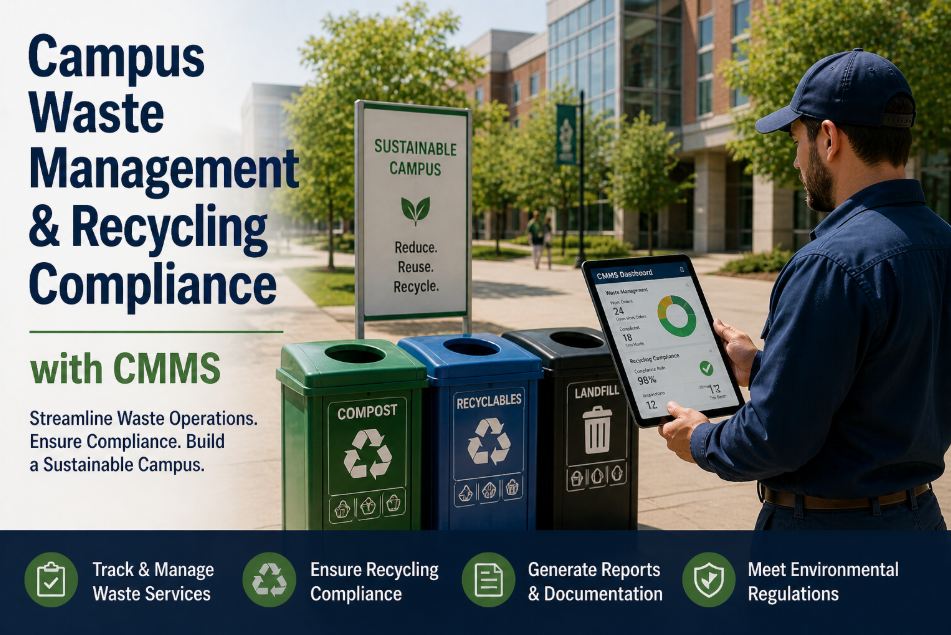
An EPA Region 3 compliance officer showed up at a 15,000-student university with a documented complaint about hazardous waste handling in the chemistry building. The facilities director spent the next four hours trying to assemble records from three different spreadsheets, a paper log in the chemistry stockroom, and a binder that had been maintained by a contractor who left eight months earlier. The inspection found three open violations: a satellite accumulation area without documented weekly inspections, a flammable waste container that had exceeded 55-gallon accumulation limits, and a manifest log with a 90-day gap that could not be explained. The civil penalty assessment: $28,500. None of it was the result of actual improper waste handling — the waste was being managed responsibly. The violations were entirely documentation failures. If your campus tracks waste compliance on spreadsheets and paper logs, start a free trial with Oxmaint or book a demo before your next surprise inspection.
Campus Waste Compliance — The Regulatory Exposure That Documentation Failures Create
EPA and State Waste Audits Catch Documentation Gaps, Not Just Handling Failures — Penalties Apply to Missing Records as Harshly as to Actual Violations
$70K
Maximum EPA civil penalty per violation per day
RCRA Section 3008 — per-day, per-violation enforcement for large quantity generators; small campuses under SQG rules face $37,500/day/violation
90 days
Maximum accumulation time for LQG hazardous waste
Large Quantity Generator rule — failure to remove accumulated waste within 90 days triggers automatic violation regardless of actual disposal timeline
Weekly
Required satellite accumulation area inspection frequency
RCRA requires documented weekly inspections of all SAAs — missing inspection records are the most common documentation violation found in campus audits
3 years
Minimum hazardous waste manifest retention period
EPA and most state equivalents — manifests, inspection logs, and training records must be retrievable on demand during any compliance inspection
The Four Campus Waste Compliance Programs That Need Documented Maintenance
Waste compliance on a university campus covers more ground than most facilities teams realize. The chemistry department's hazardous waste is the most regulated — but compactor PM schedules, universal waste recycling station inspections, and regulated medical waste from health services all carry their own documentation requirements. Missing records in any program creates audit exposure. To see how Oxmaint consolidates all four programs, book a demo or start a free trial.
01
Hazardous Waste (RCRA) Program
Chemistry, biology, and art departments generate hazardous waste regulated under RCRA. Programs require: weekly satellite accumulation area inspections, documented container labeling and dating, 90-day accumulation limit tracking, manifest logs for each off-site shipment, and annual training records for all waste handlers. Documentation failures in any element are cited independently.
Weekly inspections + 90-day accumulation tracking
02
Compactor and Dumpster Maintenance Program
Campus compactors require documented preventive maintenance — hydraulic fluid checks, cylinder seals, ram lubrication, safety interlock testing, and enclosure condition. Compactors with hydraulic leaks create spill response obligations and municipal stormwater violations. Scheduled PM with documented completion is both an equipment reliability and regulatory compliance requirement.
Quarterly PM + stormwater compliance documentation
03
Recycling Station Inspection and Contamination Control
Campus recycling programs are subject to municipal recycling ordinances and often tied to sustainability reporting commitments. Contaminated recycling streams result in material rejection fees and sustainability metric failures. Documented weekly recycling station inspections — checking container condition, overflow status, contamination levels, and signage — support both compliance and diversion rate accuracy.
Weekly station inspections + diversion rate documentation
04
Universal Waste and E-Waste Handling
Fluorescent lamps, batteries, and electronic waste handled under universal waste rules require documented accumulation start dates, container labeling, and one-year maximum accumulation tracking. Health services and research facilities may also generate regulated medical waste under state biomedical waste programs — requiring container inspections, manifest tracking, and contracted hauler documentation.
One-year accumulation limit + hauler documentation
Built for Campus Waste Compliance Reality
Every Inspection Logged. Every Accumulation Deadline Tracked. Every Manifest On-Demand.
Oxmaint auto-schedules every inspection across all waste programs — RCRA weekly SAA inspections, compactor quarterly PM, recycling station rounds, universal waste checks — with digital documentation that exports as a complete compliance package in minutes when an inspector arrives.
How Oxmaint Manages Campus Waste and Recycling Compliance
01
Waste Area and Equipment Asset Registry
Every satellite accumulation area, compactor, recycling station, universal waste collection point, and regulated waste storage location registered as an asset with its regulatory classification, applicable inspection frequency, and accumulation limits. Compliance status visible across all campus locations at a glance — not buried in a spreadsheet tab nobody checks.
Full waste program asset visibility on one dashboard
02
Auto-Scheduled Inspection Programs
RCRA weekly SAA inspections, compactor monthly safety checks, compactor quarterly PM, recycling station weekly rounds, and universal waste accumulation date reviews all auto-scheduled. Technicians receive mobile assignments with the correct checklist for the specific waste area type — no generic inspection forms that miss required documentation elements.
Zero missed inspection cycles from scheduling gaps
03
Hazardous Waste Accumulation Countdown
Every hazardous waste container logged with accumulation start date. Oxmaint tracks days elapsed against the applicable limit (90 days for LQG, 270 days for SQG). Alerts fire at 75 days and 85 days — giving the environmental health and safety team two warning windows before the limit. The satellite accumulation area that exceeded limits and triggered the $28,500 penalty above never exceeds 55 gallons undetected.
90-day and 55-gallon accumulation limits tracked automatically
04
Compactor PM and Stormwater Protection
Compactor PM work orders include hydraulic system inspection, seal condition, spill containment integrity, and stormwater drain protection verification. Any hydraulic leak flagged as a spill incident — triggering an immediate corrective action work order and documenting the response for stormwater permit compliance. Compactor PM history is the first record requested in a municipal stormwater inspection.
Compactor maintenance and spill response integrated in one record
05
Waste Handler Training Record Tracking
RCRA requires annual training records for all personnel involved in hazardous waste handling. Oxmaint tracks training completion by individual, sends 30-day renewal alerts before expiration, and exports a training compliance roster on demand. When an inspector asks for the training documentation for the five people who had SAA access this year, the answer is ready in under two minutes.
Training compliance roster audit-ready at any time
06
Compliance Audit Export Package
When an EPA or state inspector arrives, or when the institution prepares its annual environmental compliance self-audit, Oxmaint generates a complete waste compliance package: all inspection logs by program type, accumulation tracking records, manifest logs, training records, and incident reports — structured PDF exportable in under five minutes.
Audit response time reduced from hours to minutes
Waste Compliance Program — Before and After Oxmaint
| Compliance Activity |
Before Oxmaint |
After Oxmaint |
| Weekly SAA inspections |
Paper log in each chemical area — incomplete, often missing |
Mobile work order with digital checklist — 100% completion rate tracked |
| 90-day accumulation limit |
Start date on container label — nobody tracking calendar |
Countdown timer in Oxmaint — alerts at 75 and 85 days |
| Compactor PM documentation |
Technician memory + occasional service ticket — no searchable record |
PM work orders with completion photos stored in compactor asset record |
| Waste manifest tracking |
Paper manifests in a binder — gaps when staff turn over |
Digital log linked to each waste shipment — 3-year retention automatic |
| Inspector arrival response |
4+ hours assembling records from multiple locations and people |
5-minute compliance package export from Oxmaint |
| Annual self-audit preparation |
2–3 days of manual record assembly and gap identification |
Automated compliance gap report generated in minutes |
Frequently Asked Questions
Does Oxmaint handle EPA RCRA reporting as well as internal documentation?+
Oxmaint manages the internal documentation that RCRA compliance requires — inspection logs, accumulation tracking, training records, and manifest logs. The platform does not file directly with the EPA, but the data it maintains generates the records that make RCRA self-reporting and biennial report preparation accurate and efficient. Environmental Health and Safety staff typically report 70–80% time savings on biennial report preparation after implementing Oxmaint for waste program documentation.
Book a demo to see the RCRA documentation workflow.
How does the platform handle multi-department waste programs where different staff manage different areas?+
Waste areas are assigned to responsible custodians — the chemistry stockroom manager sees their SAAs, the facilities team sees the compactor schedule, the EH&S director sees everything. Inspection assignments route to the right person for each waste area type. Cross-departmental compliance is visible on the EH&S director's dashboard without requiring every department to report up through a manual process. Role-based access keeps each team focused on their compliance obligations without overwhelming anyone with the full portfolio view.
How does Oxmaint support campuses transitioning from Large Quantity Generator to Small Quantity Generator status?+
Generator status in Oxmaint is set at the facility level and determines which inspection frequencies, accumulation limits, and training requirements apply. When a campus reduces its hazardous waste generation volume and re-qualifies as an SQG, the applicable rules are updated in the platform — the 270-day accumulation limit replaces the 90-day LQG limit, inspection template requirements adjust, and the compliance dashboard reflects the new applicable standards. Multi-campus university systems with mixed LQG and SQG campuses manage each campus independently within one portfolio view.
What documentation does Oxmaint maintain for recycling diversion rate reporting?+
Recycling station inspection work orders capture container fill levels, contamination observations, and overflow incidents at each collection point. Over time, this data builds a picture of recycling program effectiveness by location — which areas have high contamination rates, which stations are undersized for demand. Combined with hauler manifest data, Oxmaint helps build the diversion rate documentation that sustainability reports require and that STARS rating submissions depend on. Campuses pursuing LEED or STARS certification find the recycling inspection records significantly simplify compliance documentation.
Campus Waste Compliance — Oxmaint
$28,500 in Penalties for Missing Documentation. That Stops Now.
Every satellite accumulation area inspected weekly — documented. Every compactor PM completed on schedule — documented. Every 90-day accumulation countdown tracked — alerts firing at 75 days. Every manifest logged for 3-year retention. When the inspector arrives, five minutes to a complete compliance package. Not four hours and three spreadsheets.
$70K
Max EPA penalty per violation per day — avoided with documentation
75 days
First accumulation limit alert — 15 days before the 90-day deadline
5 min
Audit package export when inspector arrives
3 yr
Automatic manifest and inspection log retention