A single slip-and-fall lawsuit on an icy campus sidewalk costs a university between $50,000 and $2.4 million in settlement and legal fees — and the first question every plaintiff attorney asks is whether the institution can produce timestamped documentation proving that the walkway was treated, plowed, or inspected before the incident occurred. Most universities cannot. According to the National Floor Safety Institute, slip-and-fall accidents account for over 1 million emergency room visits annually in the United States, and icy walkways on college campuses during winter months represent one of the highest-concentration liability exposures in higher education facility management. The difference between a defensible position and a seven-figure settlement is not whether your grounds crew responded to the storm — it is whether you can prove they did, when they did, what materials they applied, and which routes they covered. Paper-based snow logs, radio dispatch records, and verbal shift handovers do not survive legal discovery. CMMS-tracked storm response documentation does. Oxmaint gives campus facilities teams automated snow response work orders, GPS-referenced plow route tracking, ice melt application logs with material type and quantity, and timestamped sidewalk inspection records that hold up in court — because every action is digitally signed, time-stamped, and linked to the specific location where it occurred. If your university's snow removal documentation would not survive a plaintiff deposition today, start a free trial or book a demo to see how automated storm response logging works for your campus size and crew structure.
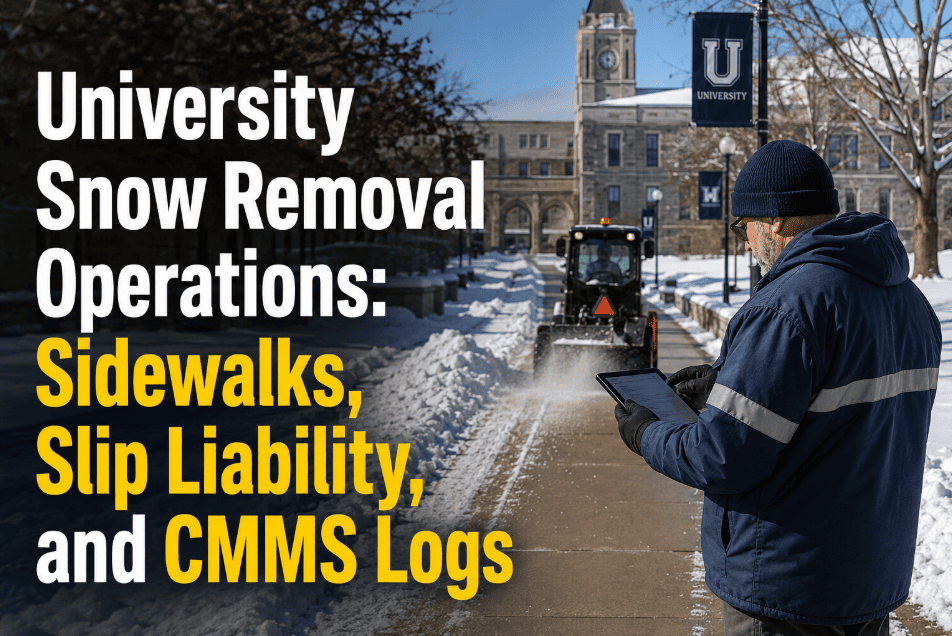
University Snow Removal Operations: Sidewalks, Slip Liability, and CMMS Logs
Sidewalk pre-treatment, plow route execution, ice melt application records, and storm response documentation — the CMMS-driven operations playbook that protects students and defends your institution.
Snow Removal Is Not a Grounds Task — It Is a Liability Management Operation
Every untreated sidewalk is an open liability. Every undocumented plow pass is a gap in your legal defense. Every ice melt application without a timestamp, material type, and location reference is a record that will not exist when the plaintiff attorney requests production logs 14 months after the incident. Oxmaint turns snow response from a radio-dispatched scramble into a documented, defensible, auditable operation — automatically. Campus facilities teams ready to close their documentation gaps can start a free trial or book a demo to map your campus zones to automated storm response workflows today.
What Is University Snow Removal Operations Management?
University snow removal operations management is the systematic planning, execution, and documentation of all winter weather response activities across a campus — including pre-storm preparation, snow plowing, sidewalk clearing, ice melt application, post-storm inspection, and the continuous generation of timestamped records that prove each action occurred at a specific location at a specific time. It is distinct from municipal snow removal because universities operate 24/7 pedestrian environments where thousands of people walk between buildings on footpaths that are narrower, more varied, and more heavily trafficked than public sidewalks — and because the institution bears direct premises liability for every square foot of walkway on its property.
The legal standard is not perfection — courts recognize that snow and ice cannot be removed instantaneously. The standard is reasonable response within a reasonable timeframe, documented with enough specificity to demonstrate that the institution had an operational plan, executed it, and can prove it. According to APPA (Association of Physical Plant Administrators), universities with documented snow response protocols and timestamped treatment records resolve slip-and-fall claims 62% faster and at 40% lower cost than institutions relying on informal logs and crew testimony. That documentation standard is exactly what a CMMS delivers — and what paper-based programs consistently fail to produce under legal scrutiny. See how Oxmaint structures snow response documentation for campuses of your size by booking a demo or starting a free trial to build your first storm response workflow.
The Four Phases of Campus Snow Response Operations
Effective campus snow removal is not a single event — it is a four-phase cycle that begins before the first flake falls and does not end until the post-storm inspection is complete and documented. Each phase has specific deliverables, specific documentation requirements, and specific liability implications if skipped or undocumented.
Campus Snow Removal Priority Classification System
Not every sidewalk can be cleared simultaneously. A priority classification system ensures that the highest-traffic and highest-liability areas are cleared first, and that the priority sequence is documented in the CMMS so that every storm response follows the same defensible order. APPA recommends a minimum three-tier priority system for campuses over 50 acres.
| Priority Level | Area Type | Clearing Trigger | Response SLA | Re-treatment Frequency | Documentation Required |
|---|---|---|---|---|---|
| Priority 1 — Critical | Main pedestrian corridors, building entrances, ADA routes, emergency exits, parking garage ramps, dining halls, health center | 1-inch accumulation | Cleared within 2 hrs of snowfall end | Every 4 hours during active storm | Timestamped completion per zone + photo |
| Priority 2 — High | Secondary walkways, classroom building approaches, residence hall paths, parking lot pedestrian crossings, transit stops | 2-inch accumulation | Cleared within 4 hrs of snowfall end | Every 6 hours during active storm | Timestamped completion per zone |
| Priority 3 — Standard | Tertiary paths, athletic facility approaches, service roads, remote parking lots, recreational trails | 3-inch accumulation | Cleared within 8 hrs of snowfall end | Once after storm ends | Completion logged in storm summary |
| Priority 4 — Deferred | Low-traffic paths, storage area access, seasonal facilities, construction zone perimeters | 4+ inch accumulation | Next business day | As needed | Completion logged when done |
The priority classification must be defined before the first storm of the season, mapped to specific campus locations, and loaded into the CMMS as preset route assignments — not decided ad hoc by the crew supervisor at 4 AM during a blizzard. Oxmaint lets you map every sidewalk segment, parking lot, and building entrance to a priority tier with pre-assigned crews and pre-loaded ice melt application rates, so storm response is executed consistently regardless of which supervisor is on shift. Configure your campus priority zones in a free trial or book a demo to see the full zone mapping workflow.
Six Documentation Failures That Lose Slip-and-Fall Cases
Universities do not lose slip-and-fall lawsuits because they failed to remove snow. They lose because they cannot prove they responded reasonably. These are the six documentation failures that plaintiff attorneys exploit most effectively — and that paper-based snow programs consistently produce.
Pre-treatment with brine solution reduces ice bonding by 80% and demonstrates proactive response. But without a timestamped record of where brine was applied, when, and at what rate, the pre-treatment legally did not happen. 73% of universities that pre-treat cannot produce application records during discovery.
Courts evaluate response time against the storm timeline. If your crew completed the main corridor plow at 6:15 AM but the only record is a supervisor's end-of-shift note saying "routes done," the plaintiff places the incident at 5:45 AM and you have no evidence of prior clearing. GPS-timestamped route completion is the standard.
Material type matters — calcium chloride works to -25F, rock salt stops working at 15F. If the incident occurred at 12F and you applied rock salt, the treatment was inadequate. If you applied calcium chloride but cannot prove it, the plaintiff assumes rock salt. Material-specific application logs with quantity and location are essential evidence.
Refreeze is the number one cause of post-storm slip injuries. A sidewalk cleared at 7 AM can refreeze by 3 PM as temperatures drop. Without a documented post-storm inspection that identified and treated refreeze areas, the institution has no evidence of ongoing monitoring — which courts interpret as abandonment of the duty of care after initial clearing.
If the incident occurred on a sidewalk that your crew had not yet reached, your defense depends on proving that a rational priority system existed and that higher-priority areas were being cleared first. Without a documented priority classification system loaded before the season, the plaintiff argues that response order was arbitrary and the delayed area was neglected.
Radio dispatch logs record that a call was made, not that the work was completed. Verbal crew reports during shift handovers are hearsay in court. The only defensible record is a digital work order completion with technician ID, timestamp, location, and action taken — which is exactly what a CMMS produces automatically and what paper programs cannot replicate.
How Oxmaint Manages Campus Snow Operations and Liability Documentation
Oxmaint replaces paper snow logs, radio dispatch records, and end-of-shift summaries with a continuous, digitally-signed documentation system that captures every treatment, every plow pass, and every inspection as it happens — not hours later from memory. Every record is linked to a specific campus zone, a specific crew member, and a specific timestamp that holds up in legal discovery. Universities ready to close their documentation gaps can start a free trial or book a demo to see the complete storm response workflow.
Configure storm response triggers by forecast threshold — when accumulation forecast exceeds 2 inches or freezing rain is issued, Oxmaint automatically generates pre-treatment work orders for all Priority 1 zones, assigns crews, and timestamps the activation. No manual dispatch required.
Map every sidewalk segment, parking lot, building entrance, and ADA route to a priority tier. Each zone carries its own clearing SLA, ice melt specification, and assigned crew — so every storm response follows the same documented priority order regardless of which supervisor is on duty.
Every ice melt application is logged with material type (calcium chloride, magnesium chloride, rock salt, brine), application rate (lbs per 1,000 sq ft), location, and timestamp. Season-end material usage reports show total consumption by zone — critical for both budgeting and liability documentation.
Plow operators and sidewalk crews mark route segments complete on mobile — with timestamp, crew member ID, and optional photo. Completion records are visible to supervisors in real time and become the permanent storm record. No post-shift data entry required.
Automated post-storm inspection work orders deploy 4 hours after clearing completion. Walk-through checklists capture refreeze areas, ponding water, snow pile obstruction, and damage — with photo documentation and digital sign-off that creates the ongoing monitoring record courts require.
Every storm event generates a consolidated report: pre-treatment records, active response timeline, route completion log, material usage, post-storm inspection findings, and total labor hours. Exportable for risk management, insurance, legal counsel, or board reporting — assembled automatically, not manually.
Paper-Based Snow Ops vs CMMS-Managed Storm Response
Measurable Outcomes of CMMS-Managed Snow Operations
Universities with timestamped storm documentation resolve slip-and-fall claims faster because complete evidence is available immediately — no discovery delays
Documented reasonable response reduces settlement exposure by demonstrating systematic care — the legal standard is proof of action, not perfection
Every pre-treatment, every plow pass, every ice melt application generates a timestamped record — zero documentation gaps across the entire season
vs. 2-3 weeks of manual record assembly from paper logs, radio dispatch records, and crew interviews for each slip claim investigation
Campus Ice Melt Material Selection and Application Rates
Material selection is not just a budget decision — it is a liability decision. Using the wrong material at the wrong temperature creates untreated conditions even when treatment was applied. CMMS-tracked material logs prove that the correct material was used for the conditions, which is a critical defense element in slip litigation.
| Material | Effective Temp Range | Application Rate | Surface Risk | Cost per Ton (2025) | Best Campus Use |
|---|---|---|---|---|---|
| Sodium Chloride (Rock Salt) | Above 15°F (-9°C) | 15-25 lbs / 1,000 sq ft | Concrete spalling, vegetation damage | $60-$80 | Parking lots, low-priority roads |
| Calcium Chloride | Down to -25°F (-32°C) | 8-12 lbs / 1,000 sq ft | Minimal concrete damage | $350-$450 | Priority sidewalks, stairs, ADA ramps |
| Magnesium Chloride | Down to -13°F (-25°C) | 10-15 lbs / 1,000 sq ft | Low concrete impact, pet-safer | $300-$400 | Building entrances, residence halls |
| Salt Brine (23% solution) | Above 15°F (-9°C) | 40-50 gal / lane-mile | Anti-bonding agent, low residue | $0.12-$0.18/gal | Pre-treatment of all priority surfaces |
| Sand/Grit (non-chemical) | All temperatures | 20-30 lbs / 1,000 sq ft | Traction only, no melting, cleanup cost | $25-$40 | Historic walkways, environmentally sensitive areas |
| Potassium Acetate | Down to -15°F (-26°C) | Per manufacturer spec | Lowest environmental impact, biodegradable | $800-$1,200 | Green building zones, sensitive landscapes |
Frequently Asked Questions
What documentation do courts require to defend a campus slip-and-fall claim?+
How should universities handle ADA-accessible routes during snow events?+
What is the optimal pre-treatment strategy for campus sidewalks before a forecast snow event?+
Can Oxmaint track snow removal equipment maintenance alongside storm response operations?+
Every Storm Is a Liability Event — Document It Like One
Your grounds crew already does the work. Oxmaint makes sure every plow pass, every ice melt application, every sidewalk inspection, and every refreeze treatment is captured with the timestamp, location, and crew ID that turns operational effort into legal evidence. No implementation project. No hardware installation. First automated storm response work orders before your next weather event.
![university-custodial-workloading-appa-levels-issa-612-cmms-mobile[1]](./manage-post-2k26/uploads/university-custodial-workloading-appa-levels-issa-612-cmms-mobile[1].png)