When the Office of Civil Rights opens an ADA complaint investigation against a university, the first document request is not for architectural drawings — it is for the transition plan. Does the institution have a written ADA transition plan? Is it current? Does it identify barriers, assign remediation priorities, include a timeline, and name an ADA coordinator? For the majority of US universities receiving federal funding, the Architectural Barriers Act of 1968 and Section 504 of the Rehabilitation Act of 1973 create compliance obligations that predate the ADA itself — obligations that the Department of Justice and the Access Board have increasingly enforced through both complaint resolution and proactive audits. A university that cannot produce its transition plan, its barrier survey records, and its remediation work order history during an OCR investigation faces consent decree negotiations that can mandate $2-10 million in facility modifications on a federally imposed timeline. The facilities team that has those records in a CMMS — barrier by barrier, work order by work order — can demonstrate good faith compliance that shapes the outcome of every regulatory interaction from insurance review to federal audit. Start a free trial with Oxmaint to build your university's ADA/ABA compliance tracking program, or book a demo and see how other institutions structure transition plan remediation in CMMS.
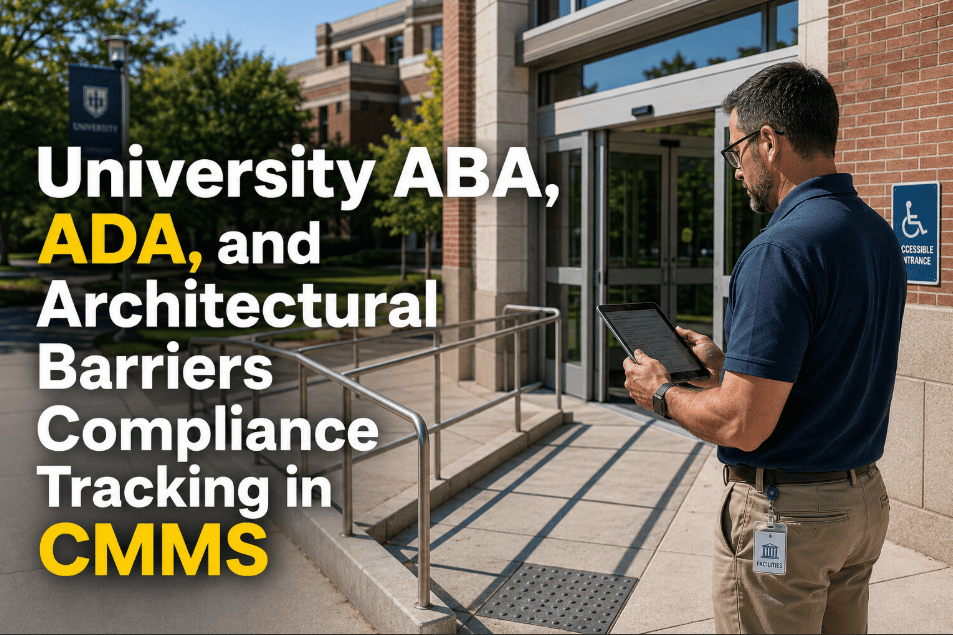
University ABA, ADA, and Architectural Barriers Compliance Tracking in CMMS
Federal ADA and ABA obligations require written transition plans, complaint workflows, and documented remediation — not just ramp installations. Here is the CMMS structure that makes compliance defensible.
ADA, ABA, and Section 504: What Each Law Requires of University Facilities
Three distinct federal frameworks govern accessibility at US universities — and they overlap in ways that create compliance obligations most facilities directors underestimate. Understanding which law applies where determines what your CMMS records must document.
What a University ADA Transition Plan Must Contain — and What CMMS Tracks
The ADA transition plan is the central compliance document for university facilities. Under 28 CFR 35.150(d), public universities must have a transition plan that identifies physical obstacles, describes the methods to make each accessible, specifies a schedule for the steps to be taken, and identifies the official responsible for implementation. Most universities have a transition plan document — fewer have a system that tracks actual remediation progress against it. That gap is where OCR findings originate.
| Transition Plan Element | Regulatory Requirement | What CMMS Tracks | Risk if Not Documented |
|---|---|---|---|
| Barrier inventory by building | 28 CFR 35.150(d)(1) | Asset-level barrier records per building, floor, and location | Cannot demonstrate systematic survey — plan deemed incomplete |
| Remediation method for each barrier | 28 CFR 35.150(d)(2) | Work order type and scope linked to each barrier record | No evidence of planned approach — compliance intent questioned |
| Remediation schedule and timeline | 28 CFR 35.150(d)(3) | PM and work order due dates with priority classification | No timeline = no good faith — OCR requires affirmative schedule |
| Responsible official designation | 28 CFR 35.150(d)(4) | Work order assigned to named staff or contractor | Ambiguous ownership creates enforcement exposure |
| Complaint grievance records | 28 CFR 35.107 | Complaint-linked work orders with response timestamps | Missing complaint records are primary OCR audit finding |
| Completed remediation evidence | OCR audit expectation | Closed work orders with photos, inspector sign-off, and date | Cannot demonstrate progress — repeated OCR inquiries likely |
If your transition plan is a PDF document sitting in a shared drive and your remediation work orders are in a separate system with no link between them, you have a transition plan in name only. OCR auditors know the difference. See how Oxmaint links barrier inventory to work orders to closed remediation records by booking a demo, or start a free trial to begin your barrier inventory today.
The 8 Most Common Architectural Barriers Found in University Facility Surveys
University barrier surveys consistently identify the same categories of non-compliance across aging campus infrastructure. Each of these requires a CMMS record — a barrier entry, a remediation work order, and a completion record with photographic evidence and inspector sign-off.
The ADA Complaint Response Workflow — From Intake to CMMS Work Order
Universities are required to have a grievance procedure for ADA complaints. But having a procedure document is not enough — every complaint must be tracked from intake through investigation, response, and remediation with timestamped records. A CMMS complaint-linked work order workflow provides exactly that audit trail.
How Oxmaint Structures ADA/ABA Compliance Tracking for Universities
Oxmaint gives university facilities and ADA coordinators a CMMS structure that connects the transition plan barrier inventory to remediation work orders to closed records — producing a defensible compliance audit trail at every step.
Frequently Asked Questions
Does every building on campus need to be fully ADA accessible?
Not necessarily — ADA Title II requires program accessibility, not necessarily barrier-free access in every building. A university must ensure that every program, service, and activity is accessible when viewed in its entirety. If a class offered in a non-accessible room can be moved to an accessible room without compromising the program, that may satisfy the requirement. However, new construction and alterations must comply with 2010 ADA Standards regardless. The key is that program accessibility decisions and their rationale must be documented — and that is where CMMS records become critical. Book a demo to see how Oxmaint tracks program accessibility decisions alongside physical barrier remediation.
What is the difference between ADA self-evaluation and a transition plan?
A self-evaluation is the initial review of all policies, practices, and physical facilities to identify barriers to access — required to have been completed by 1993 for universities subject to Title II. A transition plan is the forward-looking document that identifies physical barriers and schedules their removal. Both must be retained. If your institution has never completed a self-evaluation or its transition plan predates 2010 ADA Standards, it is functionally outdated and needs to be refreshed before the next OCR interaction. Oxmaint structures both as living documents rather than static files. Start a free trial to begin building your updated barrier inventory.
How long does a university have to remediate barriers identified in a transition plan?
The ADA regulations allow up to 3 years to complete structural changes to achieve program accessibility — but this is not 3 years from today. It was 3 years from 1992. Universities that still have barriers identified in original transition plans are already overdue on the regulatory timeline and are managing ongoing risk. For newly identified barriers, good faith requires documented remediation timelines with priority classification. OCR does not expect instant remediation of costly structural barriers — it expects documented plans, interim accommodations, and demonstrable progress. Book a demo to see how Oxmaint tracks remediation progress against transition plan milestones.
Can CMMS records be used as evidence in an ADA complaint resolution process?
Yes — and they are among the most effective evidence a university can produce. When OCR investigates an ADA complaint, they request documentation of: the complaint response timeline, whether an interim accommodation was provided, when the barrier was assessed, what remediation was planned, and whether it has been completed. A CMMS that produces timestamped records for each of these steps directly demonstrates the good faith compliance effort that OCR evaluates. Universities with complete CMMS documentation consistently achieve faster, less burdensome OCR resolutions than those reconstructing paper trails. Start a free trial and begin building your compliance documentation trail today.
ADA Compliance Is Not a Project — It Is a Continuous Documentation Program
Oxmaint gives university facilities and ADA coordinators a CMMS that connects transition plan barrier inventory, complaint workflows, remediation work orders, and closed completion records into a single, OCR-ready audit trail. Build your barrier survey, schedule your remediation work orders, and produce compliance reports in minutes — before the next complaint arrives.

![university-sustainability-initiatives-carbon-tracking-scope-1-2-3-cmms[1]](./manage-post-2k26/uploads/university-sustainability-initiatives-carbon-tracking-scope-1-2-3-cmms[1].png)