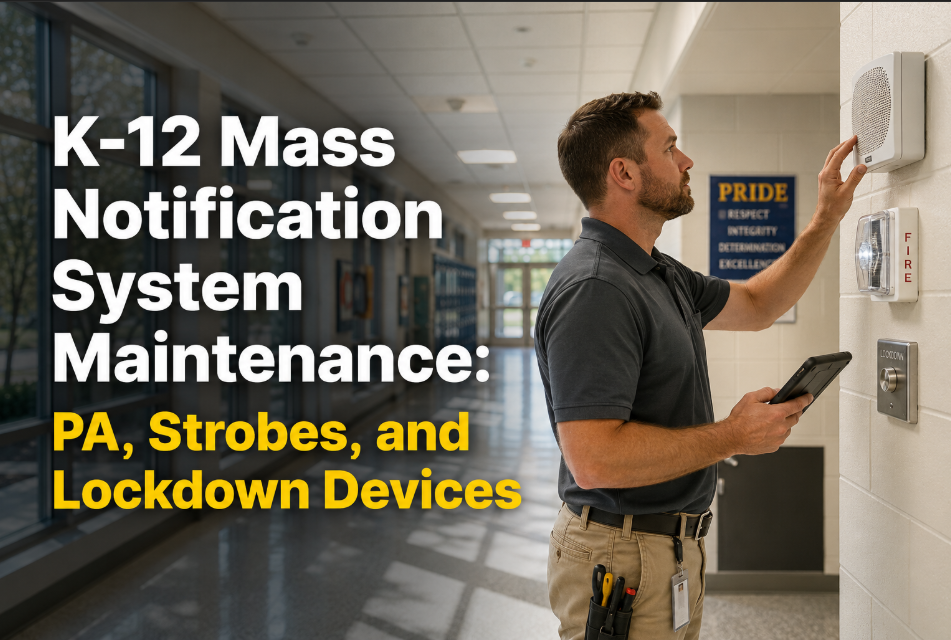
Every K-12 district in the United States has a legal and moral obligation to ensure that when an emergency occurs — a fire, an intruder, a severe weather event, a medical crisis — every student, teacher, and staff member in every building receives a clear, immediate alert and understands exactly what to do. The physical infrastructure that delivers that alert — PA speakers, visual strobes, intercom panels, lockdown devices, two-way communication endpoints — is safety-critical equipment that must perform flawlessly on the first activation, often after months or years of sitting dormant. Most districts treat this equipment like furniture: installed and forgotten until something fails during an actual emergency or a scheduled drill reveals a dead speaker in the gymnasium. NFPA 72, the National Fire Alarm and Signaling Code, establishes testing intervals for notification appliances — but compliance is only achievable when a CMMS schedules, assigns, and documents those tests systematically across every building in the district. Paper-based inspection logs, shared spreadsheets, and annual walk-throughs with clipboards produce neither the documentation trail that state fire marshals require nor the operational confidence that administrators need before activating a lockdown. Oxmaint gives K-12 facility teams automated PM scheduling for PA systems, strobe banks, intercom panels, and lockdown devices — with digital inspection checklists, technician sign-off on every test, and compliance records exportable for any state review. If your district's mass notification documentation is not audit-ready today, start a free trial or book a demo to see how automated inspection scheduling works for your building count.
K-12 Mass Notification System Maintenance: PA, Strobes, and Lockdown Devices
PA systems, visual strobes, intercoms, and lockdown devices must work perfectly on first activation. CMMS-tracked inspection schedules, drill records, and NFPA 72-compliant documentation protect students and shield districts from compliance liability.
Mass Notification Is Not a Fire Alarm — It Is a Life Safety System
PA speakers that crackle, strobes that fail to activate, intercom panels with dead zones, and lockdown devices that require staff to remember a procedure they last practiced 14 months ago — these are not maintenance inconveniences, they are life safety failures waiting for the worst possible activation moment. Oxmaint schedules and documents every test, every inspection, and every drill record automatically. Start a free trial or book a demo to map your district's notification assets to automated PM schedules today.
The Four Asset Categories in a K-12 Mass Notification System
Each component category has different failure modes, different NFPA 72 test requirements, and different consequences when it fails. Effective PM treats them as separate asset types with separate inspection schedules — not as a single "notification system" with a single annual walk-through.
NFPA 72 Testing Requirements That Apply to K-12 Notification Systems
NFPA 72 Chapter 14 establishes the inspection, testing, and maintenance requirements for mass notification systems in educational occupancies. These are not guidelines — they are the standard by which state fire marshals, insurance carriers, and district legal counsel evaluate compliance after an incident. Failing to document required tests creates legal exposure independent of whether a device actually failed.
| Component | NFPA 72 Test Type | Required Frequency | Documentation Required | Oxmaint Scheduling |
|---|---|---|---|---|
| PA amplifiers and control equipment | Functional test, output level measurement | Annually (14.4.4) | Test date, technician, results, deviations | Auto-scheduled, digital sign-off |
| Speakers — all zones | Audibility test, coverage verification | Annually (14.4.4) | Zone-by-zone pass/fail with technician ID | Zone-level work order per building |
| Visual notification appliances (strobes) | Visual inspection + activation test | Annually (14.3.1) | Quantity tested, location list, pass/fail | Building-level checklist with photo |
| Mass notification control units | Function test, override test, backup power | Semi-annually (14.4.5) | Functional test report with technician sig | Bi-annual PM with digital signature |
| Emergency power supply (UPS/batteries) | Discharge test, load test | Annually (14.4.6) | Battery condition, discharge duration | Linked to backup power asset record |
| Two-way emergency communication | Communication path test, intelligibility | Annually (14.4.7) | Each communication point verified | Station-by-station digital checklist |
Six Mass Notification Failures That Paper Inspection Programs Miss
Gymnasium, cafeteria, and auditorium speakers operate infrequently and fail silently. A speaker that produces no sound during a lockdown announcement in a 400-person gymnasium is a catastrophic coverage gap — and annual walk-through inspections without audio testing from each zone miss it entirely until activation.
NFPA 72 requires strobes to synchronize when multiple devices operate in the same field of view — unsynchronized strobes create seizure risk for photosensitive individuals. Synchronization module failures are invisible without a function test and are rarely caught by visual inspection alone during informal walk-throughs.
NFPA 72 requires mass notification systems to operate for a minimum period on backup power after primary power loss. Battery systems that pass a visual inspection but fail a discharge test create a hidden compliance gap that surfaces only when the primary power fails during an actual emergency event — precisely when backup power is needed most.
Door barricade devices and magnetic locks operate under thermal cycling, moisture, and normal door usage stress. Devices that function correctly during installation degrade over 12–18 months of physical use. Monthly function checks catch the gradual degradation that annual drill observations miss — because drills test procedure, not equipment condition.
Most states require documented records of emergency drill execution including date, time, building, drill type, and any equipment malfunctions observed. Paper drill logs are frequently incomplete, inconsistently formatted, and difficult to produce during a state review. When a malfunction occurs, the absence of documented prior testing creates immediate legal exposure for the district.
Inspection finding is only half the compliance event. The corrective action — repair work order creation, parts procurement, verification retest — must be documented as a closed loop. Paper inspection programs find deficiencies but do not automatically create the repair record that demonstrates the finding was resolved before the next state review.
How Oxmaint Manages K-12 Mass Notification Compliance
Oxmaint replaces disconnected inspection logs and paper drill records with an automated, closed-loop compliance management system. Every component, every test, every drill record, and every corrective action is captured, timestamped, and linked to the specific asset and building — making NFPA 72 compliance continuous rather than assembled annually under audit pressure. Districts ready to automate notification compliance can start a free trial or book a demo to see the full inspection workflow.
Register each PA zone, strobe bank, intercom station, and lockdown device individually in Oxmaint's asset hierarchy: District > School > Building Wing > Room > Device. Each asset carries its own inspection schedule, test history, and NFPA 72 compliance status — visible from the district dashboard.
Configure inspection frequencies to NFPA 72 requirements — semi-annual for control units, annual for speakers and strobes, monthly for lockdown devices. Oxmaint generates the inspection work order automatically on schedule and escalates to supervisors if overdue, eliminating the manual calendar management that causes compliance gaps.
Inspection checklists configured for each component type — PA speakers, strobes, intercoms, lockdown devices — guide technicians through every required test point with pass/fail recording, photo attachment, and digital signature. The resulting record satisfies NFPA 72 documentation requirements without any post-inspection transcription.
When an inspector flags a deficiency — a failed strobe, a dead speaker zone, a lockdown device that does not engage — Oxmaint automatically creates a priority work order and assigns it. The corrective action is tracked separately from the inspection record, creating the closed-loop documentation trail that state fire marshals require.
Log every emergency drill — fire, lockdown, severe weather — as a work order event linked to the notification system assets. Record drill type, date, building, observation results, and any equipment malfunctions detected. Drill records are searchable, exportable, and formatted for state annual reporting requirements.
Generate complete inspection history by school, by system type, by date range, or by NFPA 72 requirement category. When a state fire marshal or insurance auditor requests documentation of notification system testing, the full record is exported in minutes — not assembled over three days from paper binders and email chains.
Paper-Based vs CMMS-Managed Notification Compliance
Compliance Outcomes Districts Report After Switching
Every scheduled inspection generates a complete record — no gaps, no missing sign-offs, no undocumented tests from the prior cycle
Districts with CMMS-managed notification inspection programs report significantly fewer compliance citations during annual state fire and safety reviews
Automatic corrective work order creation closes the documentation loop that paper programs leave open — every deficiency is tracked to resolution
vs. 2–3 days of manual binder assembly — continuous digital capture means compliance records are always current and immediately exportable
Frequently Asked Questions
Does NFPA 72 apply to school mass notification systems in all states?+
How should districts handle mass notification systems that were installed under different standards or by different contractors?+
Can Oxmaint track emergency drill records alongside the equipment maintenance records?+
What is the recommended inspection frequency for door barricade and lockdown devices?+
Every Speaker, Strobe, and Lockdown Device Should Have a PM Schedule Today
Mass notification systems are not infrastructure that can fail gracefully. They need to work perfectly on first activation, after months of dormancy, often during the highest-stress event a school community will face. CMMS-managed inspection programs are how districts achieve that standard — and how they prove it when state reviews, insurance audits, or incident investigations ask for documentation. No implementation project. First automated inspection work orders in week one.