A single bedbug report in a K-12 school triggers a chain of events that most districts are not operationally prepared for: parent notification requirements, room closure, documentation for the health department, coordination between custodial staff and a licensed pest control operator, and a re-inspection protocol that must be recorded and retained. Multiply that by a residential alternative school, a district with 40 buildings, and an IPM program that lives in a binder on the facilities director's shelf, and you have a compliance exposure that grows every semester. The US Environmental Protection Agency's School IPM program and most state education codes now require documented Integrated Pest Management programs for K-12 facilities — not just pest control invoices, but written plans, notification records, pesticide application logs, and annual program reviews. Districts that cannot produce these records in response to a parent complaint or a state education agency audit face civil liability, program defunding risk, and in some states, mandatory corrective action plans. The CMMS that manages your HVAC PMs and work order queue can also manage your IPM program documentation — and it should. Start a free trial with Oxmaint and see how IPM documentation works inside a school district CMMS, or book a demo to walk through a K-12 IPM program configuration for your district size.
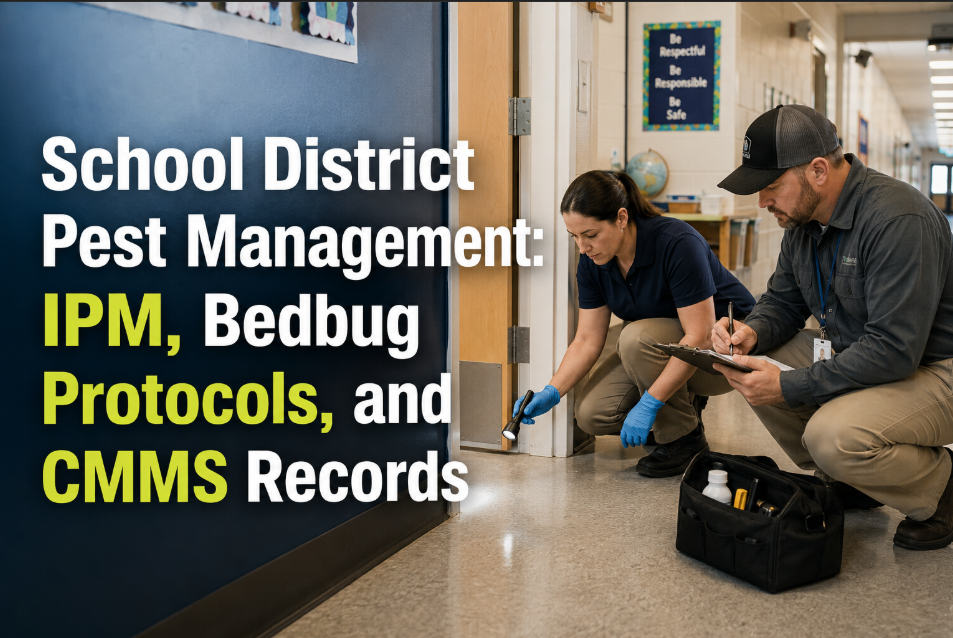
School District Pest Management: IPM, Bedbug Protocols, and CMMS Records
State education codes now require documented IPM programs — not just pest control invoices. Here is the structure, the bedbug protocol, and the CMMS records that protect your district.
What Is an Integrated Pest Management Program for K-12 Schools?
Integrated Pest Management (IPM) is an evidence-based approach to pest control that prioritizes prevention, monitoring, and least-hazardous intervention over routine pesticide application. For K-12 school districts, the EPA defines IPM as a structured program that combines physical exclusion, sanitation practices, biological controls, and targeted pesticide use — applied only when monitoring confirms a pest threshold has been exceeded, and documented at every step.
An IPM program is not "call the exterminator when someone sees a mouse." It is a written plan that covers pest monitoring schedules, threshold levels that trigger treatment, approved pesticide products, notification procedures, contractor qualification requirements, and annual program review documentation. States including California, Connecticut, New York, Texas, and Florida have enforceable IPM requirements for school districts — and the number grows each legislative session. If your district's IPM program is not documented in a system that generates audit-ready records, you are one parent complaint away from a compliance finding. See how Oxmaint structures K-12 IPM documentation by starting a free trial, or book a demo for a district-specific walkthrough.
The 8 Required Components of a K-12 District IPM Program
EPA School IPM and state education agency requirements converge on eight program components that every K-12 district must have documented. Missing any one of these creates audit exposure — and missing multiple creates liability exposure that extends to the superintendent and school board.
K-12 Bedbug Protocol: The Step-by-Step Response Schools Must Have Written Down
Bedbugs are the K-12 pest scenario that generates the most parent anxiety, most media attention, and most compliance scrutiny — and also the one for which most districts have no written protocol until they need one. The Centers for Disease Control and National Pest Management Association jointly recommend that schools have a documented response protocol before the first report, not after. Here is the framework that protects students, staff, and the district.
When a student or staff member reports a suspected bedbug: isolate the individual's belongings in a sealed plastic bag, document the report in the CMMS with date, time, location, and reporter name. Do not inspect clothing or personal items in the classroom — move to a private location. Notify the IPM coordinator within 1 hour of the report.
Within 24 hours, a licensed pest control operator (not custodial staff) inspects the reported area — seating, furniture, carpet edges, and lockers in the immediate zone. The inspection finding is documented: no evidence found, evidence found with specific locations noted, or positive identification confirmed. All three outcomes require CMMS documentation.
If bedbugs are confirmed: notify parents of students in the affected classroom within 24 hours. Notification must include confirmation of inspection findings, treatment plan, re-entry timeline, and district contact for questions. Retain copies of all notifications in the CMMS record for the work order. In many states, bedbug notification is mandatory regardless of whether pesticide is applied.
Treatment options for schools include heat treatment (most effective, no chemical exposure, 130°F+ for 90+ minutes), vacuuming and encasement, or targeted pesticide application as a last resort. The treatment method, product (if chemical), applicator license number, and room preparation requirements are all logged in the CMMS treatment record.
A follow-up inspection at 7 days and 30 days post-treatment confirms treatment effectiveness. Clearance to return to normal use is documented by the licensed inspector, not by facilities staff. The clearance record is attached to the original CMMS work order and retained for 3 years minimum. If re-infestation is detected, the protocol restarts from Step 2.
Pest Management in Residential School Facilities — A Higher Standard
Districts operating residential programs — alternative schools, treatment facilities, boarding programs, or continuation schools with on-site housing — face a significantly more demanding pest management standard than day schools. Bedbugs, cockroaches, and rodents in residential settings spread between rooms and buildings faster, create health code obligations beyond education codes, and carry housing authority inspection requirements in addition to state education agency oversight.
How Oxmaint Tracks IPM Compliance Across a K-12 District
Oxmaint gives school district facilities teams a CMMS structure that manages the full IPM program — monitoring schedules, treatment records, notification logs, contractor documentation, and annual review tracking — across every building in the district from one platform.
One system for your HVAC PMs, your work orders, and your IPM compliance documentation — that is what Oxmaint delivers for K-12 facilities teams. Start a free trial to see the IPM module in action, or book a demo and walk through a district-specific IPM program setup with our team.
What CMMS-Tracked IPM Programs Deliver for K-12 Districts
Frequently Asked Questions
Is a documented IPM program legally required for K-12 school districts?
In more than 40 US states, yes — with varying degrees of specificity. California requires a written IPM plan and annual pesticide use reporting to the state Department of Pesticide Regulation. Connecticut requires 72-hour parent notification for all pesticide applications. New York requires written notification and an IPM coordinator designation. Even in states without explicit mandates, EPA guidance creates a due diligence standard that influences civil liability outcomes. A district without a documented program is vulnerable in any pest-related parent complaint or legal proceeding. Start a free trial to build your district's compliant IPM documentation program.
Can custodial staff conduct pest monitoring, or must it be a licensed contractor?
Routine pest monitoring — checking glue traps, noting pest evidence, recording findings — can be performed by trained custodial staff as part of an IPM program. What requires a licensed pest control applicator is any pesticide application, including rodenticide bait stations that use restricted-use products. The key is that custodial monitoring results must be documented in the CMMS and reviewed by the IPM coordinator — not just verbally communicated and forgotten. Book a demo to see how Oxmaint structures custodial vs. contractor IPM tasks.
What records must be retained after a bedbug incident, and for how long?
Following a bedbug incident, districts should retain: the initial report record with date, time, and location; the licensed inspector's assessment report; all parent and staff notifications with dates; the treatment record including method, product (if chemical), and applicator license; and the follow-up clearance inspection report. Minimum retention is 3 years in most states, but 5 years is recommended to cover potential civil statute of limitations periods. Oxmaint stores all of these as attachments to the linked work order record automatically. Start a free trial to see the bedbug incident documentation workflow.
How does CMMS improve pest management coordination across a large school district?
A large district with 40+ buildings and multiple custodial supervisors faces a coordination problem: who conducted which monitoring round, which contractor treated which building, and where are the records? Without CMMS, this information lives in email threads, paper logs, and contractor invoices. With Oxmaint, every monitoring round, treatment, and notification is a work order record — visible to the IPM coordinator, the facilities director, and the superintendent — with completion status, technician assignment, and attached documentation in one place. Book a demo to see multi-school district IPM coordination.
Your District's IPM Records Are Either Ready for an Audit — or They Are Not
Oxmaint gives K-12 facilities directors a documented, auditable, CMMS-tracked IPM program across every building in the district. Pest monitoring schedules, bedbug response work orders, pesticide application logs, and notification records — all in one system that generates state-compliant reports in minutes, not days.