Every emergency work order in a school or university lab has a paper trail leading back to it, and that trail almost never starts with bad luck. It starts with a fume hood tested on the same six-month cycle as a low-use storage cabinet, a failed gas valve test closed out without anyone writing down why it failed, or a statutory inspection that slipped through because nobody's calendar caught it in time. These are not exotic failures — they are common, well-documented record-keeping mistakes that quietly turn a routine inspection program into a source of emergencies. The good news is that every one of them is fixable once a team can see its own record-keeping clearly instead of trusting memory and paper. Teams ready to find their own gaps before an emergency does can start a free trial and run a quick audit of their lab records today.
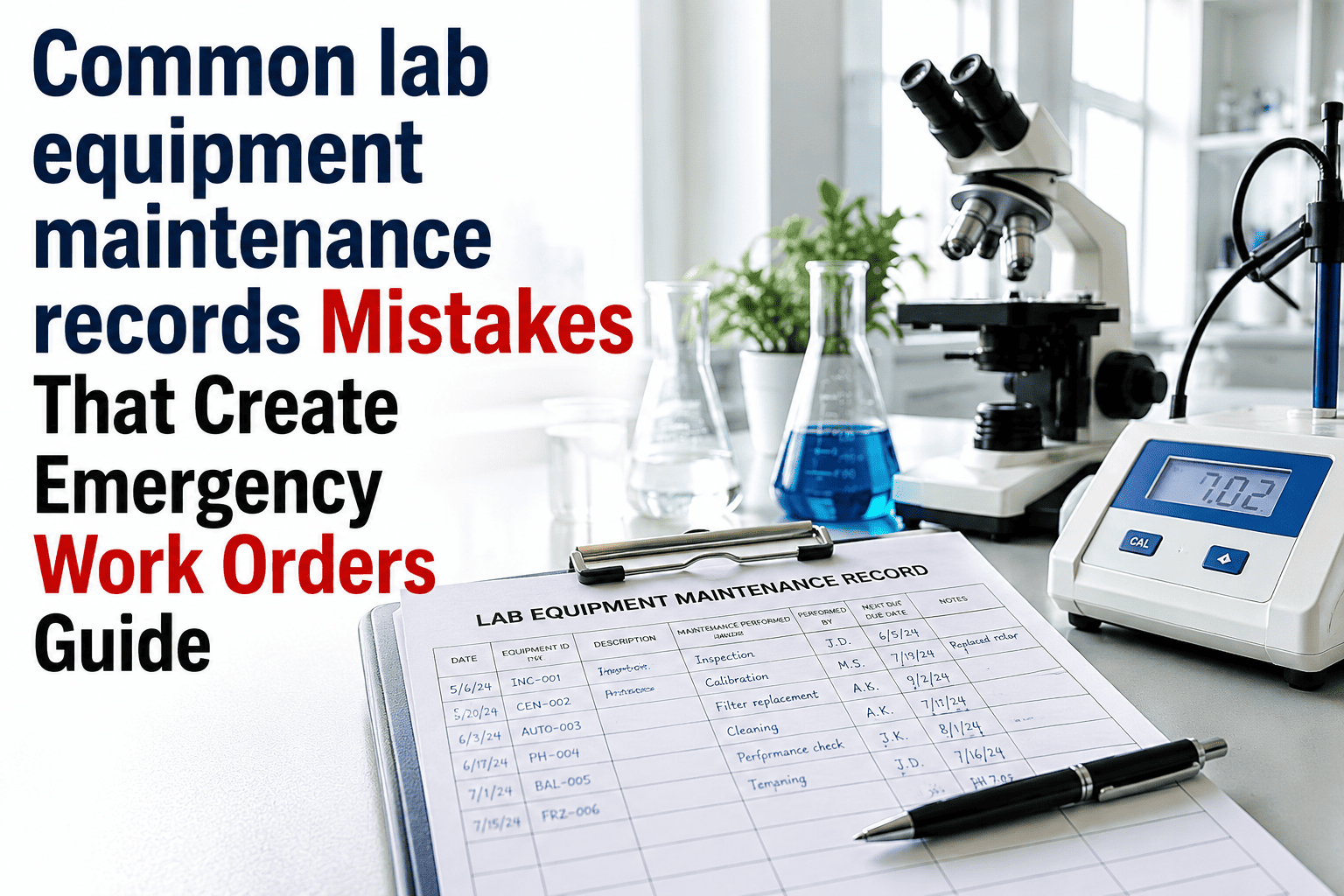
Common Lab Equipment Maintenance Records Mistakes That Create Emergency Work Orders
Most lab emergencies trace back to a small, fixable mistake in how a record was kept or a schedule was set — not bad luck.
The Record-Keeping Mistakes Behind Most Lab Emergencies
None of these require a complex root-cause investigation to spot. Most facilities teams recognize at least two or three the moment they read the list.
What it looks like: Fume hoods, eyewash stations, and storage cabinets all tested on the same calendar interval, regardless of how often they're used.
Why it backfires: A high-use fume hood can drift below safe face velocity for months between checks while a rarely-used cabinet gets tested needlessly often.
What it looks like: A technician marks a failed gas valve test "fixed" and closes the work order without recording what actually went wrong.
Why it backfires: The same valve fails again three months later, and nobody can see it's the third time, because the pattern was never recorded.
What it looks like: Replacement eyewash cartridges, gas valve seals, or fume hood filters aren't ordered until a technician is standing in front of the failed part.
Why it backfires: A scheduled repair turns into a multi-day wait for a part that should already have been on the shelf.
What it looks like: Inspection due dates live in a wall calendar or a department head's memory instead of a tracked schedule tied to each asset.
Why it backfires: A statutory annual inspection slips through unnoticed until an inspector or auditor asks for a record that doesn't exist.
What it looks like: Inspection checklists are copied from a manual or a previous district without asking the people who actually service the equipment.
Why it backfires: A critical step gets skipped because the written plan doesn't match the real fume hood or gas system in that building.
What it looks like: Each failed test is treated as a one-off event instead of being checked against that asset's own history.
Why it backfires: A fume hood that has already failed its face velocity test twice gets a third pass-by-luck check instead of the deeper repair it needs.
Find These Mistakes Before They Find You
Run a quick audit of your own lab inspection records and see which assets are quietly carrying one of these six risks right now.
How One Missed Check Becomes an Emergency Work Order
Every lab emergency follows a similar path. Breaking it into steps is the easiest way to see exactly where a tracked schedule would have caught it.
A weekly eyewash flush gets skipped during a busy week.
No alert flags the missed check, because the schedule isn't tied to the asset in any system.
The eyewash head quietly clogs with mineral scale over the following months.
A real chemical splash happens, and the eyewash fails to deliver a proper flush.
A five-minute weekly task becomes an emergency work order, an incident report, and a possible lab closure.
Which Mistake Leads to Which Emergency
Matching each mistake to the failure it usually produces makes it easier to know which one to fix first.
| Record-Keeping Mistake | Typical Emergency It Triggers |
|---|---|
| One schedule for every asset | High-use fume hood drifts below safe face velocity unnoticed |
| Failed tests closed without a cause | Same gas valve fails a third time before the root cause is found |
| Parts not linked to the schedule | Eyewash cartridge missing on the day of a real chemical splash |
| Paper and memory scheduling | Statutory annual inspection missed entirely until an inspector asks |
| No tracking of repeat failures | A repeatedly failing fume hood gets patched instead of properly repaired |
Frequently Asked Questions
What's the most common mistake that leads to a lab emergency work order?
How do failed tests turn into repeat emergencies?
Can a CMMS prevent missed statutory inspections?
Why does parts inventory matter for avoiding emergencies?
How can a facilities team find these mistakes before an emergency happens?
Catch the Small Mistake Before It Becomes the Big Emergency
Move your lab inspection records into one system that flags usage-based schedules, repeat failures, and missing parts before they turn into emergency work orders.