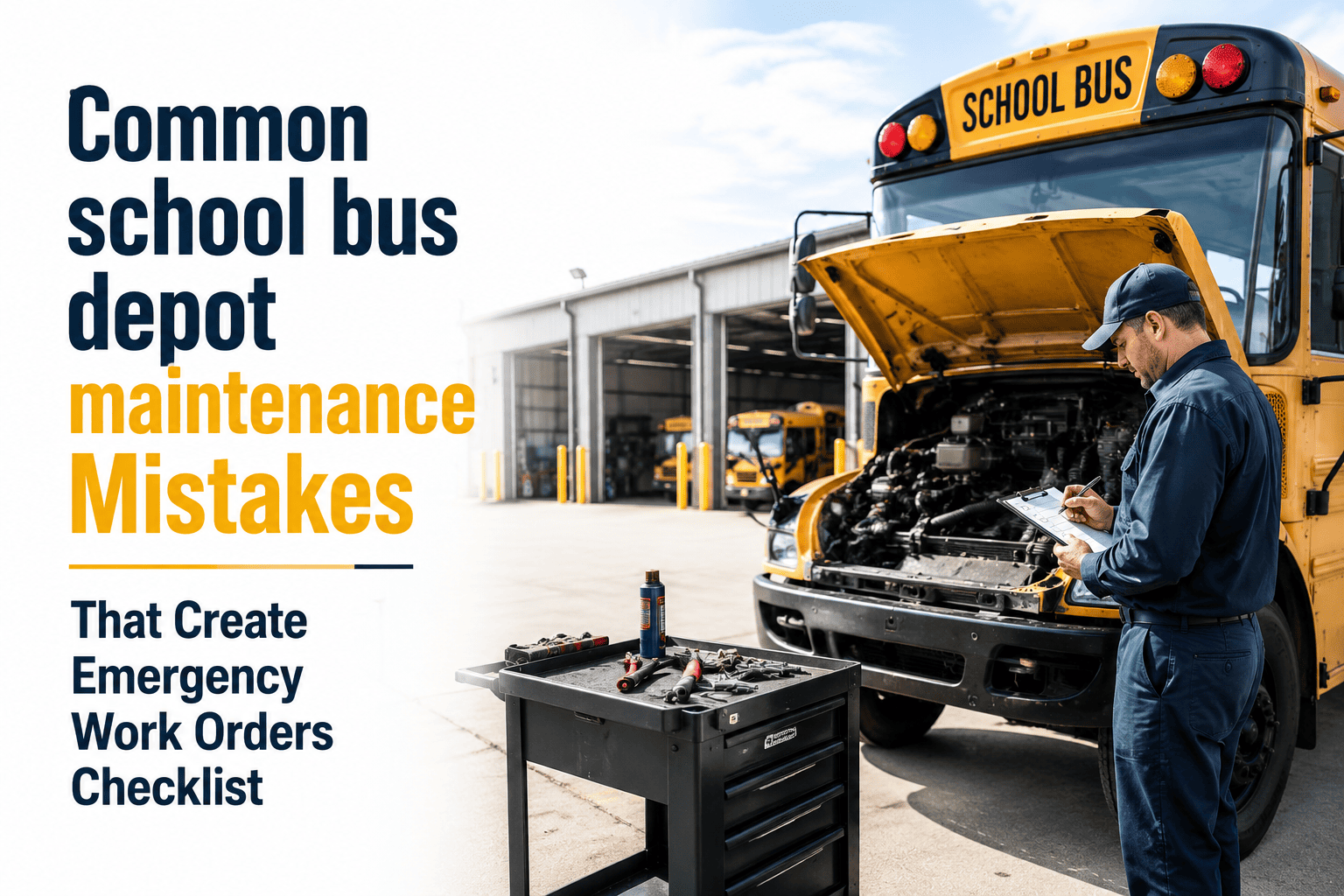
Most school bus breakdowns are not random — they trace back to the same handful of preventable mistakes repeated across depots every week. A skipped pre-trip note, a battery flagged but never replaced, a PM pushed to "next week" three weeks running. Each one looks harmless in the moment and turns into a 6 AM emergency call with a full bus stuck at the depot gate. This checklist names the exact mistakes that turn routine maintenance into emergency work orders, paired with the fix that closes each gap, so your transportation team can audit its own depot in the next ten minutes. Use OxMaint to catch these mistakes automatically before they become tomorrow's roadside breakdown.
Common School Bus Depot Maintenance Mistakes That Create Emergency Work Orders
A side-by-side checklist of the depot habits that turn into 6 AM breakdown calls — and the exact fix that shuts each one down for good, built for transportation directors and fleet foremen.
Every Emergency Work Order Has the Same Origin Story
A mechanic flags a fault on Monday. Nobody converts it into a tracked work order. By Thursday it has become a 6:14 AM radio call — a bus that will not start, a brake light nobody chased down, a fluid leak nobody logged. The mistake was never the broken part. The mistake was the gap between someone noticing and someone owning the fix. Each pairing below shows that gap and the habit that closes it.
Treating a Flagged Defect as a Note Instead of a Work Order
A driver's pre-trip inspection notes a dim headlight or a slow brake pedal, but the note stays on a clipboard or a sticky pad. The bus runs again the next morning because "it still started fine," and the defect is never assigned to anyone.
Every flagged defect converts into a work order the same hour it is reported, with a named mechanic and a due date. If a bus has an open safety-related work order, it does not leave the yard until the work order is closed and signed off.
Scheduling PM by Memory Instead of Mileage Triggers
A foreman tracks 40 to 200 buses on a whiteboard or spreadsheet, relying on memory for which bus is due for its next oil change or brake inspection. Route changes, driver shortages, and holiday breaks push the actual mileage past the due date unnoticed.
PM tasks trigger automatically from each bus's logged mileage or calendar interval, whichever comes first. The system surfaces every bus approaching its due window days in advance, so scheduling never depends on one person's memory.
Letting a Known Battery or Belt Issue "Ride" Until It Fails
A weak battery, a glazed belt, or a slow coolant leak gets noticed during a routine check, but since the bus is still drivable, the part stays in service. Two to three weeks later it fails completely — usually during a cold start or a full route.
Any defect found during inspection — drivable or not — gets logged against the bus's asset record with a severity tag. Parts with a known wear pattern are replaced on the next scheduled service instead of waiting for complete failure.
Running Out of the Right Part When the Bus Is Already Up on the Lift
A mechanic begins a brake job only to discover the correct pad set is not in the parts room. The bus sits on the lift for two extra days while the part ships, blocking the lift and turning a routine repair into unplanned downtime.
Minimum stock levels are set for every fast-wear part across the fleet's makes and models. A purchase requisition generates automatically the moment a part count drops below threshold, so the part is on the shelf before the work order is opened.
Keeping Paper Records That No One Can Pull Up Fast
Inspection history lives in paper folders or scattered spreadsheets by bus number. When a pattern of recurring faults exists, nobody notices because no one can search across six months of handwritten records in time to act on it.
Every inspection, work order, and part replacement is searchable by bus VIN in seconds. Recurring faults on the same bus surface automatically, flagging a pattern before it becomes the fourth emergency call this term.
Assuming a Bus That Started Fine Yesterday Will Start Fine Today
A bus runs its full route without incident, so no one checks battery voltage, alternator output, or coolant condition again until something actually goes wrong. Slow degradation looks identical to "fine" right up until the morning it is not.
Battery voltage and key fluid readings are logged at every scheduled service, not just when a problem is suspected. A downward trend across three readings triggers a proactive replacement before the part fails on a route with students aboard.
Letting One Person Be the Only Source of Fleet Status
Only the lead mechanic or foreman knows which buses are due for service, which have open issues, and which parts are on order. When that person is out sick or on vacation, the whole depot loses visibility into its own fleet status.
Fleet status lives on a shared dashboard that any authorized staff member can open — PM due dates, open work orders, and parts on backorder are visible to the whole team, not locked inside one person's head or one private notebook.
Transportation directors using OxMaint convert every flagged defect into a tracked, assigned work order the moment it is reported — closing the exact gap that turns small issues into roadside breakdowns.
What These Mistakes Actually Cost a Depot
| Maintenance Approach | Cost Per Mile | Annual Cost Per Bus | Breakdown Rate |
|---|---|---|---|
| Reactive, Memory-Based Scheduling | $0.58 | $8,000 - $9,500+ | High |
| Structured PM With Tracked Work Orders | $0.32 | $3,500 - $4,500 | 85% Lower |
| Each Prevented Roadside Breakdown | — | ~$8,500 Saved | Per Incident |
Who Should Own Each Fix on This Page
| Mistake Pattern | Owner | How Often Reviewed |
|---|---|---|
| Flagged Defects Not Converted to Work Orders | Foreman / Lead Mechanic | Daily |
| PM Scheduled by Memory | Fleet Manager | Weekly |
| Known Issues Left to "Ride" | Inspecting Mechanic | Per Inspection |
| Parts Stockouts on Lift Jobs | Parts Manager | Monthly |
| Single Point of Fleet Knowledge | Transportation Director | Quarterly |
Five Questions to Ask Your Depot Right Now
Frequently Asked Questions
Close the Gap Between a Flagged Defect and a Finished Repair
OxMaint converts every inspection finding into an assigned, tracked work order the moment it is reported — so the small issues your team already catches never get the chance to become tomorrow's emergency.