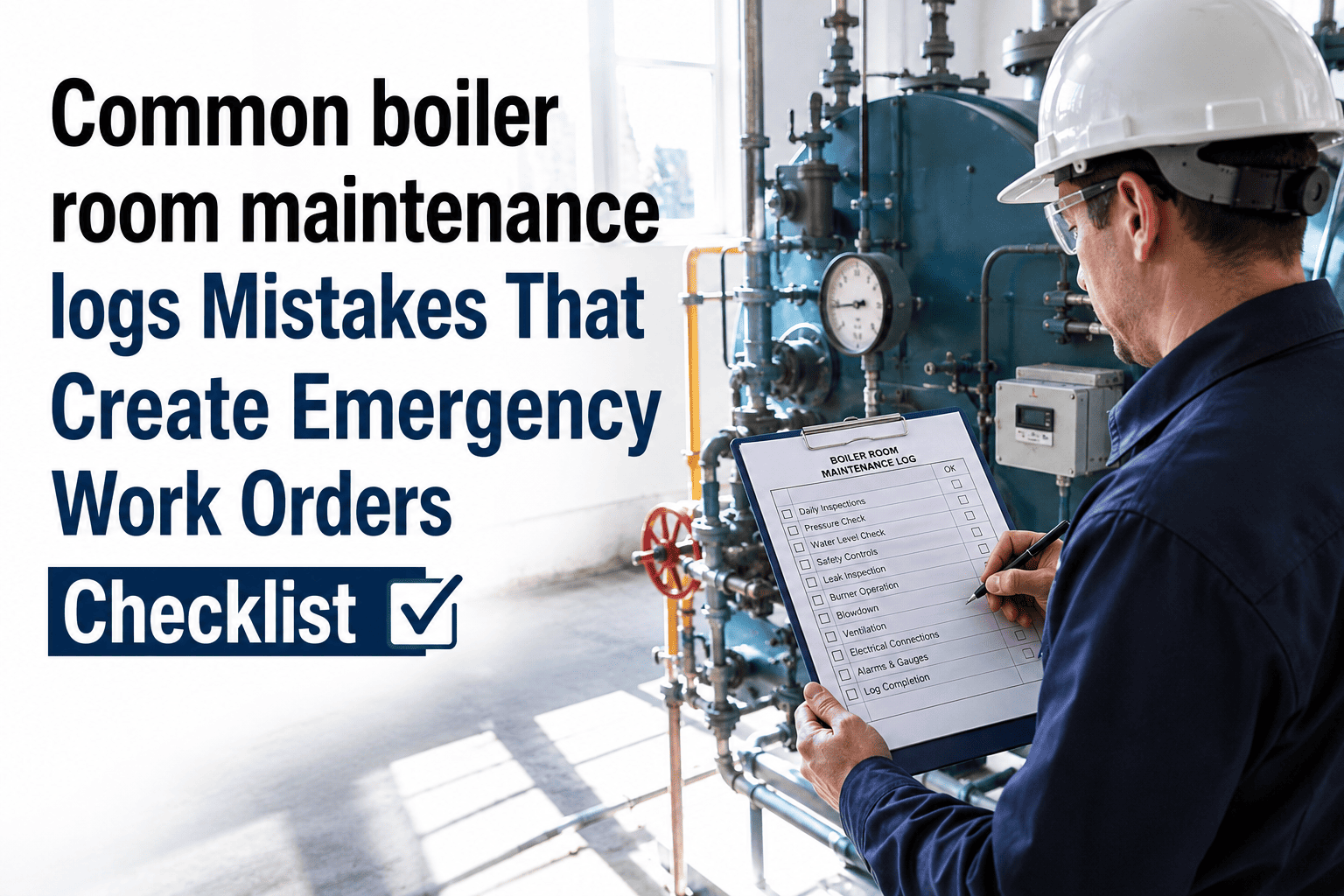
A boiler logbook with gaps in it is not a paperwork problem — it is the early warning system that already failed. School and university facilities teams that skip a blowdown entry, round a pressure reading, or leave a low water cutoff test unsigned are not just risking a failed inspection; they are removing the one record that would have caught a developing fault before it became a 2 a.m. emergency work order. This checklist breaks down the boiler room logging mistakes that turn routine maintenance into unplanned downtime, and how OxMaint's maintenance log platform closes each gap with structured, timestamped entries your team cannot accidentally skip.
Boiler Room Maintenance Log Mistakes That Create Emergency Work Orders
Eight recurring logging mistakes inside campus and district boiler rooms, the emergency they each lead to, and the fix that keeps a missed entry from turning into a closed building.
Recording the Low Water Cutoff Test as Done Without Verifying the Trip
The single most common deficiency cited during boiler inspections is a missing or incomplete low water cutoff record. A logbook entry that says "LWCO checked" without recording whether the burner actually tripped during blowdown is not a safety record — it is a guess written down to look like one.
Rounding Pressure and Temperature Readings Instead of Recording Actuals
A gauge that reads 142 psi gets written down as "140, normal" often enough that nobody notices the boiler has drifted six readings closer to its safety valve set pressure. Rounded numbers protect nothing — they erase the early signal that a trend is forming.
Logging Blowdown as a Checkbox Instead of a Timed, Measured Event
Bottom blowdown removes sludge before it can bake onto the heat transfer surface, but a checkbox that just says "blowdown done" tells nobody how long it ran, what the water quality looked like before and after, or whether it happened at all on a busy shift.
A logbook that lives on a clipboard cannot flag a drifting pressure trend or an overdue LWCO test on its own. OxMaint turns every boiler round into structured data, escalates skipped safety tests automatically, and keeps your compliance record audit-ready before the inspector ever asks for it.
Treating Water Treatment Chemistry Logs as Optional Paperwork
Each millimeter of scale on a heat transfer surface cuts thermal efficiency by several percent, and scale builds up exactly when pH and hardness logs stop being taken seriously. A water chemistry log that gets filled in only when the treatment contractor visits is not monitoring anything between visits.
Missing CSD-1 Service Records and Technician License Numbers
Inspectors expect dated CSD-1 service reports with device model numbers, set points, actual test results, and the technician's license number on file in the boiler room. A logbook that references a service visit without these details is treated the same as a missing inspection.
Leaving Shift Handover Logs Unsigned or Incomplete
An incoming operator who inherits an unsigned log inherits no information at all. If the previous shift noticed a flame signal drifting or a gas pressure reading creeping outside range and never wrote it down clearly, the next operator starts the shift blind to a developing fault.
Research on classroom conditions has linked heating disruptions to measurable drops in cognitive performance, with the effects falling hardest on students who can least afford a missed school day. A boiler emergency caused by a log that should have caught the warning sign first does not just cost a repair bill — it closes a building.
Five Metrics That Show Your Boiler Logs Are Actually Working
| Metric | How to Measure | Target | Frequency |
|---|---|---|---|
| LWCO Trip Verification Rate | Logged pass results / Total LWCO tests | 100% | Daily |
| Reading Accuracy Rate | Exact gauge entries / Total readings logged | 100% | Daily |
| Blowdown Data Completeness | Entries with time, duration, TDS / Total blowdowns | 100% | Daily |
| CSD-1 Record Completeness | Reports with license number on file / Total services | 100% | Quarterly |
| Shift Log Sign-Off Rate | Signed, complete logs / Scheduled shifts | 100% | Weekly |
Frequently Asked Questions
What causes most boiler inspection failures in schools?
The most cited failures are blocked combustion air louvers, isolation valves wrongly placed between the low water cutoff and the boiler, improperly installed relief valve discharge piping, and missing or incomplete logbook documentation. See how OxMaint keeps every record audit-ready.
How quickly must boiler inspection reports be submitted?
Most jurisdictions require inspection reports to be submitted within 14 calendar days of the inspection date, with documentation kept in the boiler room for inspector access at any time.
Why does a logged low water cutoff test still fail an inspection?
An entry that only confirms the valve was opened, without recording whether the burner actually tripped, does not meet the documentation standard inspectors require for a valid safety test.
How often should boiler water chemistry be logged?
Feedwater pH and hardness should be logged daily by the operator, not only during contractor visits, so chemistry drift is caught before scale forms on heat transfer surfaces.
Can a digital log replace a paper boiler logbook for inspection purposes?
Yes, provided the digital system retains timestamps, technician identification, and full field history. Book a demo to see a compliant digital boiler log in action.
Turn Your Boiler Logbook Into an Early Warning System, Not a Liability
OxMaint replaces the clipboard with structured digital entries, forced safety-critical fields, and automatic escalation when a test is skipped — so the next emergency work order is the one you prevented, not the one you're explaining to an inspector.