Campus facilities teams lose 12–18 hours per week answering the same questions: “When will my work order be fixed?” “Is Building 7 HVAC scheduled for repair?” “Where do I report a leak in the residence hall?” Conversational AI operations assistants eliminate this burden entirely by providing 24/7 natural-language access to every work order status, every asset record, every compliance deadline, and every maintenance KPI — to every stakeholder who needs it, in the format they understand, without a single phone call to the facilities office. The result is not a chatbot that says “your request has been received” — it is an intelligent operations interface that queries live CMMS data and constructs role-appropriate answers in under 2 seconds. Schedule a demo to see conversational AI running on live campus maintenance data.
12–18 hrs
Per week lost by facilities staff answering status inquiries that AI handles in seconds
78%
Of “where’s my work order?” calls eliminated within 30 days of conversational AI deployment
<2 sec
Response time for any question about work order status, asset condition, or compliance deadline
24/7
Availability across web, mobile, SMS, and Microsoft Teams — no business hours, no hold times
What Conversational AI Actually Does in Campus Operations
Conversational AI in facility management is not a FAQ page with a chat window. It is a natural-language interface connected directly to the CMMS, BAS, asset registry, compliance calendar, and financial systems — meaning it answers questions that require real-time data synthesis, not pre-written responses.
Core
Work Order Status Lookup
Any stakeholder asks “What is the status of the HVAC repair in Building 5?” and receives the live answer: assigned technician, current status, estimated completion, parts status, and priority ranking — pulled directly from the CMMS in real time.
Eliminates: 15–20% of facilities front desk time spent on status inquiry calls
Core
Natural-Language Work Order Creation
A residence hall coordinator types “The hot water in Miller Hall 3rd floor has been lukewarm since yesterday morning.” The AI creates a classified, prioritized, asset-linked work order with the correct trade, building, system, and urgency — no form fields, no dropdown menus.
Eliminates: 70% of work order processing time through AI classification and auto-routing
Intelligence
Asset Condition Queries
The facilities director asks “Which chillers are highest risk right now?” The AI returns a ranked list with risk scores, last PM dates, sensor deviation alerts, and recommended actions — synthesized from the asset registry, predictive models, and BAS feeds.
Eliminates: 45-minute manual dashboard review each morning
Intelligence
Compliance Deadline Monitoring
The safety officer asks “Do we have any NFPA inspections due in the next 30 days?” The AI returns every pending inspection across all buildings with assigned technicians, current status, and days remaining — flagging any at risk of breach.
Eliminates: Manual compliance calendar tracking that misses 8–15% of deadlines
Executive
KPI and Financial Queries
The CBO asks “What is our maintenance cost per square foot this quarter vs. last year?” The AI calculates from closed work order data: labor, parts, contractor spend, and energy cost — segmented by building, system type, or time period as requested.
Eliminates: Monthly spreadsheet assembly that takes 6–10 hours of analyst time
Field
Technician Knowledge Queries
A technician asks “What was the fix the last time Boiler #2 in Building 9 had a low-water cutoff fault?” The AI surfaces the specific work order, repair procedure, parts used, and technician notes from 14 months ago — institutional knowledge that would otherwise require calling a retired colleague.
Eliminates: 60% of new-hire ramp time by making institutional knowledge searchable
Role-Based Conversations: What Each Stakeholder Asks
The power of conversational AI is that it serves every role in the campus operations ecosystem through the same natural-language interface, but with responses calibrated to each stakeholder’s authority level, vocabulary, and decision context. Sign up free to see role-based conversational AI configured for your campus hierarchy.
Role
Example Question
AI Response
Time Saved
Building Occupant
“When is someone coming to fix the AC in Room 204?”
“Your request (WO #4872) is assigned to Mike R. Estimated arrival: 2:30 PM today. You will receive a notification when he checks in.”
Eliminates call
Facilities Director
“How many emergency WOs this month vs. last month?”
“This month: 14 emergencies (8.2%). Last month: 22 (12.1%). 36% reduction. Top contributor: PM compliance improvement on HVAC.”
30 min report
CBO / VP Finance
“What are our 5 most expensive assets to maintain this year?”
Ranked table: asset name, YTD cost, failure count, risk score, and replace-vs-repair recommendation with NPV — board-ready format.
6–10 hr analysis
Field Technician
“What parts did we use last time on AHU-7?”
“Last corrective WO on AHU-7 (WO #4651, Aug 12): replaced VAV actuator BEL-LF24 and fan belt AX-48. Labor: 2.1 hrs.”
15 min search
Provost / President
“Are our residence halls ready for move-in week?”
“14 of 16 halls operational. Miller Hall: 2 HVAC WOs in progress (Thursday). Adams Hall: elevator inspection Friday. Full readiness by Aug 18.”
2 hr briefing
Every Stakeholder Gets Answers in Seconds. Zero Phone Calls. Zero Waiting.
Oxmaint’s conversational AI connects directly to your CMMS, asset registry, and compliance calendar — giving building occupants, technicians, directors, and CBOs instant natural-language access to every work order, every asset, and every KPI.
How It Works: The Architecture Behind Intelligent Answers
A conversational AI that returns “I’ll forward your request to the facilities team” is a glorified email form. A conversational AI that returns the actual answer — with live data, contextual history, and role-appropriate detail — requires a fundamentally different architecture.
Layer 1
Intent Recognition & Entity Extraction
NLP parses the question to identify what the user wants (status check, create WO, asset query, KPI report) and extracts entities: building name, asset type, time period, technician name, or compliance framework.
<200ms
↓
Layer 2
Authority Verification & Data Scoping
The system verifies the user’s role and determines what data they can access. Occupants see their own WOs. Supervisors see their team. Directors see the portfolio. CBOs see financials. No unauthorized data exposure.
<100ms
↓
Layer 3
Multi-System Data Retrieval
The AI queries relevant systems simultaneously: CMMS for work orders, asset registry for equipment records, BAS for live sensors, compliance calendar for deadlines, and financial systems for cost data.
<500ms
↓
Layer 4
Response Generation & Role Calibration
The AI constructs a natural-language response calibrated to the user’s role: plain language for occupants, technical detail for technicians, financial framing for CBOs, and executive summary for leadership.
<1 sec total
The entire pipeline — from question to data-backed answer — executes in under 2 seconds. Behind a natural conversation, the AI queries 3–5 operational systems, verifies authorization, synthesizes data, and constructs a role-appropriate response.
Integration Channels: Where the AI Lives
Conversational AI is only useful if it meets stakeholders where they already work. Oxmaint’s operations assistant is available across every channel campus teams and occupants use daily. Book a demo to see multi-channel conversational AI configured for your campus.
Mobile App (iOS / Android)
Technicians & Supervisors
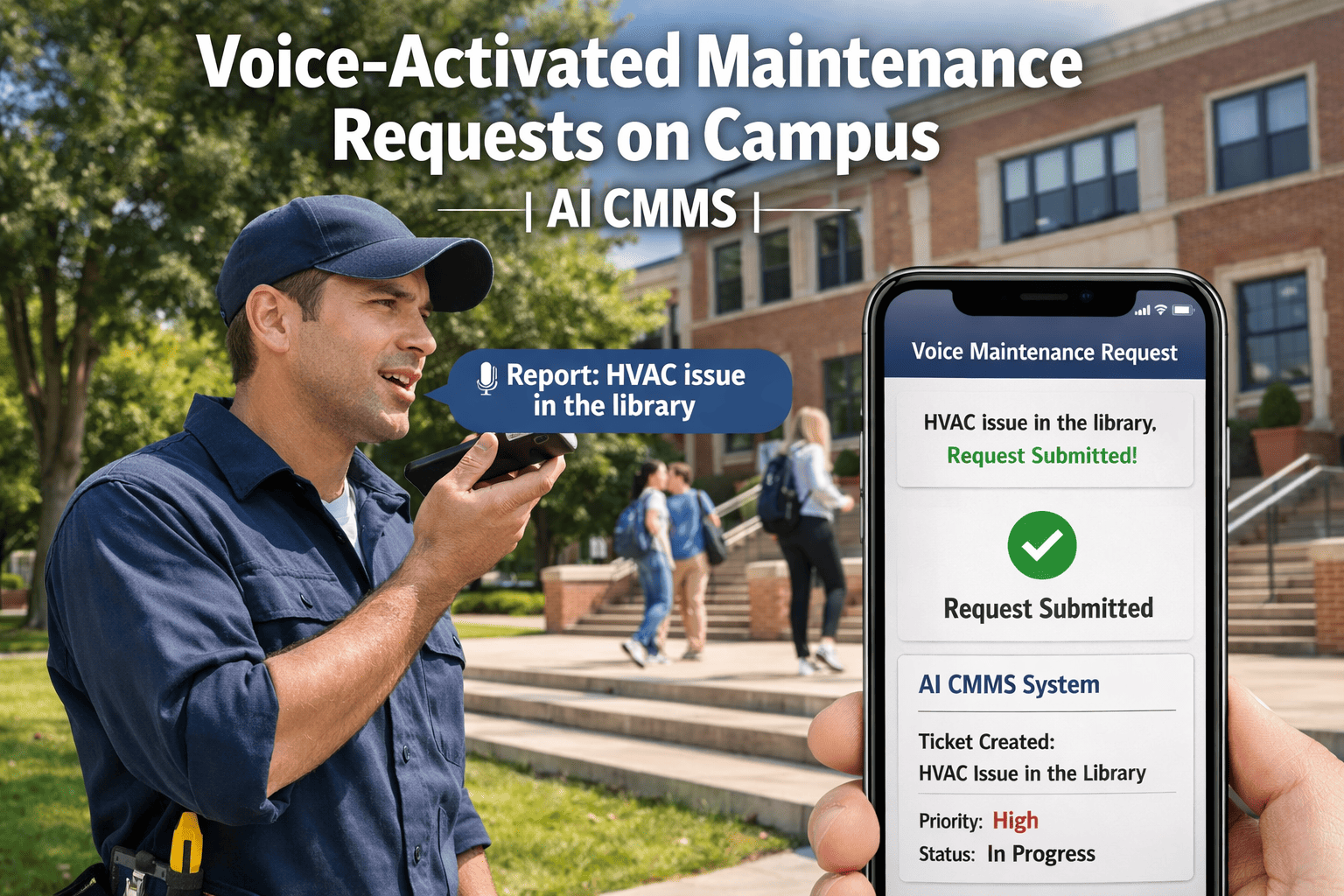
Voice and text queries from the field
Asset history lookup while standing at equipment
Hands-free voice commands during repairs
Push notifications with AI-generated briefings
Primary channel for field maintenance teams
Microsoft Teams / Slack
Directors & Coordinators
Query KPIs directly in the collaboration tool
“@OxmaintAI show me overdue PMs” in any channel
Daily morning briefing posted automatically
Emergency alerts with full context and ETA
No context switching — AI lives in your workflow
SMS / Text Message
Building Occupants & Staff
Text “status 4872” to get work order update
Text a problem description to create a WO
Receive completion notifications via SMS
No app download, no login, no training
Lowest friction for non-technical occupants
Every channel connects to the same AI engine, the same data, and the same role-based authorization — ensuring consistent answers regardless of how the question is asked
Quantified Impact on Campus Operations
78%
Fewer Status Calls
“Where’s my work order?” calls eliminated by self-serve AI
12–18 hrs
Weekly Time Recovered
Front desk and supervisor time redirected to actual operations
60%
Faster New-Hire Ramp
Institutional knowledge searchable by any technician, any time
85%
Reporting Automation
KPI queries replace manual spreadsheet assembly
<2 sec
Query Response Time
Any question about any asset, WO, or KPI answered instantly
24/7
Availability
Weekend emergencies, after-hours occupants, remote CBOs — always on
Annual Financial Impact
$95K+
Front-Desk & Supervisor Time Recovery
12–18 hours/week eliminated — equivalent to 0.3–0.5 FTE at zero hiring cost
$200K+
Compliance Deadline Protection
Proactive deadline queries prevent missed OSHA, NFPA, and ADA inspections
$150K+
Faster Decision-Making on High-Risk Assets
Instant risk score and TCO access accelerates replace-vs-repair decisions by 2–4 weeks
$500K+
Enrollment Revenue Protection
Occupant-facing AI improves satisfaction — facility quality is a top-3 retention factor
Total Annual Value
$945K+
Included in Oxmaint CMMS · Incremental cost: $0 · ROI: immediate from day one
Implementation: Conversational AI Activates in Weeks
Weeks 1–2
Data Connection
✓ Connect CMMS, asset registry, and compliance calendar
✓ Configure role-based access and authorization levels
✓ Import building and space classification data
✓ AI begins learning campus-specific terminology
Weeks 3–4
Channel Activation
✓ Deploy mobile app with voice and text queries
✓ Activate Microsoft Teams / Slack integration
✓ Enable SMS channel for building occupants
✓ Configure web portal for walk-up kiosks
Weeks 5–8
Intelligence Expansion
✓ Connect BAS feeds for live sensor queries
✓ Activate financial data queries for CBO access
✓ Enable predictive model queries for risk scores
✓ Institutional knowledge base reaches critical mass
Weeks 9–12
Continuous Learning
✓ AI accuracy improves from every interaction
✓ Automated daily briefings for director and CBO
✓ Board-ready KPI exports via natural language
✓ Occupant satisfaction surveys show measurable improvement
By week 12, every stakeholder on campus has instant access to the operational data they need without calling the facilities office or waiting for a monthly report. The AI handles 78% of routine inquiries autonomously, creates work orders from plain-language descriptions, and generates executive reporting on demand. Start your free trial and have conversational AI running on your campus data within two weeks.
Your Campus Operations Data Already Exists. Now Make It Accessible to Everyone Who Needs It.
Oxmaint’s conversational AI gives every stakeholder — from building occupants to the board — instant natural-language access to work order status, asset condition, compliance deadlines, and financial KPIs. No training. No new logins. No waiting. Deploy in weeks on data your campus already has.
Frequently Asked Questions
Is conversational AI accurate enough for operational decisions?
Yes — because the AI queries verified operational data from your CMMS, asset registry, BAS, and financial systems, then formats the factual results into natural language. Every response includes data sources and timestamps so stakeholders can verify. Accuracy for factual data retrieval exceeds 99% because the inputs are your own verified operational records, not generated opinions.
Can building occupants access information they should not see?
What happens when the AI cannot answer a question?
The AI transparently acknowledges the limitation and routes the inquiry to the appropriate human. If the question requires data the AI is not connected to, it says so and suggests who can help. All unanswered queries are logged and become training data that improves future responses. Within 90 days, the unanswered rate typically drops below 5% for operational queries.
Does this replace the facilities front desk or dispatcher?
It replaces the lowest-value 78% of their workload: status calls, request intake, and routine scheduling inquiries. It does not replace judgment calls, vendor negotiations, emergency coordination, or stakeholder relationship management. Most facilities offices report the front desk role transforms from reactive call-answering to proactive operations coordination — a significantly more valuable function.
What is the implementation timeline and cost?
Conversational AI is included in the Oxmaint platform at no additional cost. Deployment follows 4 phases: weeks 1–2 connect data sources and configure roles, weeks 3–4 activate channels, weeks 5–8 expand to BAS and financial queries, weeks 9–12 reach full intelligence. Most institutions have occupant-facing channels live by day 14 and full executive query capability by day 60.


.png)


